
Add ₹999 more to unlock FREE SHIPPING!
Your sacred cart is currently empty.
Shop Photo FramesNestled in Wanowrie, in the Haveli taluka of Pune district, the Mahadji Shinde Chhatri and Mahadev Temple complex is renowned as the memorial, shrine, samadhi (memorial site), Maruti temple, and Vitthal temple of Mahadji Shinde, the great military commander of the Maratha Empire. This historical architectural marvel stands on the banks of the Bahiroba Nala in the Wanowrie area of Pune city. Mahadji Shinde had built this Mahadev temple at Wanowrie before his passing at the age of sixty-seven in seventeen ninety-four. Following his demise, a grand memorial was erected right in front of this temple. His samadhi is situated right next to this memorial. A unique confluence of British and Rajasthani architectural styles can be witnessed in the design of this memorial.
According to historical records, the Battle of Panipat in seventeen sixty-one resulted in the martyrdom of many experienced sardars (commanders), causing a massive loss to Maratha power and a severe blow to their supremacy in North India. The shock of the defeat at Panipat also led to the passing of Nanasaheb Peshwa. In such dire circumstances, the sardars Shinde and Holkar once again held together the sprawling fabric of the Maratha Empire. Mahadji Shinde officially took over the reins of the Shinde dynasty in seventeen sixty-eight. He had learned the primary lessons of warfare and statecraft from his brothers Jayappa and Dattaji. Having directly participated in the Battle of Panipat, he possessed vast experience of the battlefield.
Following the demise of Madhavrao Peshwa, the political instability that arose in the Pune court, the assassination of Narayanrao Peshwa, the rebellion of Raghobadada, as well as the impostor’s rebellion, had crippled the administration. At such a time, Mahadji lent steadfast support to the Barbhai Council and skillfully managed the situation. During the Battle of Wadgaon in seventeen seventy-nine and the Treaty of Salbai in seventeen eighty-three, the British witnessed Mahadji’s diplomatic prowess alongside his military genius. To re-establish Maratha supremacy in North India, he successfully conducted military campaigns in places such as Gwalior, Delhi, Jodhpur, and Chittorgarh.
Despite internal differences and a competitive relationship with the Holkars, Mahadji always gave supreme priority to the interests of the Maratha Empire. He proved his supremacy by reinstating Emperor Shah Alam of Delhi on the throne. For this achievement, the Badshah (Emperor) bestowed upon Mahadji the title of ‘Alijah Bahadur’ and secured highly prestigious positions such as ‘Wakil-i-Mutlaq’ for the Peshwa. In a grand ceremony in Pune, he very humbly offered these positions to the Peshwa. With a well-equipped and modern army of about one hundred seventy-five thousand soldiers, Mahadji upheld his loyalty to the Pune court till the very end.
Besides being a valiant warrior, Mahadji was also a sensitive poet. A beautiful confluence of three languages—Marathi, Hindi, and Gujarati—is found in his poetic compositions. Most of his poems are based on devotion to Lord Krishna. After spending twenty-five years of his life continuously on the battlefield, he settled in Pune in his later years. However, due to a severe bout of fever, he passed away on February twelve, seventeen ninety-four, in Wanowrie, Pune. His demise caused a sturdy pillar of support for the Maratha Empire to collapse. Many Western historians have also praised Mahadji’s intelligence and military achievements, and his grand memorial, samadhi, and temple in Wanowrie stand as testimony to his valor to this day.
This samadhi on the banks of the stream in Wanowrie is referred to as ‘Shinde Chhatri’ in accordance with the traditions of Malwa. According to entries in the British Gazetteer, the original samadhi was a tall structure built of stone and mud. The renovation work of the original Mahadev temple within the Chhatri premises was undertaken in eighteen thirty by Mahadji’s grandson Jankoji Shinde. However, this work, which had halted after his passing in eighteen forty-two, was later completed in nineteen hundred and nine by Madhavrao Shinde, thereby preserving this historical heritage. Upon entering the Chhatri complex, one immediately sees the Maruti temple and right in front of it, the main entrance of the Shinde Chhatri. This structure is surrounded by a sturdy fortification wall about fifteen feet high. One can enter the courtyard of this memorial by paying a fee at the trust ticket counter located on the left side of the entrance. In the courtyard stands a beautiful and spacious double-storied building of the memorial.
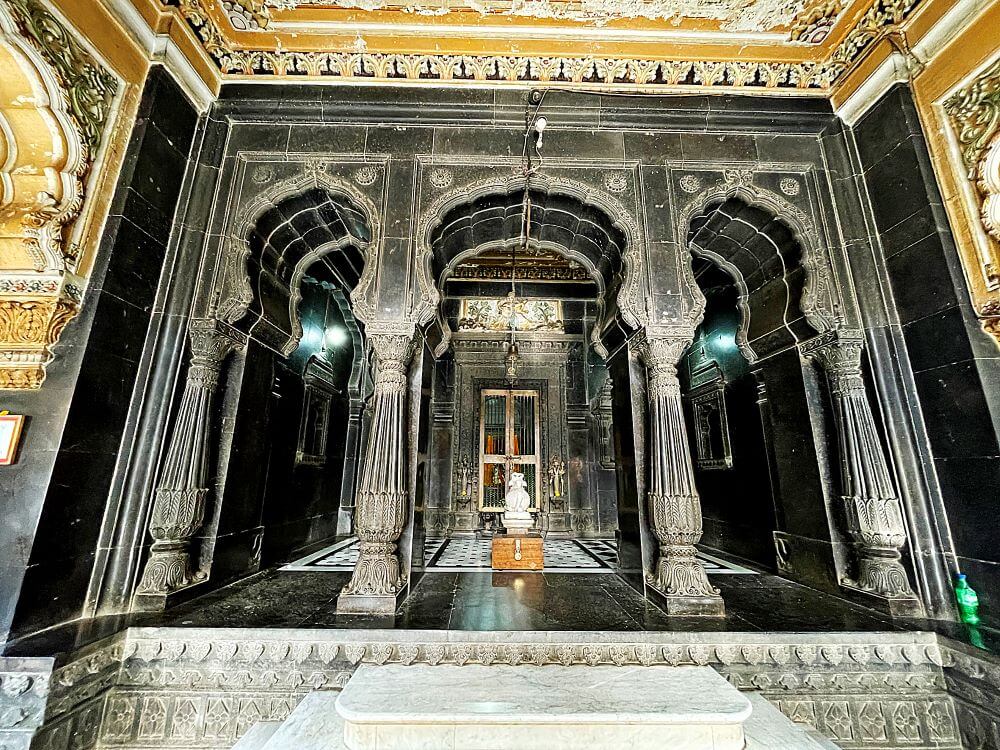
A fine blend of Maratha and Rajasthani architectural styles, this double-storied memorial is built of stone and stands on a high plinth. The carving on the walls of this structure is extremely neat and delicate. The outer walls feature ornate arches and grand pillars. The use of European-style colored glass in the windows of the memorial further enhances the beauty of the structure. The upper part of the memorial features small domes and ornamental pinnacles. Entering the memorial, which is situated on a high plinth, requires climbing nine steps from the paved courtyard. On both sides of the entrance to the memorial are characteristic carved pillar brackets. Photographs of Mahadji Shinde along with descendants of the family are displayed in the double-storied sabhamandapa (assembly hall). The beauty of the sabhamandapa is further accentuated by its black-and-white marble flooring and circular ornate arches. The ceiling of this Rajasthani-style sabhamandapa features internal floral carvings and glass chandeliers as well.
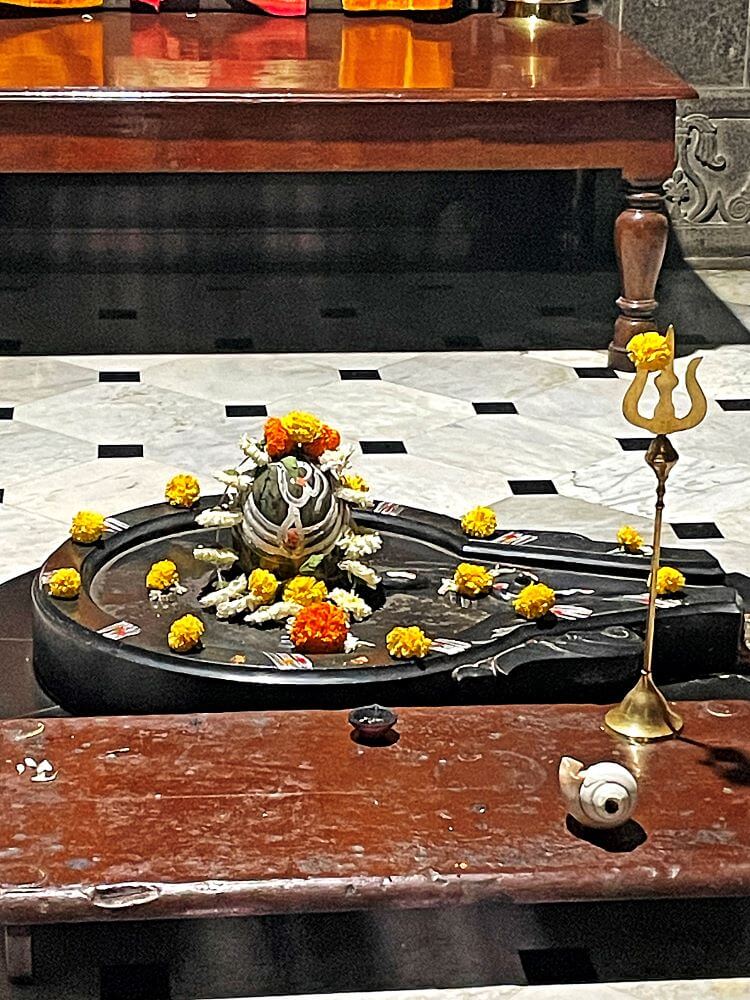
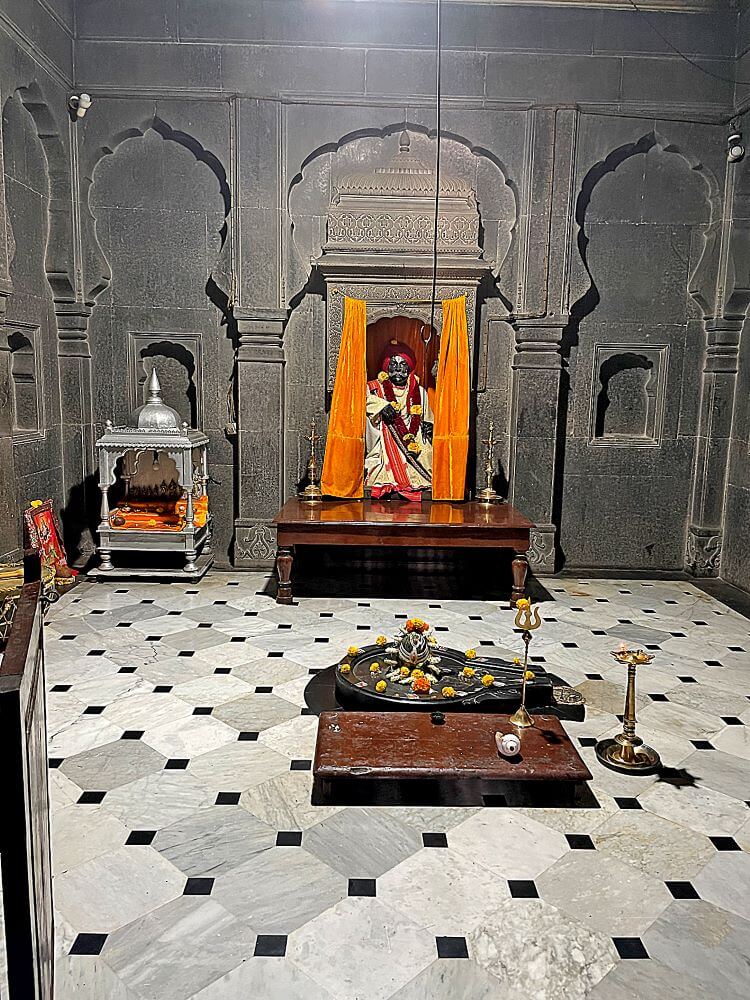
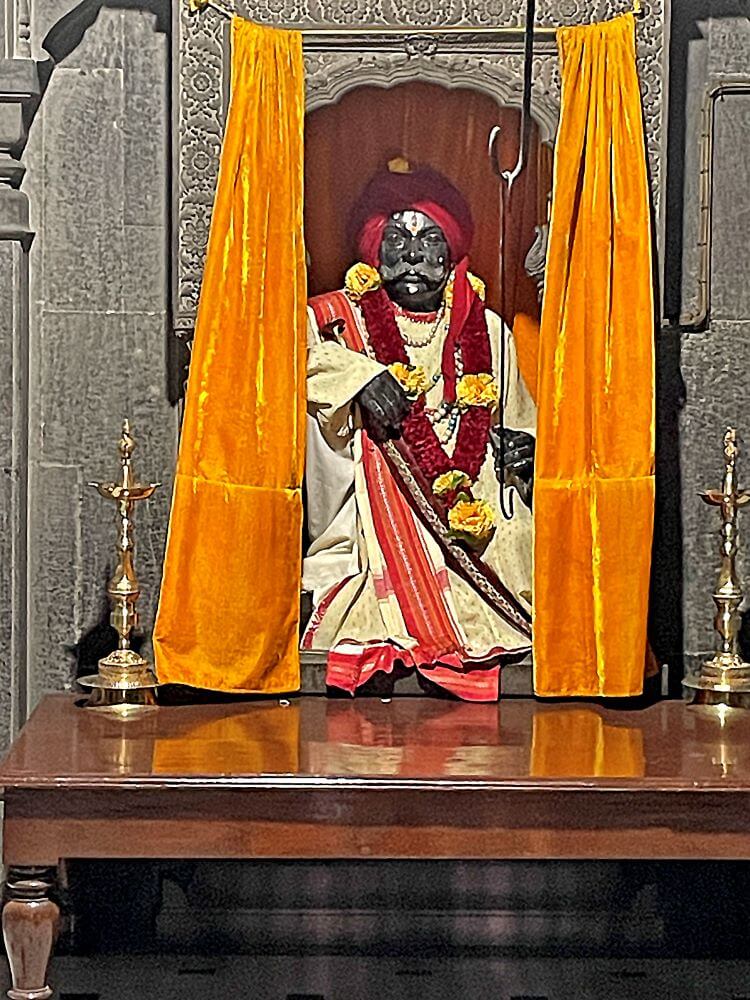
Adjoining this sabhamandapa is the Shiva temple built by Mahadji. Climbing five steps from the sabhamandapa leads into the antarala (antechamber) of the Mahadev temple. On a plinth at the entrance of the sanctum sanctorum here stands a white marble idol of Nandi. The entrance of the sanctum sanctorum features carved door jambs with two carved dvarapala (doorkeeper) sculptures at the lower end. On the lalatabimba (lintel center) of the entrance is an idol of Goddess Saraswati. Behind the black polished stone shivalinga located in the center of the floor inside the sanctum sanctorum is a sculpture of Mahadji Shinde. This sculpture was installed in nineteen seventy-one, and to its left is a small devakoshtaka (wall niche).
An exemplary specimen of North Indian or Rajasthani architectural style, the shikhara (spire) of the temple is situated alongside the memorial building and tapers as it rises high. Surrounding this main shikhara of the urushringa architectural design are numerous smaller sub-shikharas. The stones at each tier of the shikhara feature distinctive carvings. At the very top is an amalaka, surmounted by a pinnacle. Close to this shikhara, a circular staircase from the rear leads to the second floor of the sabhamandapa within the memorial.
In this courtyard, on one side, stands the main Samadhi monument of Mahadji Shinde, built in the Mughal architectural style. Around the main dome of this structure, there are four smaller domes on all four sides. In the sanctum sanctorum of the building are the Shindeshahi mask of Mahadji and a sculpture of a horse behind it. On the ceiling and pillars of the Sabhamandapa, there are multi-colored floral patterns. In addition to this, there is a temple of Lord Vitthal-Rukmini in the premises. Daily worship and Aarti are performed at the Mahadev temple, and on Mahashivratri, there is a large gathering of devotees here for Darshan. The birth anniversary of Mahadji Shinde is on December 3, and his punyatithi (memorial day) is on February 12, on which occasions devotional programs like bhajan and kirtan are held in the temple. Devotees can have Darshan at the temple here daily from morning seven to night eight.
This sacred temple stands as a testament to deep spiritual devotion, ancient architectural grandeur, and rich local cultural traditions.
The sanctum sanctorum houses the divine idol consecrated according to ancient Vedic traditions, surrounded by serene courtyards and traditional temple architecture.


Navratri, Maha Shivratri, Annual Temple Jatra & Deepotsav
Compare and book flights, secure top-rated local hotels near the temple, hire reliable guides, and rent cars instantly.
Extend your pilgrimage by visiting other highly sacred temples located nearby.


Add ₹999 more to unlock FREE SHIPPING!
Your sacred cart is currently empty.
Shop Photo FramesFill in your delivery details below to place your order.
Add comment