
Add ₹999 more to unlock FREE SHIPPING!
Your sacred cart is currently empty.
Shop Photo FramesThe Chaturmukh Mahadev Mandir, nestled on Brahmagiri Parvat near Patharwadi village in Purandar Taluka, Pune District, is an ancient and renowned temple in the region. This sacred pilgrimage site holds immense religious significance, being known as the tapobhumi, or land of penance, of Bhagwan Brahmadev, the creator of the universe. This holy place, chosen by Brahmadev for the worship of Bhagwan Shiv and situated near the sources of the Karha and Chambali rivers, is today also revered as ‘Dakshin Kashi’.
Nestled in the Purandar mountain ranges, this ancient Shiva shrine is encircled by the sub-ranges of the Sahyadris. From ancient times, this sacred area is believed to have been sanctified by the presence of various revered sages and hermits. This region finds mention in the twenty-third and twenty-fourth chapters of the revered text, ‘Shri Navnath Bhaktisar’. The great yogi, Changdev Maharaj, resided and performed penance on this plateau for some time. It is for this reason that this place became renowned as a hermitage for Siddhas. As Bhagwan Brahmadev, the creator of the universe, performed penance on this very hill, it came to be known as ‘Brahmagiri’. In local history, it is also referred to as ‘Suvarna Dongar’, meaning the Golden Hill. After the monsoon season, the yellowish grass that sprouts upon this hill, bathed in the sun’s rays, makes the entire area gleam like pure gold. It is this unique characteristic that has earned it the name Suvarna Dongar, the Golden Hill. Situated in the Karha River valley, this region lies in close proximity to Purandar Fort, thereby inheriting a rich military and cultural history.
As per the ancient Paurāṇic accounts, Lord Brahmā performed severe austerities on this very hill for a full one thousand years to receive the blessings of Bhagwān Śaṅkara. It is due to Lord Brahmā’s ‘Chaturmukha’ form, meaning His four faces, that this hill and temple came to be known as Chaturmukha. According to an incident in the Mahābhārata, when the Pāṇḍavas were in exile, they were staying at Pāṇḍeśwar in Purandar. At that time, the Śrāddha ritual for their father, King Paṇḍu, was approaching. For this ceremony, and for the meals of the sages and hermits who would arrive, a large quantity of water was needed. It was then that Bhagwān Śrī Kṛṣṇa told the Pāṇḍavas that Lord Brahmā was performing austerities on the Brahmagiri hill to the west, and that His kamaṇḍalu contained the sacred waters of एकशेआठ holy rivers. Following the divine instruction of Śrī Kṛṣṇa, the mighty Bhīma arrived at this mountain and overturned the eternal kamaṇḍalu of Brahmādeva. From this sacred event, two principal streams of water emerged. One of these streams, having originated from the kamaṇḍalu, came to be known as the ‘Karhā’. The second stream, which flowed forth after touching the lotus feet of Brahmādeva, gained recognition as the ‘Caraṇāvatī’, or locally as the ‘Cāmbaḷī’ river. Both these rivers later converge near the Saṅgameśvara Mandira in Sāsavaḍ, and it is said that there are approximately ७४ Śivaliṅgas along the course of these rivers.
This expansive temple complex is nestled on a high plateau. From here, one can behold a panoramic vista of the surrounding nature and the Sahyadri mountain ranges. Devotees and pilgrims flock to this area in large numbers to experience the strong winds and the interplay of sun and rain. Within the temple precincts are five natural water springs, and it is a popular belief that Bhima created them with a strike of his mace. The temple grounds are also graced by two colossal banyan trees. A unique feature of these banyan trees is that, unlike other banyan trees, their aerial roots are not visible. Devotees believe that these aerial roots do not reach the ground due to a curse bestowed upon these trees by Brahmadeva, whose meditation was disturbed.
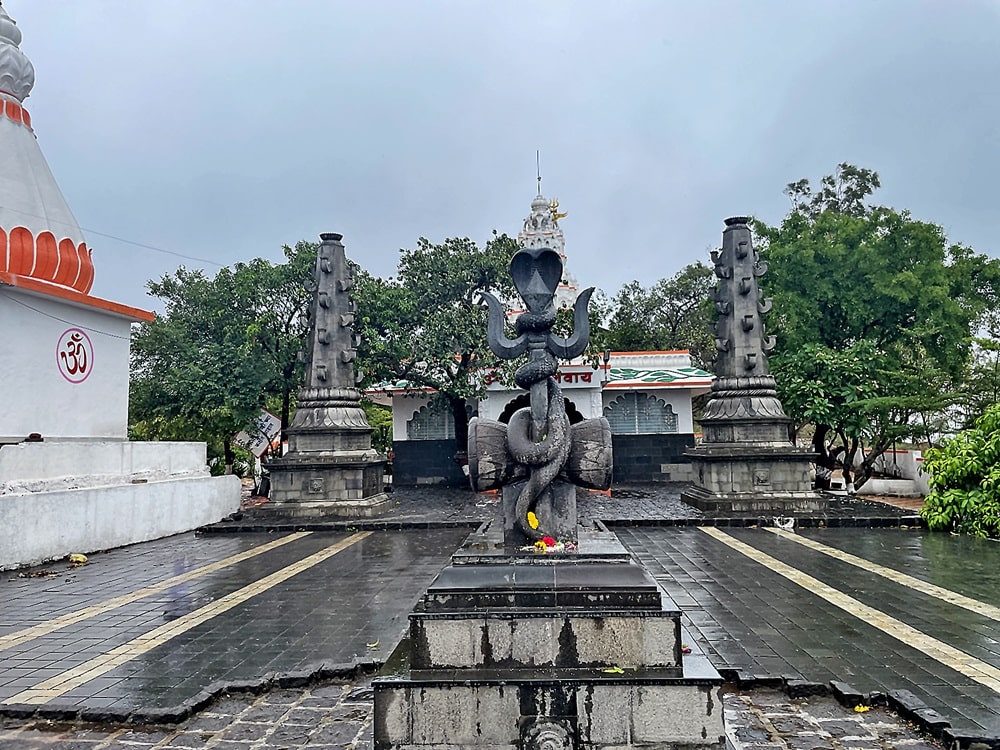
The original temple, crafted from black stone, is ancient. It has recently undergone renovation, which has given it its present form. One enters the temple courtyard through the grand gateway in the surrounding ramparts. Near the grand gateway, within the courtyard, is the Nandi Mandapa, housing a large, beautiful murti of Nandi, also carved from black stone. The golden adornments on Nandi’s body make him appear even more captivating. In the main temple courtyard, on a raised platform, there is an exquisite sculpture depicting a drum, a damaru, a nāga, and a trishula. Outside the temple, there are two tall deepamālas. These are adorned with intricate carvings, alongside verses of Shiva-stuti.
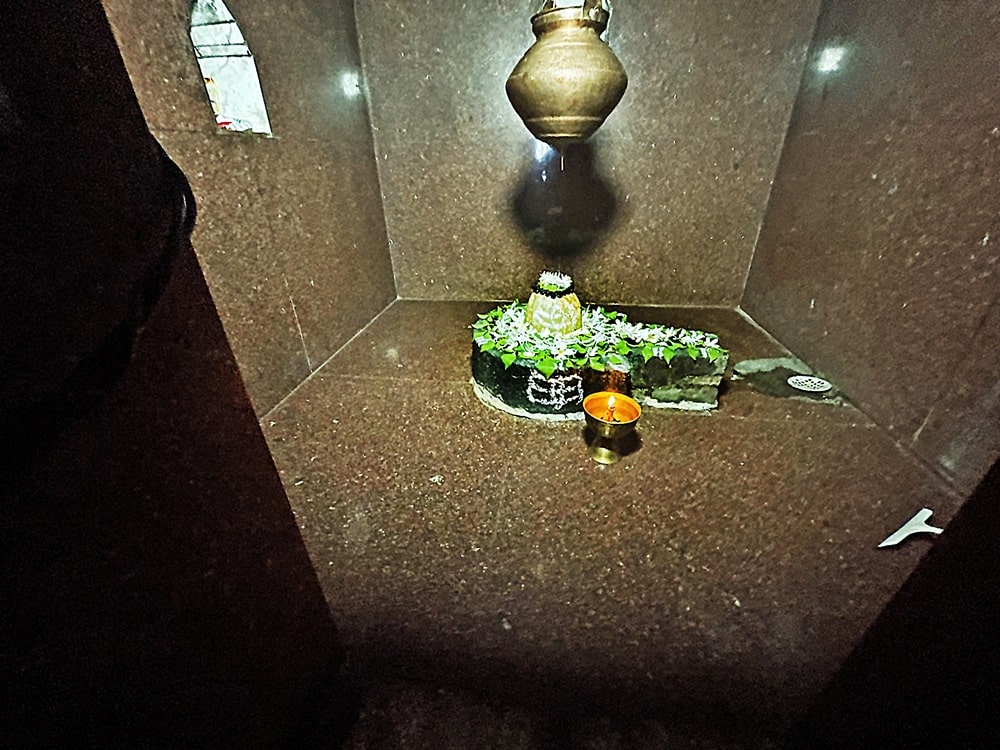
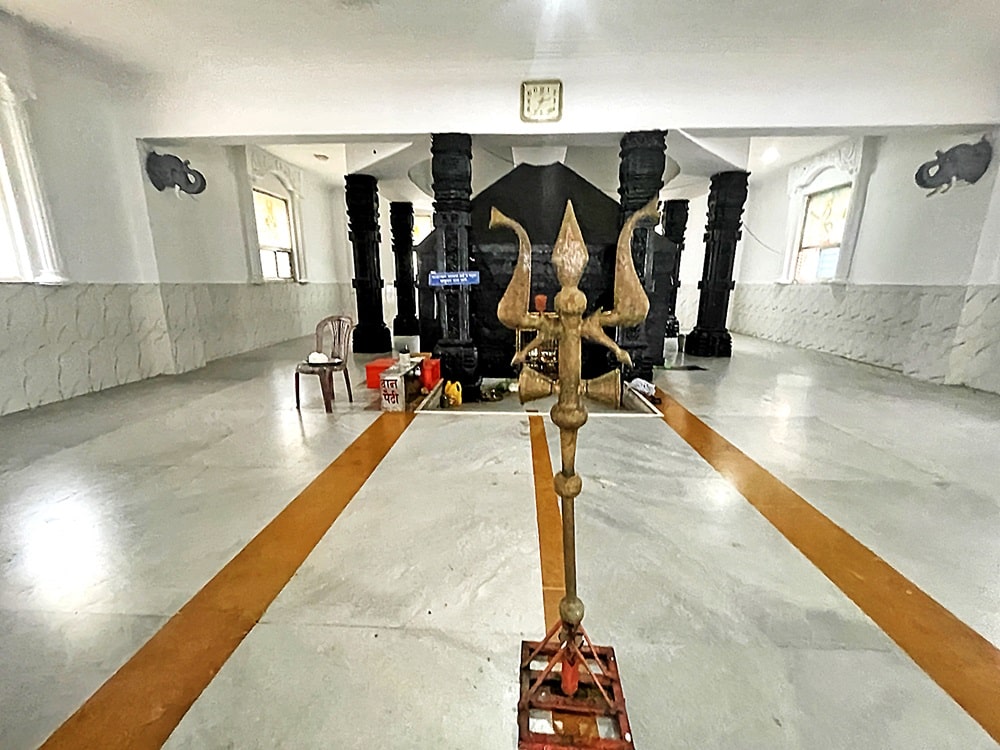
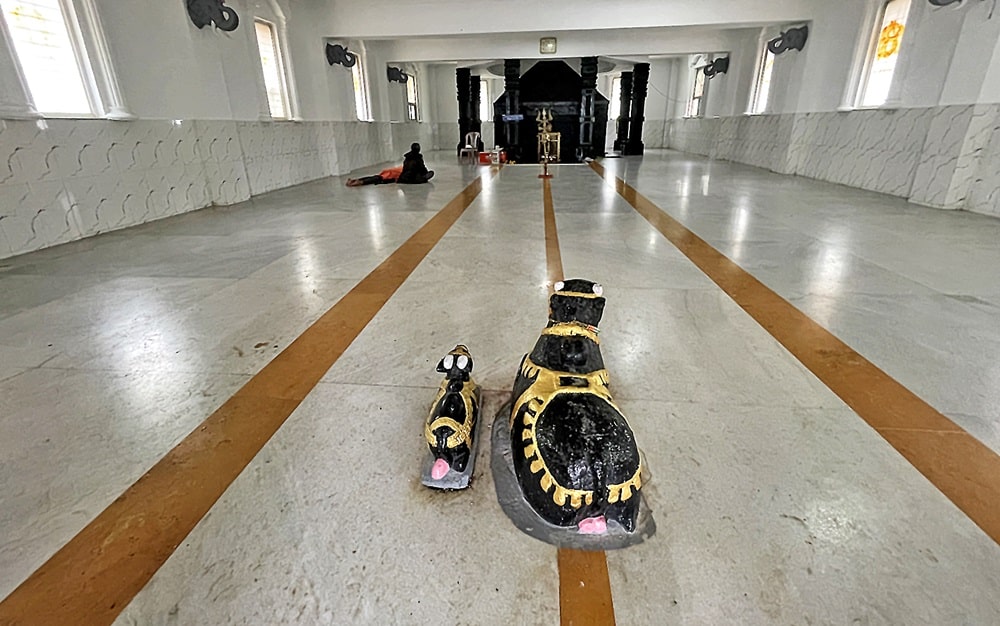
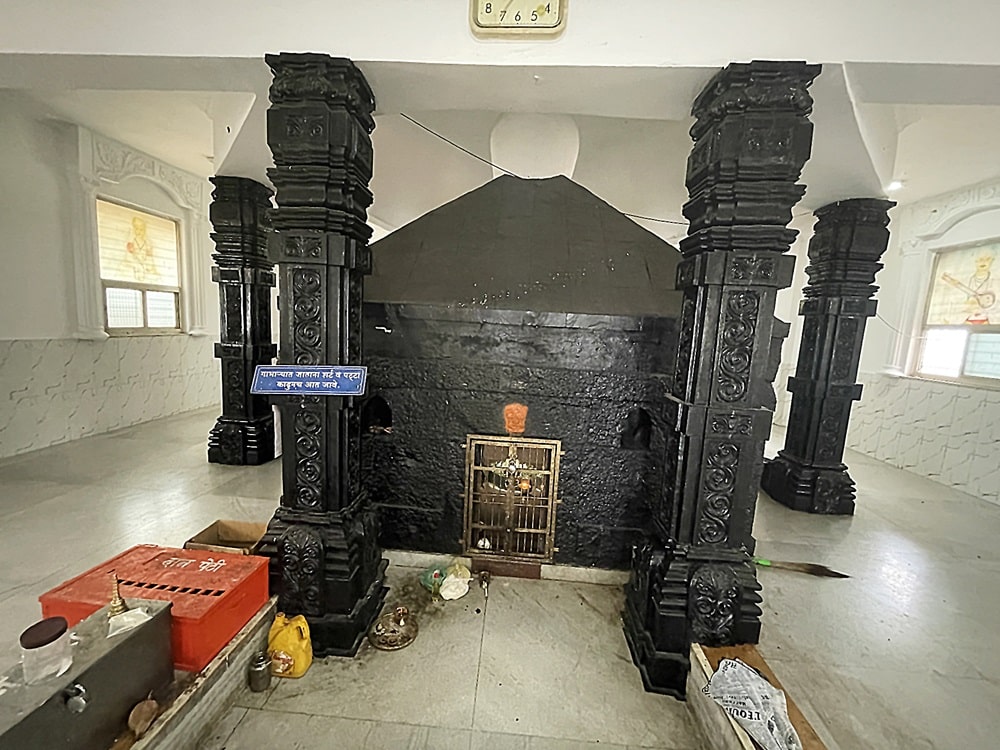
The temple’s architecture comprises a sabhamandapa (assembly hall) and a garbhagriha (sanctum sanctorum). Within the spacious sabhamandapa, there are two sacred Nandi murtis, one small and one large. Further ahead, before the garbhagriha, repose a brass trishula and a damaru. It appears that this sabhamandapa was constructed at a later period, in front of the main temple. Within the sabhamandapa, leaving space for a pradakshina marga (circumambulatory path) ahead, lies the garbhagriha. The garbhagriha’s construction is of original black stone. On the outer side of the garbhagriha stand ancient stone pillars, adorned with distinctive artistry. At the centre of the garbhagriha is the principal Shivapindi, which is in a ‘Chaturmukha’ form. Images of Mahadeva’s faces are carved on all four sides of this pindi. Such a Chaturmukha pindi is considered rare. Above this garbhagriha rises a circular, four-tiered shikhara (spire) that tapers upwards. This shikhara features devakoshthakas (niches for deities) on each tier. At the very top of the shikhara are an amalaka and a kalasha. To the left of the main temple is a Datta Mandir, and within the temple courtyard are separate small shrines dedicated to Brahmadeva and Ganapati.
Throughout the year, this sacred temple joyously celebrates a variety of religious festivals and auspicious occasions. The holy month of Shravan holds special significance for this divine abode. For the entire month, programmes of Abhishek, Pujan, and Bhajan-Kirtan are lovingly organised here. On Shravani Mondays, thousands of devotees from Pune and the Purandar region come here for Darshan. At this time, the entire area resonates with the resounding chants of Lord Shiva’s holy name. A grand fair is held here on Mahashivratri. On this blessed day, the temple’s Deepmalas (lamp towers) are illuminated, and Shiva-Stuti is recited throughout the night. During this fair, various programmes by local artists, commemorating the traditions of the Pandava era, are presented. Considering the religious and historical importance of the Chaturmukh Temple and the increasing number of devotees, the Government of Maharashtra has bestowed upon this temple the status of a ‘C’ class pilgrimage site.
This sacred temple stands as a testament to deep spiritual devotion, ancient architectural grandeur, and rich local cultural traditions.
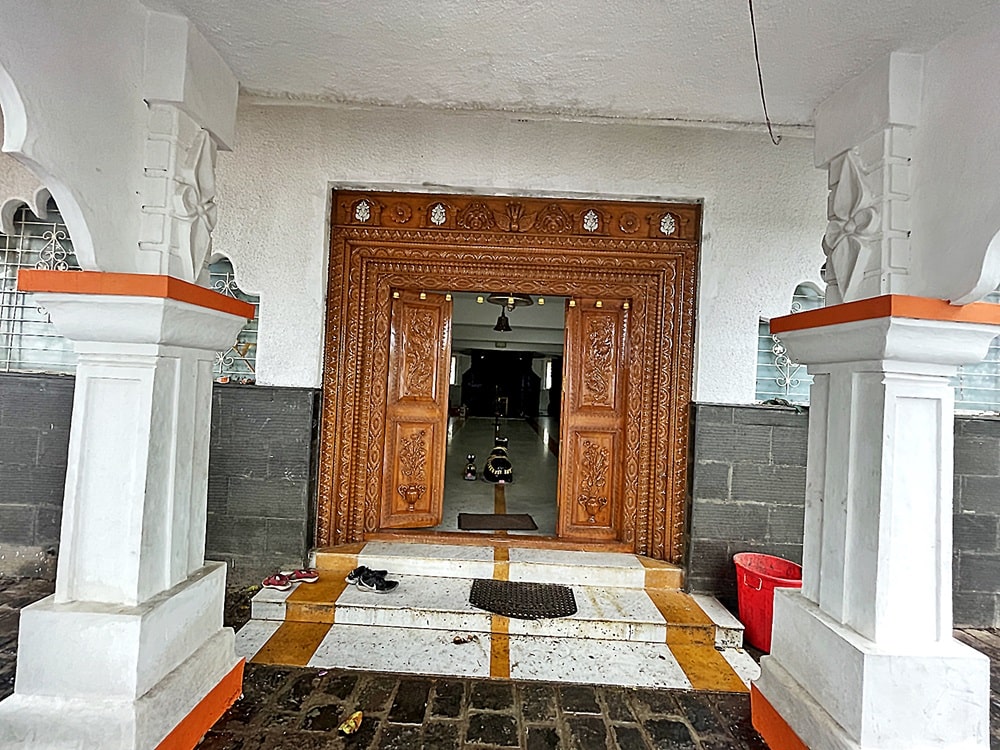
The sanctum sanctorum houses the divine idol consecrated according to ancient Vedic traditions, surrounded by serene courtyards and traditional temple architecture.
Navratri, Maha Shivratri, Annual Temple Jatra & Deepotsav
Compare and book flights, secure top-rated local hotels near the temple, hire reliable guides, and rent cars instantly.
Extend your pilgrimage by visiting other highly sacred temples located nearby.


Add ₹999 more to unlock FREE SHIPPING!
Your sacred cart is currently empty.
Shop Photo FramesFill in your delivery details below to place your order.
Add comment