
Add ₹999 more to unlock FREE SHIPPING!
Your sacred cart is currently empty.
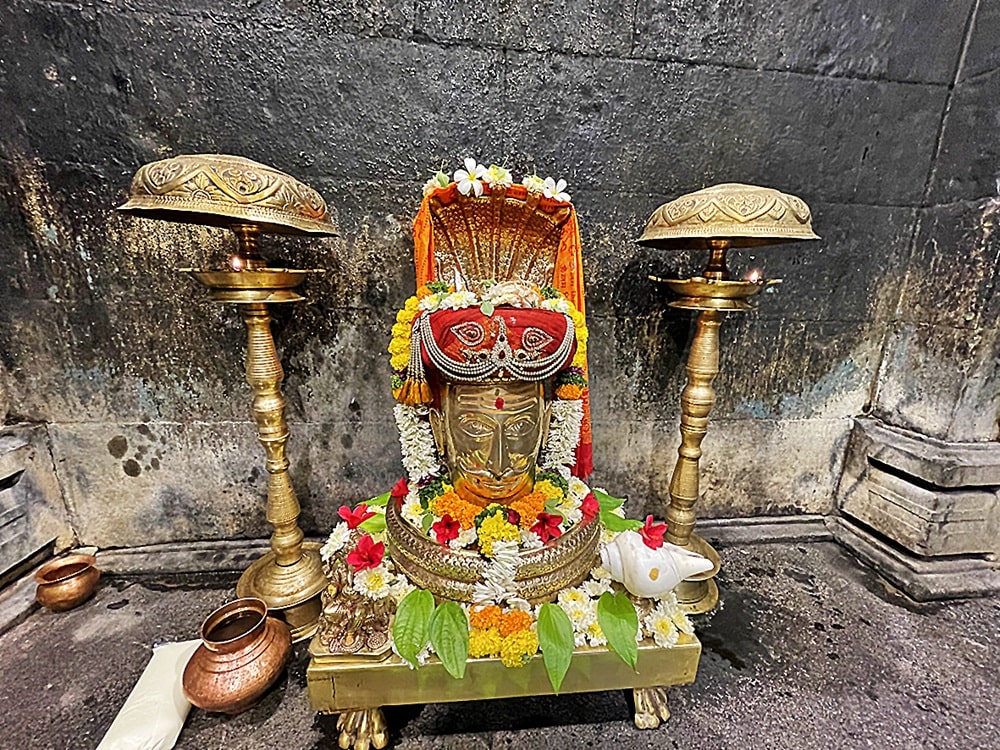
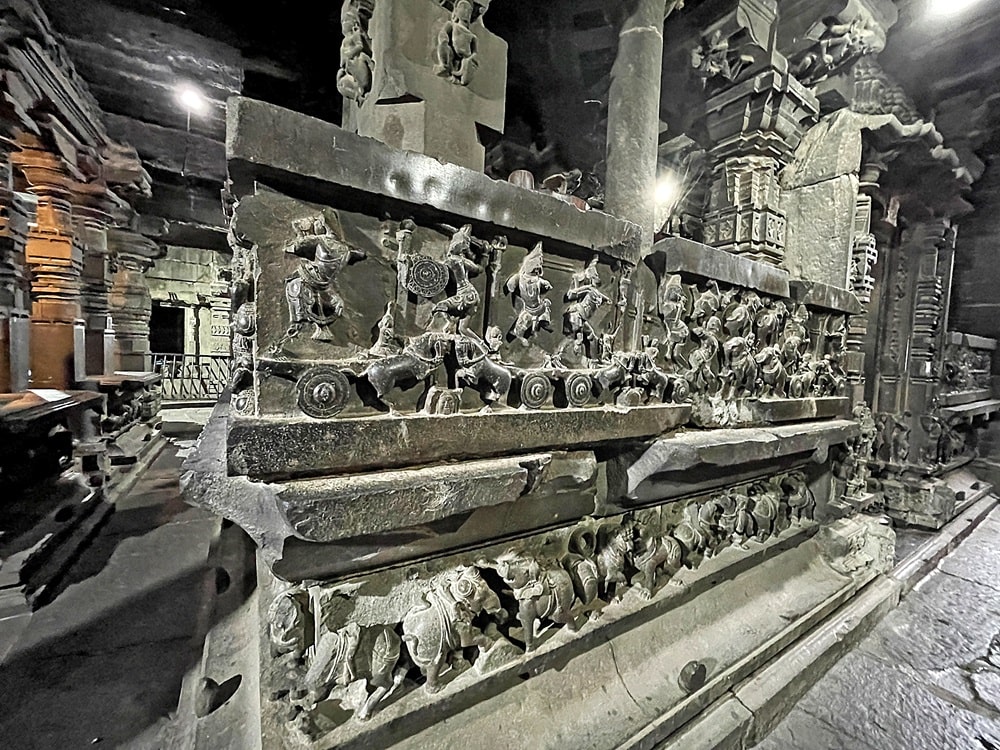
Shop Photo FramesThe ancient Bhuleshwar Mandir, nestled on a hilltop near Yavat in Pune district, is revered as an exceedingly rich heritage of Yadav-era architecture. The primary mythological backdrop of this sacred site is the captivating dance of Devi Parvati, who assumed the form of a Bhil woman while Bhagwan Shankar was engrossed in penance here. It is due to this very dance that Shankar’s meditation was broken, causing Him to forget His penance, and thus the Deity came to be known as ‘Bhuleshwar’. It is said that the *pedha* offerings made to the *Shivlinga* here naturally disappear. Within the grand structure of black stone, there are distinctive sculptures adorned with scenes from the Ramayana and Mahabharata.
This Mandir was constructed during the twelfth-century Yadav rule, and thereafter, this edifice witnessed many transformations. According to historical records, a major renovation of this Mandir was undertaken in the Christian year १२३० during the reign of Yadav King Singhan, in the time of the Yadav kings of Devgiri. In the sixteenth century, Murar Jagdev Pandit, a chieftain of the Adilshahi of Bijapur, built a fort named Daulat Mangal on this hill.
This imparted military significance to the area. This fort is also known as Mangalgad. From here, it was easy to keep watch over Pune city and the surrounding region.
During the Shiv period, this Mandir gained historical importance. Rajmata Jijau used to visit this Mandir for *darshan* with her young Shivba. During the reign of Chhatrapati Shivaji Maharaj, special attention was given to preserving the sanctity of this Mandir, and it became an important place of devotion in the Swarajya. In the eighteenth century, during the Maratha Empire, especially the Peshwa period, the glory of this Mandir further increased. Brahmendra Swami, the spiritual guru of Thorale Bajirao Peshwe and Chhatrapati Shahu Maharaj, undertook a major renovation of this Mandir in the Christian year १७३७. Records indicate that approximately one lakh rupees were spent on this work at that time. During this same period, the three *shikharas* (spires) on the upper part of the Mandir and the grand *nagarkhana* (drum house) were built. Sardar Damaji Gaikwad had contributed २५ thousand rupees for this work. An historical record is available stating that after achieving victory in the Vasai campaign, Chimaji Appa offered a golden crown and one hundred and twenty-five golden idols to Bhuleshwar Mahadev.
The legend told regarding the Mandir is that once Bhagwan Shankar was seated on this hill, performing penance in solitude. At that very moment, Devi Parvati appeared there in the form of a Bhil woman. Parvati performed a beautiful dance here to attract Shankar’s attention. Bhagwan Shankar was enchanted by her captivating form. Due to this event, Shankar’s *samadhi* (deep meditation) was broken, and He completely forgot Himself and His penance. Shankar was ‘bhulale’ (enchanted or deluded) by Parvati’s beauty or her charm, and thus this Deity received the name Bhuleshwar. Another story is also told that the Pandavas built this Mandir in just one night during their period of exile. In Bharatgaon, near the Mandir premises, there is a Mandir of King Bharata, and its connection is traced back to the Ramayana period.
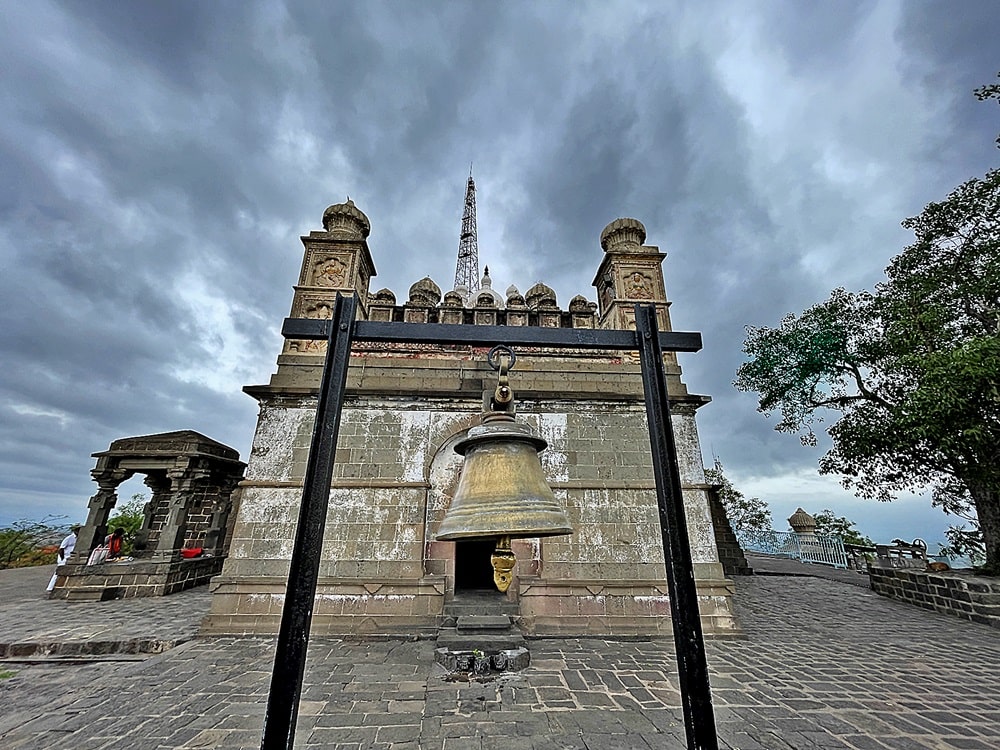
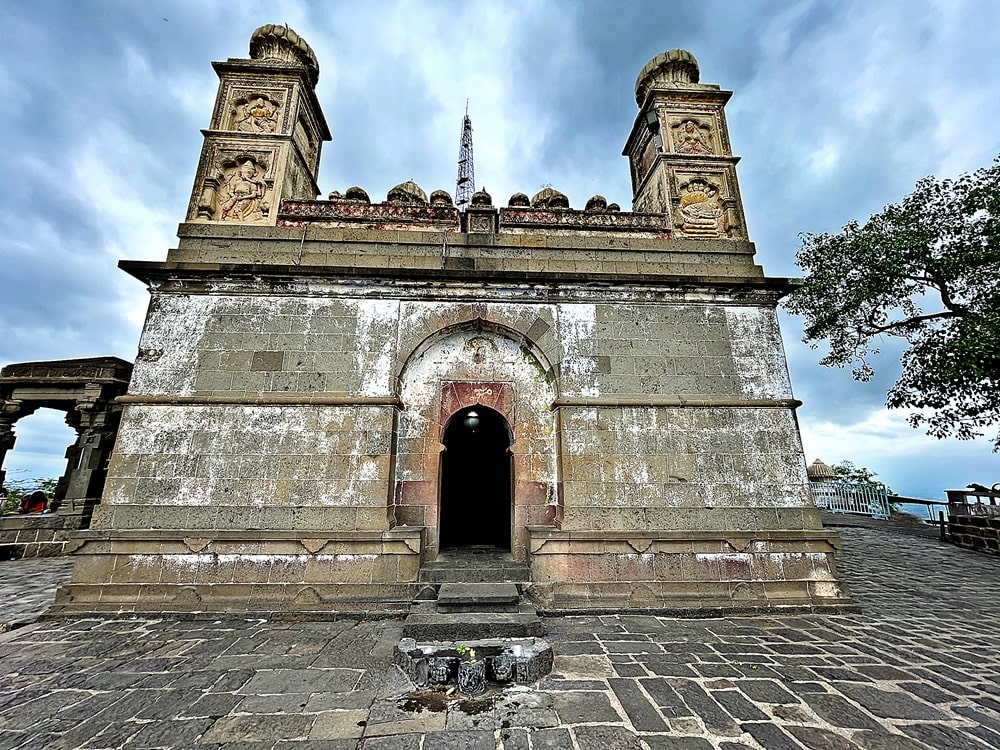
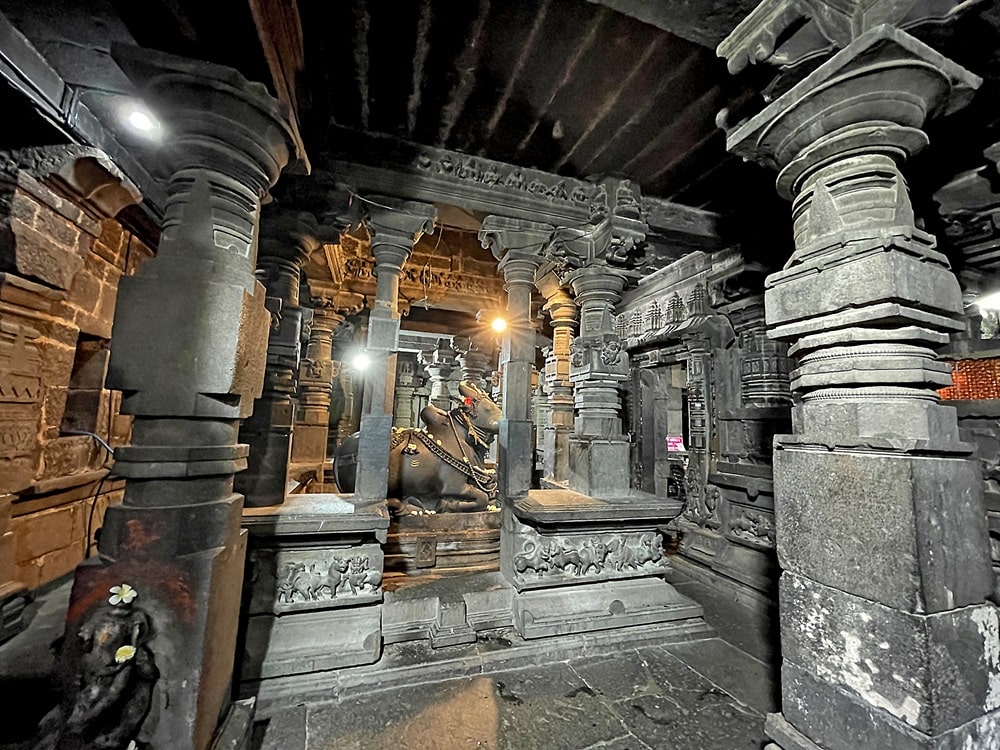
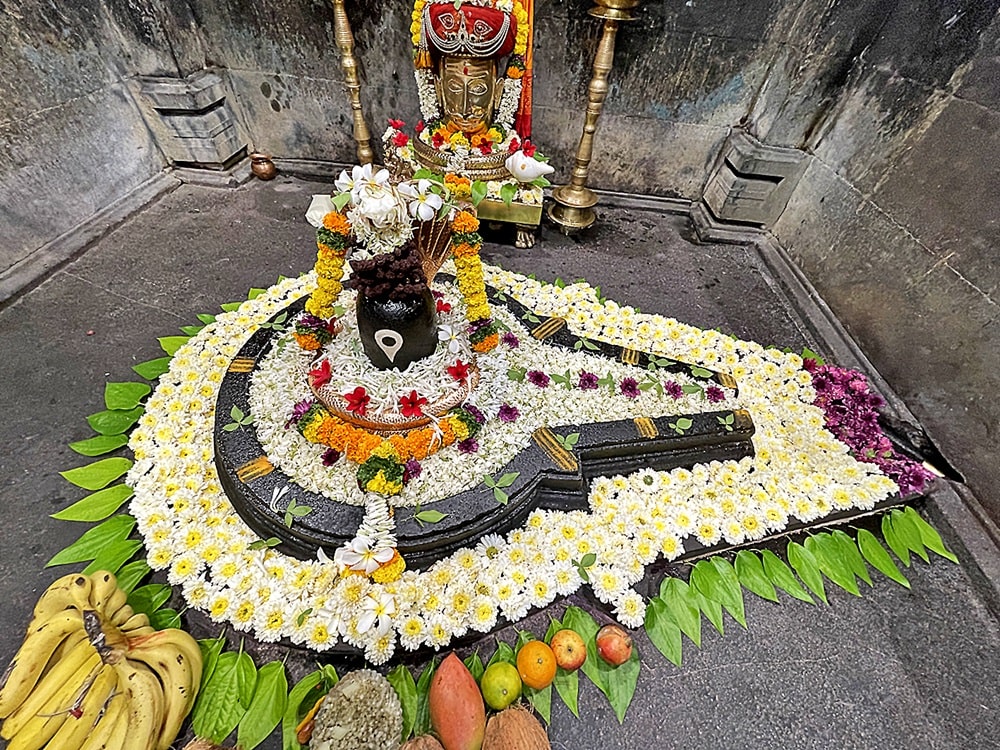
The path to this Mandir is near the village of Yavat on the Pune-Solapur Highway. Situated on a hilltop at an altitude of approximately ७०० meters above sea level, this Mandir appears like a crown. The ramparts and bastions at the entrance of the Mandir still bear witness to the Daulat Mangal Fort. When viewed from the outside, this Mandir resembles a mosque or a fort. This is referred to as ‘camouflage’ or ‘deceptive’ architecture. In the medieval period, the exterior of this structure was deliberately altered to protect the Mandir from foreign invaders, so that invaders would not perceive it as a Mandir. The main entrance of the Mandir is in the *gomukhi* style and is hidden behind the bastions. This is considered a special style of fort construction from the time of Shivaji Maharaj. The architectural style of the Mandir and the carvings here are considered an excellent example of Indian sculpture. A special type of black basalt stone has been used for the construction of the Mandir. This stone is completely different from the brown stone found in the surrounding area. The entire Mandir is built on a *chauthara* (platform) approximately four meters high. Beautiful images of Brahma, Vishnu, and Mahesh are carved at the entrance of the Mandir. The Mandir’s structure comprises a *Nandimandap*, *Sabhamandap*, *Antaral*, and *Garbhagriha*. Upon entering the Mandir, directly in front, in the *Nandimandap*, there is a Nandi approximately two meters high. The bells, chains, and ornaments on Nandi’s neck and body are carved in stone with extreme detail. Nandi’s neck is slightly turned to the right. The *Sabhamandap* has many carved pillars, and scenes from various mythological stories are carved on them. In the center of the *Sabhamandap*, on a raised platform, there is a tortoise sculpture. Important scenes from the Ramayana and Mahabharata are depicted in sculptural form on the walls of the Mandir. Among these, the sculptures of Draupadi Swayamvar, Bhishma lying on a bed of arrows (*Sharpanjari Bhishma*), and the mighty Bhima throwing an elephant into the sky are extremely exquisite and distinctive. On the outer wall of the *Garbhagriha* is the extremely rare sculpture of ‘Vainayaki’, Ganesha in a female form. Such a sculpture is seen in only a few places across India. This idol has a trunk like Ganapati, and in the ‘Devi Sahasranama’, this deity is referred to as ‘Lambodari’ or ‘Ganeshwari’. She is seated in the group of the Saptamatrikas. The pillars of the Mandir have inverted serpent hoods and various geometric patterns. This is considered a characteristic of Yadav-era sculpture. The door of the *Garbhagriha* is adorned with carvings. Symbols of the five elements – *Prithvi* (earth), *Aap* (water), *Tej* (fire), *Vayu* (air), and *Akash* (space) – are carved on it. The main *Shivlinga* in the *Garbhagriha* is slightly below ground level, and natural water continuously seeps here. A unique feature of the *Shivlinga* here is the devotees’ belief that *pedhas* or sweet offerings made here naturally disappear. If five *pedhas* are placed on the *Shivlinga*, some of them vanish, and the mystery of where these *pedhas* go remains unsolved to this day. Below the main *Shivlinga*, there are three more subtle *lingas*, which are considered symbols of the *Tridevashaktis*. The *shikhara* of the Mandir is in the Nagara style and is beautifully adorned with intricate carvings using bricks and lime. Various animals, birds, and reptiles are carved on this *shikhara*.
Throughout the year, this sacred temple joyfully celebrates numerous religious festivals and auspicious occasions. Mahashivaratri stands as the grandest festival observed here. On this blessed day, thousands of devotees throng to the temple for Darshan. During this sacred night, special Jagaran (all-night vigil) is observed, and Lord Mahadeva is worshipped with elaborate rituals and Abhishekam. In the holy month of Shravan, this sacred precinct transforms into a vibrant fairground. A large fair is held every Monday of Shravan. The main attractions of this pilgrimage are the Palkhi (palanquin) procession that commences from Saswad on the fourth Monday of Shravan and the procession organised by the villagers of Malshiras. At this time, the Deity is bathed with holy water, and a grand Maha-Aarti is performed. Devotees, filled with immense faith, ascend the hill to witness this Palkhi ceremony and receive the blessings of Lord Mahadeva. During the auspicious period of Deepavali, the temple is adorned with brilliant illuminations. At that time, this temple, crafted from dark stone, appears even more magnificent and divine, bathed in the glow of lights. Devotees can have Darshan of Bhuleshwar Mahadeva in this temple daily from five o’clock in the morning until twelve o’clock noon, and again from four o’clock in the evening until eight o’clock at night. Considering the increasing number of devotees in this region and the available facilities, the Government of Maharashtra has honoured this sacred site by bestowing upon it the ‘B’ grade status of a pilgrimage centre.
This sacred temple stands as a testament to deep spiritual devotion, ancient architectural grandeur, and rich local cultural traditions.
The sanctum sanctorum houses the divine idol consecrated according to ancient Vedic traditions, surrounded by serene courtyards and traditional temple architecture.
Navratri, Maha Shivratri, Annual Temple Jatra & Deepotsav
Compare and book flights, secure top-rated local hotels near the temple, hire reliable guides, and rent cars instantly.
Extend your pilgrimage by visiting other highly sacred temples located nearby.


Add ₹999 more to unlock FREE SHIPPING!
Your sacred cart is currently empty.
Shop Photo FramesFill in your delivery details below to place your order.
Add comment