
Add ₹999 more to unlock FREE SHIPPING!
Your sacred cart is currently empty.
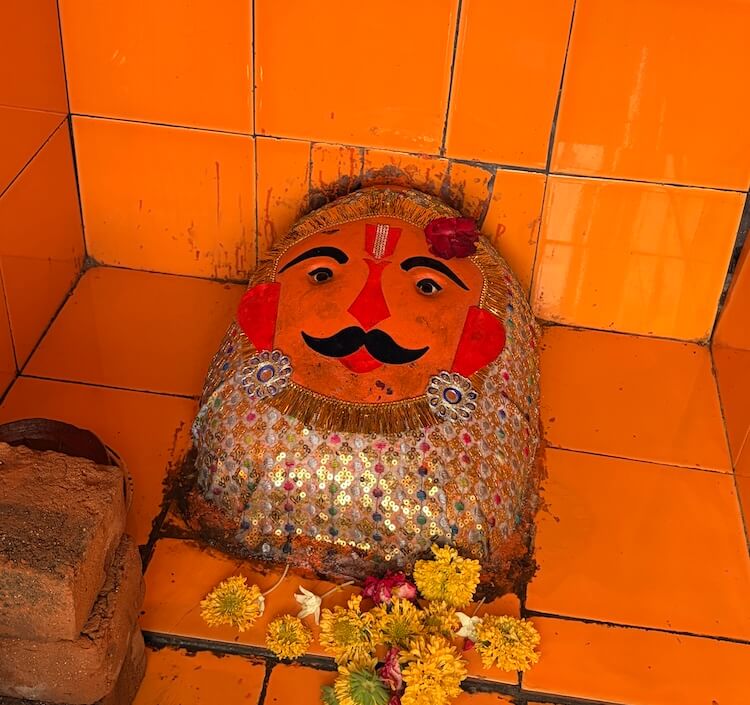
Shop Photo FramesIn the village of Limdi, perched upon a hill overlooking the Machhan River is the Suryamukhi Hanuman Temple. An image of Lord Hanuman facing east is known as ‘Suryamukhi Hanuman’ or ‘Purvabhimukha Hanuman’. Only a handful of such temples are found across India. According to religious belief, the worship of Suryamukhi Hanuman bestows brilliance, success, fame and honour. Devotees worship this east-facing form of Hanuman to attain knowledge and learning. It is customary to worship the deity while chanting the mantra, ‘Om Ham Suryamukhe Hanumate Phraum Namah’. Local people regard this shrine as a sacred place where heartfelt vows are fulfilled.
The Hindu religious tradition and ancient scriptures describe many manifestations of Lord Hanuman. Among them, the form of ‘Suryamukhi Hanuman’ is accorded special significance. According to tradition, Surya, the Sun God, is regarded as Hanuman’s Guru. Consequently, the Suryamukhi form symbolises not merely an eastward direction but also the sacred Guru-disciple tradition, the pursuit of knowledge, radiant brilliance and inner strength.
Ancient texts such as the ‘Valmiki Ramayana’ and the ‘Parashara Samhita’ contain detailed accounts of the relationship between Hanuman and Surya. It is told that once, during his childhood, Hanuman beheld the newly risen sun. Mistaking the glowing, crimson orb for a ripe fruit, he leapt into the heavens to claim it. Witnessing this, Lord Indra hurled his thunderbolt at the child, striking his left jaw. It was from that moment, with his jaw thus broken, that he came to be known as ‘Hanuman’. According to mythological lore, thereafter, Hanuman accepted Surya as his Guru and expressed his desire to study under him. Since Surya travelled continuously across the sky in his celestial chariot, Hanuman acquired knowledge by flying before the chariot while constantly facing his Guru. In this manner, he mastered the four Vedas, the six Vedangas and the entire body of sacred knowledge. This episode, in which Hanuman kept his face turned towards his Guru while receiving instruction, forms the religious foundation of the Suryamukhi manifestation.
The east-facing Suryamukhi form is regarded as especially auspicious and life-giving. In later temple tradition, sacred iconography and Vastu practice, the east-facing (Suryamukhi) form of Hanuman is considered particularly auspicious and is associated with knowledge, vitality and spiritual illumination.
According to the local legend of the Suryamukhi Hanuman Temple at Limdi, this region was once covered with dense forest. Two sages, Jati and Yati, performed severe penance here. During that period, Lord Hanuman was travelling through the sky in search of the Pandavas. Seeing Him pass overhead, the two sages offered their reverential salutations. Pleased with their devotion, Hanuman descended to the earth to grant them His divine darshan. After blessing the sages, He ascended once more into the heavens. At the spot where His feet had touched the ground, a self-manifested stone image appeared. Thereafter, the sages Jati and Yati built a small shrine dedicated to Lord Hanuman at this sacred place. Over the centuries, the temple has undergone several phases of renovation and restoration.
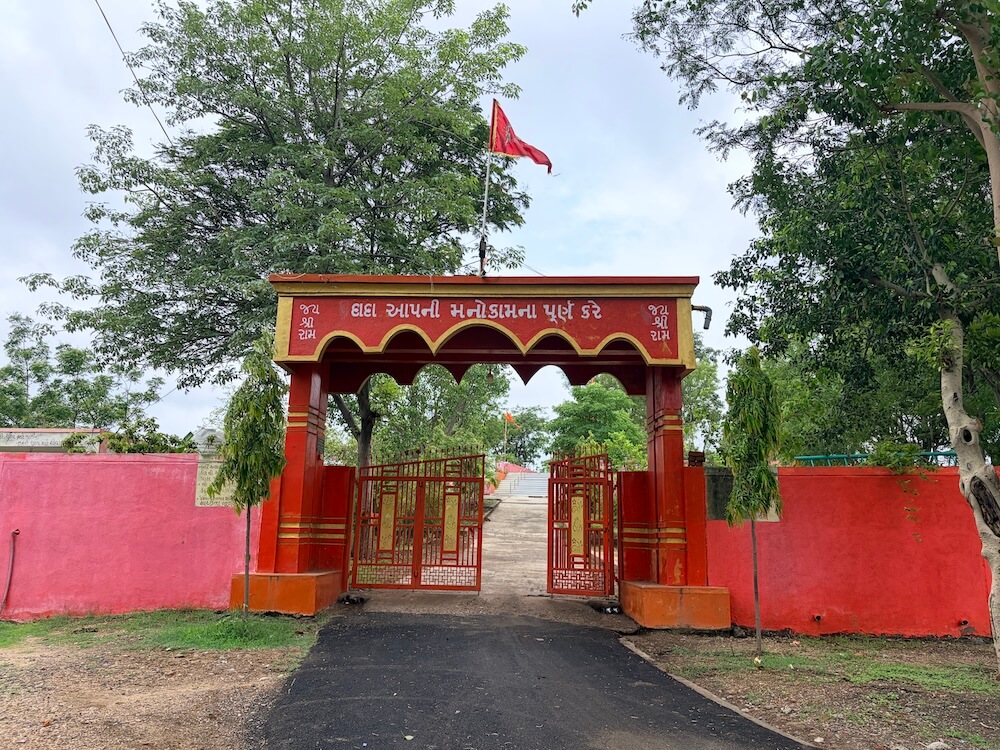
A monumental gateway and protective boundary wall stand along the approach road leading to the temple, situated a short distance from Limdi village. The temple complex includes a dedicated parking area for vehicles and a children’s garden. A motorable road reaches the foot of the hill. From there, a flight of stone steps leads to the temple. Safety railings have been provided on both sides of the staircase, while benches are placed at intervals to allow pilgrims to rest. The entire temple precinct is enclosed by a protective fence. The grounds are shaded by dense trees and contain several small shrines dedicated to local deities.
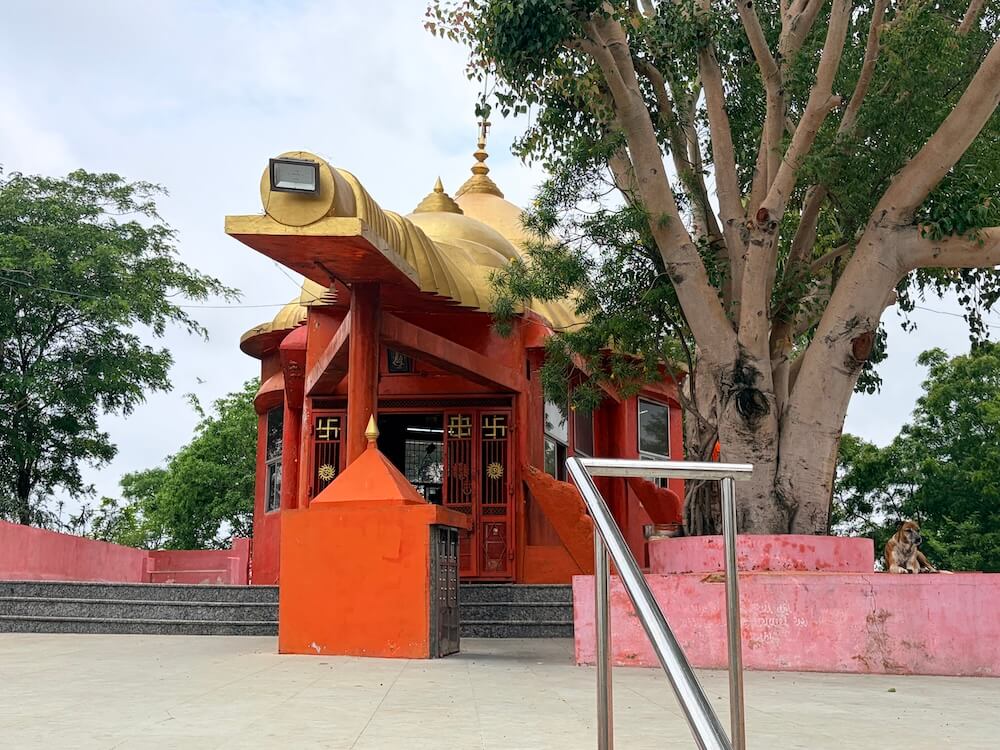
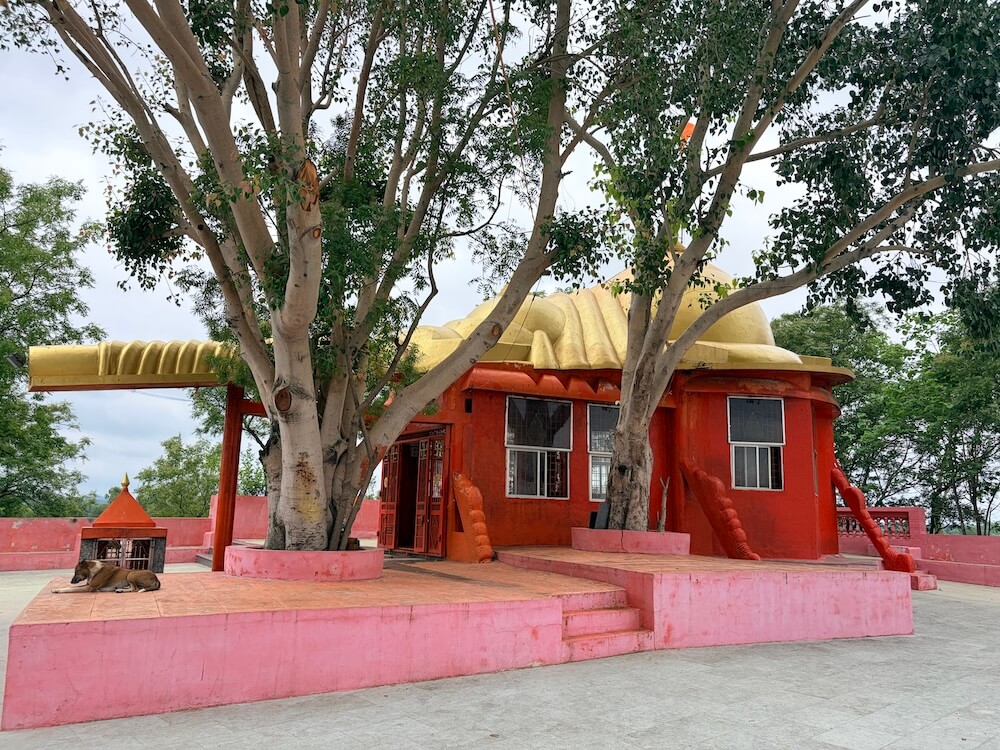
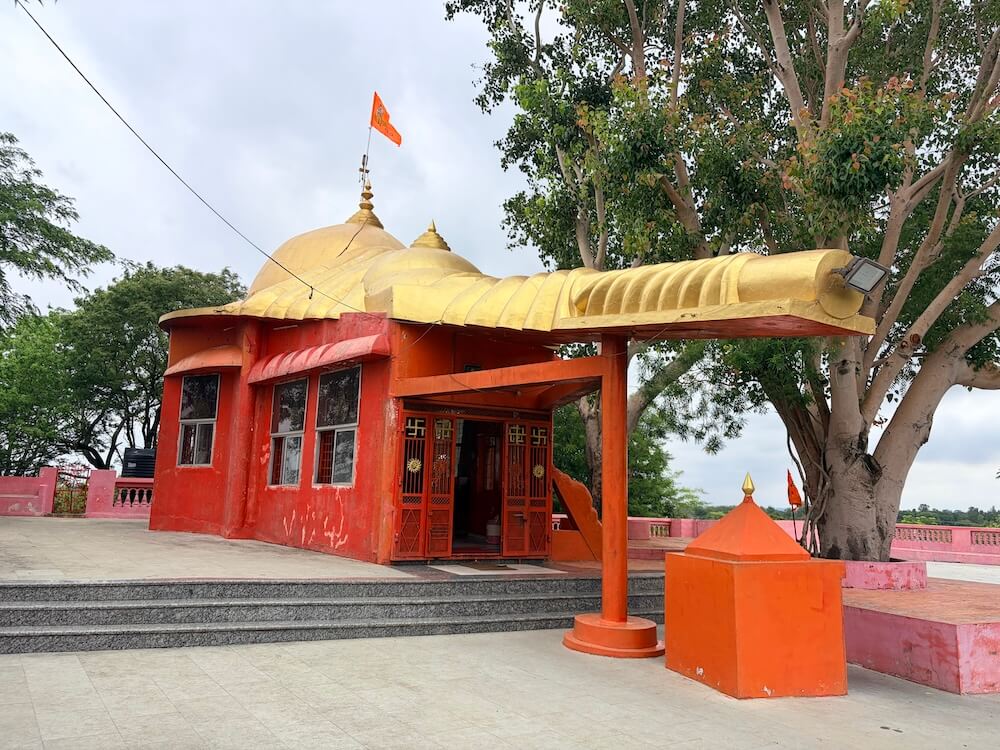
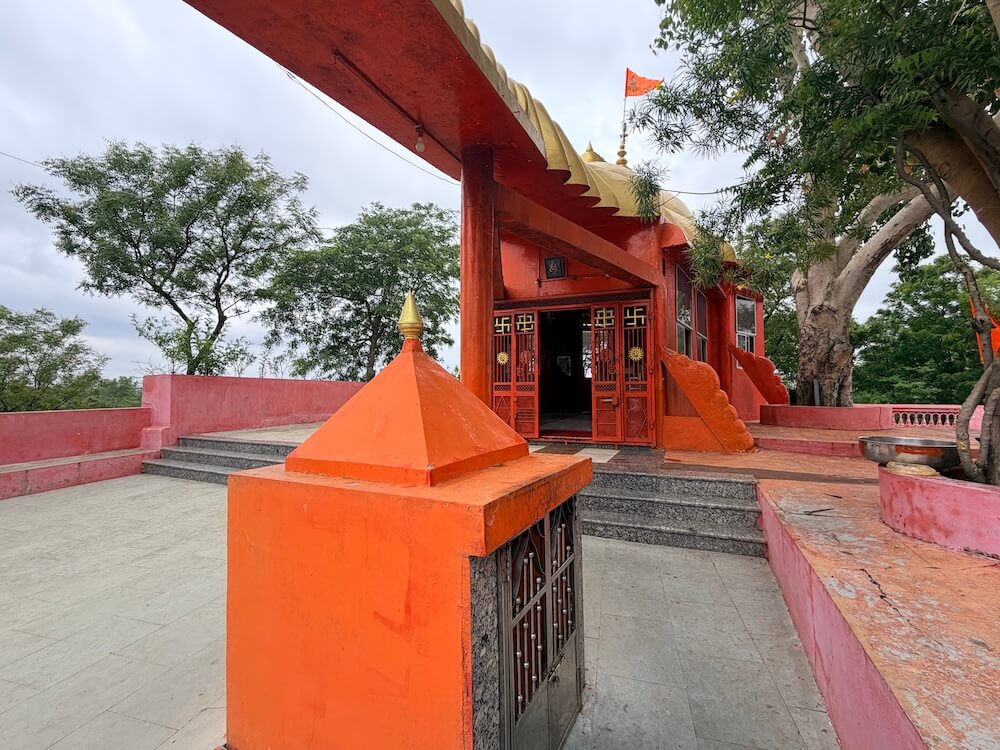
The principal temple stands on the highest part of the hill, reached by climbing another short flight of steps. Its architectural layout comprises an entrance porch and an assembly hall. The entrance porch is supported by a single pillar, while its triangular roof rests against the wall of the assembly hall.
At the centre of the assembly hall stands an ornate makhar. Upon the vajrapitha within it is installed a stone image of Lord Hanuman, richly anointed with vermilion. The image is carved in high relief, with a mace positioned beside it. The makhar is surmounted by a domed spire.
One of the temple’s most distinctive architectural features is its roof, which has been designed entirely in the shape of Hanuman’s mace. The portion above the entrance porch resembles the handle of the mace, while the section above the assembly hall is rounded like its head.
Two domed spires rise above the roof of the assembly hall. Each is crowned with an amalaka, a kalasha and a sacred flag. The entire roof has been painted in a golden hue.
Hanuman Jayanti is the temple’s principal annual festival. A large fair is held in the temple precincts to mark the occasion. Devotees gather in great numbers for darshan and to fulfil vows made to the deity.
Offerings include ceremonial garments, ornaments of gold and silver, and sweets. The celebrations include religious rituals, sacrificial fire ceremonies, devotional singing, Ram Katha discourses and the distribution of Mahaprasad.
A ceremonial palanquin procession of Lord Hanuman is also taken through the surrounding area. Numerous devotees from neighbouring villages participate in this procession.
The temple also celebrates Ram Navami, Shri Krishna Janmotsav, Dussehra, Diwali and the holy month of Shravan.
Large numbers of devotees visit the temple every Tuesday, Saturday and Sunday. Darshan of Suryamukhi Hanuman is available daily from 6.00 a.m. until 8.00 p.m.
This sacred temple stands as a testament to deep spiritual devotion, ancient architectural grandeur, and rich local cultural traditions.
The sanctum sanctorum houses the divine idol consecrated according to ancient Vedic traditions, surrounded by serene courtyards and traditional temple architecture.
Navratri, Maha Shivratri, Annual Temple Jatra & Deepotsav
Compare and book flights, secure top-rated local hotels near the temple, hire reliable guides, and rent cars instantly.
Extend your pilgrimage by visiting other highly sacred temples located nearby.


Add ₹999 more to unlock FREE SHIPPING!
Your sacred cart is currently empty.
Shop Photo FramesFill in your delivery details below to place your order.
Add comment