
Add ₹999 more to unlock FREE SHIPPING!
Your sacred cart is currently empty.
Shop Photo FramesChandika Devi is none other than Kali Devi, a manifestation of Adishakti Mahamaya. This Devi is the revered deity of the Koli community in Parel and Sewri. She is the Gramdevi (village deity) of Parel. This Devi is also known as the Kuldevata (family deity) of Hemadpant, the royal priest of Mumbai’s ancient king, Pratap Bimba. The Devi’s ancient abode is on the old Golangi Hill in Parel. Devotees from Mumbai come here for Darshan, believing that the Devi’s presence here is vibrant and active. Adjacent to this temple is the famous Baradev Mandir. A rare Shiva idol, a magnificent example of sculpture, dating back approximately one thousand five hundred years, is enshrined in this temple. Due to this unique feature, the temple has also become a focal point for archaeologists and history scholars.
According to the mythological narrative in the scripture ‘Durga Saptashati’, the demons Shumbha and Nishumbha conquered the kingdom of the three worlds from Devraj Indra. The defeated Devas then sought refuge with Adishakti Bhagavati. As they were praying to Bhagavati, Devi Parvati arrived there. From her body’s sheath (kosh), Devi Ambika manifested. Chanda and Munda were servants of Shumbha and Nishumbha. They saw Ambika and described her beauty to Shumbha. Shumbha sent a message to Ambika, asking her to become his wife. Ambika rejected the message. Then, Shumbha and Nishumbha sent Chanda and Munda to capture her. Upon seeing them, Ambika became enraged, and from her body, Devi Kali manifested. She decapitated Chanda and Munda. Because Kali Devi slew Chanda and Munda, Bhagavati named her Chamunda. As she emerged from Devi Parvati’s body sheath, she is also known as Kaushiki. She is also known by the name Chandika.
The exact history of Chandika Devi’s temple is unknown. This Devi is the Kuldevata of Hemadpant Chamare, also known as Chavare, the royal priest of King Pratap Bimba. According to historians, the Prabhadevi temple in Mumbai might have been established by King Pratap Bimba. Chandika Devi was also installed alongside Prabhadevi in this temple. An ancient abode of this very Devi is on Golangi Hill. It is said that this site has existed here since ancient times. In those days, this hill covered a vast area from Bhoiwada to Chinchpokli. The village of Parel was situated on the slopes of this hill. During the British government’s rule, there was a Governor’s House in Parel. At that time, the government flag used to fly atop Golangi Hill. Hence, this hill was called ‘Flagstaff Hill’. Temple scholars state that the current temple structure of the Devi, based on its architectural style, dates back to the British era. According to local tradition, this temple belongs to the first half of the nineteenth century.
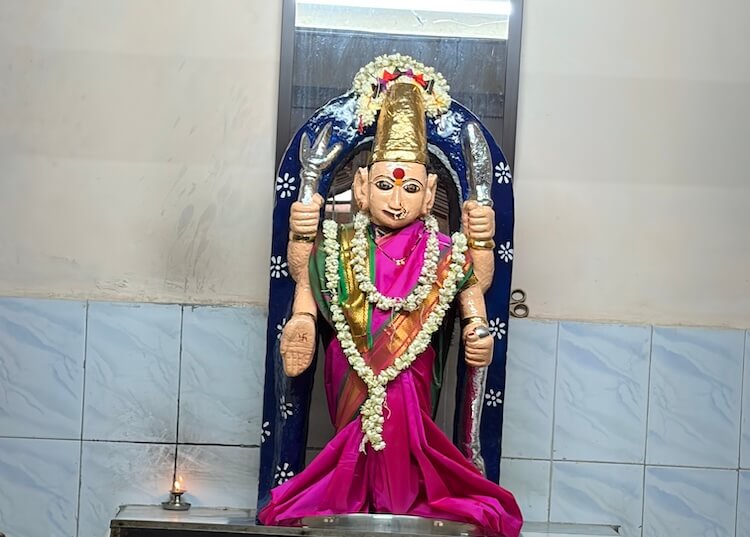
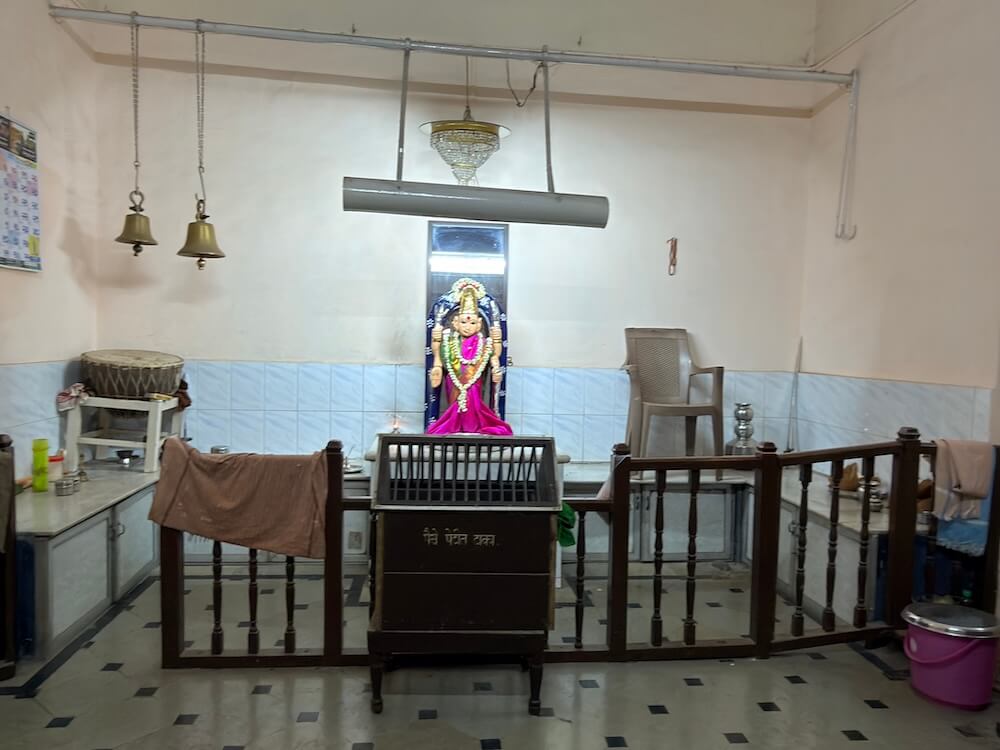
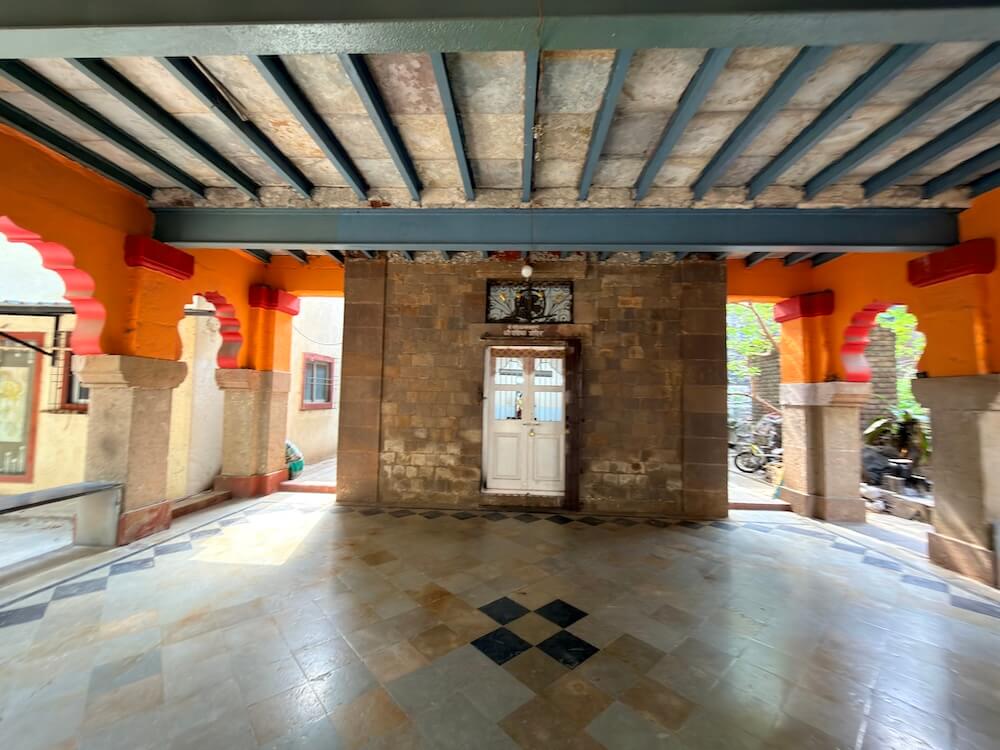
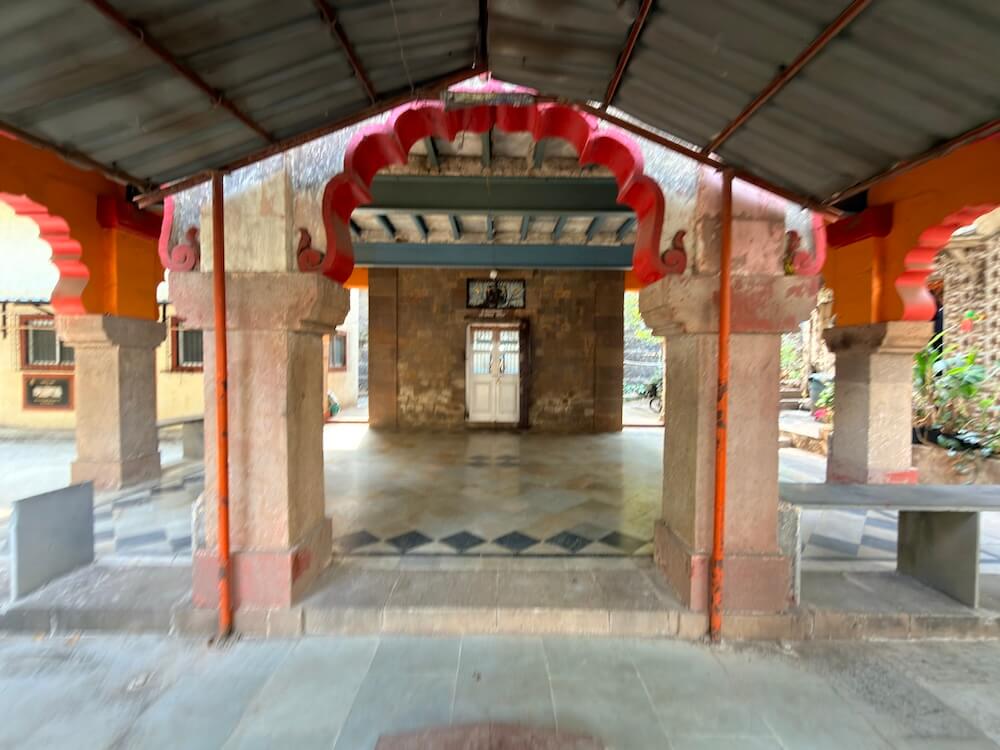
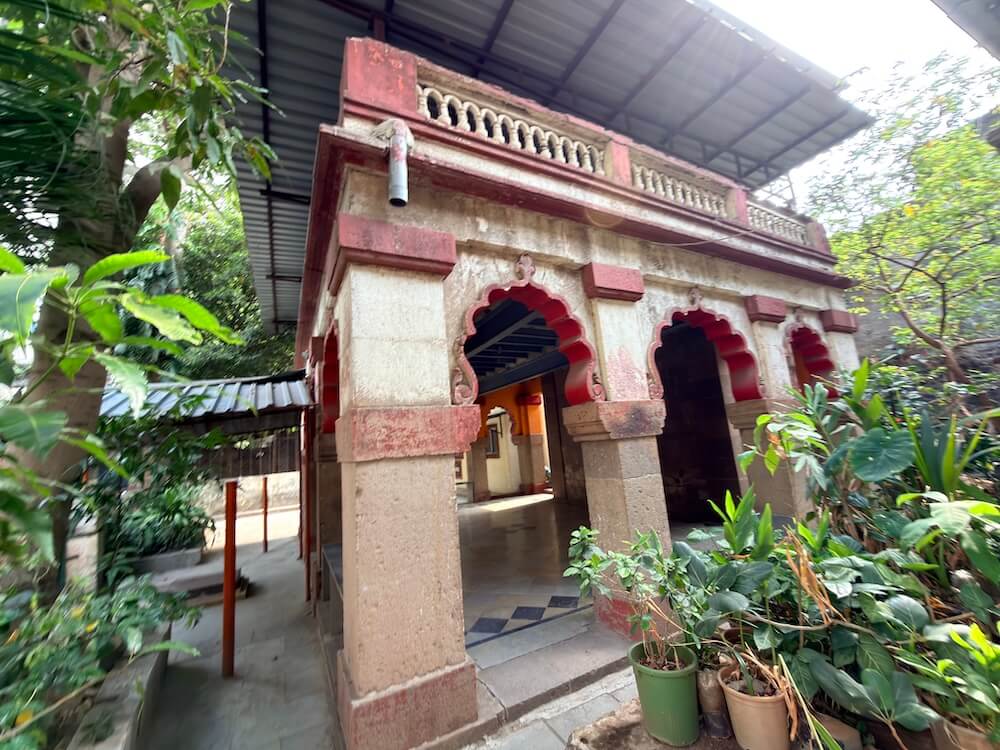
This temple is situated on a large plot of land. Inside the courtyard wall in front of the temple, a tin shed has been erected for the convenience of devotees. The temple’s structure consists of a Sabhamandap (assembly hall) and a Garbhagriha (sanctum sanctorum). The temple’s architecture bears the imprint of Maratha architectural style. The Sabhamandap here is open-plan. It has wide, square stone pillars. These pillars feature arched niches. Marble flooring has been laid in this Sabhamandap. There are seats for devotees to sit. The temple’s Garbhagriha is square-shaped and built with stone blocks. Inside, on a high altar, the idol of Chandikamata is seated. This idol, carved in stone, is adorned with garments, ornaments, and flower garlands. Here, the Devi is four-armed. One hand of this Devi, who holds a bow, trident, and sword, is in the Varadamudra (boon-granting gesture). The Garbhagriha has a Shikhara (spire) bearing the influence of Maratha architectural style. It has an Amalaka and Kalasha (finial).
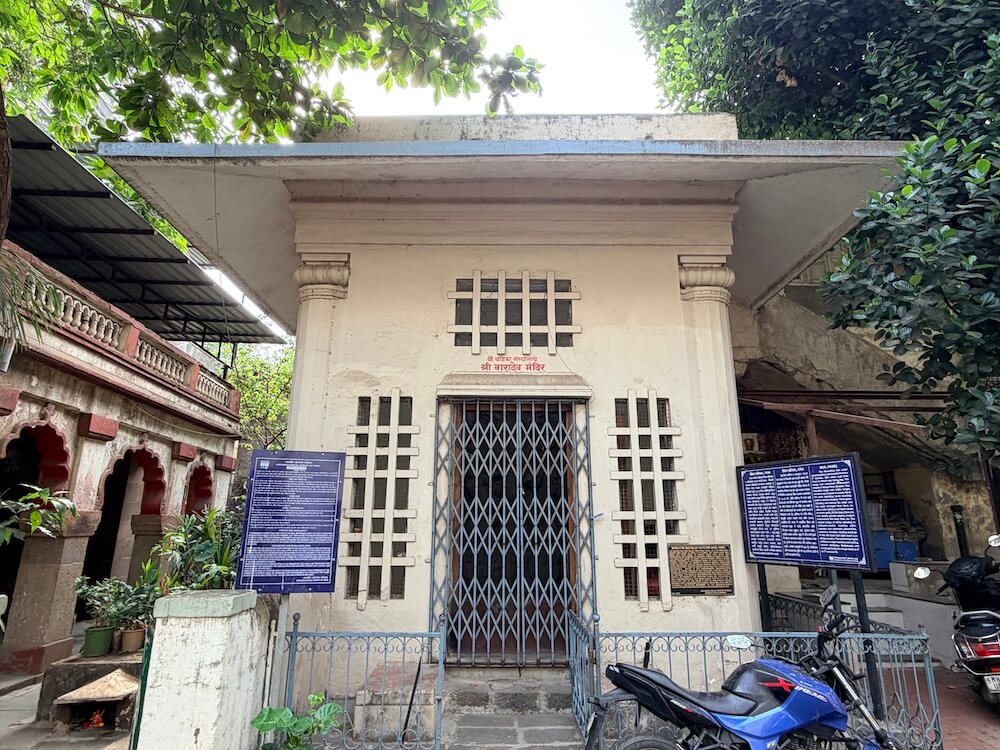
Adjacent to this temple is the Baradev Mandir. This temple is small and elongated rectangular. Although this temple is simple, the Shiva idol enshrined there gives it immense significance for Shiva devotees and archaeologists. The Shiva idol enshrined here dates back approximately one thousand five hundred years. During this period, the Trikutaka kings ruled over Aparanta, which included Thane, Raigad, and the islands of Mumbai. In the subsequent period, i.e., the sixth century, they became vassals of the Kalachuris. The Jogeshwari, Elephanta (Gharapuri), and Mandapeshwar caves in Mumbai belong to the period of these Trikutaka and Kalachuri kings. The Kalachuri dynasty branch that ruled in Maharashtra originated from Maheshwar, also known as Mahishmati. The founder of this branch was Krishnaraja (५५० to ५७० CE). His silver coins were known as ‘Krishnaraja-rupaka’. Some of these coins were found in the Kalbadevi and Thakurdwar areas of Mumbai. This discovery clearly indicates his rule over these islands. The Kalachuri kings were followers of the Pashupata sect, i.e., Shaivites. They created the famous ‘Shiva Srushti’ at Elephanta. A Shiva idol, similar to the sculptures found in front of the main caves at Elephanta, is enshrined today in the Baradev Mandir.
According to historians, the creation period of this idol is ५२५ to ५३० CE. It is carved on a three and a half meter (११.५ feet) high grey basalt stone slab. This sculpture features a total of seven images of Shankara. Among them, three images are standing one above the other in the center. These images are in Samapada Sthiti (equipoise posture). To their left and right are two Shiva images each. All these images are without Jata (matted locks). Their faces bear calm, self-absorbed expressions. Six of these Shiva images are two-armed, while the topmost Shiva image is ten-armed. They hold an Akshamala (rosary) and Kamandalu (water pot). The right hand of the central standing idol is in the Vyakhya Mudra (gesture of exposition). In this sacred image, Bhagavān Shiva is adorned with a *japamālā*. All the Shiva forms wear *kaḍe* (bracelets) on their wrists and a *graiveyaka* (a type of tight-fitting necklace) around their necks. They are crowned with a *jaṭāmukuṭa* (matted hair crown) and wear *kuṇḍalas* (earrings) in their ears. The Shiva image above them has its right hand in *dhyānamudrā* (meditation posture). In the topmost central position, the ten-armed Shiva image clearly displays a *parashu* (axe), *akṣamālā* (rosary), shield, and *kamaṇḍalu* (water pot) in its hands. Generally, in popular Shiva images, Lord Shiva-Shankar is depicted wearing a tiger skin. However, in this sculpture, He is shown wearing an *adhovastra* (lower garment). This *adhovastra* has a pleated fold, known as *hastīshuṇḍaka* (elephant’s trunk), between the two legs.
In her essay, ‘Seeking Stylistic Sources for Parel and Elephanta Sculptures,’ the esteemed sculpture scholar Aparṇā Bhogal has put forth an important perspective. According to her, through this idol, the sculptor intended to convey that the Shiva-tattva (essence of Shiva) is all-pervading. This Shiva-tattva permeates the East, West, South, North, as well as the lower, upper, and even higher realms. The Shiva forms in this sculpture embody the ‘Mahāpuruṣa’ (great being) form, with a lion-like chest, broad shoulders, and a slender waist. This view was presented by the German Indologist Heinrich Zimmer in his revered work, ‘Myths and Symbols in Indian Art and Civilization’ (edited by Joseph Campbell, one thousand nine hundred and forty-six). Below these seven Shiva images, five images of Shiva-gaṇas (attendants of Shiva) are carved. Here, these Shiva-gaṇas are seated cross-legged, holding musical instruments such as the *ektārī* (one-stringed instrument), *kacchapī vīṇā* (lute), and *tāḷa* (cymbals). Three of these *gaṇa* images are partially carved.
According to Dr. Sadashiv Gorakshkar, this sculpture represents the *Aṣṭamūrti Shiva* (eight-fold form of Shiva). He believes that if the seven Shiva images in this sculpture and the stone on which it is carved are considered as a *piṇḍī* or *liṅga* (aniconic representation of Shiva), then there are a total of eight forms. The concept of *Aṣṭamūrti Shiva* is associated with the Pāśupata sect. *Aṣṭamūrti* is also a form of Rudra. The influence of the Pāśupata sect in the caves of Ghārāpurī (Elephanta) is noteworthy in this regard. The renowned American Sanskrit scholar Barbara Stoler Miller has also corroborated this view. Due to the total of twelve images in the sculpture, this idol is now referred to as ‘Bārādev’ (Twelve Deities).
The esteemed Indian archaeologist and Padma Shri awardee, Dr. Madhukar Keshav Dhavalikar’s concise translation of his book ‘Cultural Heritage of India’ has been published under the title ‘Mumbai’s Glorious Heritage.’ In it, he has provided detailed information about this Shiva sculpture in Parel. According to Dr. Dhavalikar, this Shiva sculpture was created in Parel itself. However, this idol could not be completed. It is believed that due to the incomplete carving of some of its parts, the idol was not consecrated.
This idol, left incomplete by the sculptors, was buried underground over time. On the ninth of October, one thousand nine hundred and thirty-one, while work was underway on the Parel to Sewri road on Golanjī Hill, this idol was discovered by workers. Dr. Āchārya, the then director of the ‘Prince of Wales Museum,’ and Father Heras, a professor of history at St. Xavier’s College in Mumbai, thoroughly examined this idol. Father Heras wrote an article in the ‘Times of India’ on the fourteenth of October, one thousand nine hundred and thirty-one, clarifying that it was a Shiva idol. Efforts were made to move the idol to a museum for its proper preservation as an invaluable treasure. However, due to the insistence of the local devotees, it was kept here in a small temple. An exact replica of this idol was created in one thousand nine hundred and fifty. That replica is preserved in the ‘Chhatrapati Shivaji Mahārāj Vastu Saṅgrahālay’ (Chhatrapati Shivaji Mahārāj Museum). The Archaeological Survey of India has declared this temple a ‘National Protected Monument.’
During the Navarātra festival of Chandikā Devī, devotees are granted entry into this Bārādev temple. Otherwise, the temple remains closed. Devotees must view the idol through the mesh on the temple door. Navarātra is the grandest festival at the Chandikā Devī temple. On the eighth day of Navarātra, a *homahavana* (fire ritual) is performed at the Chandikā temple. Here, in addition to Chandikā Devī and Bārādev, there is also a temple dedicated to Vāgheshwarī Devī. Due to this religious significance, the area is thronged with devotees during the Navarātra festival. Devotees can have *darshan* (sacred viewing) here daily from six o’clock in the morning until nine o’clock at night.
This sacred temple stands as a testament to deep spiritual devotion, ancient architectural grandeur, and rich local cultural traditions.
The sanctum sanctorum houses the divine idol consecrated according to ancient Vedic traditions, surrounded by serene courtyards and traditional temple architecture.
Navratri, Maha Shivratri, Annual Temple Jatra & Deepotsav
Compare and book flights, secure top-rated local hotels near the temple, hire reliable guides, and rent cars instantly.
Extend your pilgrimage by visiting other highly sacred temples located nearby.


Add ₹999 more to unlock FREE SHIPPING!
Your sacred cart is currently empty.
Shop Photo FramesFill in your delivery details below to place your order.
Add comment