
Add ₹999 more to unlock FREE SHIPPING!
Your sacred cart is currently empty.
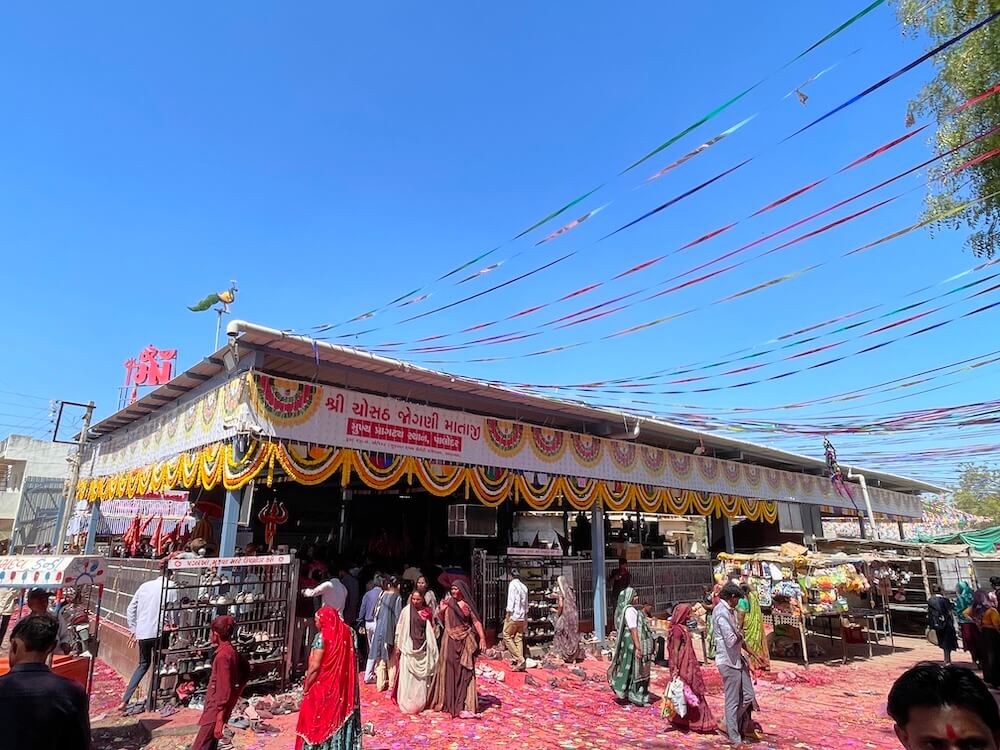
Shop Photo FramesIn the village of Palodar, situated in close proximity to Mehsana city, lies the ancient and spiritually ‘jagrut’ sanctuary of Chosath Jogani Mata. A singular hallmark of this temple is the devout worship of a formless ‘Yantra’ of the Goddess enshrined within the sanctum sanctorum. This sacred site is intrinsically linked to a significant episode from the Mahabharata. It is traditionally believed that Sahadeva, the youngest Pandava, engaged in a celestial duel with Yogini Mata at this very location. Furthermore, the temple serves as the stage for the renowned two-day ‘Shukan Mela’ (Fair of Augury) held annually in the month of Phalgun. During this fair, precise prognostications, known as ‘Varatara’, are delivered to farmers and the common folk regarding the agricultural prospects and general welfare of the forthcoming year.
According to mythological chronicles, the village currently known as Palodar was anciently renowned as Paleshwar or Puliya. Following the monumental victory over the Kauravas and prior to the coronation of Yudhishthira, the ‘Rajsuya Yagna’ was organised. To ensure the success of this grand sacrifice, Sahadeva was entrusted with the momentous responsibility of inviting Lord Krishna. Before departing for Dwaraka, Sahadeva sought the blessings of Mother Kunti. While bestowing her grace, Kunti imparted a crucial injunction. She commanded him to refrain from engaging in combat with anyone during his journey through the Khandavaprastha route and warned that should battle arise, he must never venture towards the south, for doing so would inevitably invite defeat.
Guided by his mother’s blessings, Sahadeva journeyed towards Dwaraka via the Khandava forest and reached Paleshwar, an ancient seat of the Jogani Goddess. The Goddess, assuming the guise of a young maiden, intercepted his path, declaring that not even a leaf could stir without her volition and challenged him to a duel for attempting to pass without her sanction. Sahadeva accepted the challenge and during the fierce combat, one of his arrows grazed the Goddess. It is said that from the sixty-four drops of blood that fell upon the earth, sixty-four ‘Joganis’ (Yoginis) were manifested. To make Sahadeva realise her transcendent power, the Goddess cast her ‘chunar’ (veil) over his head, plunging him into sensory disorientation. In his bewildered state, Sahadeva inadvertently violated Kunti’s warning and moved towards the south, resulting in his defeat. Humbled, he sought the Goddess’s forgiveness, whereupon she revealed herself in the form of Ranchandi and permitted him to proceed to Dwaraka. In Hindu theology, the sixty-four Yoginis are considered emanations of the supreme feminine energy, divided into eight mandalas, each representing a distinct aspect of divine power.
This mythological foundation is complemented by historical and spiritual dimensions. Between the ninth and twelfth centuries AD, numerous temples dedicated to the Chosath Yoginis were erected across India. The temple at Palodar remains a significant vestige of this expansive Tantric tradition. In Hindu Tantra, Yoginis are venerated as the fundamental primordial energy of cosmic creation, representing various manifestations of the power wielded by Parvati. The Rigveda references ‘Tantra’ in the sense of ‘weaving’, implying the integration of mental and physical faculties to achieve spiritual perfection. Traditionally, these practices are pursued under the rigorous guidance of a preceptor. The local Tantric worship focuses on the evolution of human intellect, based on the belief that Yoginis are born in human form and attain divinity upon achieving specific ‘Siddhis’ (supernatural powers). The ancient custom of worshipping these deities to avert natural calamities persists to this day.
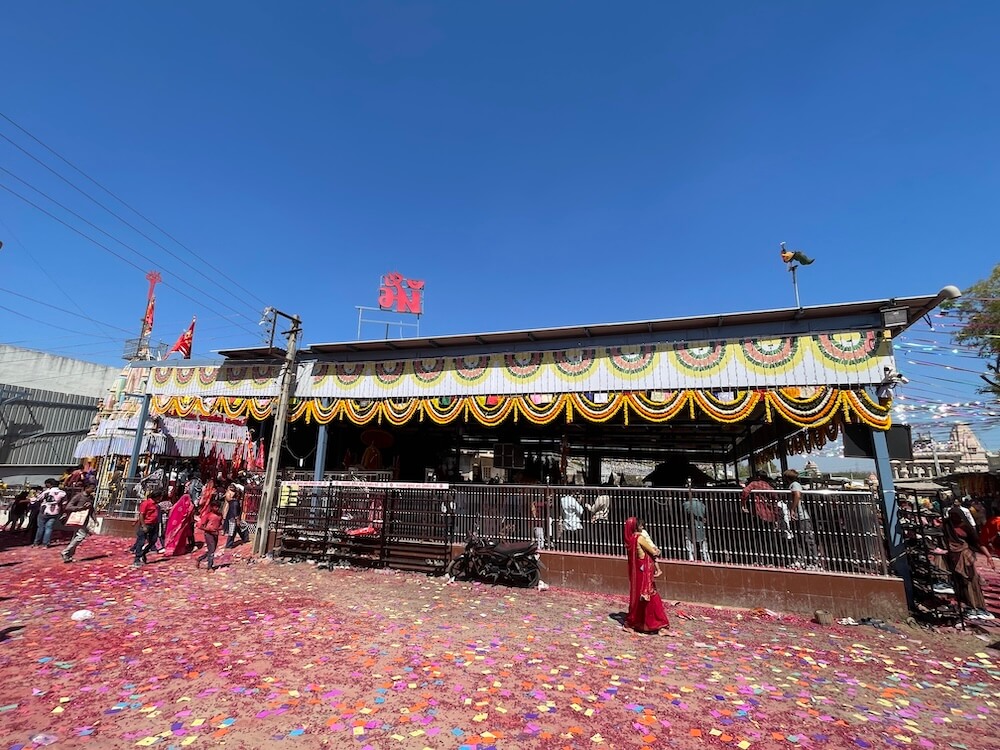
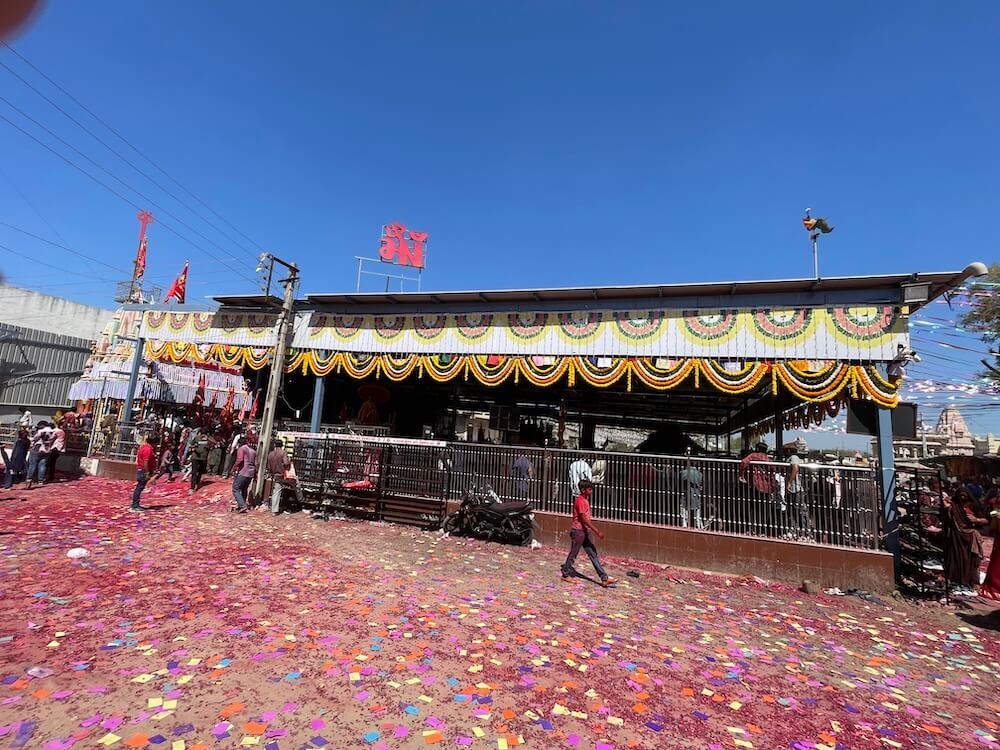
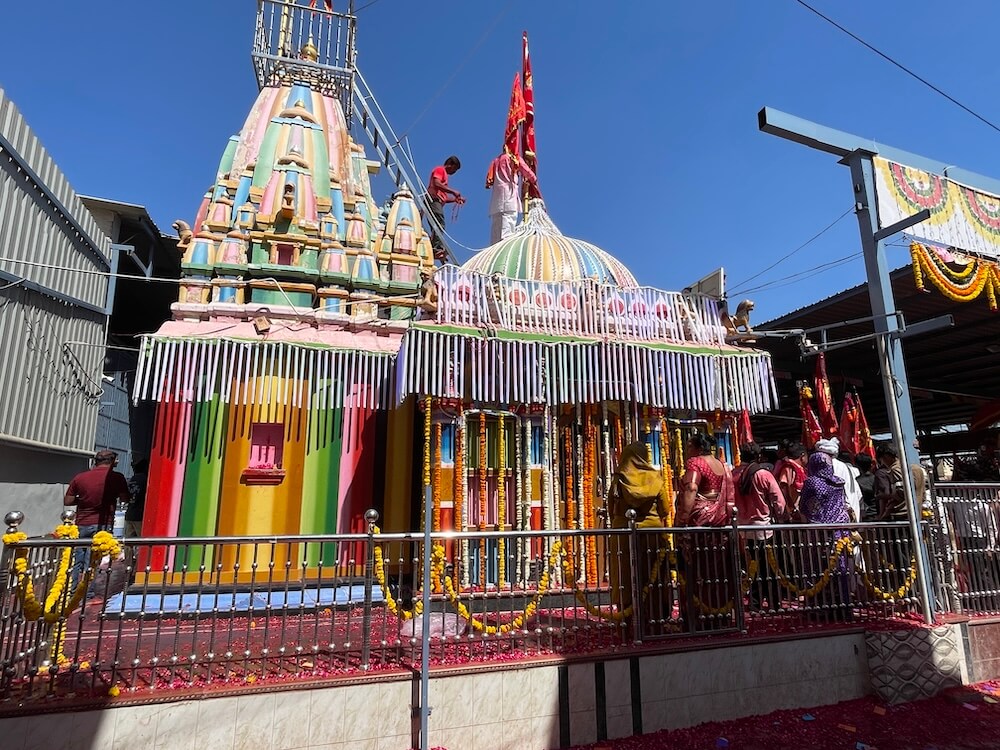
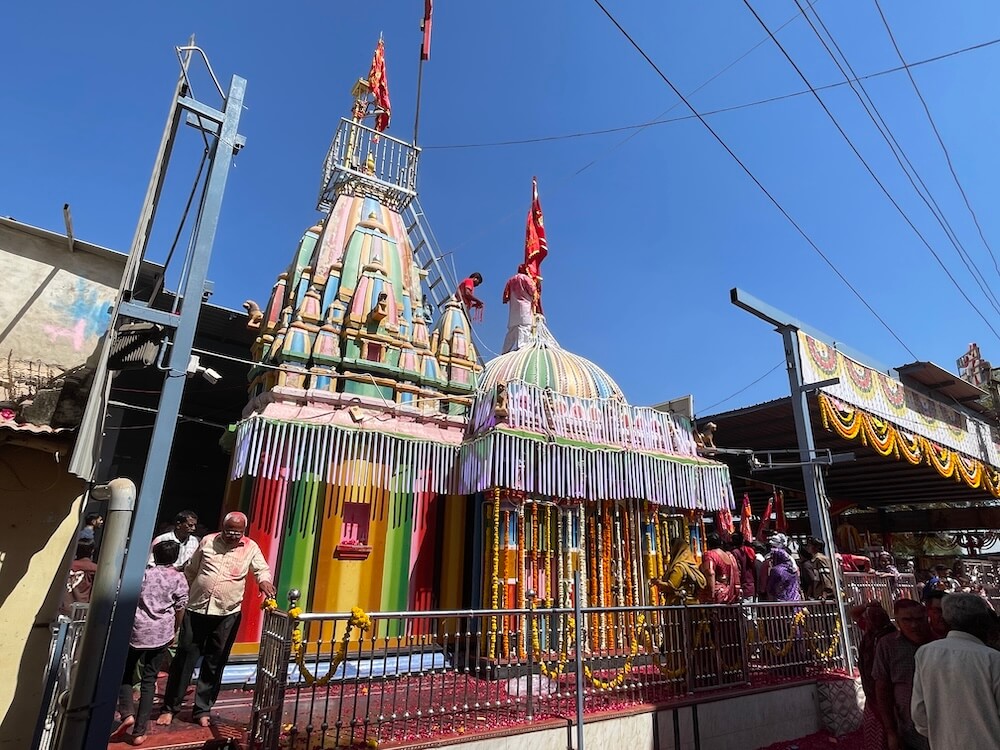
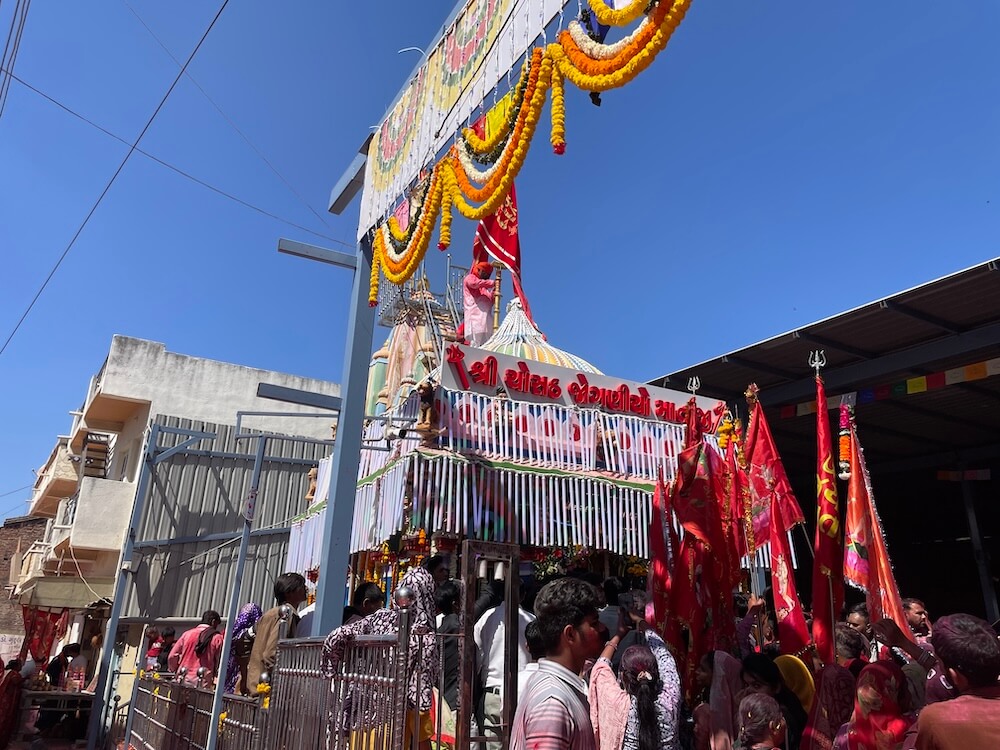
The temple faces an expansive paved courtyard sheltered by a roof and enclosed by stainless steel railings. Upon entering, one encounters a sculpture of a lion – the ‘vahana’ of the Goddess – seated on a pedestal before the main sanctum. The courtyard ceiling is adorned with paintings depicting the glory of the Goddess and the precinct also houses a ‘Yagnakunda’ (sacrificial pit). Constructed primarily in the ‘Nagar’ architectural style, the temple stands upon an elevated paved plinth. Though modest in scale, the structure is finely proportioned, following the traditional layout of a ‘Sabhamandapa’ (assembly hall), ‘Antarala’ (vestibule) and ‘Garbhagriha’ (sanctum sanctorum). The sanctum is crowned by an ‘Urushringa’ style spire featuring a two-tiered ‘Amalaka’ and a ‘Kalasha’ (pinnacle), while a domed spire surmounts the assembly hall. The exterior and the carved arches of the roof feature intricate sculptures of lions and sages.
Access to the assembly hall is provided through three entrances. The doorway to the sanctum sanctorum is plated in silver, adorned with exquisite craftsmanship, featuring an image of the Sun carved above and gatekeepers at the doorposts. At the heart of the sanctum, the sacred ‘Yantra’ resides upon a pedestal, meticulously decorated and flanked by a trident and an idol of Mahakali. Images of lions guard the idol and ‘Mangal Kalasha’ (auspicious pots) are carved at the base of the pedestal. A ceremonial chariot of the Goddess is kept in an open space nearby. To the right of the main temple, a stage has been erected for festival performances and the ‘Garba’ (perforated earthen lamps) offered by devotees are also kept here. A small shrine dedicated to Kaal Bhairav is also situated within the complex.
The nature of worship and cultural heritage at this site is unique. In the Brahmanical tradition, the role of Yoginis is distinguished from that of conventional mother goddesses. This sanctuary, dedicated to the feminine divine, seeks to harmonise human life with the forces of nature, viewing Jogani Mata as a vital link between the cycles of nature, agriculture and human existence. The number sixty-four holds a sacred status in Tantric lore and accordingly, this temple commemorates the collective power of the sixty-four Yoginis. Historically, Tantric knowledge was guarded with extreme secrecy, accessible only to a limited number of initiates. Due to a historical tendency to marginalise the spiritual legacy of feminine power, written research on Yoginis is sparse. Nonetheless, their potent presence has survived for generations in the folk consciousness, perched at the intersection of myth and reality.
Daily rituals and ‘Aarti’ are performed with steadfast regularity at the temple. Devotees visit in large numbers, driven by the firm belief that earnest service to the Goddess ensures the fulfilment of all desires. The ‘Pragat Din’ (Appearance Day) of the Goddess is celebrated with great fervour on Phalgun Suddha Panchami. Following a ritual worship of the ‘Yantra’, a grand procession of the Goddess is taken through the village. On this auspicious day, a traditional offering of ‘Sev’ is made to the deity.
Furthermore, a significant fair is held on Phalgun Vadya Ekadashi and Dwadashi. On the inaugural day, farmers from every community of the village gather in the pavilion before the temple. A flower, representing the divine sanction (‘Kaul’) of the Goddess, is placed upon the head of one of the villagers wearing a Gandhi cap. By observing his movements and behaviour with meticulous care, the ‘Varatara’ or prophecy for the coming year is delivered. Thousands of devotees from across the district arrive to witness this unique tradition. The fair also features ‘Ras-Garba’ performances. Additionally, the Sharadiya Navratri festival is observed with enthusiasm, culminating in a grand chariot procession of the Goddess through the village on the auspicious day of Dussehra. Devotees may seek ‘darshan’ daily from 6:00 am to 8:30 pm.
This sacred temple stands as a testament to deep spiritual devotion, ancient architectural grandeur, and rich local cultural traditions.
The sanctum sanctorum houses the divine idol consecrated according to ancient Vedic traditions, surrounded by serene courtyards and traditional temple architecture.
Navratri, Maha Shivratri, Annual Temple Jatra & Deepotsav
Compare and book flights, secure top-rated local hotels near the temple, hire reliable guides, and rent cars instantly.
Extend your pilgrimage by visiting other highly sacred temples located nearby.


Add ₹999 more to unlock FREE SHIPPING!
Your sacred cart is currently empty.
Shop Photo FramesFill in your delivery details below to place your order.
Add comment