
Add ₹999 more to unlock FREE SHIPPING!
Your sacred cart is currently empty.
Shop Photo FramesShuklatirtha, revered as one of the pre-eminent pilgrimage sites in the country, serves as the Swayambhu (self-manifested) seat of Lord Shukleshwar Mahadev. Ancient Shuklatirtha, mentioned in numerous sacred scriptures such as the ‘Narmada Purana’, ‘Shiva Purana’ and ‘Markandeya Purana’, stands as the most prominent amongst the 333 ‘Shiva Tirthas’ and 28 ‘Vishnu Tirthas’ located along the banks of the river Narmada. Devotees hold the steadfast belief that a Darshan (sacred viewing) of Shukleshwar Mahadev at this site fulfils all heartfelt desires. It is further believed that such a visitation grants liberation from various sins, ensures that one never encounters the terrors of hell even in dreams and ultimately leads to the attainment of Moksha (spiritual liberation). It is the divine presence of Shukleshwar Mahadev that has bestowed the name ‘Shuklatirtha’ upon this hallowed ground.
In this region, which was known as ‘Naimisharanya’ during the Mahabharata era, the river Narmada flows in a graceful crescent formation. According to the Puranic legend associated with Shukleshwar Mahadev, King Chanakya of the Ikshvaku dynasty was once deeply troubled by physical, mental, and worldly afflictions. To seek deliverance, he performed rigorous Tapasya (penance) dedicated to Lord Mahadev. Pleased by his devotion, Mahadev appeared and instructed him: “Go forth from Amar-kantak, the source of the river Narmada, carrying black garments, a black cow, and a black boat. At the place where these three objects turn white, you shall find liberation from all sorrows.” Following these divine instructions, the King journeyed past several holy sites along the Narmada banks. Upon reaching Shuklatirtha, all three objects miraculously turned white. At that very moment, an extraordinary Shivling emerged from the Patala (netherworld). Declaring that not only the King but also his ancestors would receive salvation, Mahadev invited King Chanakya to ask for a boon. The King requested that for the welfare of mankind, the Lord should reside at this spot for eternity. Granting this plea, Mahadev settled here permanently. Regarding this Tirtha, the ‘Reva Khanda’ of the ‘Skanda Purana’ mentions that it is the abode of Kalagnirudra and Kanthdev. It is also recorded therein that Indra and Kubera both worshipped Lord Shiva at this location. Furthermore, the Reva Khanda recounts the legend of the ‘Satyanarayana Vrata’. According to that story, a merchant named Sadhu had a daughter named Kalavati. Whilst performing the Satyanarayana Puja, she learnt that her husband had arrived by boat. She rushed to the riverbank to welcome him without taking the Prasad (sanctified food offering). Angered by this, Lord Satyanarayana caused the boat to disappear. Local villagers maintain that this episode from the Satyanarayana narrative took place at Shuklatirtha.
The name ‘Shuklatirtha’ has become established through the union of two Sanskrit words : ‘Shukla’ (white or bright) and ‘Tirtha’ (holy place). The Narmada flows in a crescent shape through this village, which is regarded as the ‘Karmabhumi’ of learned Agnihotri and Samavedi Brahmins. A legend explains this geographical feature : in antiquity, many sages performed meditation and Yajna (sacrificial rituals) on these banks. They used vast quantities of ritual materials such as Darbha (sacred grass), Akshata (consecrated rice), flowers and Samidha (sacrificial wood). This caused the riverbed of the Narmada to become filled, leading the river to assume a fierce form and flood the surrounding areas. The sages appealed to Lord Vishnu, who then commanded the Narmada to recede by two Kos (an ancient measure of distance). As the waters receded, a radiant, white-coloured idol of Lord Vishnu emerged from the riverbed. The sages consecrated this idol, formed of white sand, at that very location. Since then, the river has flowed through the village in a crescent shape. The idol that emerged was originally worshipped as ‘Hunkarnath’, a name that eventually evolved into Omkarnath. The Omkarnath temple is located within this same village and the Vishnu idol therein is also known as ‘Shuklanarayana’.
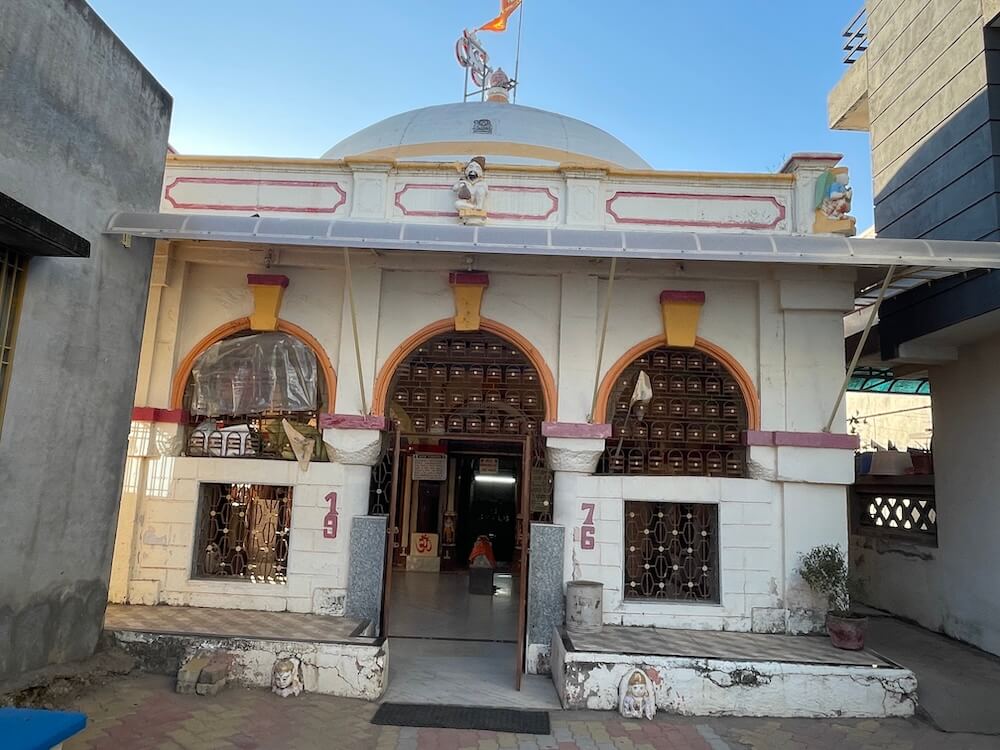
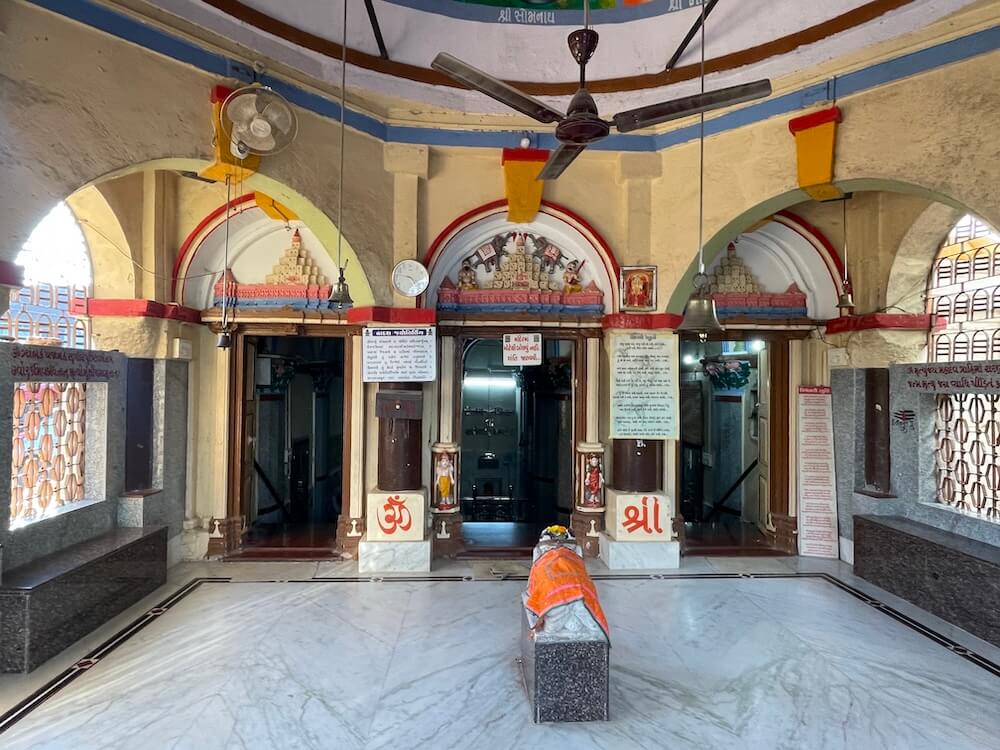
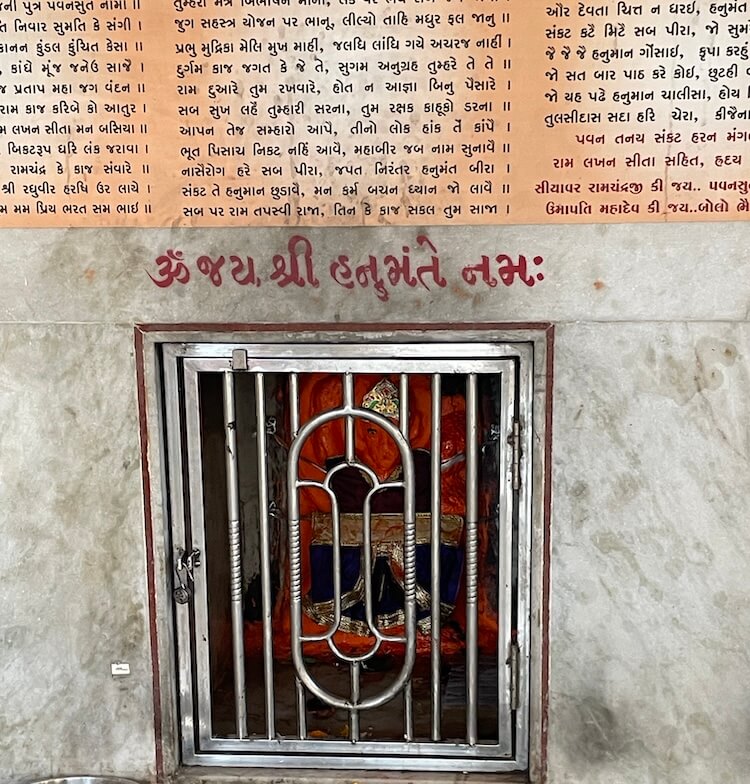
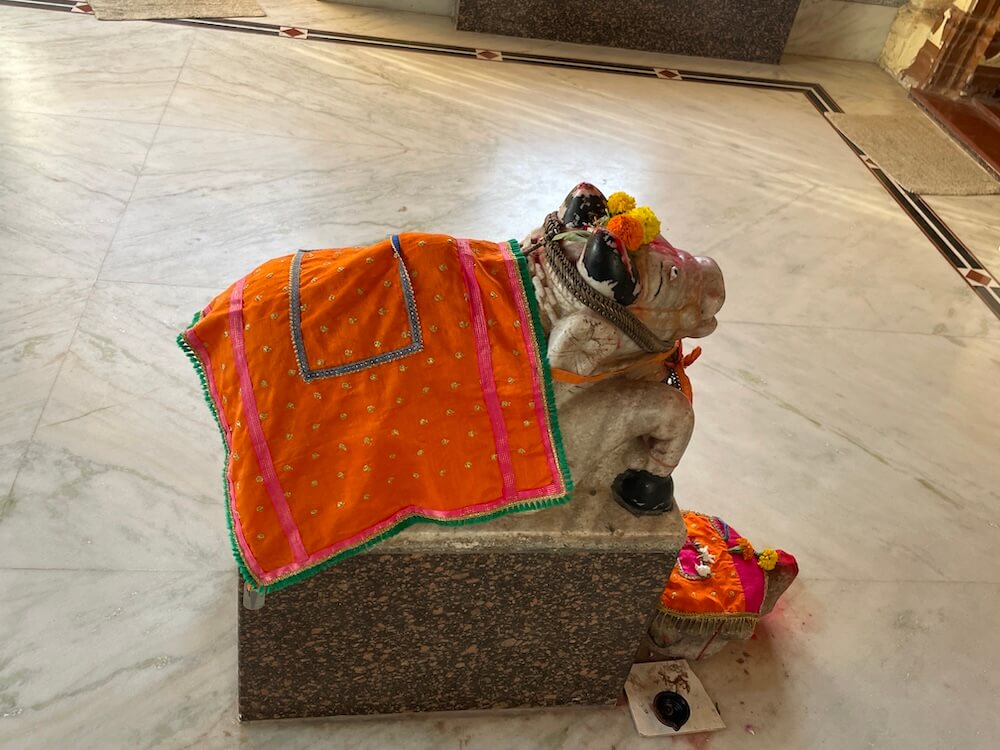
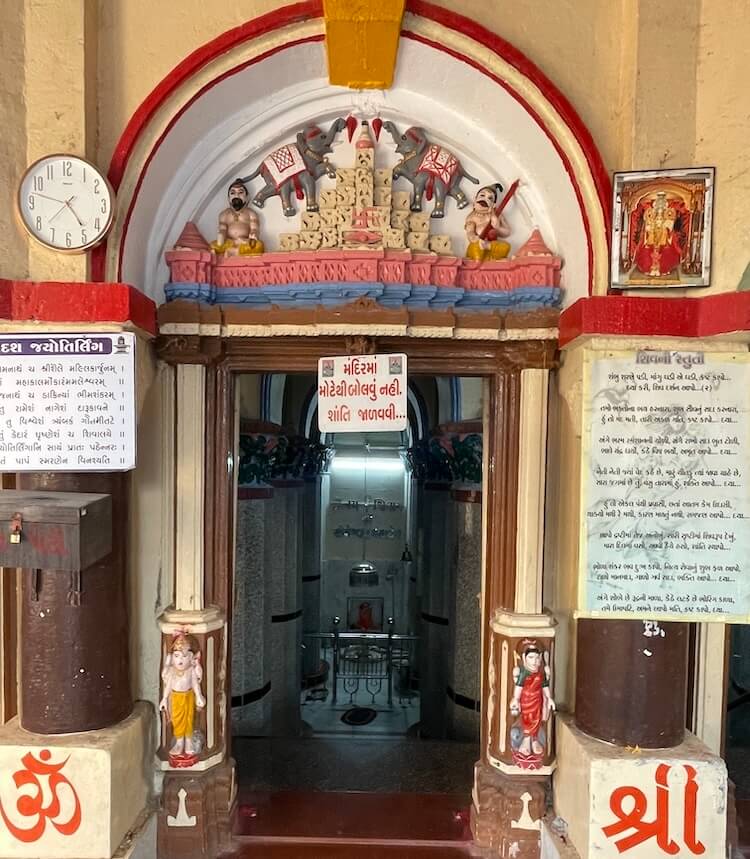
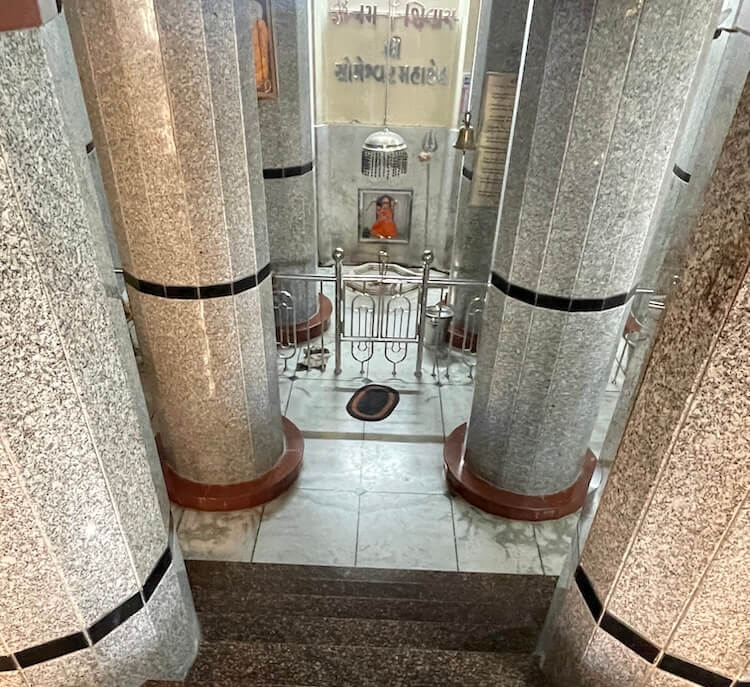
The temple of Shukleshwar Mahadev stands amidst the bustling settlement of the village. The architectural structure consists of a Sabhamandap (assembly hall) and a Garbhagriha (sanctum sanctorum). The Sabhamandap is a two-storeyed structure, featuring sculptures of ascetics and devotees near the ceiling. It is topped by a domed spire. This hall, which boasts tall arched windows and an arched entrance, underwent restoration in the year 1976. The interior ceiling of the hall, supported by large arches, is decorated with circular depictions of the twelve Jyotirlingas. Within the Sabhamandap, an idol of Lord Hanuman is enshrined on the right, while an idol of Nandi sits upon a raised platform. The Garbhagriha has three entrances, each adorned with carvings in the shape of temple spires above their arches. The sanctum itself is situated in a sunken area, reached by descending eight steps. Between these steps stand large circular pillars, the upper portions of which are intricately carved with floral and leaf patterns. The arches between these pillars also feature fine carvings. Inside the sanctum, the Shivling of Shukleshwar is on the right, Someshwar is in the centre and Patteshwar Mahadev is on the left. These Shivlings are enclosed within a heptagonal Shalunka. A brass serpent provides a protective canopy over the Lings. In the niches behind them, idols of Mother Parvati and a Trishul (trident) are placed. The stone Ling of Someshwar Mahadev is small in size. The exterior of the Garbhagriha is topped with an Urushringa style spire and the outer walls of the temple feature niches containing various deities.
Ritual worship is performed regularly at this temple. Many devotees visit during Mahashivratri and on every Monday of the month of Shravan. It is a devout belief that during the five-day period from Kartiki Ekadashi to the full moon, Lord Shiva and Lord Vishnu are present here in their subtle forms. A grand fair is organised in the village during this time. On these occasions, thousands of pilgrims perform Abhishek (ritual bathing of the deity) on the Shivlings and offer Bel leaves.
This sacred temple stands as a testament to deep spiritual devotion, ancient architectural grandeur, and rich local cultural traditions.
The sanctum sanctorum houses the divine idol consecrated according to ancient Vedic traditions, surrounded by serene courtyards and traditional temple architecture.
Navratri, Maha Shivratri, Annual Temple Jatra & Deepotsav
Compare and book flights, secure top-rated local hotels near the temple, hire reliable guides, and rent cars instantly.
Extend your pilgrimage by visiting other highly sacred temples located nearby.


Add ₹999 more to unlock FREE SHIPPING!
Your sacred cart is currently empty.
Shop Photo FramesFill in your delivery details below to place your order.
Add comment