
Add ₹999 more to unlock FREE SHIPPING!
Your sacred cart is currently empty.
Shop Photo FramesDevjagan, situated upon the banks of the Dadhar river, has from ancient times been regarded as a sacred ‘tirthakshetra’ (holy pilgrimage centre). Here lies the venerable and time-honoured sacred seat of Rameshwar Mahadev. According to the tradition preserved in the local ‘Sthanmahatmya’ (legend narrating the spiritual glory of the place), this Shivalinga was established by the Pandavas. The temple of Rameshwar Mahadev is itself ancient, though in more recent times it has undergone renovation and restoration. One distinctive feature of this temple precinct is the presence of the rukhda tree—rare in this region, yet widely revered and considered sacred among many communities. Twice each year, a large yatra (pilgrimage fair) is held here.
According to local belief, the Jambusar region bears a connection with the era of the ‘Mahabharata’. In the ‘Vana Parva’ of the ‘Mahabharata’, within the ‘Tirthayatra Parva’, Chapter 29, the sage Dhaumya Rishi—who served as the Pandavas’ purohit (family priest)—describes sacred places lying toward the western direction. In the 13th shloka of this passage, mention is made of Jambumarg. It is said there that Jambumarg is home to many sages’ ashrams (hermitages) and that numerous deer dwell there. In the Vishnu Purana, Jambumarg is described as a maha-aranya (great forest). In the book ‘Aitihasik Sthanavali’ (Historical Gazetteer), published in 1969 by the Ministry of Education, Government of India and authored by Vijayendra Kumar Mathur, it is stated that Keshavrai Patan in today’s Kota district of Rajasthan is Jambumarg, also known as Jambu Aranya. Yet, by the belief of the people of Jambusar, this very Jambumarg is none other than Jambusar itself and they say that it was from here that the great forest began.
The legend associated with this temple relates that during their period of exile (vanvas), the Pandavas resided here. At that time they established the Shivalinga and performed a great yajna (sacrificial rite). Many rishis (sages) were present for this sacred undertaking. During the course of the yajna, several cows were released. One of these cows wandered through the villages in the Nada region. According to a folk tradition, those villages whose inhabitants offered her water have never suffered shortage of drinking water. However those villages where the cow was not given water, the people, even today, must still struggle and roam in search of drinking water.
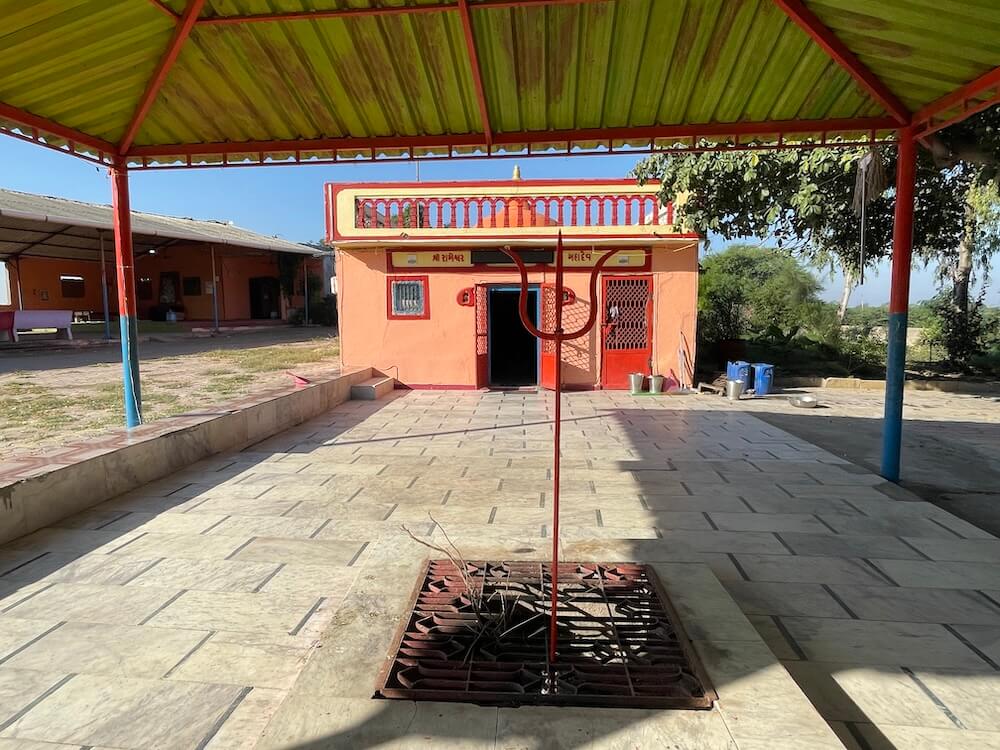
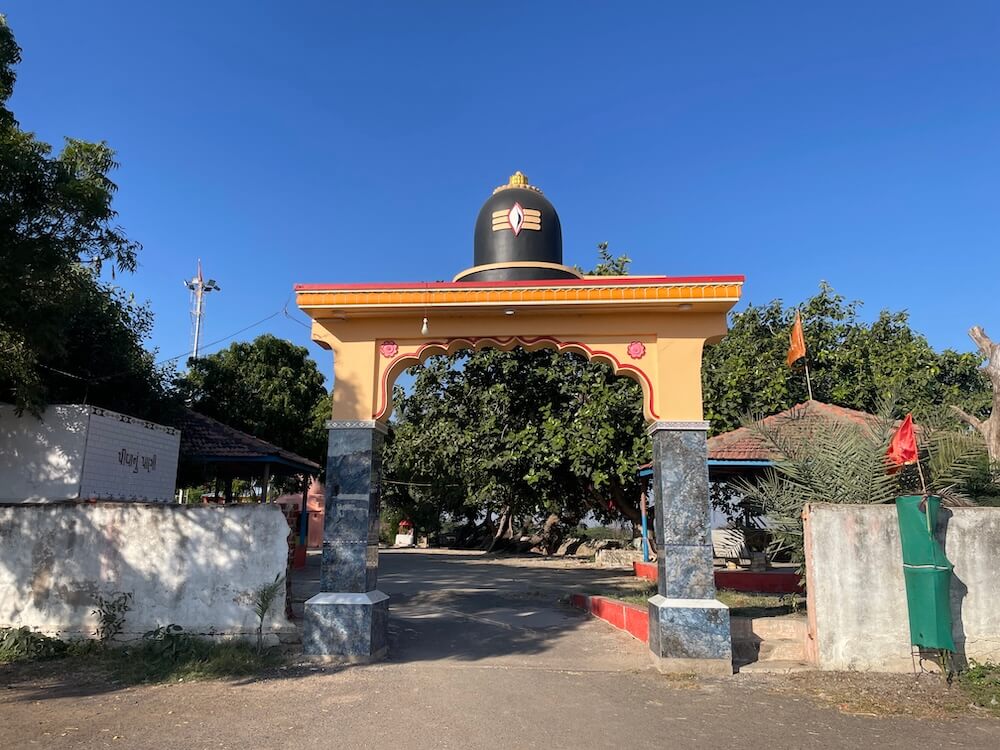
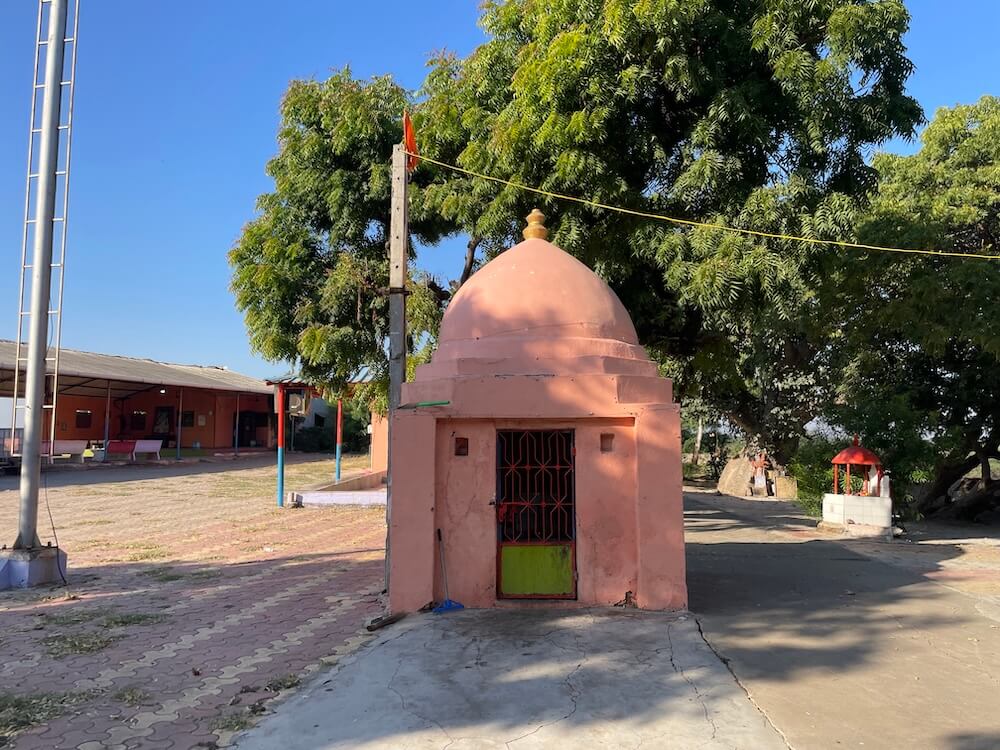
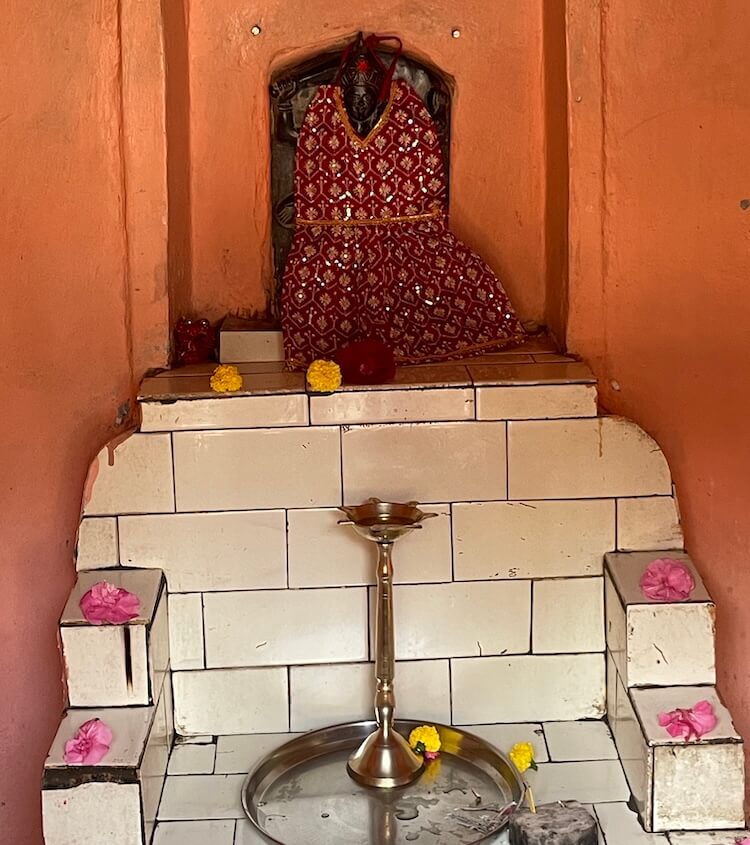
Devjagan lies about 35 kilometres from Jambusar. At a distance of five kilometres from the village, in a broad and expansive compound by the side of a large pond, stands this temple of Rameshwar Mahadev. The temple premises are enclosed by a boundary wall and there is a grand entrance gateway. Upon its upper portion, at the centre, is a Shivalinga. Throughout the courtyard, there is paving with paver blocks. As one enters through this gateway, there are two ‘yajnashalas’ (ritual halls) on either side. Directly ahead stands a small shrine of Ambamata. Within, upon a marble pedestal, the goddess is enthroned as an idol carved in black stone. To the left side of the courtyard, a long shed of tin roofing has been constructed. Various religious programmes are conducted here. At the centre of the courtyard stands the temple of Rameshwar Mahadev. In front of the temple, beneath a tin-roofed shed, is the ‘havan kund’ (sacred fire-pit).
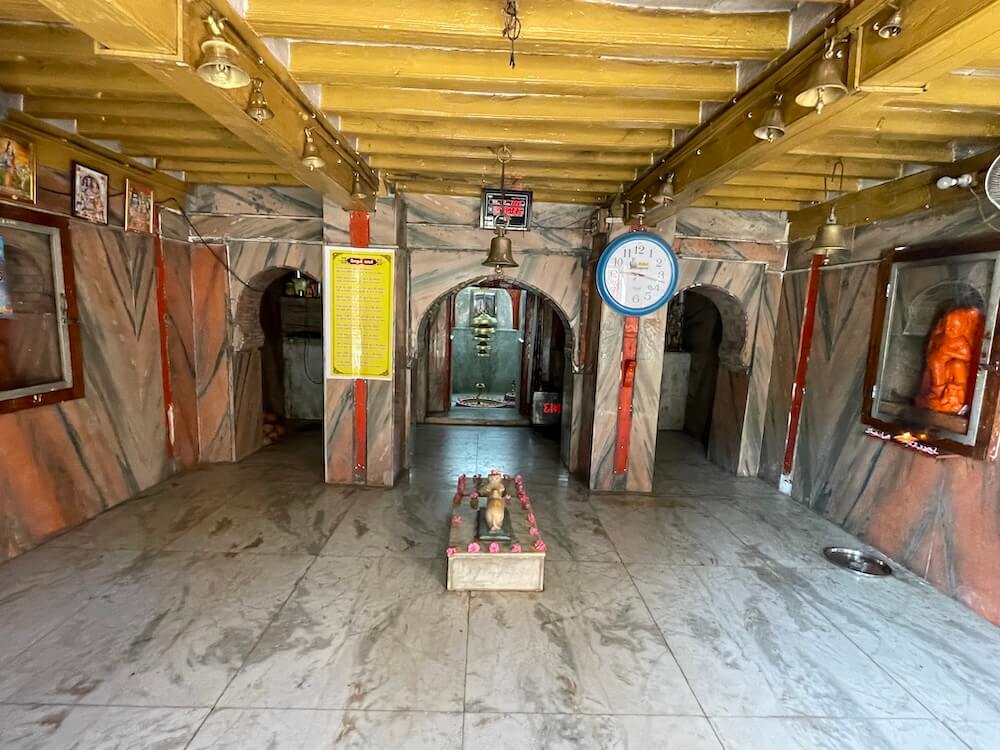
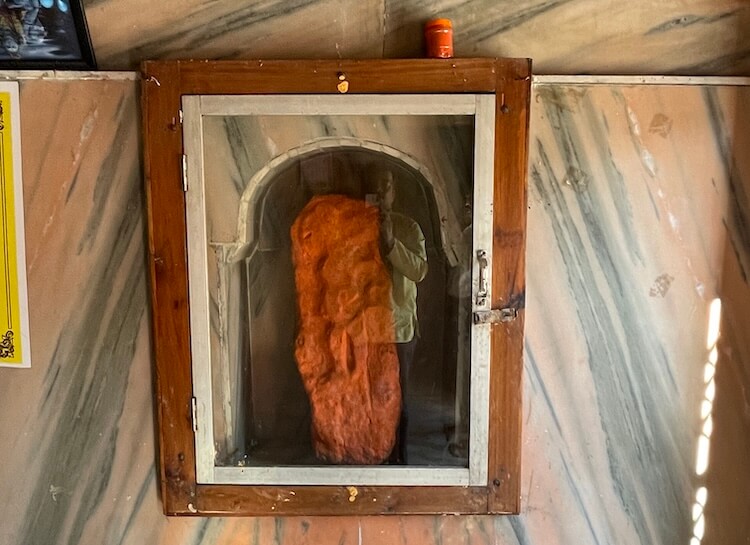
The temple, though modest in scale, is constructed in a contemporary style, following a traditional architectural plan consisting of a sabhamandap (assembly hall), antaral (vestibule), and garbhagriha (sanctum sanctorum). The sabhamandap is accessed via two doors, with its walls featuring devkoshtakas (niches for deities). The niche on the right houses an image of Hanuman alongside a stone idol of the gramdevata (village deity) anointed with shendur (vermilion), while the left niche enshrines another representation of the village deity. Before the vestibule, figures of Nandi the bull and a tortoise rest upon marble plinths. Descending two steps from the vestibule, one enters the garbhagriha. Within lies a large marble shalunka (base), at the centre of which is the stone shivalinga. Above it, a five-metal (panchdhatu) cobra spreads its hood, sheltered by a five-tiered brass chhatra (ceremonial umbrella). Adjacent to the primary shivalinga is a smaller stone counterpart, also protected by a brass serpent. A large brass samai (oil lamp) stands nearby. Within the sanctum, a large brass mukhwata (mask) of Rameshwar Mahadev is kept, which is ceremoniously placed upon the shivalinga during fairs and festivals. The rear wall of the sanctum features a niche with an idol of Parvati, while the left and right walls house idols of Ganpati and Hanuman, respectively. The sanctum is crowned by a large domed shikhara(spire), topped with an amalak (stone disk) and a kalash (finial).
Within the temple precinct stands the rukhda (baobab) tree. One meaning of the word rukhda is simply ‘tree’. The Rukhda (baobab) tree is native to Africa (Madagascar). It is a tree that can provide food, water, shelter and relief from sickness. The common Hindi name is ‘Gorakh Imli’ and it is also known as ‘Kalp Vriksh’. Many devotees regard this tree as a form of the Pandavas themselves and take its darshan. It is also told that many years ago, during a yagna held in the month of Shravan, a monkey sat through the entire ceremony until the purnahuti (final offering), refusing even prasad (consecrated food). The monkey eventually breathed its last there and its samadhi(memorial shrine) remains within the temple precincts.
The temple observes regular ritual worship, drawing many devotees from across the Jambusar Taluka. Childless couples often place a shrifal (coconut) before the shivalinga as a vow. The temple sees a surge of pilgrims every Monday and on Purnima (full moon day). Various Hindu festivals, including Mahashivratri, are celebrated with great fervour. Many pilgrims arrive for darshan (sacred viewing) during Mahashivratri and Chaitri Purnima. On the Amavasya (new moon) of the month of Shravan, a massive yatra is organised, attracting countless people from various parts of the district. During this fair, many devotees arrive carrying kavads (ornate poles with pots of holy water). The festivities include yagnas and diverse religious rites. Notably, it is said that milk from all animals, with the sole exception of camel milk, is utilised during these sacred rituals.
This sacred temple stands as a testament to deep spiritual devotion, ancient architectural grandeur, and rich local cultural traditions.
The sanctum sanctorum houses the divine idol consecrated according to ancient Vedic traditions, surrounded by serene courtyards and traditional temple architecture.
Navratri, Maha Shivratri, Annual Temple Jatra & Deepotsav
Compare and book flights, secure top-rated local hotels near the temple, hire reliable guides, and rent cars instantly.
Extend your pilgrimage by visiting other highly sacred temples located nearby.


Add ₹999 more to unlock FREE SHIPPING!
Your sacred cart is currently empty.
Shop Photo FramesFill in your delivery details below to place your order.
Add comment