
Add ₹999 more to unlock FREE SHIPPING!
Your sacred cart is currently empty.
Shop Photo FramesA Khatu Shyam temple has been recently established in the Sikandarpur area of Latur city. This magnificent temple has been built in Latur, modeled after the famous Khatu Shyam temple located in Khatu, in the Sikar district of Rajasthan. Khatu Shyam Baba is also known as ‘Baliadev’ in some regions. He is considered an avatar of Lord Shri Krishna in the Kali Yuga. Devotees hold the sentiment, “Haare Ka Sahara, Baba Shyam Hamara” (The support of the defeated, Baba Shyam is ours). Driven by this devotion, many devotees come here for Darshan.
There is a large community of followers of Khatu Shyam in Rajasthan, Gujarat, and across North India. According to mythological legends, Khatu Shyam was the grandson of the mighty Bhima from the Mahabharata and the son of Ghatotkacha. Ghatotkacha fathered this son with a demon princess named Katankata. Because his hair was curly at birth, he was named ‘Barbarika’. Another name for him was ‘Suhamad’. At the behest of Shri Krishna, Barbarika performed penance to Navadurga and attained the boon of immortality. Through rigorous penance, he also pleased Lord Shiva and received three arrows from him. With the help of these arrows, he became capable of winning any war. He had promised his mother that he would fight on the side of the weaker party in the war between the Pandavas and the Kauravas.
Lord Shri Krishna was aware of the boon Barbarika had received. Therefore, Krishna explained to Barbarika that no matter which side he fought for, the opposing side would become weak. If he fought for the Kauravas, the Pandavas would become weak and he would have to fight for them. If he fought for the Pandavas, the Kauravas would become weak and he would have to fight for them. Thus, he would end up fighting against both sides and eventually, only he would remain alive. By explaining this, Krishna dissuaded him from participating in the war. Later, Shri Krishna asked for his head as a donation. He gave that donation. Pleased by this sacrifice of Barbarika, Shri Krishna granted him the boon that in the Kali Yuga, he would be worshipped by the name ‘Shyam’, and whoever takes his name with devotion will have all their wishes fulfilled. At that time, Barbarika had also expressed a desire to witness the war between the Kauravas and Pandavas with his own eyes. To enable him to watch the war, Krishna placed his head at a high vantage point on the battlefield of Kurukshetra.
It is said that many years later, his head was discovered in a pond in the village of Khatu in present-day Rajasthan. Subsequently, the then-king of that region built a temple for him. That temple is famous as the Khatu Shyamji Temple. Many devotees come here on foot for the ‘Nishan Yatra’, carrying the colorful flag of Baba. Many Khatu Shyam temples have been built across India. A large number of Rajasthani and North Indian communities reside in Latur. Every year, many devotees from here used to travel to Khatu Dham in Rajasthan. Some devotees felt that there should be a grand Dham of Baba in their own city as well. To give shape to this concept, the ‘Shri Shyam Seva Samiti, Latur’ was established. The committee finalized this site in the Sikandarpur area on the Latur-Barshi Road for the temple. The Bhumi Pujan (groundbreaking ceremony) for this temple was performed on February 28, 2021. The intention was for the temple’s design to resemble Khatu Dham in Rajasthan. For this, expert artisans were specially called from Jaipur and Jodhpur in Rajasthan. The stones used in the temple and the carvings on them are excellent examples of Rajasthani architectural style. The main idol of Khatu Shyam has also been specially crafted in Jaipur. The construction of this temple was completed in three years, and the Pran Pratishtha (consecration) of the idol of Khatu Shyam Baba was performed on February 22, 2024.
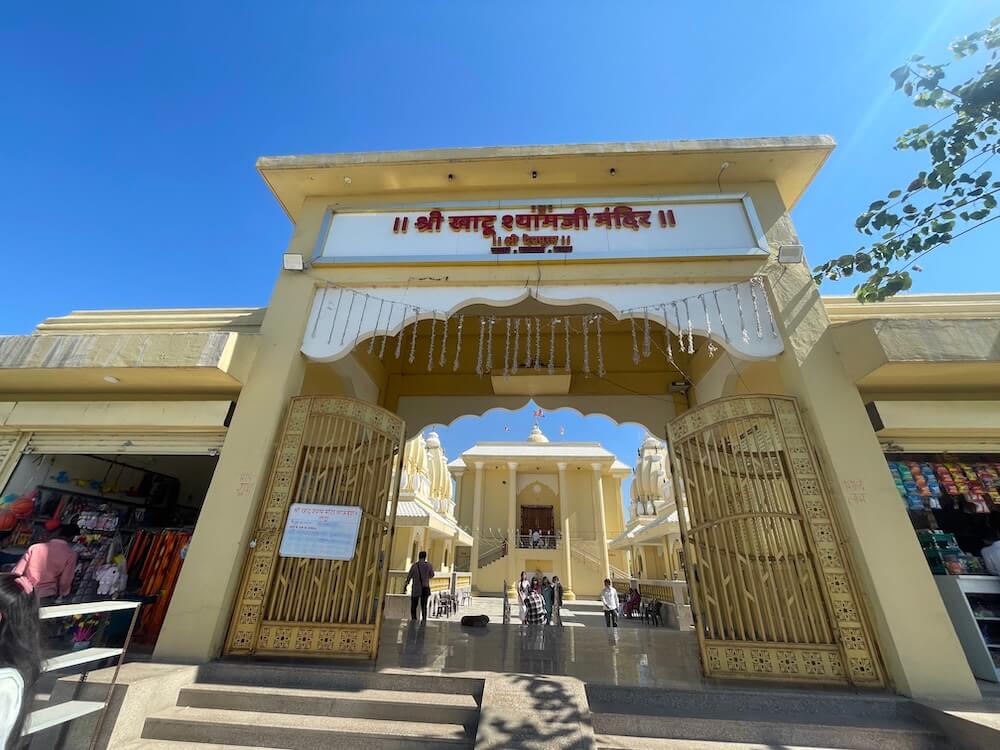
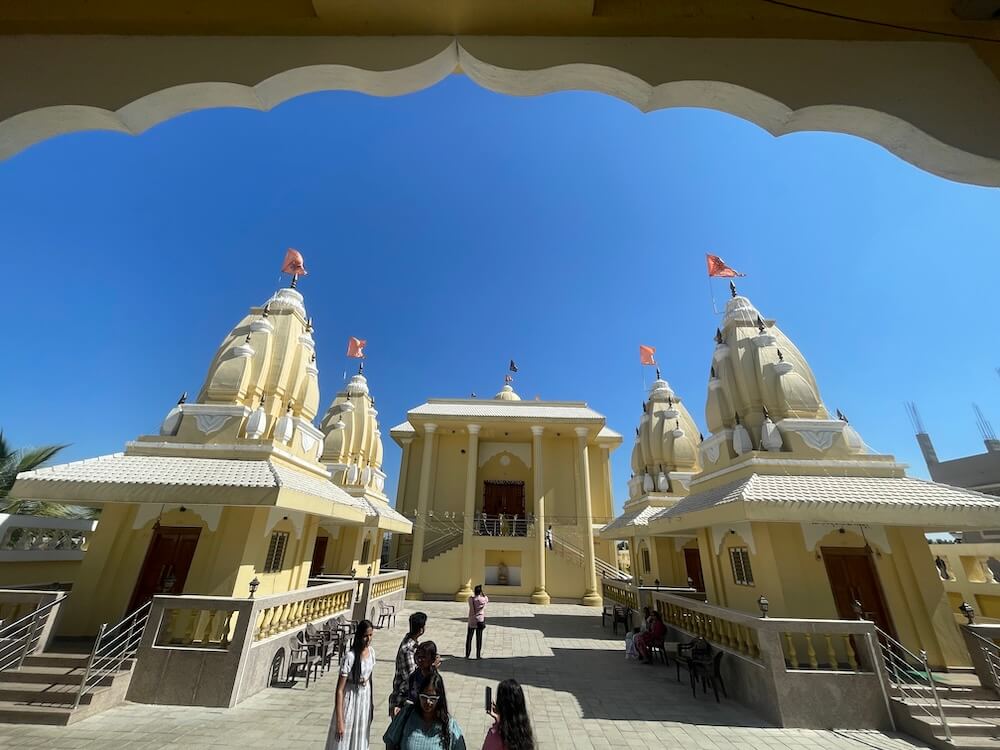
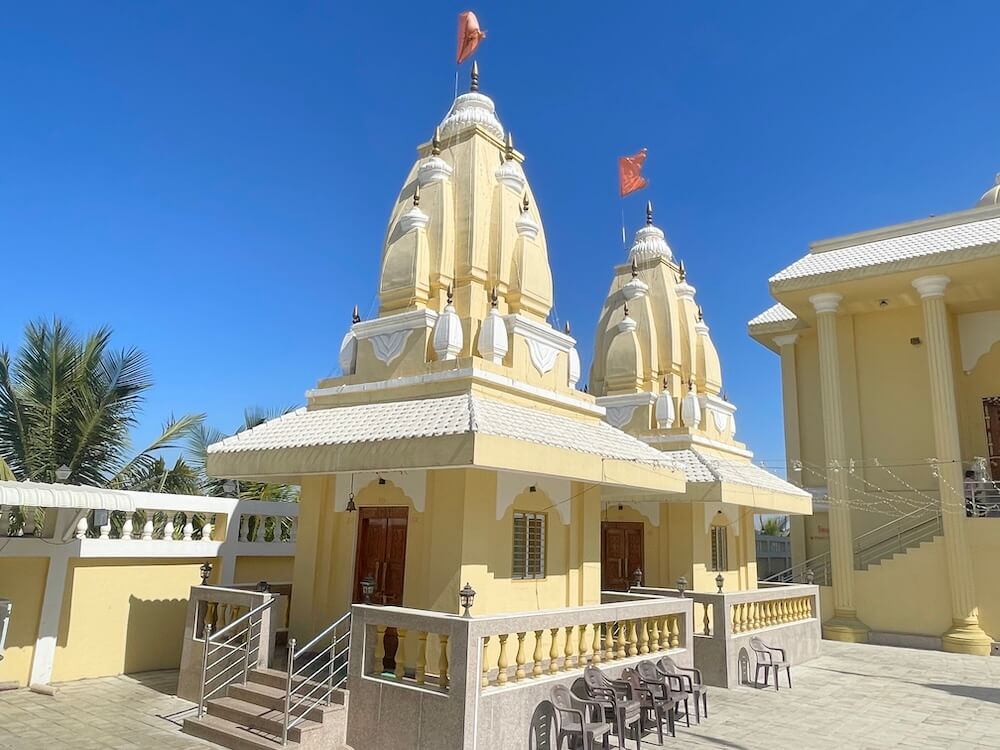
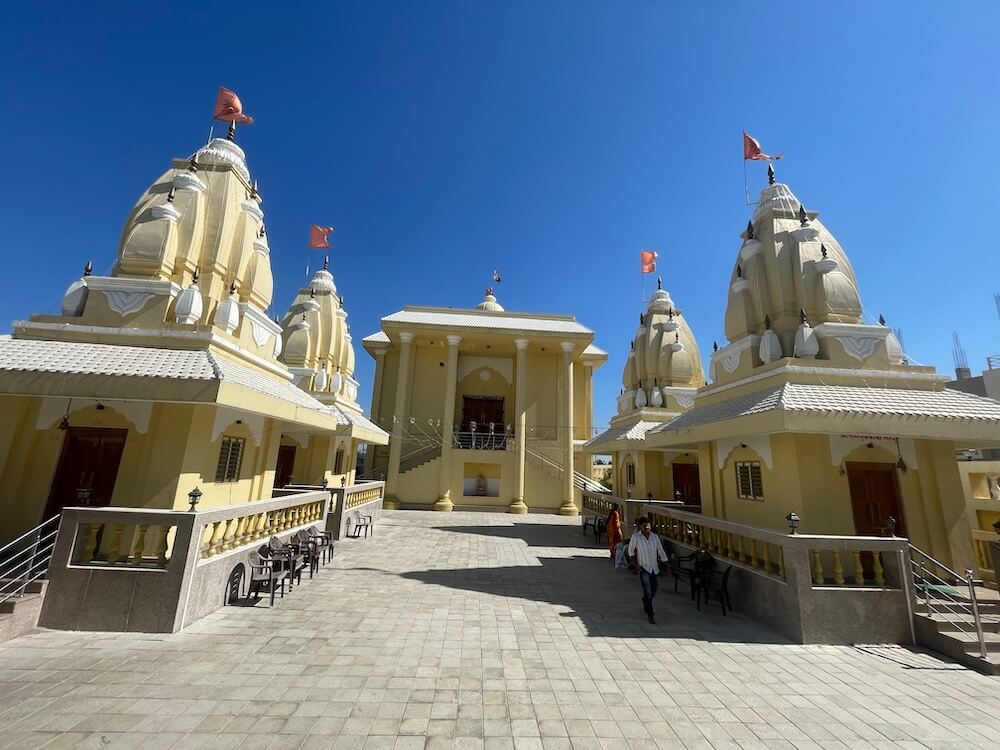
The temple has an attractive entrance gate. The main Khatu Shyam temple is situated at a height in front of the temple courtyard. There are also four sub-temples here: Ganpati, Ramdev, Shivshankar, and Vitthal-Rakhumai. All four of these temples are built in the same style. There are two stairways in the front to reach the main entrance of the Khatu Shyam temple. For devotees who cannot climb these stairs, a lift facility has also been provided.
The overall construction of the temple resembles the temple architectural style of Rajasthan. The temple is two-storied. Its facade is attractive. The tall pillars have added a unique radiance to the structure of this temple. One enters the spacious Sabha Mandap (assembly hall) through the main door. There is a small dome above the Sabha Mandap. The temple has a total of three Shikharas (spires). The middle one, which is above the main sanctum, is the tallest. The temple has a spacious Sabha Mandap. Directly in front is the large Garbhagriha (sanctum sanctorum). In the center of the main Garbhagriha, the idol of Khatu Shyam is seated. The mask of the idol has been crafted exactly like the original idol in Rajasthan. It is adorned with a crown, earrings, jewelry, and garments. To the left and right of this Garbhagriha are the shrines of Rani Sati Dadima (Narayani Devi) and Salasar Balaji (Hanumanji). It is said that these idols were specially crafted in Jaipur and brought here.
Aarti is performed five times a day in the temple. Devotees can visit the temple from 6:00 AM to 12:00 PM and from 5:00 PM to 9:00 PM. Special prayers and Bhajan Sandhya are organized here on the Ekadashi of the Shukla Paksha every month. Dev Uthani Ekadashi is celebrated with great enthusiasm. Krishna Janmashtami is celebrated here on a large scale. A fair is held at this temple on the Shukla Ekadashi and Dwadashi of the Phalguna month. A massive crowd of devotees gathers for this. Devotees from Latur, Dharashiv, Beed, and the Karnataka border also arrive in large numbers. During this festival, a grand procession (Nishan Yatra) of Khatu Shyam Baba is taken out. For out-of-town devotees, there are Bhakta Niwas (pilgrim accommodation) and Prasad facilities available on the temple premises.
This sacred temple stands as a testament to deep spiritual devotion, ancient architectural grandeur, and rich local cultural traditions.
The sanctum sanctorum houses the divine idol consecrated according to ancient Vedic traditions, surrounded by serene courtyards and traditional temple architecture.


Navratri, Maha Shivratri, Annual Temple Jatra & Deepotsav
Compare and book flights, secure top-rated local hotels near the temple, hire reliable guides, and rent cars instantly.
Extend your pilgrimage by visiting other highly sacred temples located nearby.


Add ₹999 more to unlock FREE SHIPPING!
Your sacred cart is currently empty.
Shop Photo FramesFill in your delivery details below to place your order.
Add comment