
Add ₹999 more to unlock FREE SHIPPING!
Your sacred cart is currently empty.
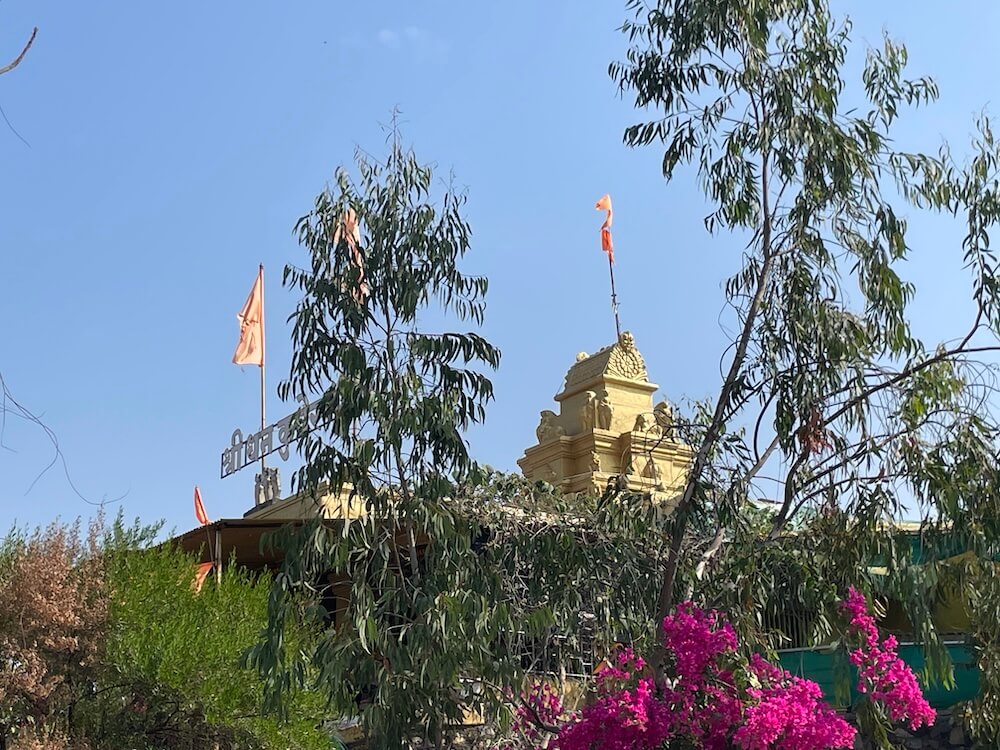
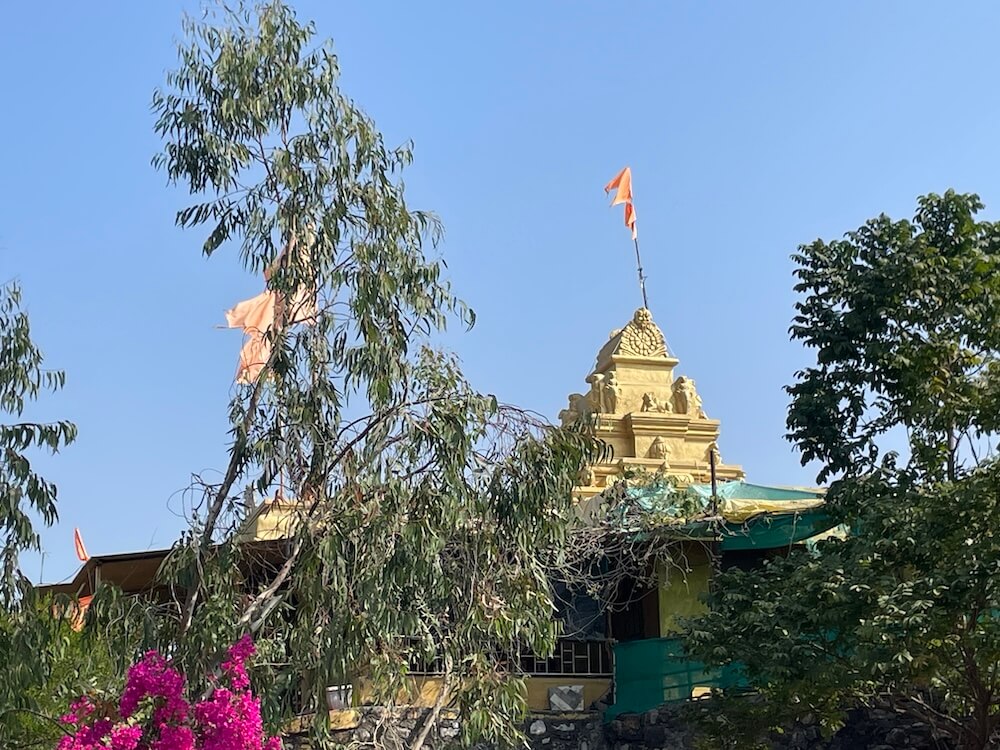
Shop Photo FramesThe sacred land of Vidarbha has been purified by the presence of saints and the abodes of various deities. Located on the Khamgaon-Shegaon route in the Buldhana district of this very land, the Shri Dhankuber Temple has become a major center of faith for devotees. Temples dedicated to Kuber, regarded as the deity of wealth and the lord of the northern direction among the Ashtadikpalas (eight directional guardians), are extremely rare across the country. Being one such rare site, this temple was established in 1999 under the inspiration of Mahamandaleshwar Suresh Nageshwar alias Indradev Maharaj of ’13 Bhai Khalsa Naga Akhada’ (Haridwar). Known as Ayyajidham, this temple complex offers darshan of Lord Balaji and Mata Mahalaxmi along with the idol of Lord Kuber.
In Indian culture, Lakshmi is considered the mother of prosperity, while Kuber is known as the guardian and manager of that wealth. Kuber, one of the Ashtadikpalas in Hinduism, is not only the deity of wealth but is also regarded as the king of Yakshas, Rakshasas, and Guhyakas. References to the origin of Kuber are found in the Vishnu Purana and Srimad Bhagavata Purana. He is the grandson of Lord Brahma and the son of Sage Vishrava. Being the son of Sage Vishrava and Idavida, he is also called Aidavida. Relation-wise, he is the stepbrother of Ravana, the king of Lanka, Kumbhakarna, and Vibhishana. Like his father, Kuber undertook severe penance to propitiate Lord Brahma. Pleased with his divine devotion, Lord Brahma bestowed upon him the title of ‘Lokpal’ and entrusted him with the sovereignty over all the wealth in the world. At this time, Lord Brahma also gifted him the Pushpaka Vimana. According to the Valmiki Ramayana, Ravana later forcibly snatched this vimana from Kuber.
Kuber also shares a very close bond with Lord Shiva. According to the Shiva Purana, Kuber performed long penance in Kashi to please Mahadev. Pleased by his unswerving devotion, Mahadev embraced Kuber as a dear friend and blessed him to be the Lord of Wealth (Dhanapati). Kuber is believed to reside in the city of Alakapuri, located near Mount Kailash in the Himalayas. In iconography, Kuber’s form is described somewhat differently; he is depicted as short with a large belly. Since one of his eyes is brownish in color, he is also called Pingaksha. When Lord Rama returned to Ayodhya after slaying Ravana, he too emphasized the righteous management of wealth, the roots of which lie in Kuber’s philosophy.
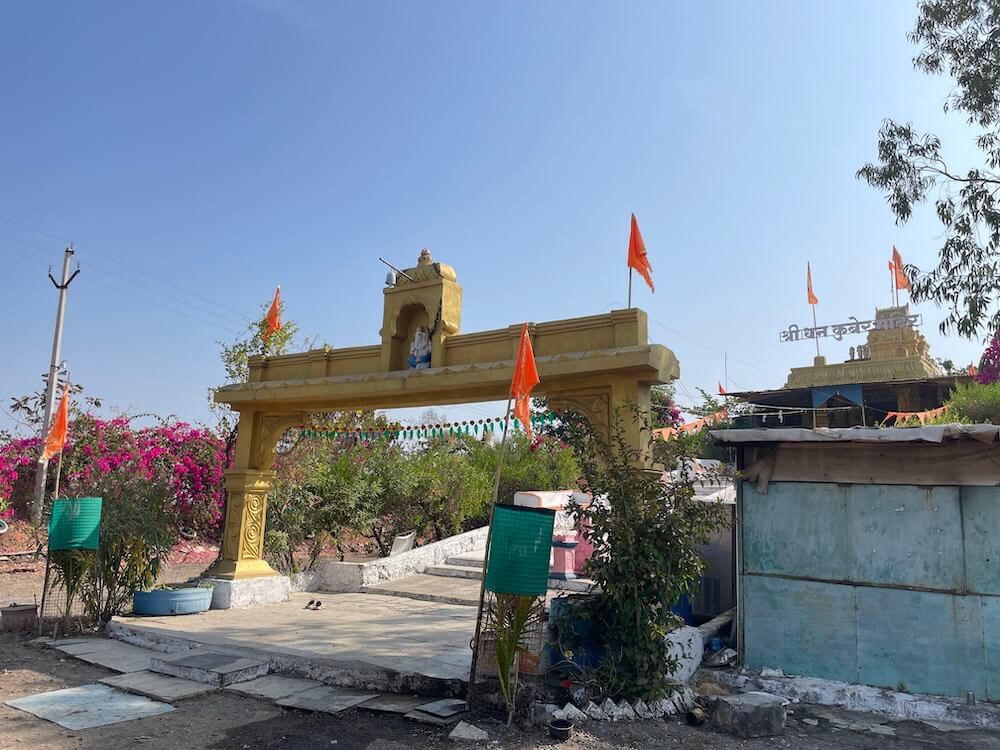
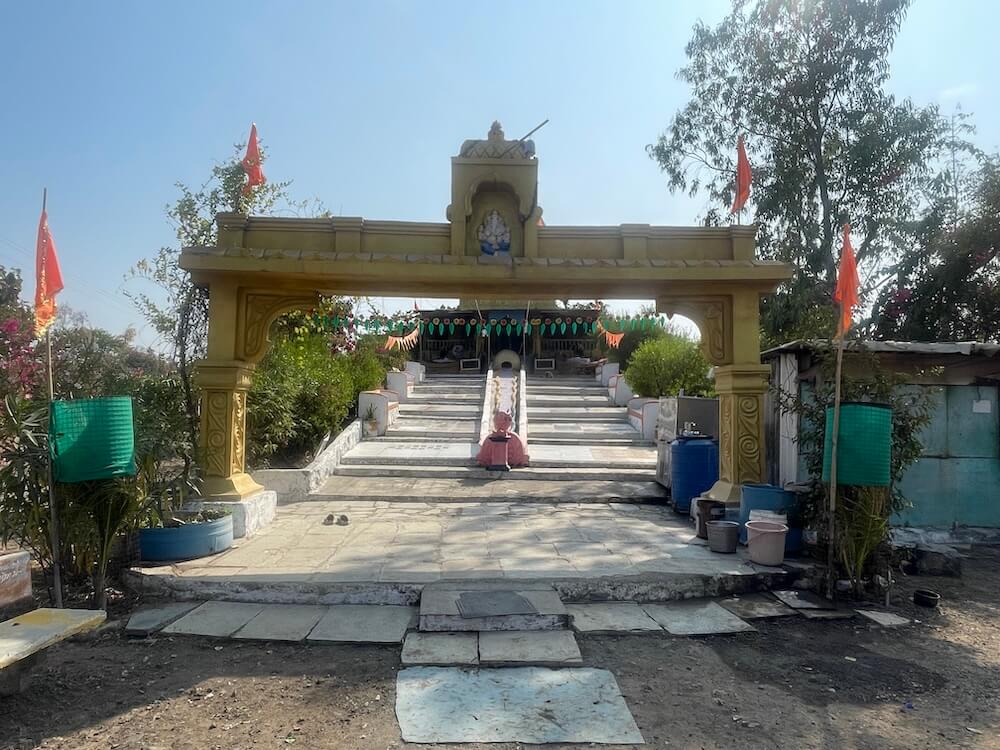
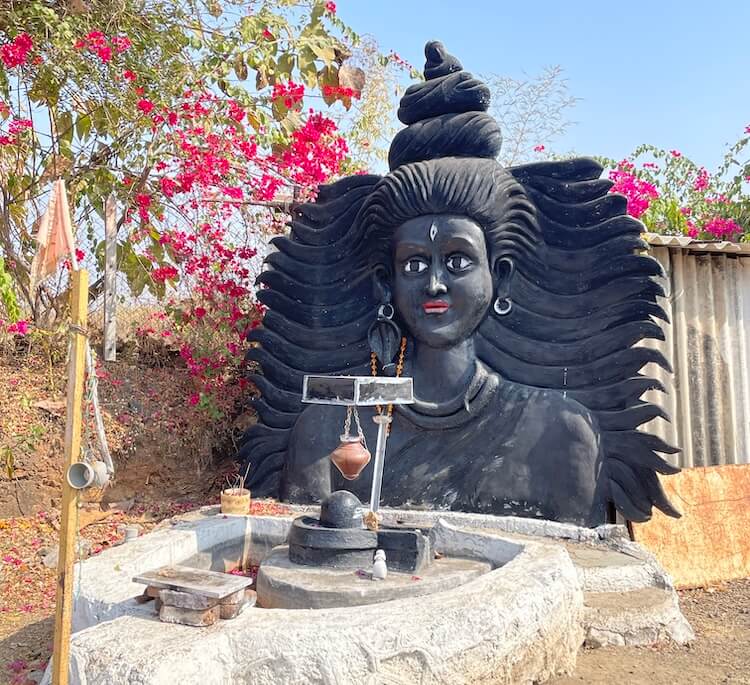
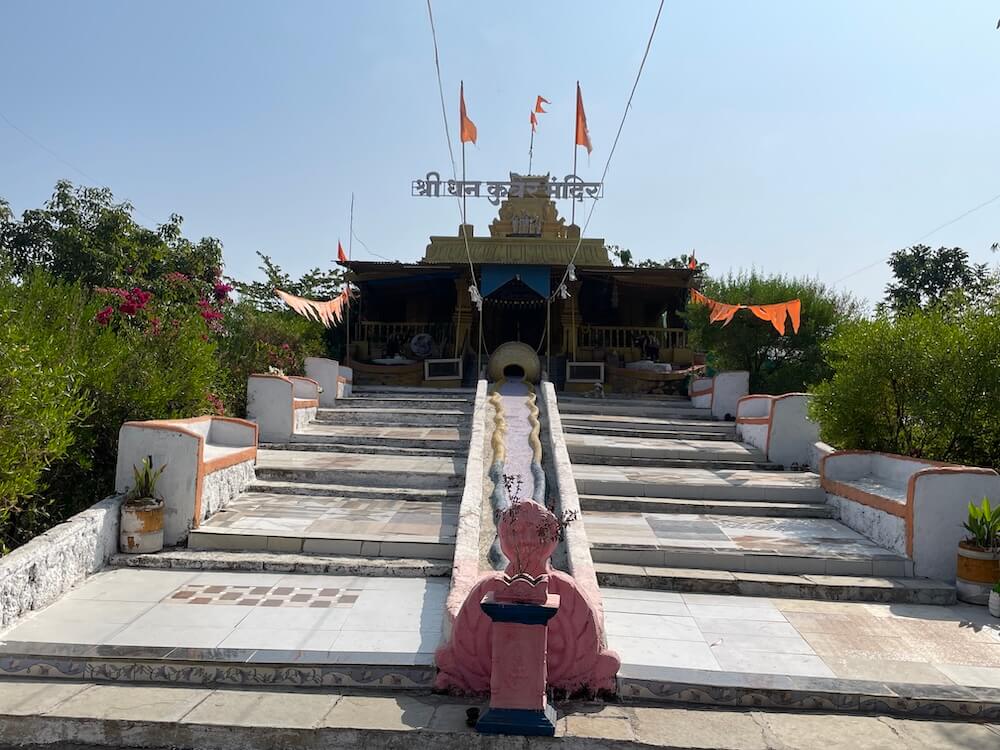
Located about six kilometers from Khamgaon city, along the Shegaon Road, the grand archway of this temple catches one’s attention. Spread across an area of about seven acres, as one enters this Ayyajidham temple complex, a small lake comes into view. At the start of the temple courtyard stands a small shrine dedicated to Veer Mahabali Hanuman. Beyond that is a grand replica of Lord Shiva’s idol, and a Shivling is consecrated in the pool (kund) in front of it. A beautiful sculpture of Lord Ganesha is carved at the main entrance of the temple. As one climbs the steps, seating arrangements for devotees are provided on both sides. In the middle of the staircase, a scene depicting a shower of wealth pouring from a large pot (kumbh) above serves as a major attraction for visitors.
The temple follows a traditional architectural design, comprising a Sabhamandap (assembly hall) and a Garbhagriha (sanctum sanctorum). Inside the sanctum sanctorum, a seated idol of Lord Kuber is enshrined on a large pedestal. The right hand of this idol is in the blessing posture (ashirwad mudra), while the left hand holds a pot of wealth (Dhanakalash). To the left of Lord Kuber is the idol of Lord Balaji, and to his right is the idol of Goddess Mahalaxmi. All three idols are seated upon lotus flowers. The spire (shikhara) of the temple features sculptures of rams (Mesh) and elephants (Gajaraj), with statues of Lord Rama, Lakshmana, Sita, and Hanuman carved beneath them.
Due to the belief that having darshan of Lord Kuber on Amavasya (new moon day) fulfills wishes, many devotees visit here for darshan on this tithi. On this day, some devotees also offer Annadana (food donation). On every Amavasya, Maha Aarti is performed at this temple, followed by the distribution of Mahaprasad. Various religious events are also held here on Shani Amavasya and Somvati Amavasya. During Deepavali, events such as Dhankuber Kalash Puja, Shiva Puja, Kuber Yajna, Yamadeepdan, Vaman Puja, Chandra Puja, etc., are organized here. On the occasion of the temple’s anniversary celebration held every year on March 1, Hawan, Pravachan, Kirtan, and Mahaprasad are organized. Every year after Ganeshotsav, the temple trust collects Ganesha idols ranging from five to fifteen feet in height. These idols are preserved in the complex throughout the year and are given free of cost to interested mandals the following year. The trust also organizes matrimonial meets for prospective brides and grooms in the premises from time to time.
This sacred temple stands as a testament to deep spiritual devotion, ancient architectural grandeur, and rich local cultural traditions.
The sanctum sanctorum houses the divine idol consecrated according to ancient Vedic traditions, surrounded by serene courtyards and traditional temple architecture.
Navratri, Maha Shivratri, Annual Temple Jatra & Deepotsav
Compare and book flights, secure top-rated local hotels near the temple, hire reliable guides, and rent cars instantly.
Extend your pilgrimage by visiting other highly sacred temples located nearby.


Add ₹999 more to unlock FREE SHIPPING!
Your sacred cart is currently empty.
Shop Photo FramesFill in your delivery details below to place your order.
Add comment