
Add ₹999 more to unlock FREE SHIPPING!
Your sacred cart is currently empty.
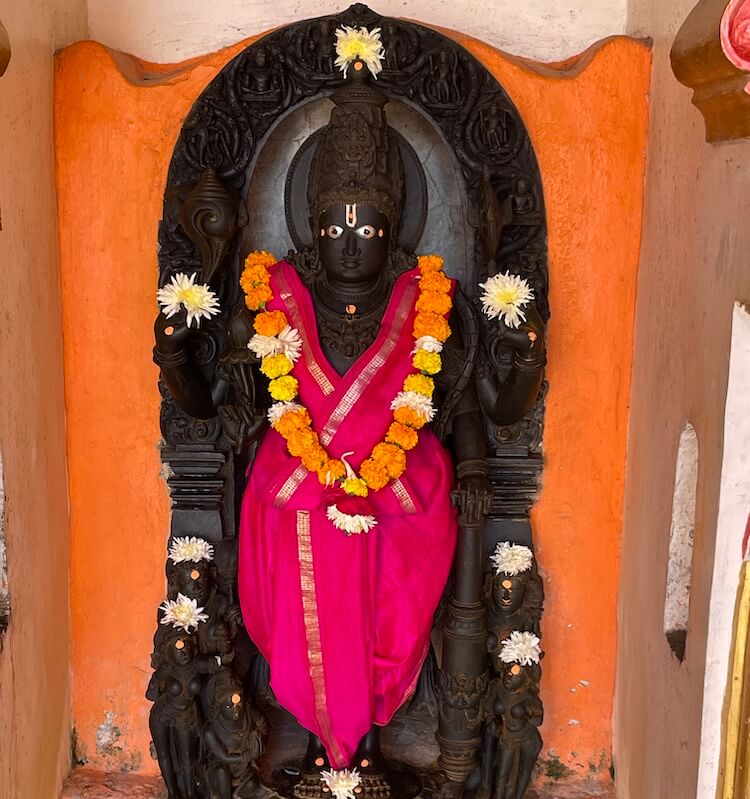
Shop Photo FramesBuldhana district is considered historically significant. This region has witnessed numerous political and cultural transitions during the eras of the Satavahanas, Vakatakas, Rashtrakutas, Yadavas, and subsequently the Mughal and Maratha empires. In ancient times, the village of Mehkar was known as Meghankar Nagari. Situated on the banks of the Painganga River, this village is mentioned in ancient scriptures such as the Skanda Purana, Padma Purana, and Matsya Purana. The Sharangdhar Balaji Temple located in this city is a place of faith for millions of devotees. It is said to be one of the rare temples in the country that houses a combined idol of Shri Vishnu and Shri Lakshmi. The idol, carved from Gandaki stone, is considered a marvel of sculpture.
The legend regarding this temple states that where the city of Mehkar stands today, there was once a dense forest that was part of the Dandakaranya. On the holy banks of the Painganga River here, many sages and seers lived in their hermitages, performing penance and sacrificial rites. It is believed that Lord Brahma himself created the Painganga River from his ‘Pranita Patra’ during a great sacrifice. Therefore, this river and the surrounding area were considered extremely sacred. However, this holy atmosphere was overshadowed by a cruel demon named Meghankar. This demon constantly created obstacles in the sacrifices of the sages, desecrated the sacrificial altars, and often killed and devoured the ascetic sages.
Distressed by his atrocities, the sages sought the mercy of Lord Vishnu. Accordingly, Lord Vishnu came here to protect his devotees. A fierce battle took place here between Lord Vishnu and the demon Meghankar. To counter the demon’s illusory powers, the Lord showered arrows from his bow, which led to the end of Meghankar. In this battle, Vishnu held the Sharang bow, hence this form of Vishnu here came to be known as Sharangdhar. After this victory, the sages requested Lord Vishnu to reside there permanently for the protection of his devotees. Accordingly, Lord Vishnu became established here in his four-armed form. Although the bow is not visible in the hands of the idol here, there is an engraved image of Vishnu holding a bow on the crown and the aureole.
The city of Mehkar was previously surrounded by a fortification. Some parts of the northern side of this fortification still remain. Upon entering through the gateway here, there was a fort-like citadel on an elevation. This citadel was previously under mounds of earth, and half of it was owned by the Deshmukh Patil and Bhise Patil families of the village. During the excavation for the construction of a school on the land owned by Rambhau Bhise Patil, the Sharangdhar idol was discovered underground on Margashirsha Shuddha Panchami, December 7, 1888. During the excavation, a basement built of stone and bricks was found. In this basement, the magnificent idol, 3.4 meters in height, was kept in a horizontal position inside a wooden box. Along with the idol, small idols of Garuda, Keshavraj, and Balaji, as well as idols of Ganesha and Tulja Bhavani, along with some copper plates, inscriptions, and valuable items, were found in the box. Upon hearing the news of the discovery of this idol, British officials issued an order to confiscate it. The then British Deputy Collector, Sir Richard Temple, took possession of the copper plates, inscriptions, and valuable items and sent them to the British Museum in London. He also intended to send the idol of Sharangdhar to London. However, upon getting wind of this, the villagers immediately decided to perform the consecration of the idol. Subsequently, prominent individuals of the village such as Janakiram Appa Pathak, Rambhau Thite Patil, and Annasaheb Deshmukh, with the help of the villagers, performed the consecration of the idol at four o’clock in the morning. Angered by this, the British officials imprisoned more than 60 villagers. Janakiram Pathak and two others had to serve six months in prison, while Rambhau Thite Patil lost his position as Police Patil.
Thereafter, the villagers purchased the properties in the area where the idol was found or received them as donations to clear the surroundings. Subsequently, public contributions were collected from the village and the surrounding areas. The magnificent temple structure was built from the materials donated by many. It is mentioned in the government gazette that the construction of this temple cost one and a half lakh rupees around the year 1888.
This temple was built using white stones and dressed stones found in the temple premises. The stones used for the temple were carved and shaped by stone-cutters from the Lonar area. The teak wood required for the temple construction was brought from the Chandrapur area. Skilled craftsmen and masons were brought from the Solapur area to ensure the temple construction was excellent. It took about 25 years, from 1888 to 1913, for the temple construction to be completed. In 1913, the idol was re-consecrated in this temple by Pralhadbuva Girolikar Shastri.
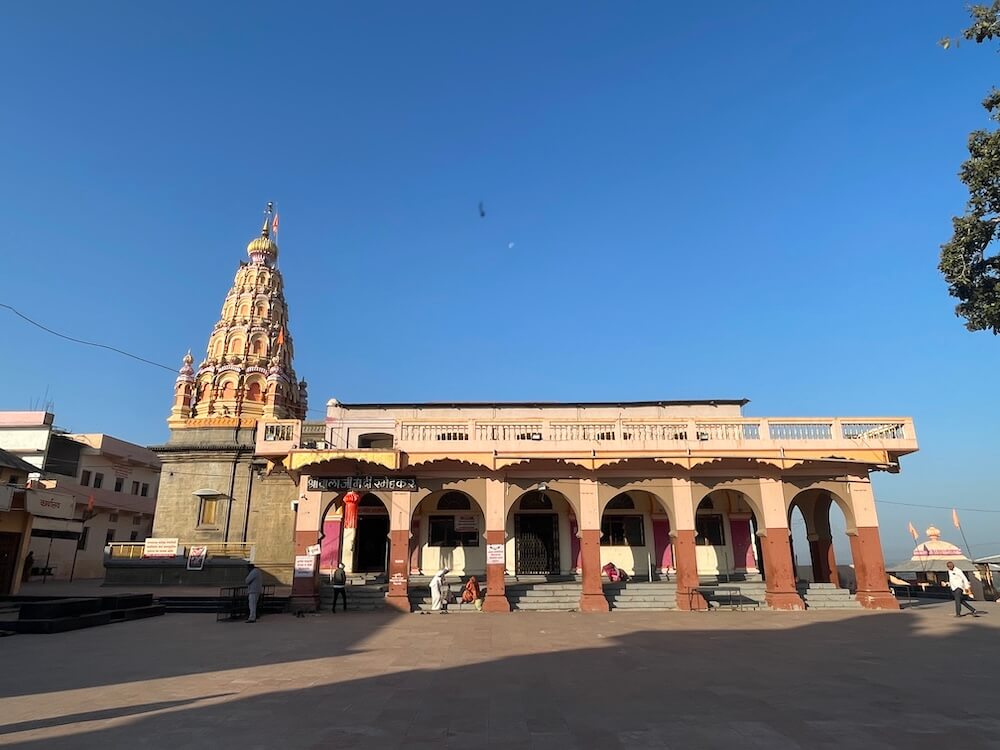
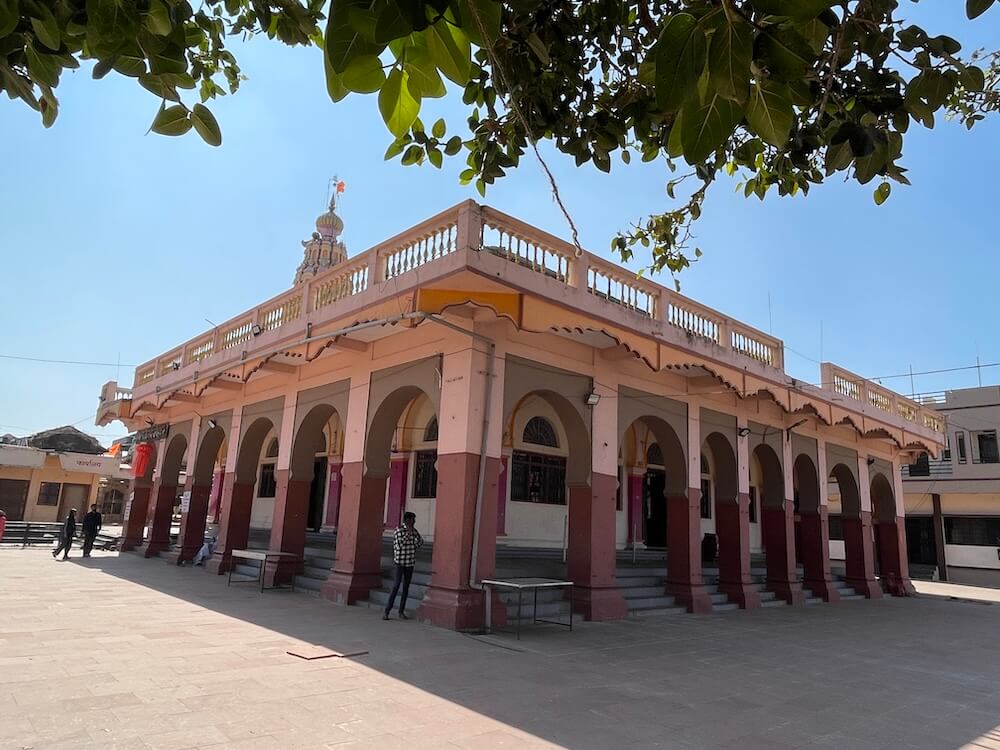
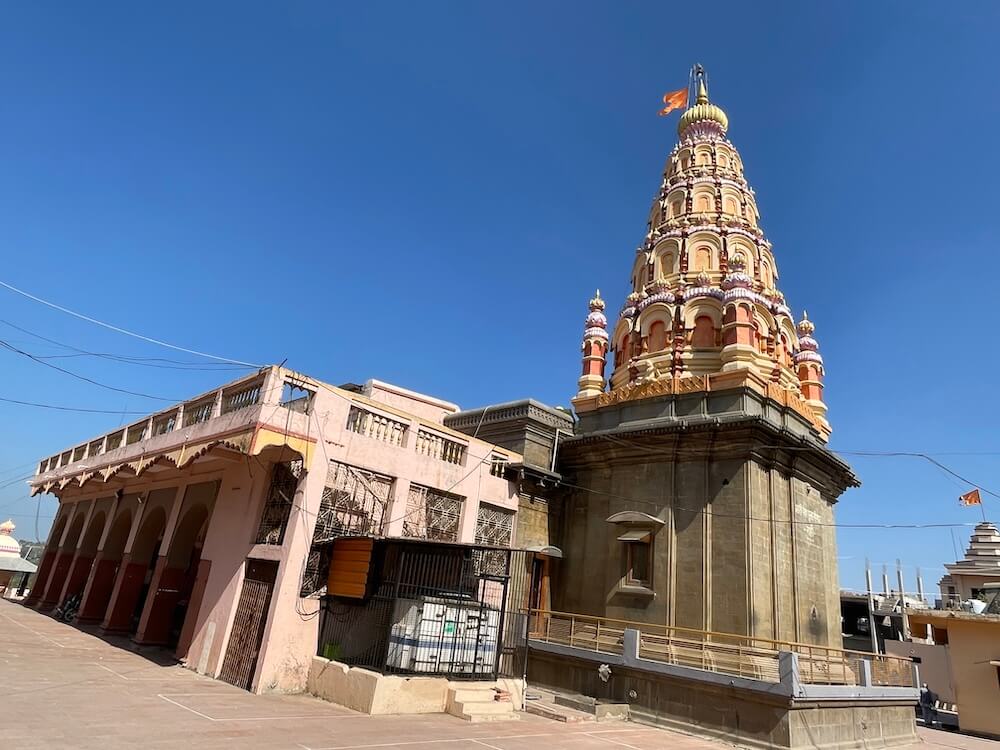
There is a vast courtyard on all four sides of this temple. A bastion and a wall are built on the eastern side. In the middle of this wall is a stone main gate with intricate carvings. This main gate was built between 1890 and 1900. A few steps from here is another main gate. There are balconies on this main gate from east to west. In the early days, it was used as a Nagarkhana (drum house). In the grand courtyard, the beautiful structure of the temple stands right in front. The structure of this temple consists of an open Mandap, a Sabha Mandap, an Antaral, and a Garbhagriha. One enters the Mandap by climbing five steps from the courtyard. From this Mandap, one can enter the enclosed Sabha Mandap. There are wooden pillars in this Sabha Mandap. There are corridors on three sides of the Sabha Mandap on these pillars. The ceiling here also has exquisite carvings. One enters the open Antaral by climbing three steps from the Sabha Mandap. From this Antaral, one can have the darshan of the Balaji idol in the Garbhagriha.
The idol of Sharangdhar Balaji is enshrined on the Vajrapitha in the sanctum sanctorum. This idol is 3.4 meters tall, 0.75 meters thick, and 1.2 meters wide. Standing in the Samacharan posture, the idol features an elongated crown on its head. At the base of this crown is a Kirtimukha, and in the central space, an image of Lord Vishnu holding the ‘Sharang’ bow is carved. In the lower right hand of the main idol is a lotus, and in the upper right hand is a mace. The upper left hand holds a discus (Chakra), and the lower left hand holds a conch (Shankha). The Prabhavali (halo) features carvings of the Dashavatara, including the Matsya, Kurma, Varaha, Narasimha, and Vamana avatars. In the niche above them, Lord Brahma with three faces is depicted alongside a swan. In the niche on the upper left side, Lord Shiva is depicted with Nandi. Following this, the Parashurama, Rama, Balarama, and Kalki avatars are carved. The hair of the idol falls in a fringe from beneath the crown. The eyebrows of the idol are arched like a bow, and the nose is sharp. On the chest of the idol, the Bhrigulanchhana (a mythological mark representing the footprint left by Sage Bhrigu on Lord Vishnu’s chest) is imprinted. This three-dimensional idol is adorned with an Ekavali, Phalakahar, and Pralambahar necklace. It also features Skandapatra on the shoulders, Keyura on the arms, and Udarabandha, Katishutra, Padangada, and Padapatra. To the left of the Balaji idol is Shri Lakshmi, whose gaze is directed toward the feet of Sharangdhar. In front, the idols of Lord Vishnu’s gatekeepers, Jaya and Vijaya, are carved. On the right side, Bhulakshmi is seated.
To the right of the idol is another idol carved in black stone, measuring 83 by 53 centimeters in height and width. The Sharangdhar idol and this idol are similar in terms of sculptural characteristics, leading to the belief that both were crafted by the same artisan. While in Vrindavan the chant is ‘Vrindavan Bihari Lal Ki Jai’ and in Tirupati it is ‘Govinda Govinda’, in Mehkar the chant is ‘Lakshmiraman Sharangdhar Govinda Govinda’.
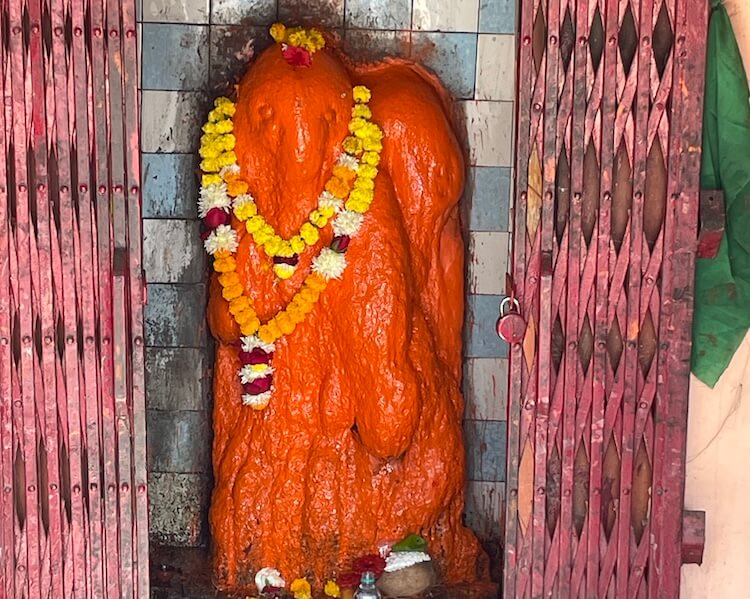
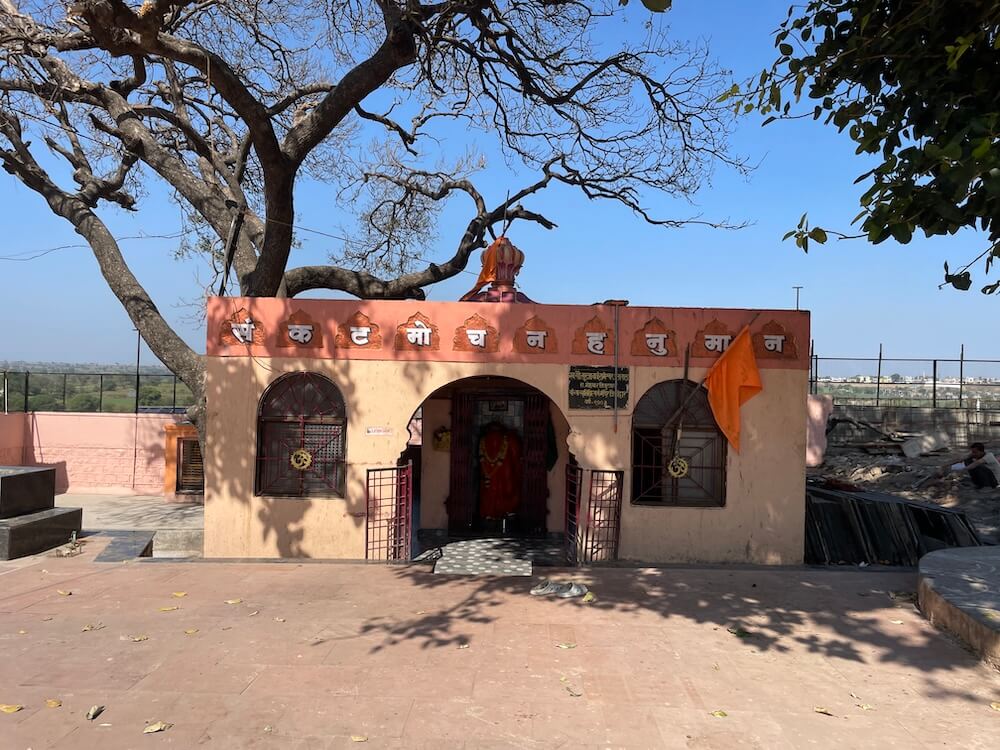
Directly in front of this temple is the temple of Garuda Deva. This idol was found at the exact spot where the idol of Sharangdhar was discovered in the ground. Carved from black Gandaki stone, this idol is not in bird form but in human form. Additionally, the temple premises house temples dedicated to Shri Siddha Ganesh, Tulja Bhavani, Jagadamba Mata, and Sankatmochan Hanuman. To the right of the Ganesh temple is the Keshavraj temple. Keshavraj is considered the elder brother of Balaji. The idol of Keshavraj is also carved from black Gandaki stone.
The temple premises include a Prasadalaya, where food is served daily from 11.30 AM to 2.30 PM. A Bhaktanivas has also been built in the area to provide accommodation for devotees arriving from afar. The Painganga (Pranita) river flows near this temple. Since it flows from the north to the south and then turns westward, it is considered as sacred as the Ganga.
This temple is open for Darshan daily from 5.30 AM to 9.30 PM. Festivals such as Gudi Padwa, Ram Navami, Hanuman Jayanti, Gokulashtami, Ganeshotsav, and Vijayadashami are celebrated here. During the month of Shravan, the Vishnu Sahasranama is chanted and the Ganesha Atharvashirsha is recited throughout the month. The Balaji Navaratri festival takes place in the month of Ashwin. On the day of Vijayadashami, the Utsava Murti (processional idol) of the temple is taken out for Simollanghan in a palanquin procession. The Kurvandi festival is celebrated on Tripurari Purnima, during which the temple is decorated with oil lamps. The idol of Sharangdhar was discovered on the day of Margashirsha Shuddha Panchami, which is why the Sharangdhar Prakatdin is celebrated here on this day. A grand ten-day festival is held from Nag-Diwali, i.e., Margashirsha Shuddha Panchami to Purnima. During this period, the idol is adorned with different costumes and ornaments according to the day.
This sacred temple stands as a testament to deep spiritual devotion, ancient architectural grandeur, and rich local cultural traditions.
The sanctum sanctorum houses the divine idol consecrated according to ancient Vedic traditions, surrounded by serene courtyards and traditional temple architecture.
Navratri, Maha Shivratri, Annual Temple Jatra & Deepotsav
Compare and book flights, secure top-rated local hotels near the temple, hire reliable guides, and rent cars instantly.
Extend your pilgrimage by visiting other highly sacred temples located nearby.


Add ₹999 more to unlock FREE SHIPPING!
Your sacred cart is currently empty.
Shop Photo FramesFill in your delivery details below to place your order.
Add comment