
Add ₹999 more to unlock FREE SHIPPING!
Your sacred cart is currently empty.
Shop Photo FramesThe city of Ambajogai in Beed district is considered the cultural identity of Marathwada. Legend has it that the Goddess Jogeshwari, originally from Konkan, came here to marry Vaijanath of Parli and chose to rest in this very soil. For this reason, Ambajogai is considered the maternal home (maher) of the Goddess. The Jogeshwari Devi temple in Ambajogai is believed to be the original Shaktipeeth. Many sub-shrines (upapithas) of this Goddess are found in villages across Marathwada. One such ancient temple among these sub-shrines is located in Pargaon, in the Ashti taluka. This temple is also recognized as a sacred site of the Mahanubhava sect.
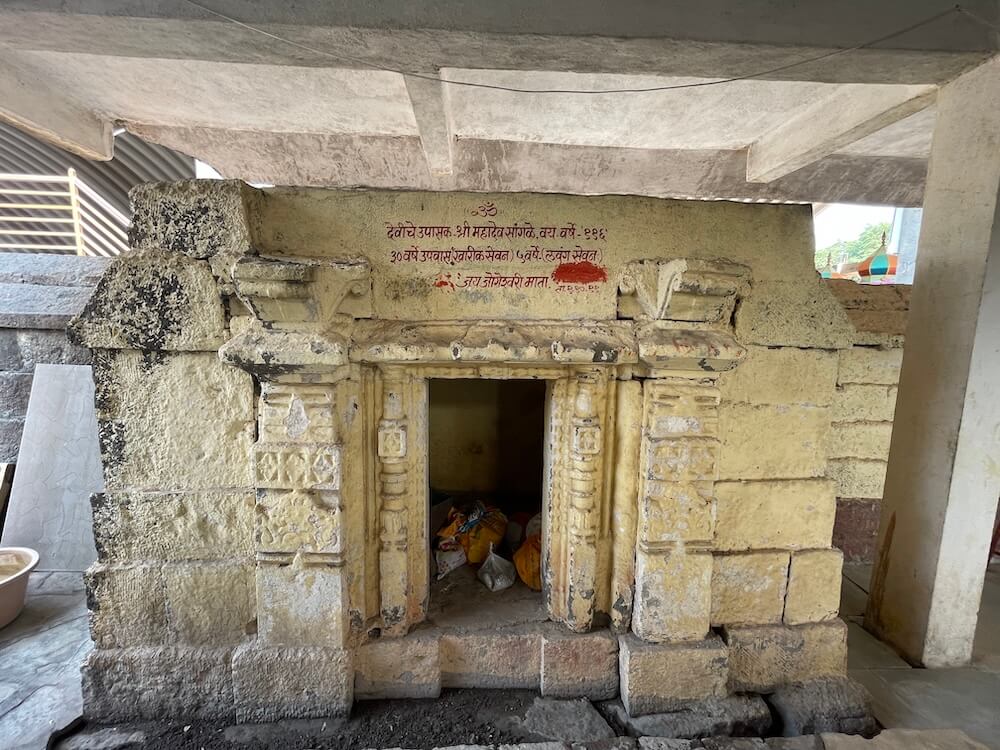
Local villagers state that this temple, built of stone in the Hemadpanti architectural style, dates back to approximately the eleventh century. References in Mahanubhava texts mention that Chakradhar Swami was a devotee of this Goddess and used to visit this temple for darshan. According to historians, the temple was likely renovated about five hundred years ago. Although the exact period of the temple is not yet clear, it is widely accepted that the temple belongs to ancient times. The legend regarding this temple is that in the middle of the night, the Jogeshwari Devi of Ambajogai set out to meet her brother, Bhairoba of Wai. As she reached the outskirts of this village, the wheel of the Goddess’s chariot broke. The villagers requested the Goddess to rest in the village until the chariot was repaired. However, the broken chariot could not be fixed before sunrise, and thus, the Goddess became established here. The ‘Gadamodi’ temple, marking the spot where the chariot wheel broke at the village outskirts, still exists today.
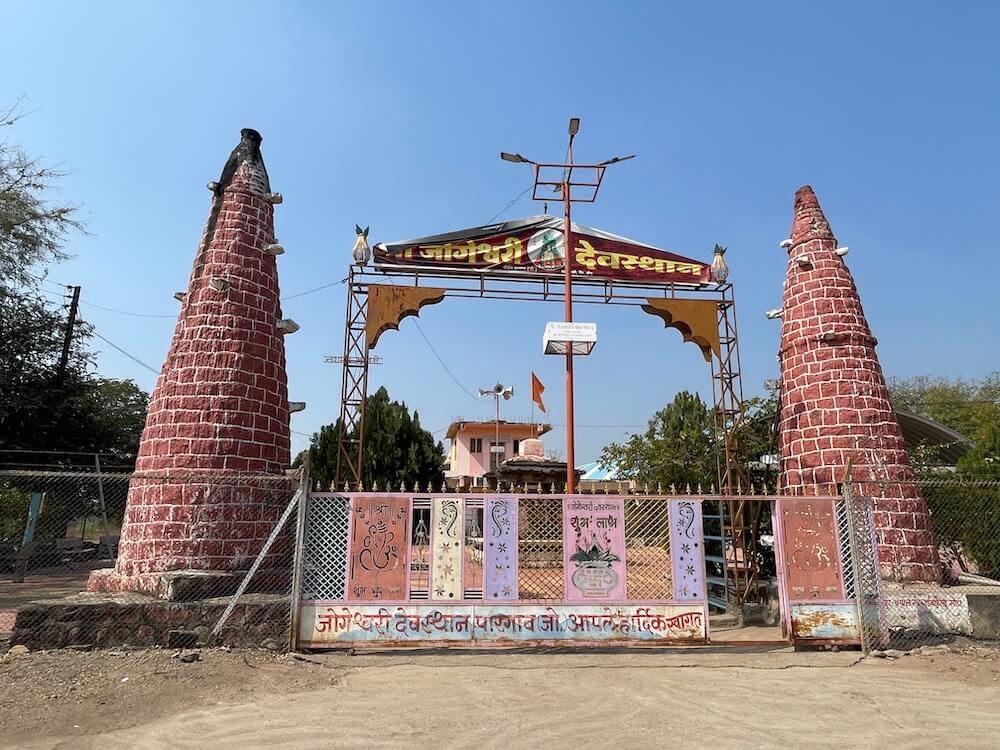
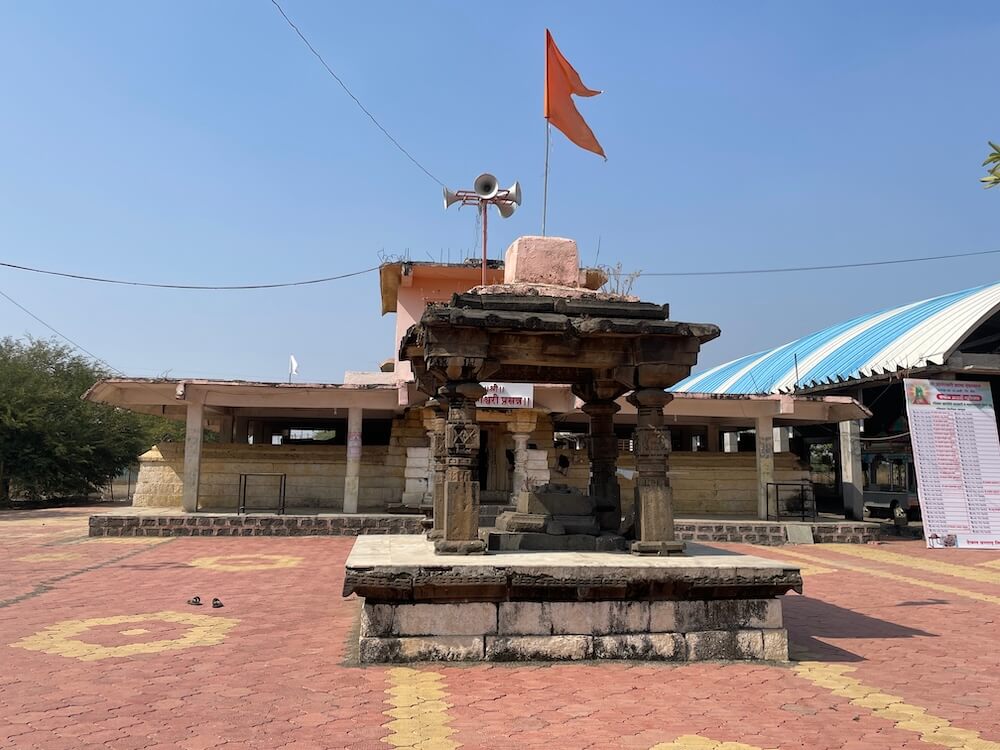
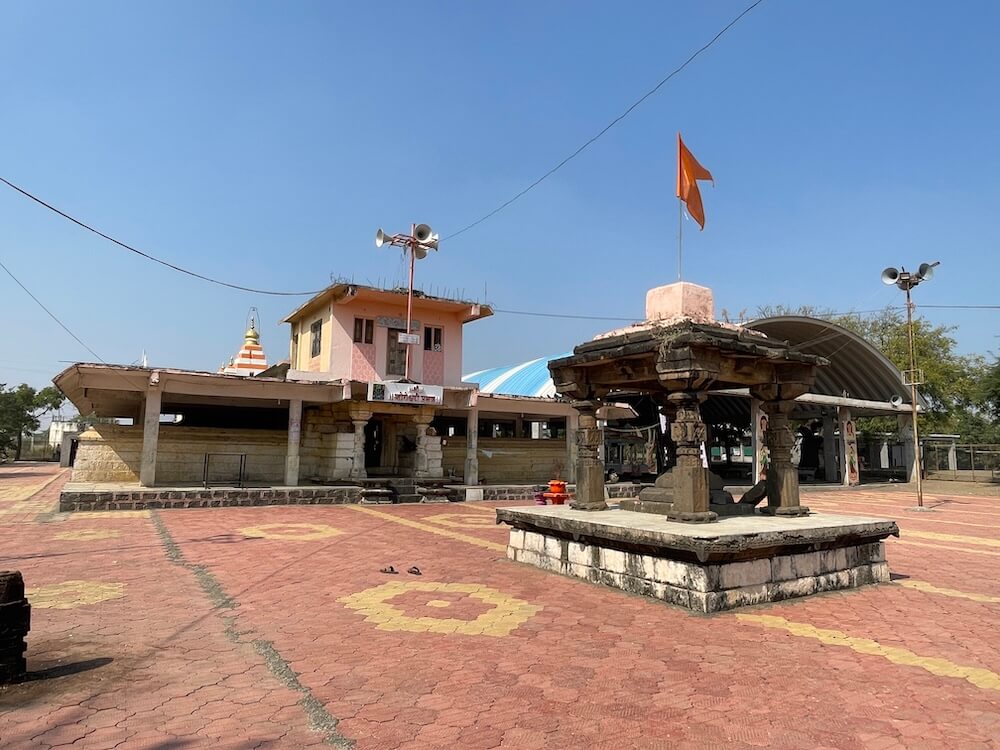
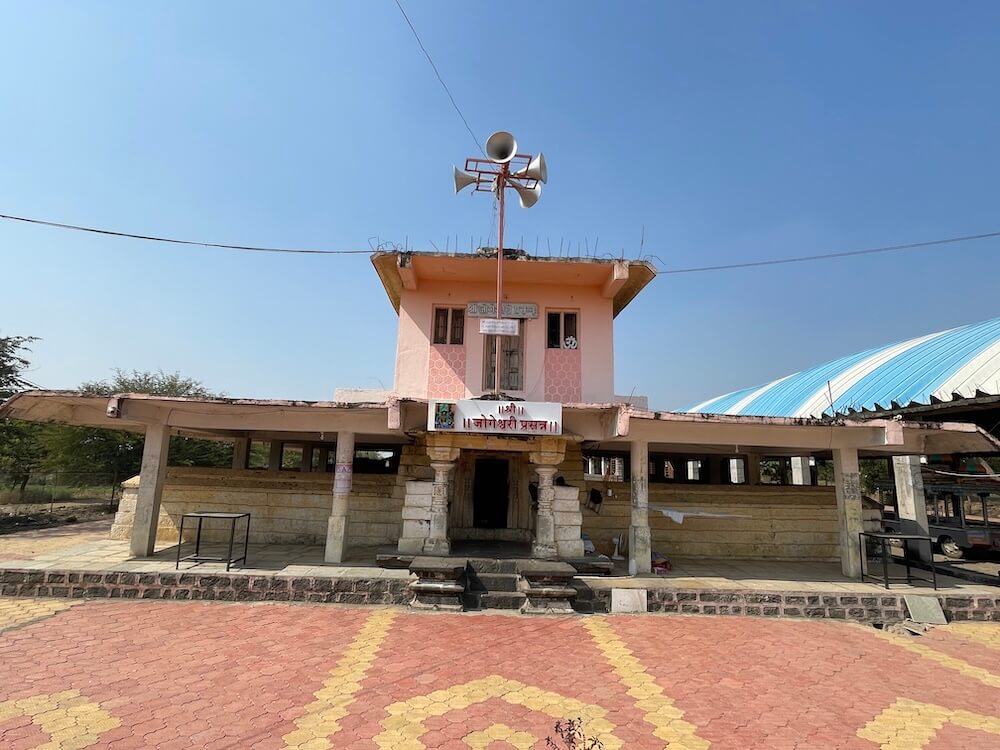
In the spacious, paver-blocked courtyard of the Jogeshwari temple located by the roadside, there are stone platforms on both sides of the entrance. On these stand circular lamp towers (deepmalas). There are seats for devotees in the courtyard, and a platform is visible in front of the temple. This platform features four ornate pillars, with a Shiva Linga placed between them. In this Shiva Linga, there is a circle in the center of a square base (shalunka), and four linga-stones are placed upon that circle. In two of the four corners of the square base, there are animal faces, with their tongues shown protruding from their mouths. In the other two corners, there are human faces. Archaeology enthusiasts speculate that this spot may have been a sacrificial altar in ancient times. In front of this platform is a Tulsi Vrindavan, and beyond that, a Shiva Linga on a stone pillar.
Further ahead is the second fortification wall of the temple. There is an entrance within this stone fortification. In front of the entrance is a porch (mukhamandap). Since the porch is elevated above the courtyard, there are three steps to ascend. The porch has four ornate pillars. On the square panels of the pillars, there are composite carvings, animal sculptures, and Kirtimukhas. On the platforms on both sides of the porch, there are cement-concrete pavilions built in recent times. The porch has railings on both sides, and ahead lies the entrance with five door-jambs (dwarashakhas). The entrance features vine-scroll motifs, leaf motifs, floral motifs, and pillar motifs, while the lintel (lalatbimba) bears a sculpture of Lord Ganesha. The architrave (mandarak) is decorated with floral carvings. In front of the entrance, in the original courtyard of the temple, there is a pavilion similar to the outer porch. In the original courtyard, a cement-concrete darshan-mandap has been built in recent times from the entrance to the temple. This darshan-mandap contains a sacrificial altar (yagnakund) and a tortoise sculpture. The darshan-mandap is semi-open, and its roof is divided into two sections, one higher and one lower.
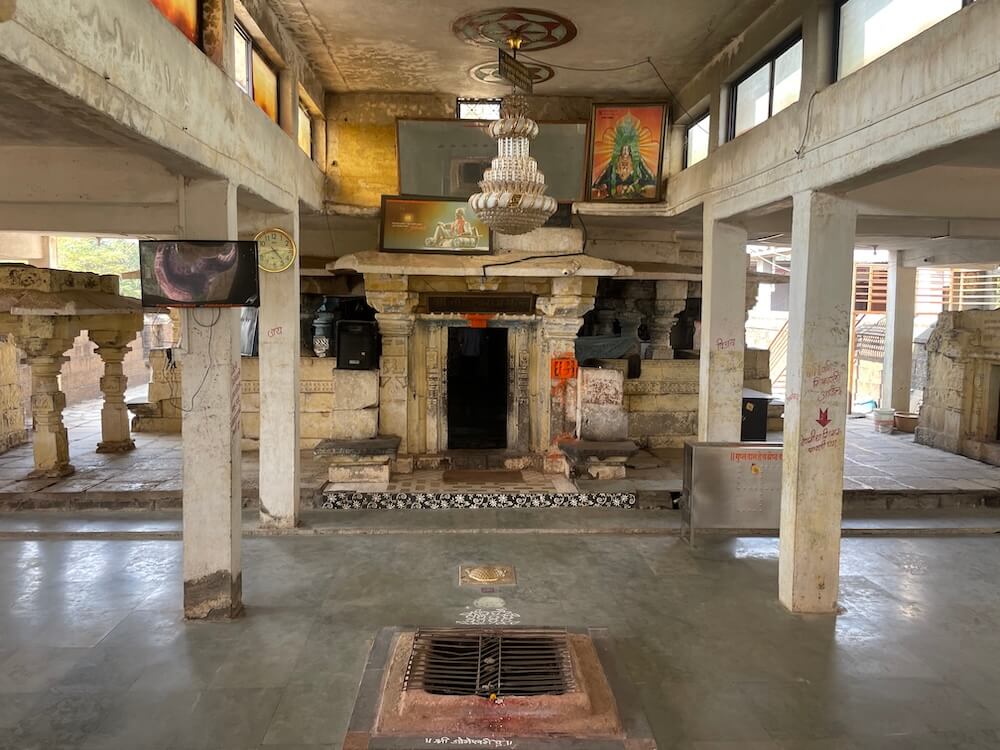
The temple structure consists of three semi-pavilions (ardhamandapas), a main assembly hall (sabhamandap), an antarala (vestibule), and the sanctum sanctorum (garbhagriha). The door-jambs of the assembly hall feature floral and pillar carvings, with a Ganesha sculpture on the lintel. The archway contains spire sculptures. The architrave has a moon-stone (chandrashila) and Kirtimukhas on both sides. The assembly hall has two additional doors on the left and right sides. Entering through the main entrance leads into the semi-pavilion. The semi-pavilion has stone benches (kakshasanas) on the outer side. Each semi-pavilion has four ornate pillars. The assembly hall contains eight ornate pillars, all standing on square bases. On the ceiling between every four pillars, there is a circular pattern. On the square panels of the pillars, various types of composite carvings, animal sculptures, and Kirtimukhas are carved. There are load-bearing Yaksha sculptures on the brackets and floral carvings on the beams.
In the center of the assembly hall, there is a platform. It is said that this is the place where Chakradhar Swami, the founder of the Mahanubhava sect, resided. The niches in the walls of the assembly hall and the vestibule contain statues of various deities. The door-jambs of the sanctum sanctorum feature floral and pillar carvings, with a Ganesha sculpture on the lintel. The architrave has a moon-stone and Kirtimukhas on both sides. The sanctum sanctorum contains four ornate pillars. The design of these pillars is similar to those in the assembly hall. There is a circular pattern on the octagonal ceiling. The self-manifested (swayambhu) stone of Jogeshwari Devi is enshrined in the sanctum sanctorum, while on a Vajra-pitha against the back wall are the idols of four-armed Vishnu and Lakshmi. All the deities have crowns on their heads. There is a staircase on the exterior of the temple to reach the roof. On the roof of the sanctum, there are small spires (laghu shikharas) at all four corners, topped with amalakas and finials (kalashas). The roof features a five-tiered square spire. Each tier of this spire contains niches for deities. At the top of the spire, there are two amalakas placed one above the other, topped with a finial.
The stone fortification of the temple contains many niches housing statues of various deities. One of the niches in the fortification contains an idol of Shani Dev. Adjacent to the fortification in the courtyard is a small temple, which houses ancient idols of four-armed Vishnu and Lakshmi. Beside the original fortification of the temple is a large hall built in recent times. Various religious programs are organized here during festivals. The main annual fair (jatrotsav) is celebrated with great enthusiasm on Chaitra Purnima. On this occasion, the Goddess is seated in a palanquin and taken in a procession around the village amidst the sound of drums and the showering of gulal. Thousands of devotees from the surrounding area participate in the palanquin procession. After touring the village throughout the night, the Goddess is re-installed in the temple at dawn. The Sharadiya Navratri festival is the second most important festival here. Apart from this, festivals like Chaitra Padwa, Dussehra, and Diwali are celebrated with great fervor. There is a large crowd of devotees at the temple on Tuesdays, Fridays, Purnima, Amavasya, and Ashtami.
This sacred temple stands as a testament to deep spiritual devotion, ancient architectural grandeur, and rich local cultural traditions.
The sanctum sanctorum houses the divine idol consecrated according to ancient Vedic traditions, surrounded by serene courtyards and traditional temple architecture.
Navratri, Maha Shivratri, Annual Temple Jatra & Deepotsav
Compare and book flights, secure top-rated local hotels near the temple, hire reliable guides, and rent cars instantly.
Extend your pilgrimage by visiting other highly sacred temples located nearby.


Add ₹999 more to unlock FREE SHIPPING!
Your sacred cart is currently empty.
Shop Photo FramesFill in your delivery details below to place your order.
Add comment