
Add ₹999 more to unlock FREE SHIPPING!
Your sacred cart is currently empty.
Shop Photo FramesDharur, a town near Paithan, which was the capital of the Satavahanas, has been renowned as an important marketplace since ancient times. Even today, its gold market, khawa (a milk-based sweet), and custard apples are famous throughout India. The Dharur Fort, located near this very village, was built by the Rashtrakuta kings. The village of Dharur is mentioned in the copper plate inscriptions of Rashtrakuta King Govinda III (reign 793 to 814 CE). After the Rashtrakutas, the Chalukyas of Kalyani and the Yadavas of Devagiri ruled here. Subsequently, this fort has witnessed many changes in power, including the Bahmani, Adilshahi, and Nizamshahi dynasties. After parting ways with Chhatrapati Shivaji Maharaj, Netaji Palkar took refuge in this very fort. On March 11, 1795, after the Battle of Kharda, this fort came under the control of the Marathas, but after some time, it again fell into the hands of the Nizam. In the vicinity of this fort, there is an ancient and famous temple of Ambachandi Devi. It is widely believed that this Devi fulfills the vows of her devotees.
This sacred site is said to be approximately twelve to thirteen hundred years old. Experts opine that the temple’s construction, in the Hemadpanti architectural style, might be around seven to eight hundred years old. The legend associated with this temple is that in ancient times, this region was ruled by the demon Chandasura. In his arrogance of power, this demon began to inflict untold atrocities upon his subjects. To be liberated from the torment of this demon, the people prayed to Amba Bhavani. Responding to the fervent pleas of her devotees, Amba Bhavani slew the demon and, for the welfare of her devotees, she chose to reside here permanently.
This temple is situated on the bank of a river and at the foothills of a hill. At the entrance of the courtyard, there is a welcoming arch with a ‘bashingi sajja’ (a type of decorative projection) supported by two circular pillars. Further ahead, in the paved courtyard, one first encounters the temple of Mahadeva. In front of the temple, there is an idol of Nandi on a Vajra Peetha (diamond pedestal) and a Shivlinga on the ground. A brass serpent holding a canopy (chhatra) is placed over this Shivlinga, and a copper vessel for performing abhishek (ritual bathing) with a continuous stream of water is suspended from the ceiling above the Linga. The temple’s roof features a small dome-shaped shikhara (spire), topped with a kalasha (finial). On both sides of the temple, there are seating arrangements for devotees.
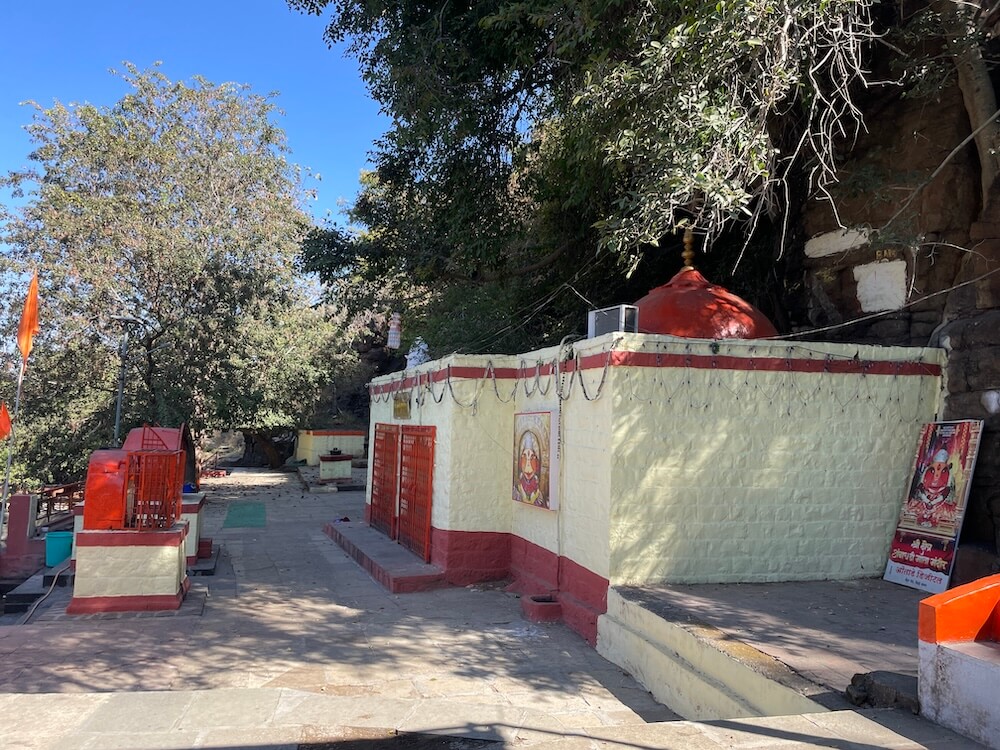
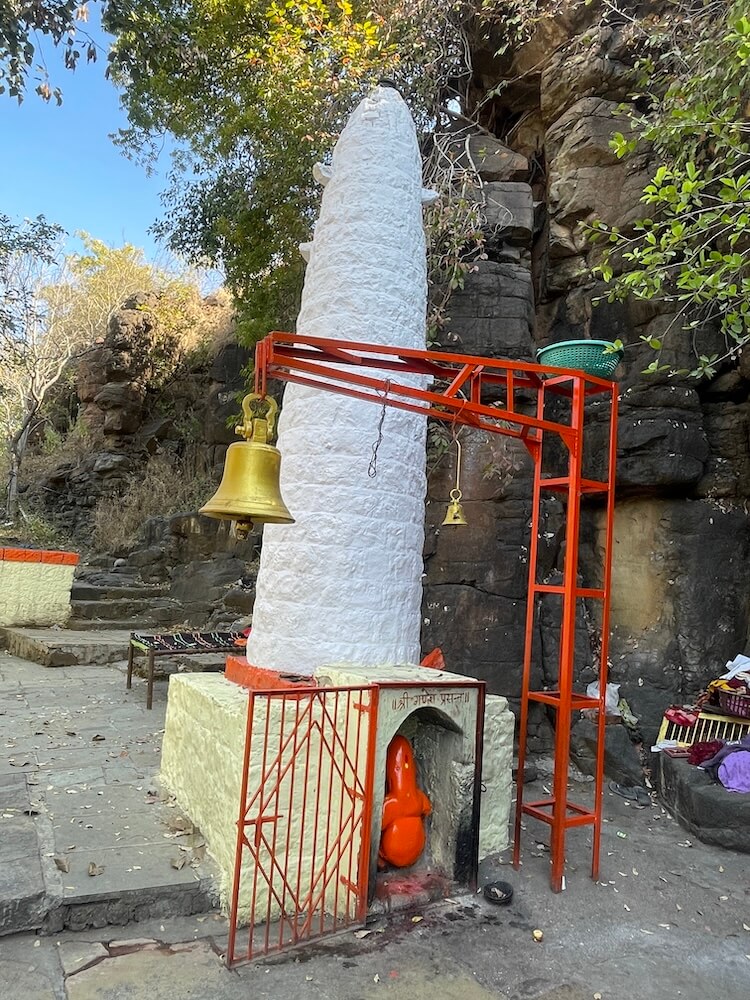
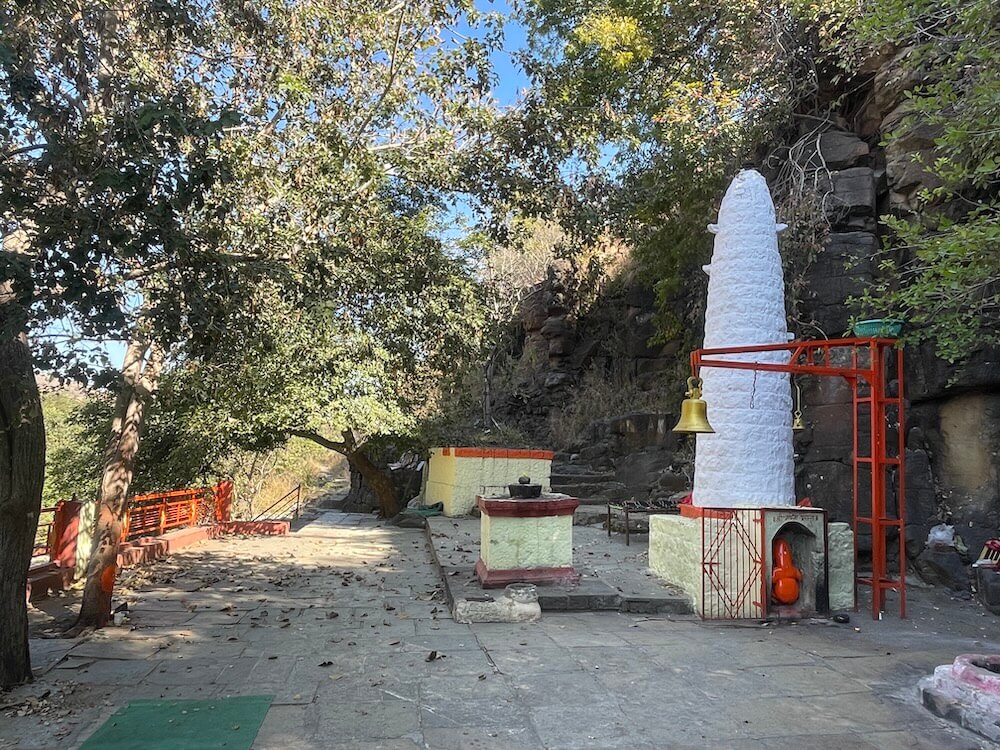
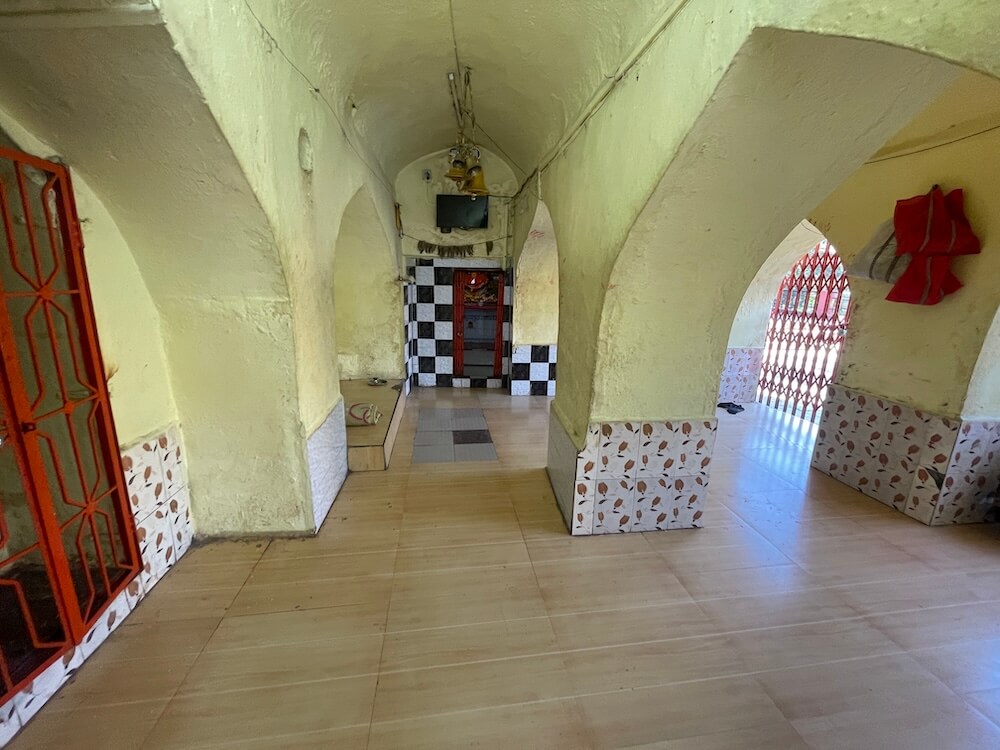
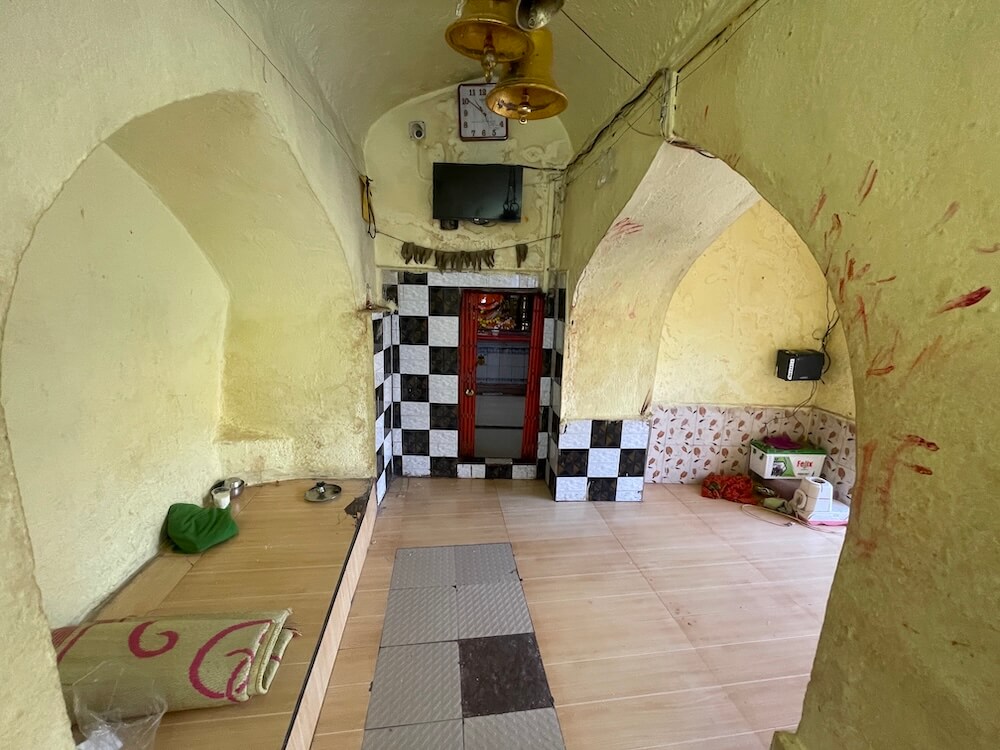
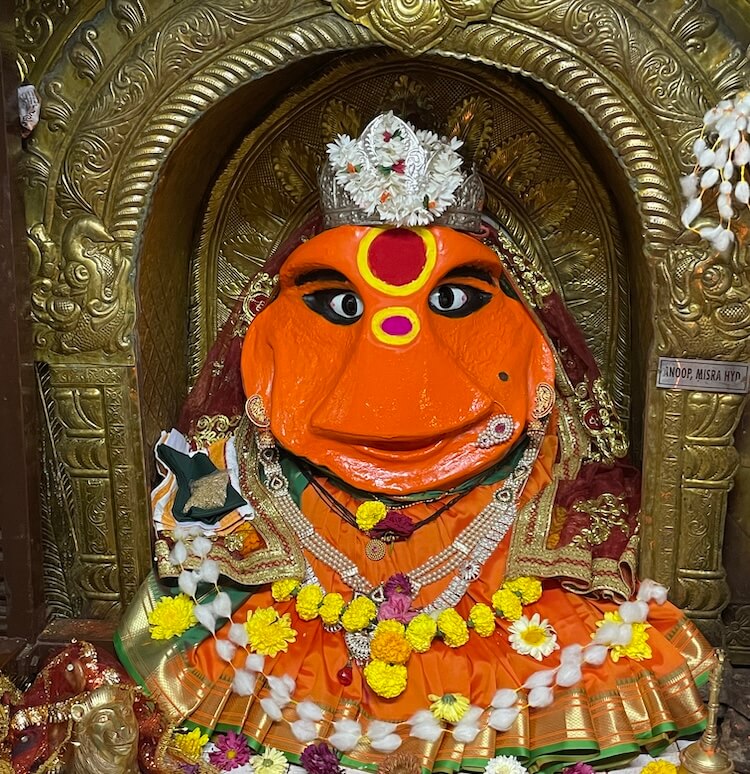
Further ahead, adjacent to the cliff, is the temple of Ambachandi Mata. In front of the temple, there are two platforms (chautharas), and on these platforms are ‘meghadambaris’ (canopies/shrines). In one of these meghadambaris, there is an idol of Maruti and a Shivlinga, while in the other, there is a stone representation of Khandoba. Further in the courtyard, there is a platform for a Deepmala (lamp tower). Within the niche (devakoshthaka) of this platform, there is an ancient idol of Ganesha, smeared with vermilion (shendur). On the platform, there is a circular Deepmala, and beside the Deepmala, on the ground, is a Yagyakunda (sacrificial fire pit). In front of the Deepmala, there is a Tulsi Vrindavan (sacred basil plant enclosure). The temple’s structure comprises a Sabhamandapa (assembly hall), Antarala (vestibule), and Garbhagriha (sanctum sanctorum). The entrance to the Sabhamandapa is open-door in nature. In the Sabhamandapa, there are three rows, each with three square pillars. All pillars are connected to each other by semicircular arches. Above the arches is the ceiling. The left side of the Sabhamandapa is enclosed as it abuts the cliff. In the first Garbhagriha on this side, there is a self-manifested (swayambhu) ‘tandala’ (an aniconic representation) of Khoklya Devi. Devotees believe that by having darshan (sacred sight) of this Devi, ailments like cold, cough, and fever in small children are cured. The right side of the Sabhamandapa is open and features sliding iron mesh shutters. Beyond the Sabhamandapa, there is a narrow and small Antarala, and further ahead is the entrance to the Garbhagriha. The entrance has sliding iron mesh shutters. Inside the Garbhagriha, within a niche (devakoshthaka) on a Vajra Peetha, there is a self-manifested (swayambhu) ‘tandala’ of Ambachandi Bhavani Devi. This Devi, adorned with clothes and ornaments, has a silver crown on her form. On the exterior of the niche, there is an ornate torana (decorative archway) with a Kirtimukha (glorious face motif) at its center. The ceiling of the Garbhagriha has a dome-shaped shikhara.
A dam has been constructed on the river in front of the temple. There are stone steps to descend into the dam. The courtyard has been beautified along the water reservoir, and there are seating arrangements for devotees here. The entire temple complex is adorned with lush greenery.
The Sharadiya Navratrotsava is the main annual festival here, celebrated with great enthusiasm. For ten consecutive days, the temple is crowded with devotees coming for Devi’s darshan and to fulfill their vows. On this occasion, various programs such as Bhajan (devotional singing), Kirtan (narrative singing), music, Mahaprasad (sacred food offering), Jagaran (all-night vigil), and Gondhal (folk ritual) are organized in the temple. During the auspicious period of Chaitra Navratri, from Chaitra Padwa to Ram Navami, a large number of devotees come for Devi’s darshan. Various religious programs are organized in the temple during all festivals and celebrations such as Dussehra, Diwali, Makar Sankranti, Kojagiri Pournima, Shravan Maas, Nagpanchami, and others. On Tuesdays, Fridays, Purnima (full moon), Amavasya (new moon), Ashtami (eighth day of lunar fortnight), and other such days, the temple witnesses a large gathering of devotees.
This sacred temple stands as a testament to deep spiritual devotion, ancient architectural grandeur, and rich local cultural traditions.
The sanctum sanctorum houses the divine idol consecrated according to ancient Vedic traditions, surrounded by serene courtyards and traditional temple architecture.
Navratri, Maha Shivratri, Annual Temple Jatra & Deepotsav
Compare and book flights, secure top-rated local hotels near the temple, hire reliable guides, and rent cars instantly.
Extend your pilgrimage by visiting other highly sacred temples located nearby.


Add ₹999 more to unlock FREE SHIPPING!
Your sacred cart is currently empty.
Shop Photo FramesFill in your delivery details below to place your order.
Add comment