
Add ₹999 more to unlock FREE SHIPPING!
Your sacred cart is currently empty.
Shop Photo FramesShripad Vallabha is considered the first incarnation of Dattatreya, Shri Narasimha Saraswati the second, and Swami Samarth of Akkalkot the third. He appeared in Akkalkot in the year 1856 from the Kardali forest. Through his mysterious divine plays, mantras, and guidance, he would resolve the material, spiritual, and mental problems of his devotees. It is the firm belief of devotees that even today, by having darshan of the objects he handled and his crystal padukas, all their problems are resolved. It is for this reason that there are a large number of maths containing his padukas and personal belongings across Maharashtra. Among the few maths established during Swami’s lifetime, one is situated at Kej, and it is the belief of devotees that having darshan here bestows the merit of a pilgrimage to Akkalkot.
This Math was established in the year 1875. The Padukas and personal belongings gifted by Swami Samarth with his own hands are preserved safely in this Math. It holds special significance as a Math established during the lifetime of Swami. Many legends are prevalent regarding this Math, and it is also mentioned in the text ‘Swami Samarth Charitra’. The Jahagir granted by the Nizam to the Jahagirdar of Kej, Dhurandhar Deshpande, had been confiscated. When he could not regain the Jahagir despite many efforts, he sought refuge at the feet of Swami of Akkalkot.
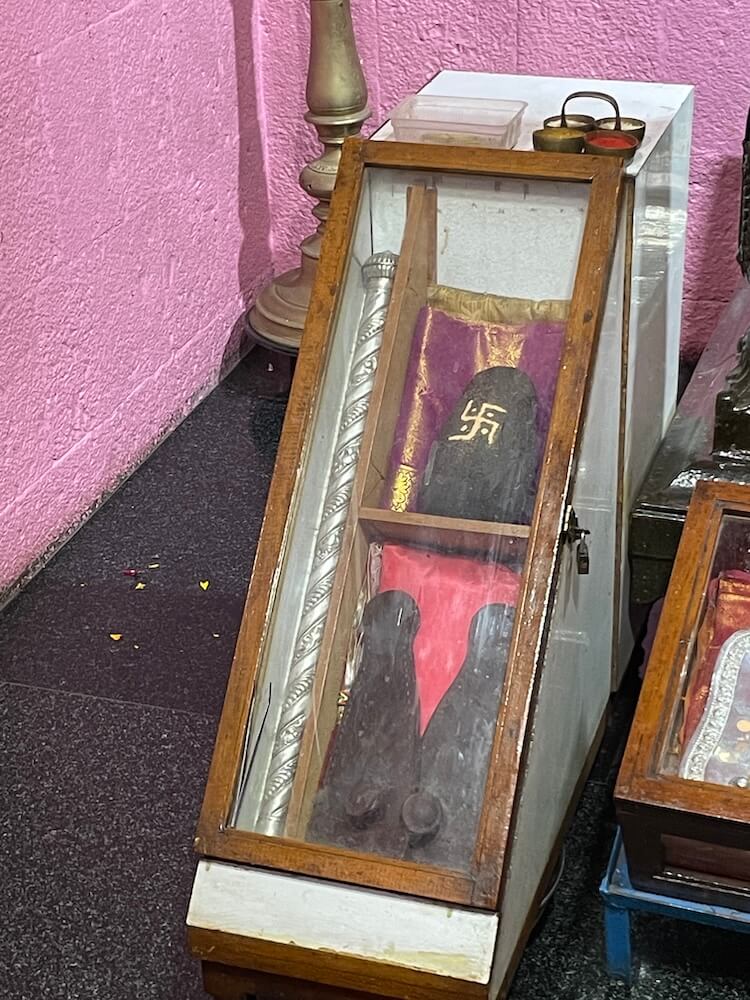
The Swami advised him to go to the court of the Nizam in Hyderabad. Accepting the Swami’s command as supreme, Deshpande reached the Nizam’s court and received his Jagir back. Considering this to be a miracle of the Swami himself, he The crystal padukas of Swami from Akkalkot, the stone gifted by Swami, and other sacred items were brought to Kej. A matha was established here, and Swami’s padukas and other items were placed for worship.
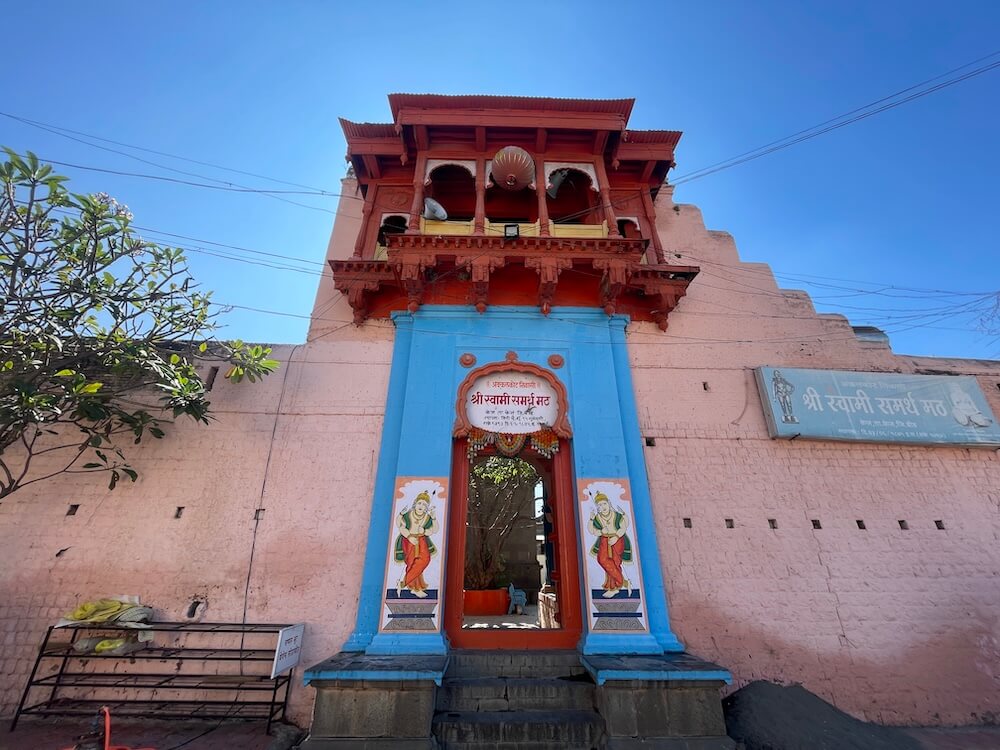
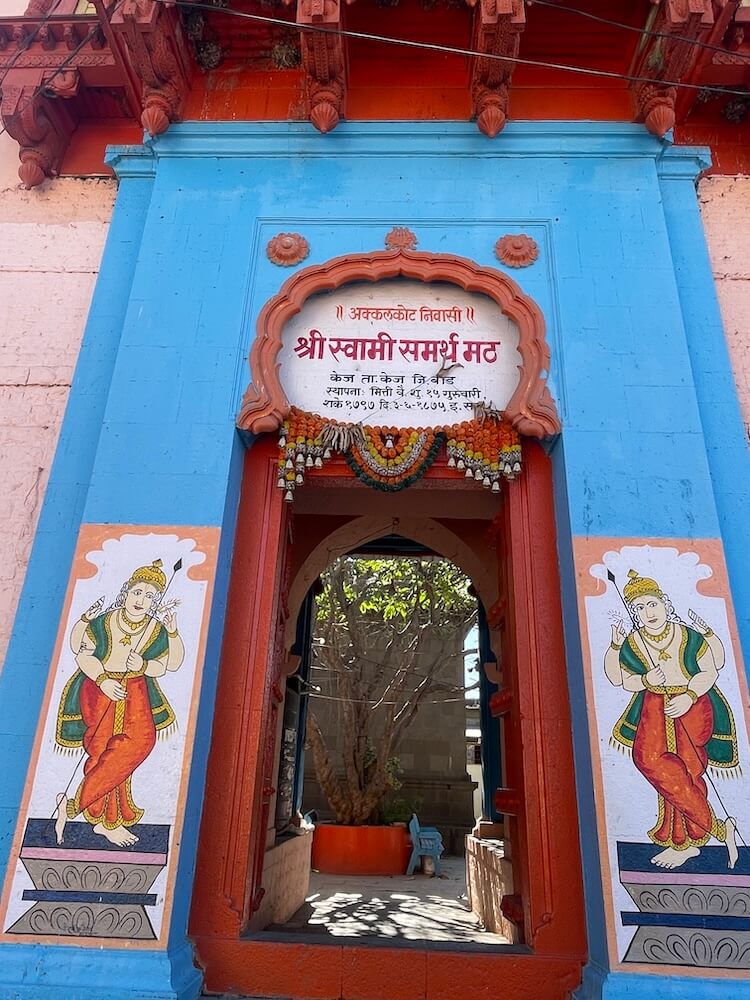
This Matha, located in the central part of the village, is accessible by a paved road, and a spacious parking area is available in front of it. The sturdy fortification wall surrounding the Matha has two entrance gates. The main two-story entrance gate is approximately thirty feet high. Since this entrance is situated at a higher elevation than the road, there are three steps in front of it. Paintings of gatekeepers are depicted on both sides of the entrance. Above the entrance, there is an arched torana with lotus motifs on both sides. Inside the entrance, there are guard rooms on the left and right sides. There is a Nagarkhana on the upper floor of the entrance gate.
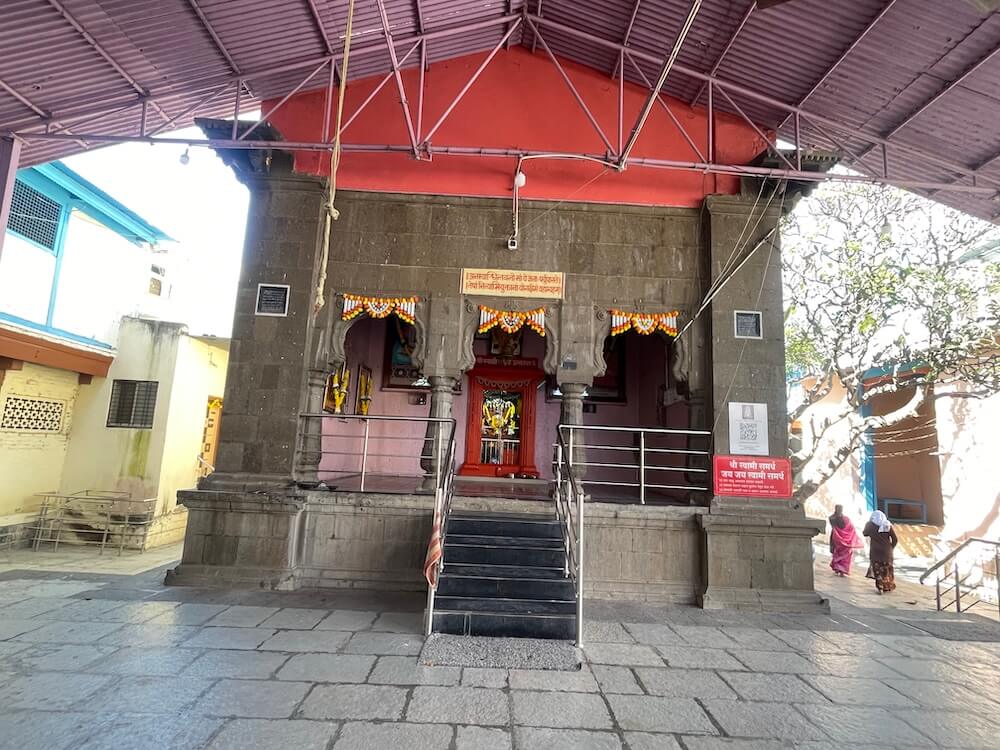
In the paved courtyard of the Math, adjacent to the fortification wall, are the residences of the descendants of the Math’s founder, Dhurandhar Deshpande. In the courtyard, there are some trees with platforms built around them. The structure of the Math is built of carved stone, consisting of a Sabha Mandap (assembly hall), Antarala (vestibule), and Garbhagriha (sanctum sanctorum). On a plinth approximately three feet high, there is a semi-open Sabha Mandap featuring iron pillars on the exterior and a corrugated metal roof. To enter the Sabha Mandap, there are three steps each on the left and right sides, located along the outer wall of the Antarala. The Antarala is approximately four feet higher than the Sabha Mandap, and there are four steps leading to the entrance of the Antarala. There is a stainless steel railing on both sides of the steps and on the front side of the antarala. In the antarala, four ornate pillars on the front side are connected to each other by an arched torana. The pillars, which stand on lotus-shaped bases, feature lotus capitals. On the walls of the antarala, there are many small and large images of Swami Samarth.
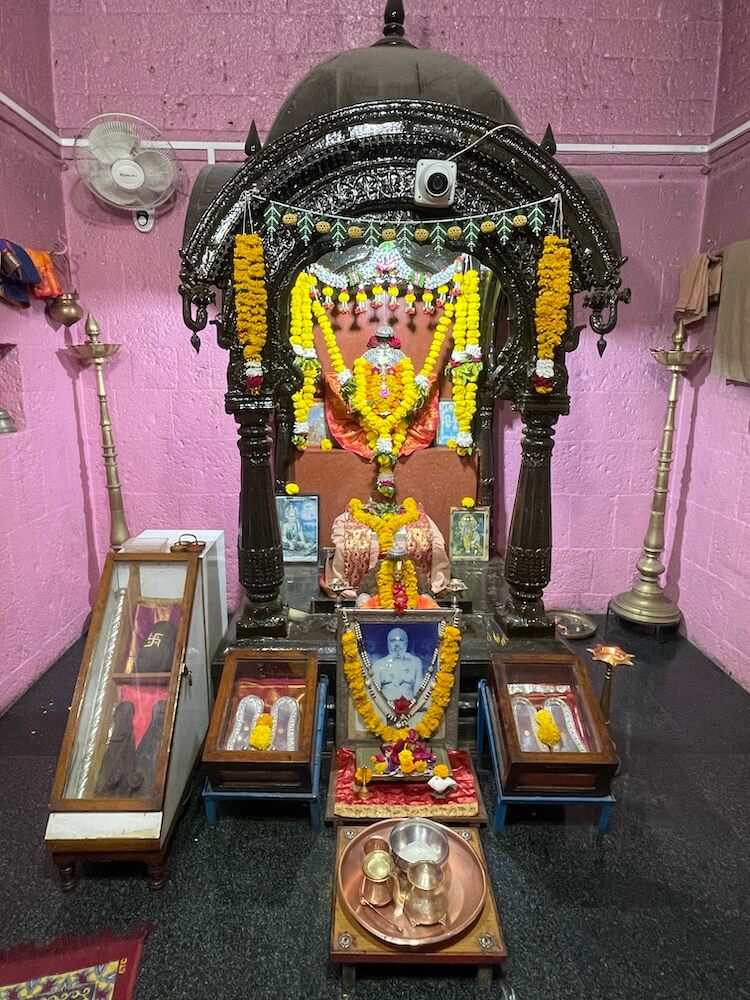
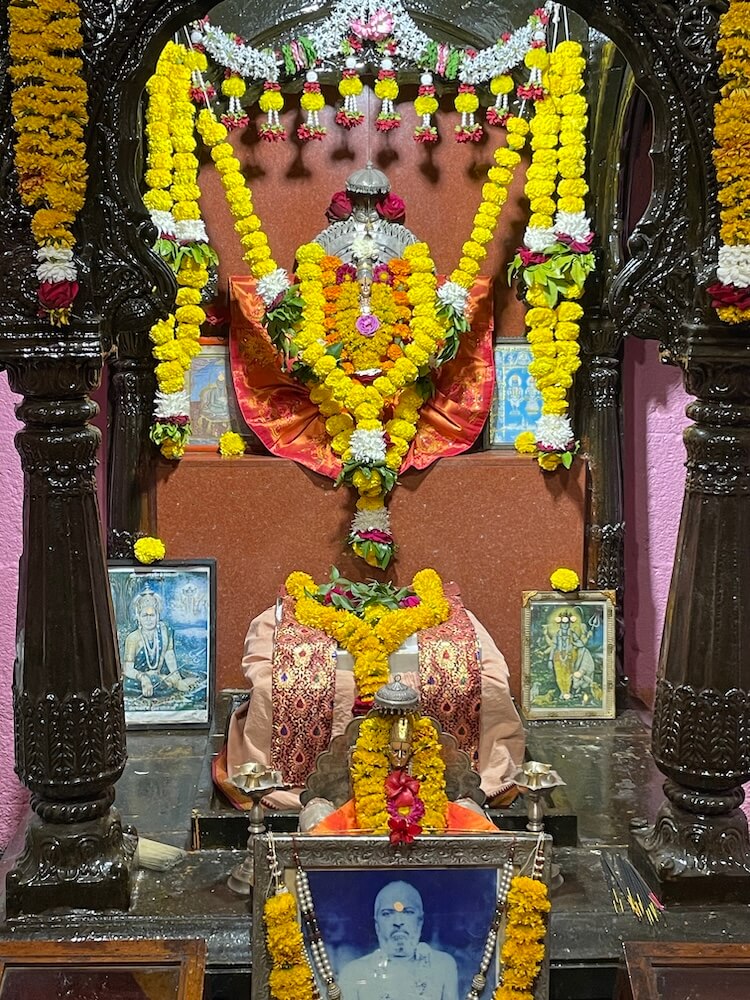
Ahead is the entrance to the sanctum sanctorum. On both sides of the entrance, there are two intricately carved pillars. On the door frames, there is vertical fluted ornamentation, and on the lintel, there is a sculpture of Lord Ganesha. Above the entrance, there is a torana, and on the architrave, a Kirtimukha is carved. The entrance has ornate wooden shutters. Inside the sanctum sanctorum, the crystal padukas and a silver idol of Swami Samarth are placed within an ornate wooden shrine set upon a Vajrapitha. Other items given by Swami to his devotee Deshpande have also been kept in the shrine.
On the day following Gudi Padwa, the Shri Swami Samarth Prakat Din is celebrated at the Math. On this occasion, various religious programs such as Bhajans, Kirtans, music, scripture reading, and Mahaprasad are organized for four consecutive days. The Swami Punyatithi ceremony on Chaitra Vadya Trayodashi, Dattatreya Jayanti, and the Guru Dwadashi festival on Ashwin Vadya Dwadashi are also celebrated here. Apart from this, festivals and celebrations like Mahashivratri, Ram Navami, Dussehra, and Diwali are observed at the Math. During all these festivals, many devotees of Swami from the surrounding areas visit the Math for Darshan. Various religious programs are organized on these occasions. There is a large influx of Swami devotees at the Math on Thursdays, Ekadashi, Purnima, Amavasya, and other such days. For Swami devotees arriving from out of town, there is a Bhakta Niwas facility available here at a reasonable fee.
This sacred temple stands as a testament to deep spiritual devotion, ancient architectural grandeur, and rich local cultural traditions.
The sanctum sanctorum houses the divine idol consecrated according to ancient Vedic traditions, surrounded by serene courtyards and traditional temple architecture.
Navratri, Maha Shivratri, Annual Temple Jatra & Deepotsav
Compare and book flights, secure top-rated local hotels near the temple, hire reliable guides, and rent cars instantly.
Extend your pilgrimage by visiting other highly sacred temples located nearby.


Add ₹999 more to unlock FREE SHIPPING!
Your sacred cart is currently empty.
Shop Photo FramesFill in your delivery details below to place your order.
Add comment