
Add ₹999 more to unlock FREE SHIPPING!
Your sacred cart is currently empty.
Shop Photo FramesShri Tuljabhavani of Tuljapur is well-known throughout Maharashtra as the family deity of Chhatrapati Shivraya. There are hundreds of temples dedicated to Shri Tuljabhavani Mata in her various forms across the country. The three-and-a-half Shakti Peethas in Maharashtra and the fifty-one Shakti Peethas in Bharat are especially renowned. This deity of the Shakta tradition is worshipped in villages throughout Maharashtra. The temples of the Goddess in Kolhapur, Mahur, Tuljapur, and Vani are famous. Such another vibrant and picturesque sacred site is located at Warangphata in Kalamnuri Taluka of Marathwada. This temple stands on a high hillock adorned with lush greenery, alongside the Nanded-Nagpur National Highway.
Although this temple has been built in recent times, the local priests say that the idol here is thousands of years ancient. The legend about the Goddess is that in ancient times, a Shakta renunciate was worshipping the Goddess in this area, which was then a dense forest. Pleased by his devotion, the Goddess appeared before him in her manifest form and asked him to ask for a boon. At that time, the renunciate asked for the boon that she should reside there permanently and fulfill the desires of all devotees who come for her darshan. As per the devotee’s request, the Goddess was enshrined here in idol form.
The original form of this shrine consisted of the idol of Shri Bhavani Mata, her padukas, a Shivlinga, and an idol of Bhairavnath, all on a platform under a Bori tree in the wilderness. In the year two thousand three, the villagers built a simple temple at this spot. In the year two thousand eleven, the shikhara (spire) of the temple was constructed. In the year two thousand fourteen, the temple was declared a tourist destination, and consequently, the renovation of the temple and development of its surroundings were carried out with government funds.
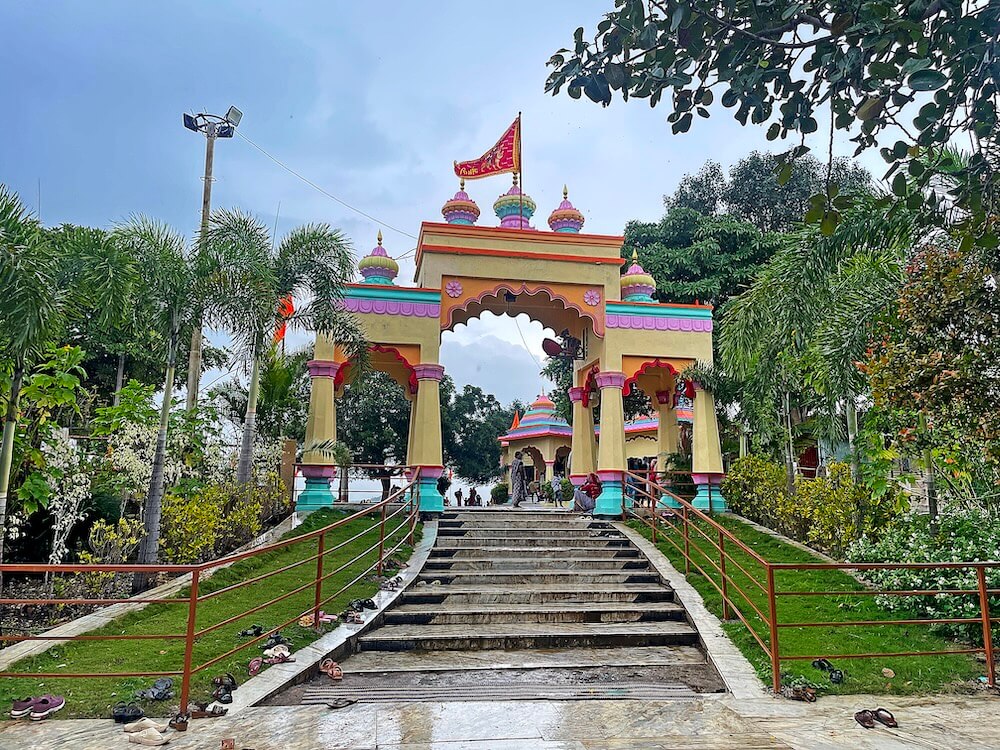
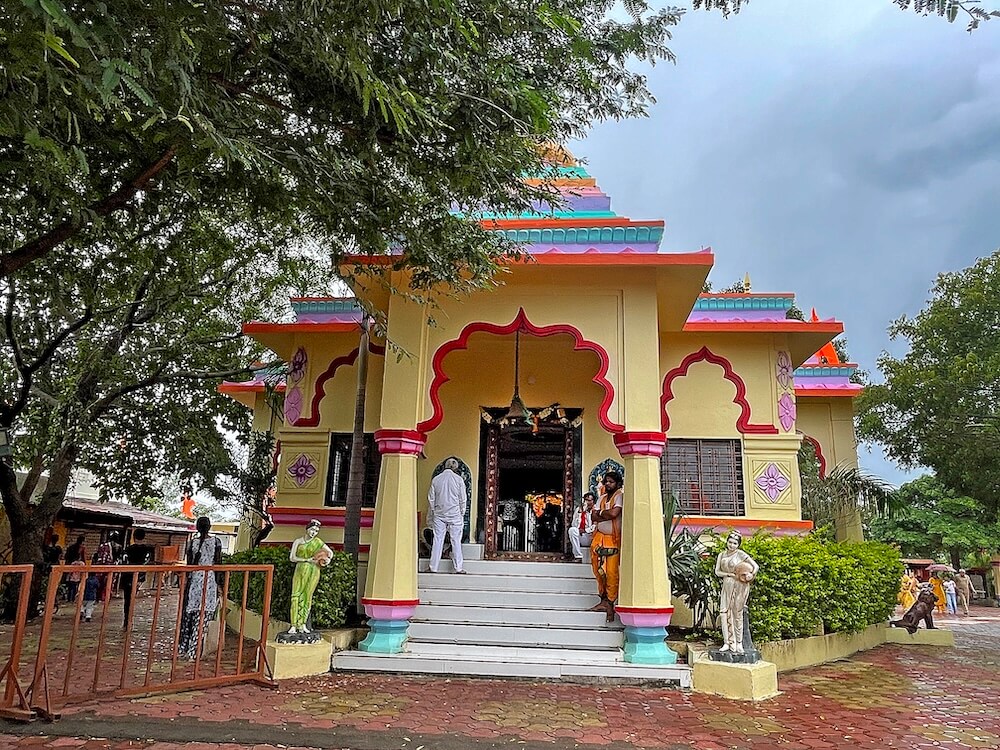
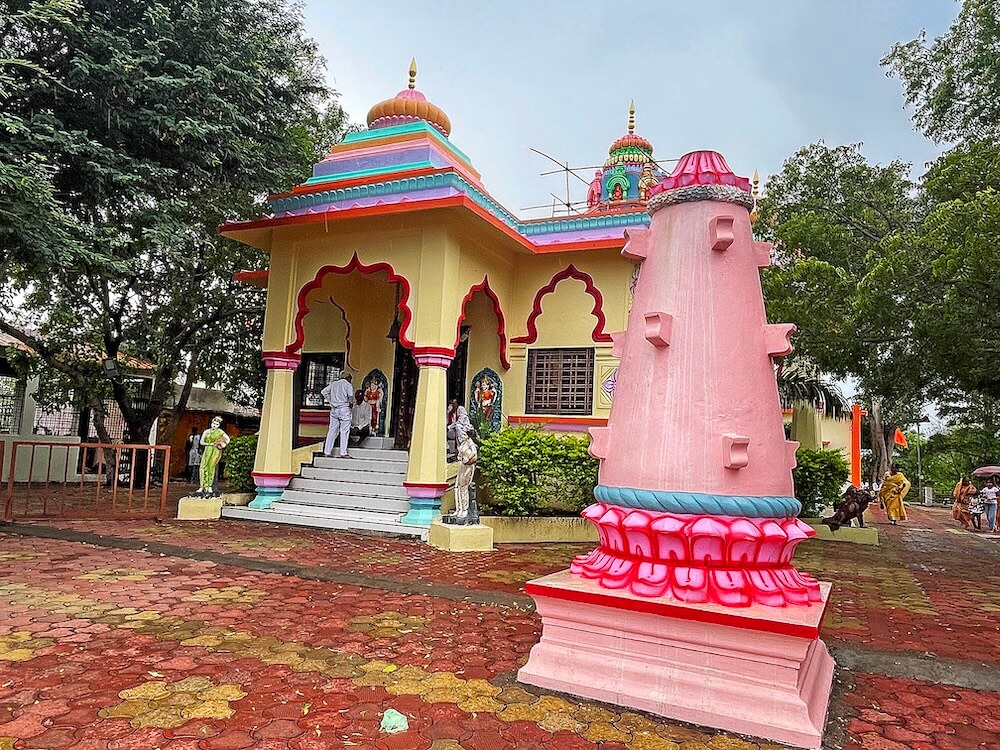
This temple is located on a high hillock near the village, alongside the Nanded-Nagpur National Highway. The temple has a large entrance gate within its fortification. In front of the entrance, there are approximately eleven spacious steps. At the entrance, on both sides, there are four intricately carved pillars each, connected by an arched mihrab. There are three continuous welcome mandapas (pavilions) on these pillars. The mandapas on the left and right sides are lower in height, while the central mandapa is taller. Each of the side mandapas has one amalaka (finial), and the central mandapa has three amalakas. All amalakas are topped with kalashas (pots). In the spacious courtyard of the temple, there are seats for devotees to sit. There are also deepastambhas (lamp pillars) on the platform. There is a yagyakunda (sacrificial fire pit) in the courtyard. Here, near the fortification, there are vermilion-smeared stone idols of Shri Bhavani Devi and Shri Hanuman. Devotees have tied votive clothes near the idols. This entire temple complex, adorned with lush greenery, falls under the jurisdiction of the Forest Department.
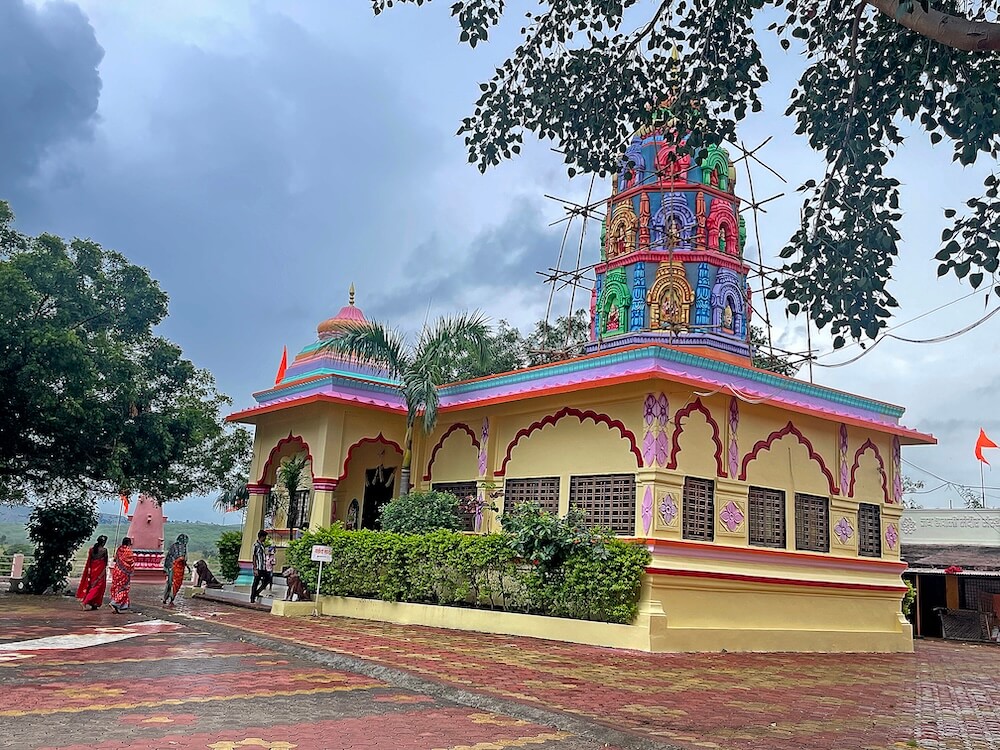
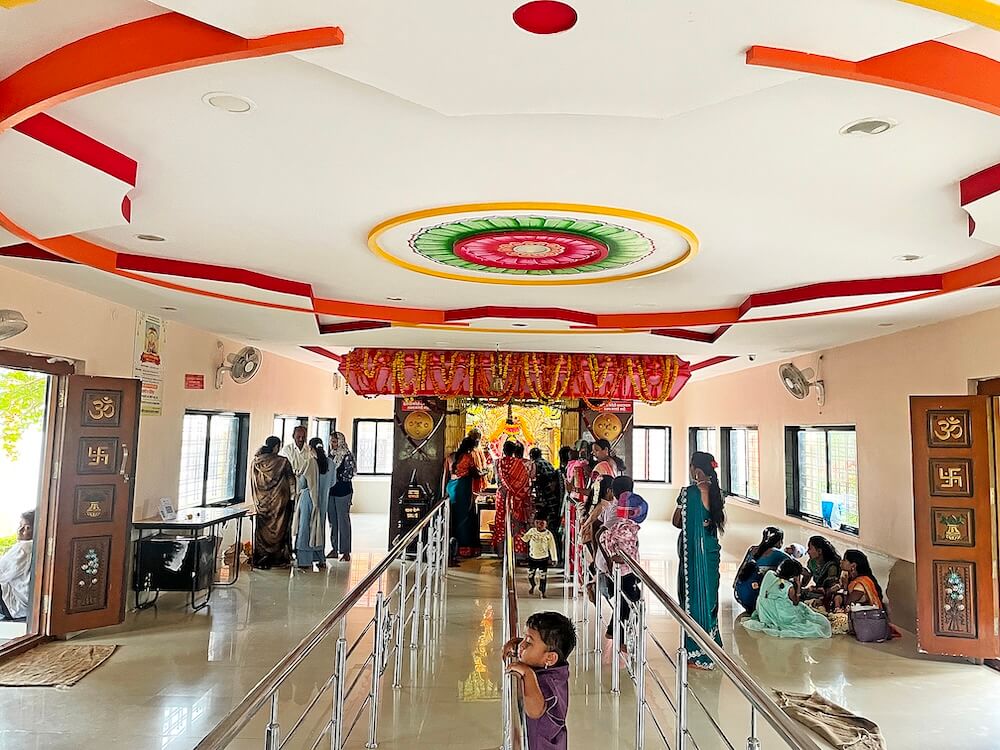
The temple’s structure comprises a mukhamandapa (front porch), a sabhamandapa (assembly hall), and a garbhagriha (sanctum sanctorum). In front of the mukhamandapa, there are two lion sculptures on both sides. Inside the mukhamandapa, on the front side, two intricately carved circular pillars are connected by an arched mihrab. Since the entrance to the sabhamandapa is higher than the courtyard, there are five steps leading to the entrance. At the entrance, on both sides, there are sculptures of Shankha, Chakra, Gada-dharini Chaturbhuj Narayani as dwarpalas (gatekeepers). The doorframes of the entrance are adorned with leaf and flower motifs, while the lalata-bimba (central lintel) features a sculpture of Shri Ganapati. The entrance has intricately carved wooden doors. The sabhamandapa has two additional doors on its right and left sides. The enclosed sabhamandapa has ventilators for light and air. Inside the sabhamandapa, queue management is facilitated with stainless steel railings. Further ahead is the entrance to the garbhagriha. On both sides of the entrance, there are shields and swords on the pillars.
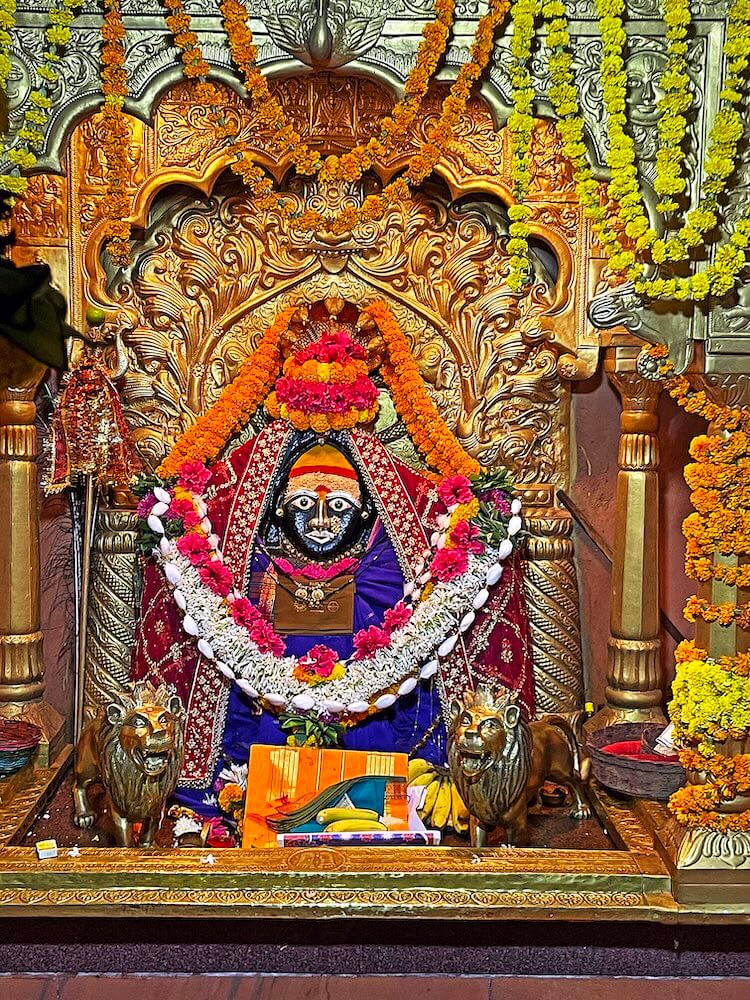
Inside the garbhagriha, on a vajra-peetha (diamond throne), there is a four-armed idol of Shri Bhavani Mata in her Mahishasuramardini form, set in a brass makhar (shrine). The Goddess holds a trident, a sword, and a human skull in her hands. Mahishasura lies beneath the Goddess’s feet. Adorned with various garments and ornaments, the Goddess wears a silver crown on her head. A five-headed serpent, Panchaphaneshwar Naga, holds a canopy over the Goddess. On both sides of the idol, there are brass lion sculptures. In the brass prabhavali (halo) behind the idol, there are makara-torana, gaja-torana, creeper and floral motifs, and a Kirtimukha at the top. As the idol of the Goddess faces east, on certain days of the year, the rays of the rising sun perform a sacred anointing of light upon the Goddess. There is a circumambulatory path around the exterior of the garbhagriha.
The roof of the mukhamandapa has a square domed shikhara. At the apex of the shikhara is an amalaka, topped with a kalasha. The roof of the garbhagriha has an octagonal shikhara with three tiers. Each tier contains eight devakoshthakas (niches for deities) with idols of various deities. At the apex of the shikhara, there are two amalakas placed one above the other, topped with a kalasha and a dhwajapataka (flag).
At some distance from this temple, there is a circular, Shivlinga-like temple of Shri Mahadev, which is also fortified. This temple comprises a mukhamandapa, a sabhamandapa, and a garbhagriha. In the mukhamandapa, there are two pillars on the front side, and the rear part of the roof is supported by the walls of the sabhamandapa. The entrance to the sabhamandapa is elevated from the courtyard. The enclosed sabhamandapa has ventilators for light and air. Inside the sabhamandapa, in front of the entrance, there is a black stone idol of Nandi. The garbhagriha is deeper than the sabhamandapa and is wall-less and open. There are three steps leading down into the garbhagriha. In the center of the garbhagriha is a Shivlinga. A brass serpent holding a canopy is over the Shivlinga, and an abhishekapatra (vessel for ritual pouring) holding a stream of water is suspended from the ceiling. On the roof of the temple, there is a approximately twenty-foot-tall idol of Shri Mahadev in a meditative posture. Previously, the Shivlinga here was in the Shri Bhavani Devi temple, but in recent times, a new temple was established, and the Shivlinga was installed here. Near the temple, there is a children’s park developed by the Forest Department. Various types of play equipment are provided here for children. Behind the temple, there is an auditorium for cultural activities and a wedding hall.
The Sharadiya Navratrotsav is the main annual festival here, celebrated with great enthusiasm. During this time, for ten consecutive days, there is a large gathering of devotees who come to the temple for darshan and to fulfill their vows. On this occasion, devotees offer khana-naral (coconut and blouse piece), sarees, and auspicious ornaments to the Goddess. From Ashwin Shuddha Pratipada to Dussehra, for ten consecutive days, various religious programs such as bhajan, kirtan, jagaran, gondhal, pravachan, and mahaprasad are organized in the temple. Mahashivratri, Shravan Maas, Margashirsha Maas, Chaitra Padwa, Diwali, Kojagiri Pournima, Kartik Pournima, and other festivals and celebrations throughout the year are observed in the temple.
This sacred temple stands as a testament to deep spiritual devotion, ancient architectural grandeur, and rich local cultural traditions.
The sanctum sanctorum houses the divine idol consecrated according to ancient Vedic traditions, surrounded by serene courtyards and traditional temple architecture.
Navratri, Maha Shivratri, Annual Temple Jatra & Deepotsav
Compare and book flights, secure top-rated local hotels near the temple, hire reliable guides, and rent cars instantly.
Extend your pilgrimage by visiting other highly sacred temples located nearby.


Add ₹999 more to unlock FREE SHIPPING!
Your sacred cart is currently empty.
Shop Photo FramesFill in your delivery details below to place your order.
Add comment