
Add ₹999 more to unlock FREE SHIPPING!
Your sacred cart is currently empty.
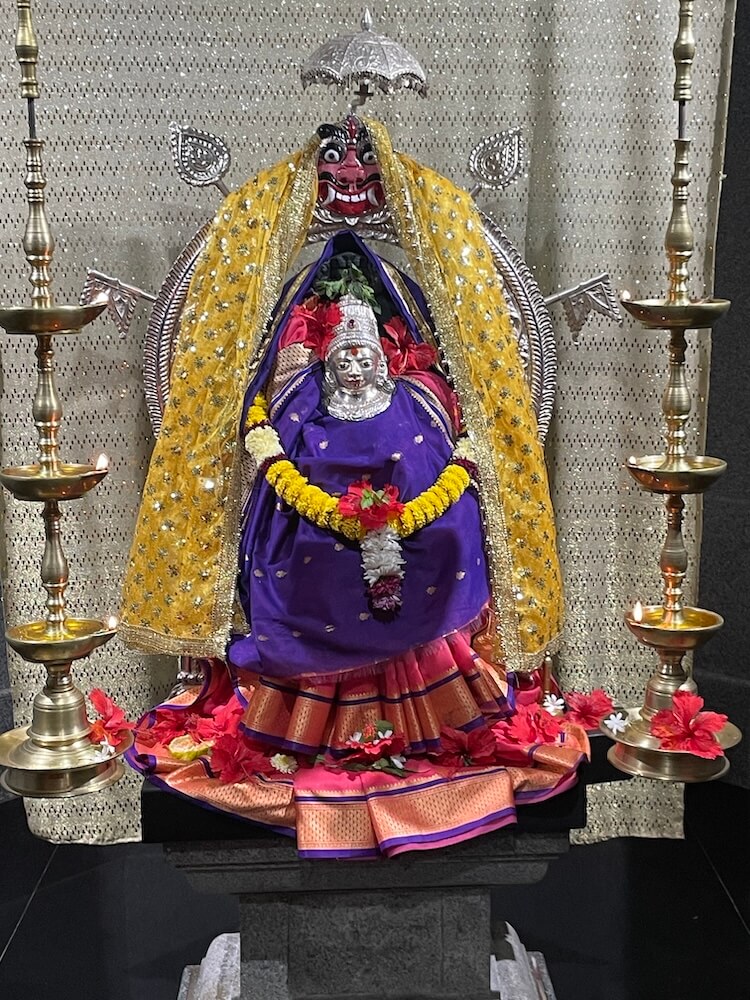
Shop Photo FramesGoddess Mahalasa, the presiding deity of countless devotees in Goa and the Kuladevi (family deity) of the Karhade and Padye Brahmin communities, is believed to be the Mohini avatar of Lord Vishnu. According to a legend, the Goddess chose to reside in Verna, formerly known as Varenyapuram or Varunapur, because she was fond of the place. Due to the fear of foreign invaders, the original idol of the Goddess was moved to Mardol in Ponda taluka. The spacious temple standing at this original site in Verna-Varenyapuri has today become a place of faith for thousands of devotees.
Goddess Mahalasa is considered one of the most important and ancient deities of Goa. Her temple was originally built on the Sonsada plateau in Verna. At that time, it was considered one of the largest temples in Goa. In the book ‘For the Love of Mandovi’ written by Dr. Mohan Pai, it is mentioned that this temple, situated in the region of Varenyapuram, was the largest temple in Goa. In those days, Varunapur was a major trading center. This temple also became an important social and cultural hub of Goa. In the sixteenth century, the Portuguese invaders launched a campaign to destroy all temples in Goa. At that time, the devotees of the Goddess safely moved the idol from this temple to Mardol in Ponda taluka.
Many legends are associated with the temple. One of them relates to the avatar of Goddess Mahalasa. According to this, Lord Vishnu took the Mohini avatar to distribute the nectar (Amrita) that emerged from the churning of the ocean (Samudra Manthan). An Asura named Swarbhanu, who had deceitfully disguised himself as a Deva, tried to consume the nectar by sitting in the row of the Devas. At that moment, Vishnu severed him into two parts with his Sudarshana Chakra. Those two parts came to be known as Rahu and Ketu. Mohini chased Rahu and slew him on a hill named Mahalasa, and stood upon it. That is why she came to be called Rahu Mardini or Mahalasa Narayani.
According to another legend, the Goddess came to Gomantak in the form of Vayu (wind). While searching for a suitable place to reside, she reached Varenyapur. The citizens there presented their grievances to her regarding the water scarcity in the region. For them, the Goddess pressed her toe on the ground, and a stream of water gushed out. It is said that this spot is located at some distance from the temple of the Goddess. It is known as Nupur Tirtha. It is said to be the source of the Sal River. Near the temple of the Goddess, there is a beautiful Pushkarini (stepped tank) built of laterite stone. It is the faith of the devotees that because the Goddess’s blessings are behind both these water bodies, the water in these places never dries up.
According to a story, a cowherd once saw the Goddess in a stone on the Sonsada plateau. He called his master and showed it to him as well. Seeing that the Goddess had manifested there, they, with the help of their associates, built a small temple there initially. This was later transformed into a large temple. According to some historians, the original idol of Goddess Mahalasa was carved from a Shaligram stone found in the Gandaki River in Nepal. From Nepal, it was first taken to Nevasa in the Ahilyanagar district of Maharashtra. However, due to the harassment under the Muslim rule there, the idol was brought to Bicholim in Goa, and eventually, it was brought to Verna.
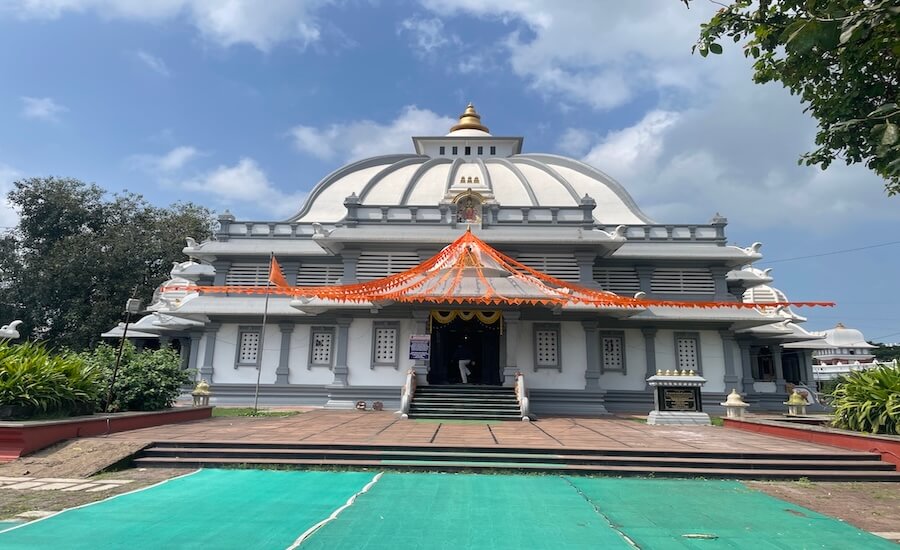
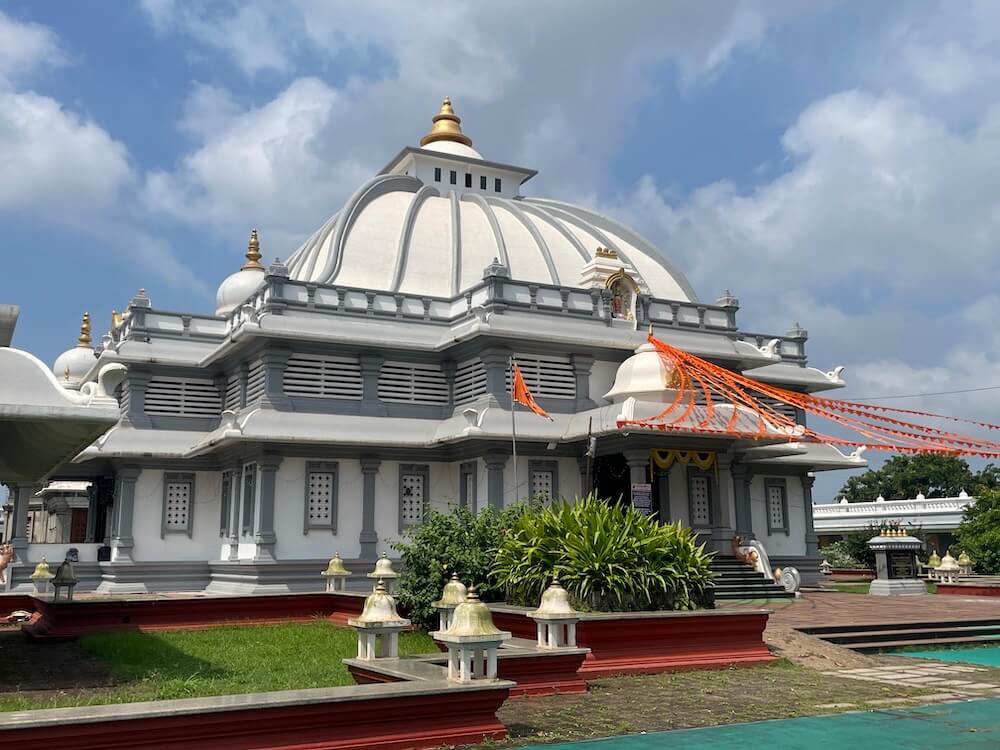
According to some experts, this original temple at Verna was built during the Chalukya period. After the renovation that took place a few years ago, the temple has attained its current grand form. There are many structures in this temple complex. This includes the main temple with a spacious Sabha Mandap (assembly hall), a Pushkarini, beautiful gardens, schools, offices, priests’ residences, Bhakta Niwas (pilgrim accommodation), multi-purpose halls, and a Kalyan Mandap. The temple complex is spread over several acres. There is a Pushkarini in front of the main entrance of the temple. To the right of the temple stands an eight-tiered Deepmal (lamp tower) on an octagonal base. On each tier of this Deepmal, there are lamp niches, and at the top, there is a structure resembling a canopy. The structure of the temple consists of a Mukhamandapa (entrance porch), a grand Sabha Mandap, and the Garbhagriha (sanctum sanctorum).
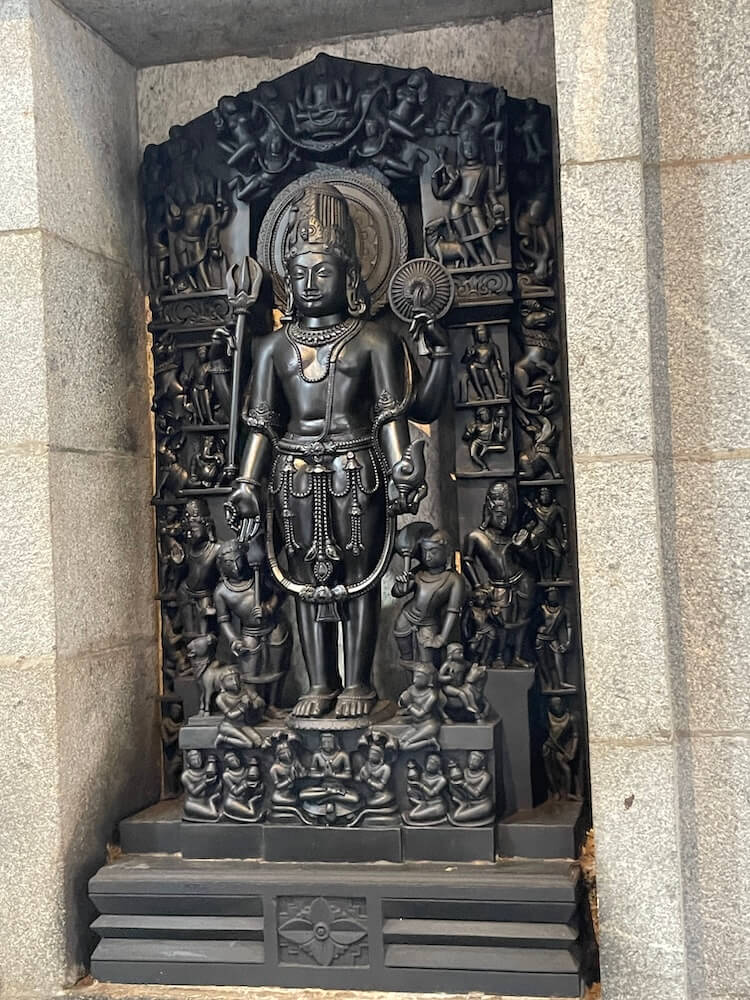
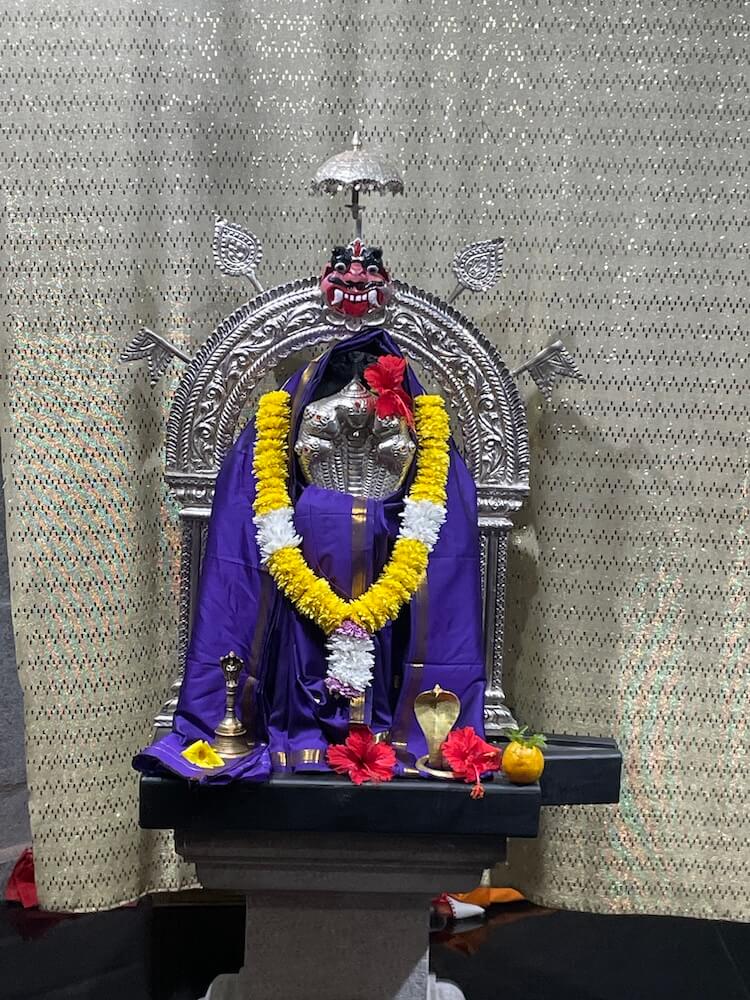
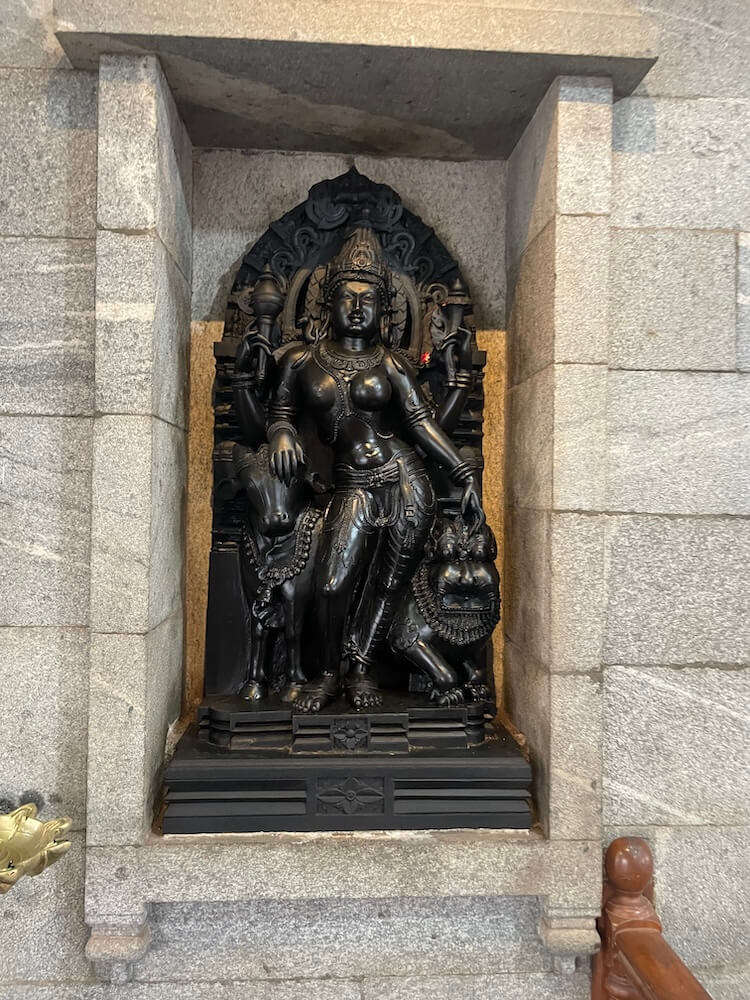
To enter the Sabha Mandap of this temple, which is situated on a high plinth, one has to climb seven steps from the Mukhamandapa. One enters the enclosed Sabha Mandap of the temple through an entrance with pillared branches. Several deities are installed in this Sabha Mandap and in the sub-shrines adjacent to the Garbhagriha. These include Ganapati, Nagadevata, Sateri, Mahalaxmi, Chandramouleshwar, Adi Shankaracharya, and Sharada Devi. Each of these sub-shrines has a circumambulation path (Pradakshina Marg). The walls of the main Garbhagriha are made of stone. In the niches on both sides of the entrance to the Garbhagriha, idols carved from black stone with intricate workmanship are installed. One of them is Ardhanari Nateshwara, which is considered a combined form of Lord Shiva and Goddess Parvati. The idol on the other side is Harihara, which is a combined form of Lord Shiva and Vishnu. Above the door frame is a Kirtimukha. Goddess Mahalasa Narayani is situated on a Vajrapitha in the Garbhagriha. It is said that this four-armed idol of the Goddess was carved from the Gandaki stone of Nepal. The Goddess holds a Trishula, a sword, a demon’s head, and a vessel in Her four hands. She stands upon a demon and wears the Yajnopavita (sacred thread). The Yajnopavita is generally worn by men; however, as an exception, it is seen worn in some incarnations of Goddess Parvati. Apart from the Sabha Mandapa and the Shikhara over the main sanctum sanctorum, there are also Shikharas over the sub-sanctums of this temple.
Outside the main temple, there is a temple of Suvarnakarshan Bhairava. The literal meaning of this name is the Bhairava who attracts gold. Next to it is the Chausath Yogini temple. In this temple, there is Samhara Bhairava in the center, and beside Him, in a semi-circular arrangement, are the idols of the sixty-four Yoginis. Near the temple, there are other temples such as the Khandoba temple and the Hanuman temple.
Aarti is performed in the temple every morning and evening. Except during festival periods, devotees can have Darshan from 6:00 AM to 12:30 PM and from 4:00 PM to 8:00 PM. Many festivals are celebrated in the temple. Navaratri Utsav is the largest festival celebrated here. During this time, there is a large gathering of married women (Suvasinis). Apart from this, the Ram Navami festival is also celebrated on a grand scale. The annual festival of this temple is celebrated from the Shashthi to the Ashtami of the Krishna Paksha in the month of Chaitra. A Ratha Utsav (chariot festival) also takes place at that time. During this festival, a procession of the Goddess is taken out in a chariot. There is a Palkhi Seva every Sunday, in which the Goddess travels around the temple in a flower-decorated palanquin.
This sacred temple stands as a testament to deep spiritual devotion, ancient architectural grandeur, and rich local cultural traditions.
The sanctum sanctorum houses the divine idol consecrated according to ancient Vedic traditions, surrounded by serene courtyards and traditional temple architecture.
Navratri, Maha Shivratri, Annual Temple Jatra & Deepotsav
Compare and book flights, secure top-rated local hotels near the temple, hire reliable guides, and rent cars instantly.
Extend your pilgrimage by visiting other highly sacred temples located nearby.


Add ₹999 more to unlock FREE SHIPPING!
Your sacred cart is currently empty.
Shop Photo FramesFill in your delivery details below to place your order.
Add comment