
Add ₹999 more to unlock FREE SHIPPING!
Your sacred cart is currently empty.
Shop Photo FramesKhandoba is worshipped especially in Maharashtra, Karnataka, and Andhra Pradesh. There are fourteen main seats (peethas) of Khandoba across these three states. Yadgir is the only such site located in Andhra Pradesh. Adimailar, Mangasuli, Mailarlinga, Deverguddu, and Mannamailar are the five sites in Karnataka, while Jejuri, Andur, Naldurg, Nimgaon, Shengud, Pali, Satare, and Bale are the eight sites in Maharashtra. Like all other sacred sites, devotees believe that the ‘Jagrut’ (awakened) Khandoba at Bale, near Solapur city, grants their prayers.
According to the villagers, this temple is about four to five hundred years old. The legend of the temple states that Lord Mahadev took the avatar of Khandoba to destroy the demons Mani and Malla. After slaying the demons, Khandoba established himself at Adimailar in Karnataka, which is why it is considered the original seat of Khandoba. Later, King Nal and Damayanti performed deep devotion to Khandoba at Andur in Dharashiv district. Khandoba was pleased with them. Damayanti requested that Khandoba establish himself at Andur, and thus, Khandoba was installed there. Mankoji Patil of Bale village used to visit Andur regularly for the deity’s darshan. As he grew old and found it impossible to travel, he requested the Lord to come to his village. The Lord agreed, saying, “I will follow you in the form of a child. However, the moment you look back, I will establish myself right there.” The Lord began to follow him. As soon as they reached the Patil Wada in the village, Mankoji Patil looked back to see if the Lord was following him. At that very moment, the Lord stopped there. Later, the Patil built a temple at this spot. Since the Lord arrived here in the form of a child (Bal), the village came to be known as Bale.
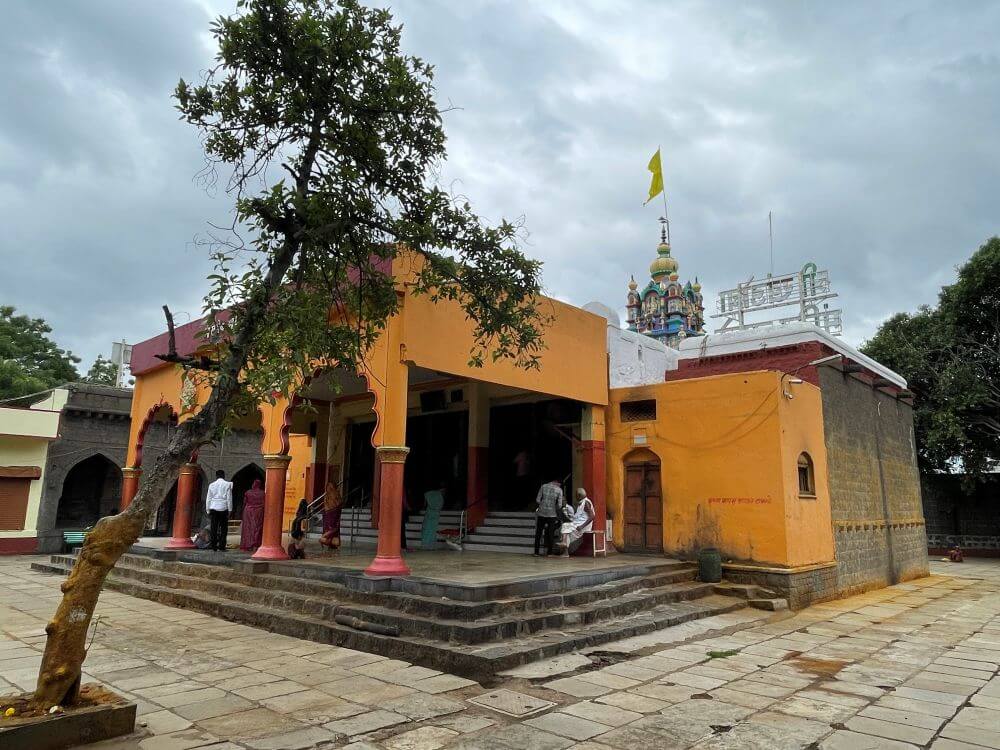
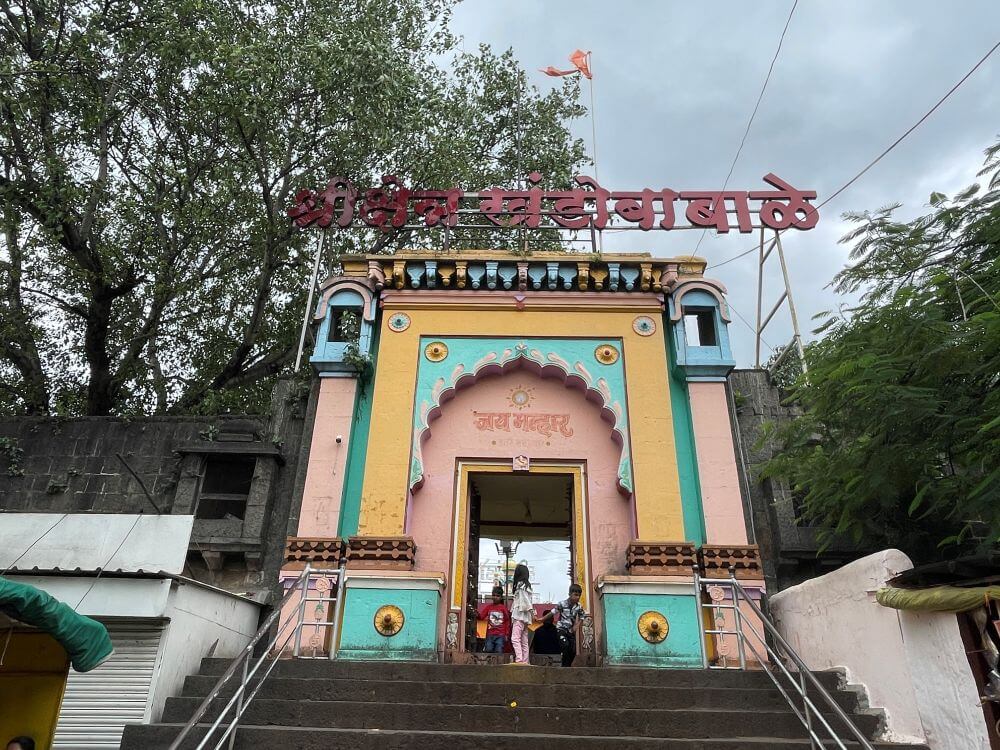
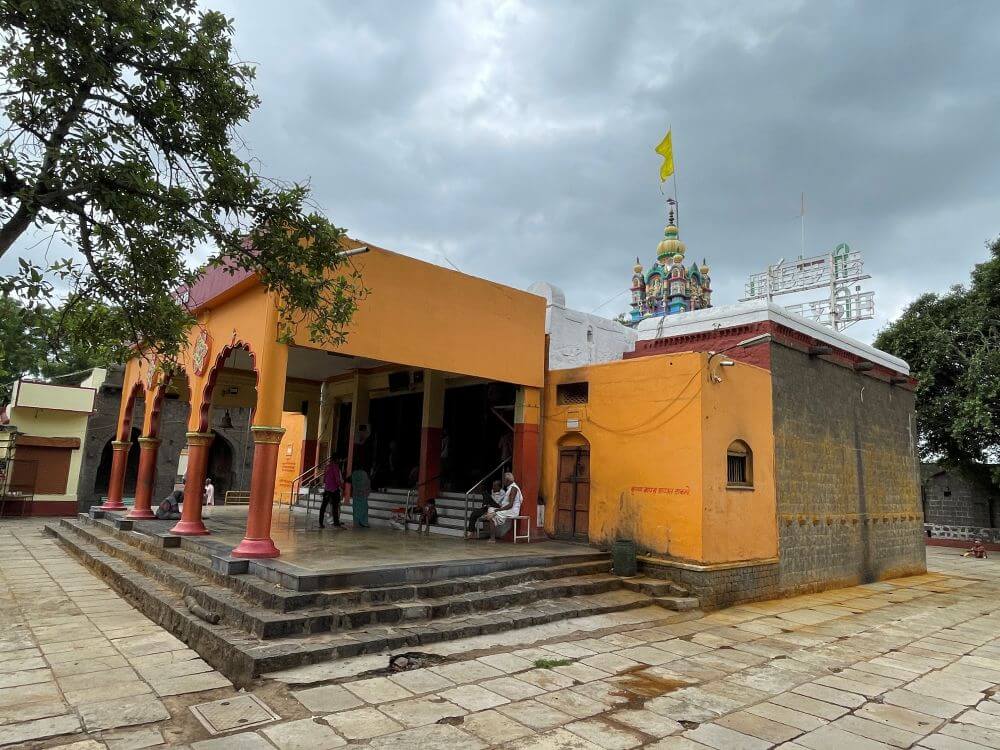
Bale village is located on the Pune-Solapur highway. The Khandoba temple is situated within the Patil Wada. There are shops selling worship materials on both sides of the road leading to the temple. The temple has two entrances, one on the north and one on the east, within its sturdy fortification walls. Since the temple is built about five to six feet higher than the road, there are eleven stone-carved steps in front of both entrances. At the top of the steps, in the center of the platform, is a tortoise sculpture. There are guardian sculptures (dwarapalas) at the base of the door frames. On the lintel (lalatbimba) is an image of Lord Ganesha, and above the architrave is a moonstone (chandrashila). There are Kirtimukhas on both sides of the moonstone. The decorative pillars on both sides of the entrance support a torana. The two-story eastern entrance has a nagarkhana (drum house) on the upper floor. Both entrances have guard rooms on the inner sides, leading into the temple courtyard.
The spacious courtyard has seating for devotees. There is a small temple of Maruti in the courtyard, housing a black stone idol of Maruti sitting in a meditative Padmasana posture. Beside the temple, on a stone platform, stands an ancient lamp pillar (deepmal). Opposite the Hanuman temple is a Ganesha temple, which houses a standing black stone idol of Ganesha. There are lamp pillars beside this temple as well. In the center of the courtyard, on a carved stone platform, are the brass footprints (padukas) of Khandoba and Banubai. In front of the platform are two small lamp pillars. Under the Audumbar tree in the courtyard, there is an idol of Narsoba smeared with vermilion. The worship of the deity begins by pouring water over this Narsoba idol. The temple has a kitchen where the deity’s food is prepared on traditional hearths. In front of the temple, there is a stone Tulsi Vrindavan, Nandi, a Shiva Linga, and several ancient sculptures.
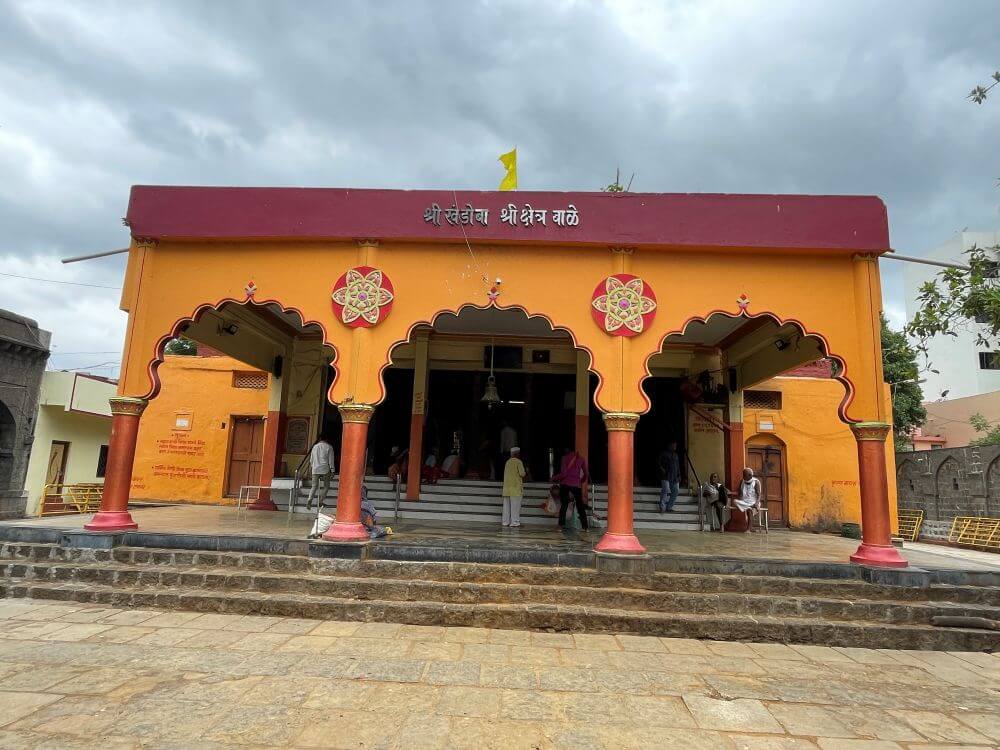
The temple structure consists of an Ardhamandapa, a Sabhamandapa, and a Garbhagriha (sanctum sanctorum). The Ardhamandapa appears to have been built later, attached to the original Sabhamandapa. The Ardhamandapa is higher than the courtyard, and the Sabhamandapa is higher than the Ardhamandapa. There are steps to move from the courtyard to the Ardhamandapa and from there to the Sabhamandapa. A room adjacent to the Ardhamandapa houses the deity’s chariot, ancient masks, and ritual vessels. On this side is the ‘Palang Mahal’ (bed chamber), where the silver masks of Khandoba used to be kept during festivals.
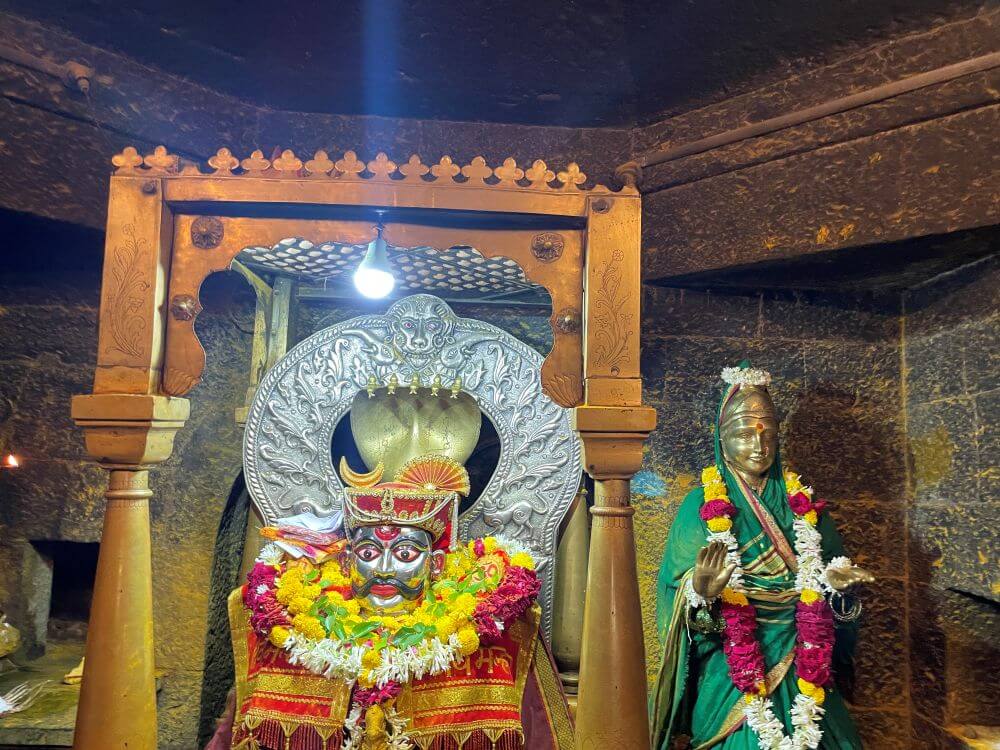
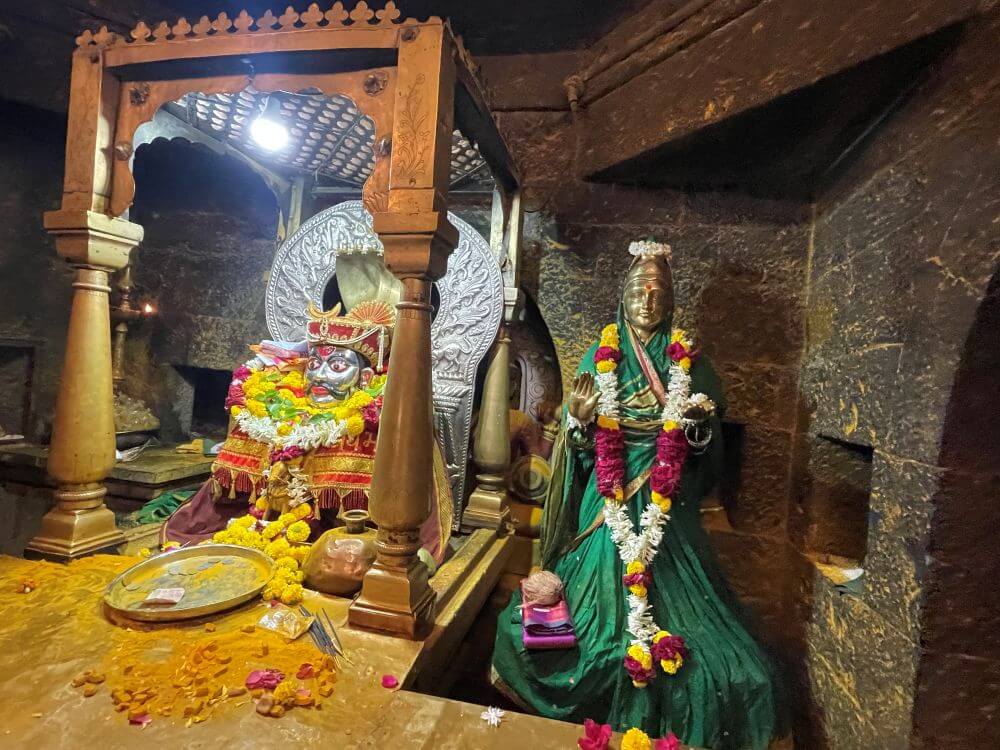
The enclosed Sabhamandapa has four rows of six square wooden pillars each, all standing on stone bases. Ahead lies the entrance to the Garbhagriha. On both sides of the entrance, in the front wall of the sanctum, are niches for deities (devakoshthas). The door frames feature pillar carvings, and the lintel bears an image of Ganesha. Above the entrance is a balcony (sajja) and two Kirtimukhas. The architrave also features a moonstone and a Kirtimukha. Inside the Garbhagriha, the deity’s Linga is placed on a Vajrapitha (diamond pedestal) within an ornate frame (makhar), adorned with a silver mask of Khandoba. A brass cobra holds a canopy over the deity. Beside the deity, on the Vajrapitha, is the idol of Goddess Mhalasa. Behind the deity is a silver prabhaval (halo). Behind the halo are the idols of the deity’s armed bodyguards. There are windows in the sanctum for light and ventilation. It is said that for a few days of the year, the morning sun rays from the eastern window fall directly on the deity’s feet. The octagonal ceiling of the sanctum features circular carvings in the center.
Behind the Garbhagriha, on a pedestal, is the Chintamani stone. Devotees place their hands on this stone to seek the deity’s guidance (kaul). It is believed that if the Chintamani rotates to the right after placing one’s hand on it, the devotee’s wish will be fulfilled. The roof of the sanctum has a four-tiered square shikhara. Each tier of the shikhara features niches with various deity idols. The shikhara is adorned with several urushringi (miniature) shikharas, minarets, and pillar carvings. At the very top, there are two amalakas stacked one above the other, crowned by a kalasha.
Khandoba’s Navratri festival is celebrated with great enthusiasm from the first to the sixth day of the bright fortnight of Margashirsha. Every Sunday in the month of Margashirsha, a procession (chhabina) of the deity is taken out. During this time, programs such as Maha-abhishek, bhajans, Mahaprasad, jagaran, gondhal, and aradi dance are organized. Mahaprasad is served every Sunday from 10:00 AM to 2:00 PM. All festivals like Chaitra Padwa, Dussehra, and Diwali are celebrated in the temple. The number of devotees visiting for darshan is higher on Sundays, Shashthi, Purnima, and Amavasya.
This sacred temple stands as a testament to deep spiritual devotion, ancient architectural grandeur, and rich local cultural traditions.
The sanctum sanctorum houses the divine idol consecrated according to ancient Vedic traditions, surrounded by serene courtyards and traditional temple architecture.
Navratri, Maha Shivratri, Annual Temple Jatra & Deepotsav
Compare and book flights, secure top-rated local hotels near the temple, hire reliable guides, and rent cars instantly.
Extend your pilgrimage by visiting other highly sacred temples located nearby.


Add ₹999 more to unlock FREE SHIPPING!
Your sacred cart is currently empty.
Shop Photo FramesFill in your delivery details below to place your order.
Add comment