
Add ₹999 more to unlock FREE SHIPPING!
Your sacred cart is currently empty.
Shop Photo FramesIn India, especially in South India, the influence of Shakta traditions is particularly evident. Consequently, there is a greater abundance of temples and Shakti Peethas dedicated to the Goddess in the southern regions. Tulja Bhavani is the Kuladevi (family deity) of Chhatrapati Shivaji Maharaj, the revered deity of Maharashtra. This Goddess possesses many names and forms, and Rupa Bhavani is one such name. The ancient and famous temple of Rupa Bhavani is located in Bhavani Peth in the city of Solapur. Devotees hold a deep faith that the living Goddess here grants their prayers.
It is said that this temple is two hundred to two hundred and fifty years old. According to legend, Bandoba Pujari used to work as a farm laborer in the field of a local moneylender named Shah. While he was clearing and plowing the fallow land, his plow struck a stone idol that emerged from the ground. As the idol appeared to be the exact likeness of Tulja Bhavani, the words “Rupa Bhavani” (the form of Bhavani) spontaneously escaped Bandoba Pujari’s lips. The people gathered there began to address the Goddess by this name. As the gathered devotees began to pray to the Goddess and their wishes started to be fulfilled, the fame of the Goddess being “Jagrut” (awakened/living) spread throughout the city. This led to a surge of devotees flocking for her darshan. Later, the moneylender Shah built a temple for the Goddess at this site. To this day, the descendants of Bandoba Pujari serve the Goddess in this temple.
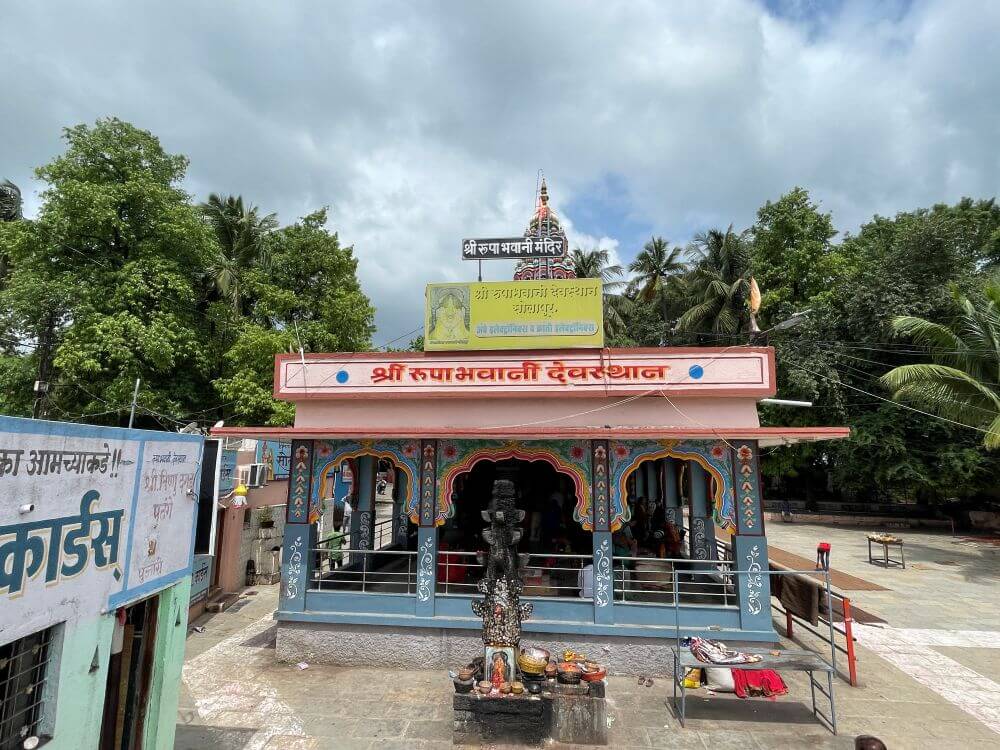
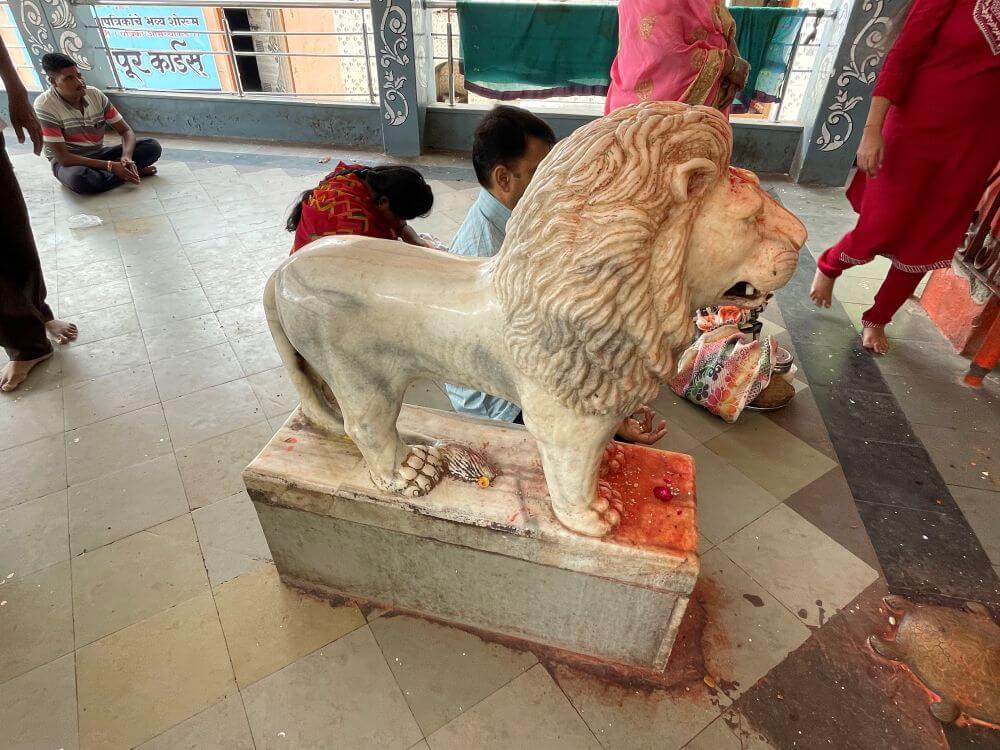
The temple is surrounded by a sturdy fortification with a two-storied entrance gate. Near the entrance, there are several shops selling worship materials. On the floor above the entrance is the Nagarkhana (drum house). Inside the entrance, there are guard rooms on both sides and a staircase leading to the upper floor. Since the spacious courtyard of the temple is at a lower level than the entrance, there are steps to descend. A small garden in the courtyard contains various types of flowering plants. In front of the temple, there is a small stone platform with Padmapadukas (footprints) placed upon it. Beside it, on a larger platform, stands a Deepmala (lamp tower). The base of the Deepmala features worn and ancient sculptures. The temple structure consists of a Sabhamandapa (assembly hall), Antarala (vestibule), and Garbhagriha (sanctum sanctorum). The open-style Sabhamandapa has seating arrangements for devotees on the left and right sides. In the Sabhamandapa, a total of ten ornate pillars on three sides are connected by arched gateways. There are baskets for flour and salt in the Sabhamandapa. Devotees coming for darshan offer items like flour, salt, oil, and grains as ‘Jogwa’. In the Sabhamandapa, there is a Yajna Kunda (sacrificial fire pit), and in front of it, on a platform, are a marble lion sculpture and a tortoise sculpture on the ground.
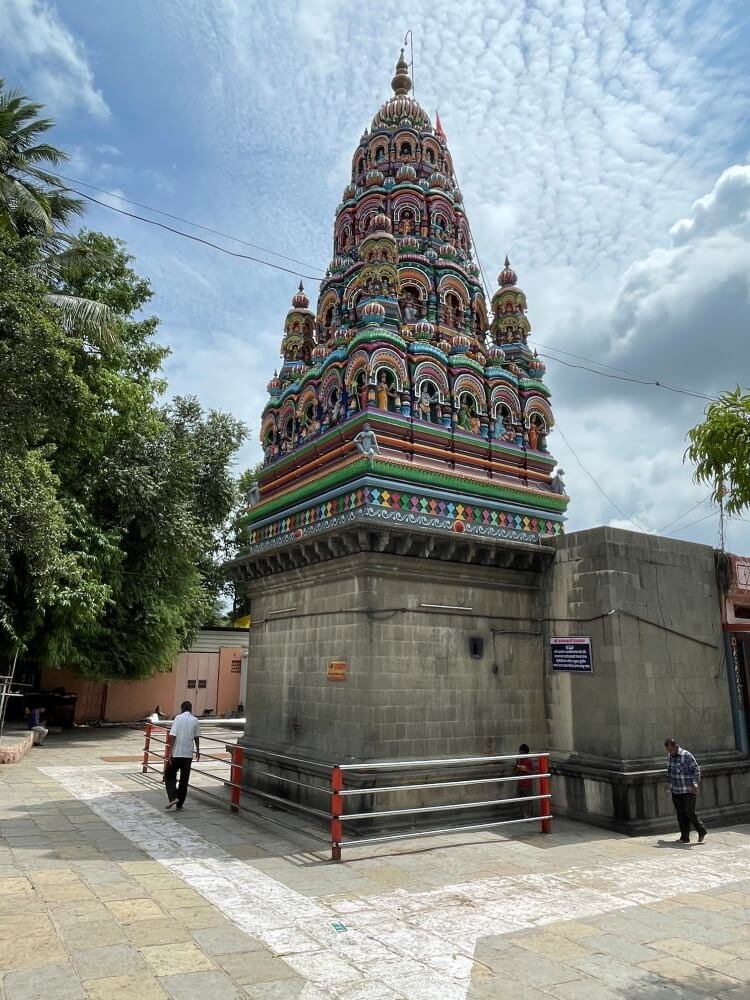
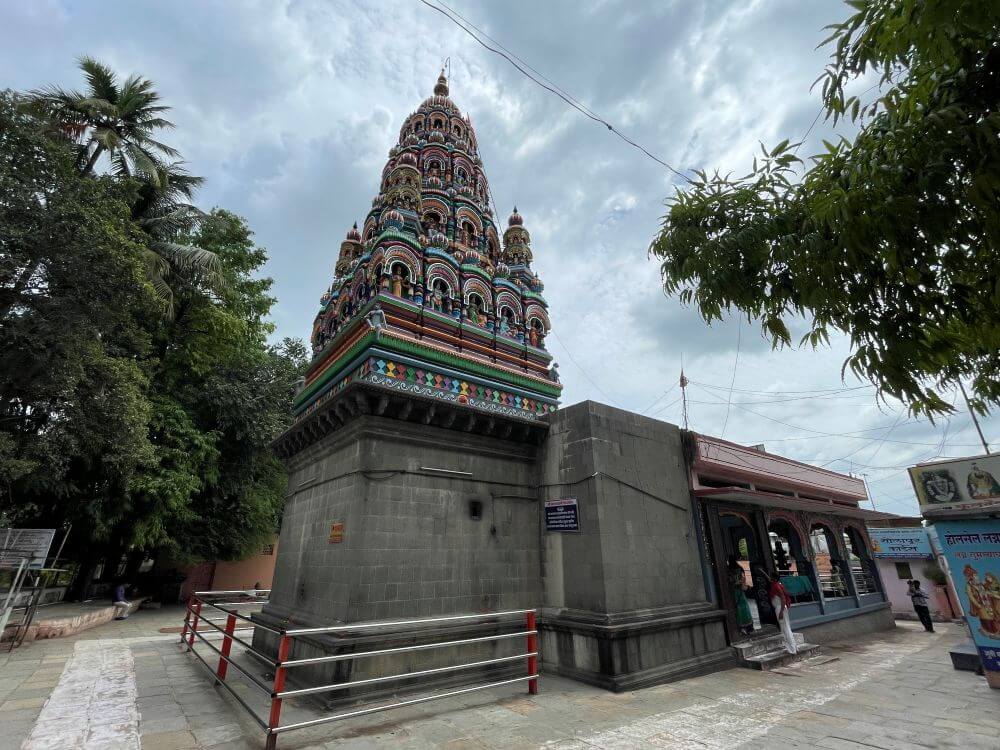
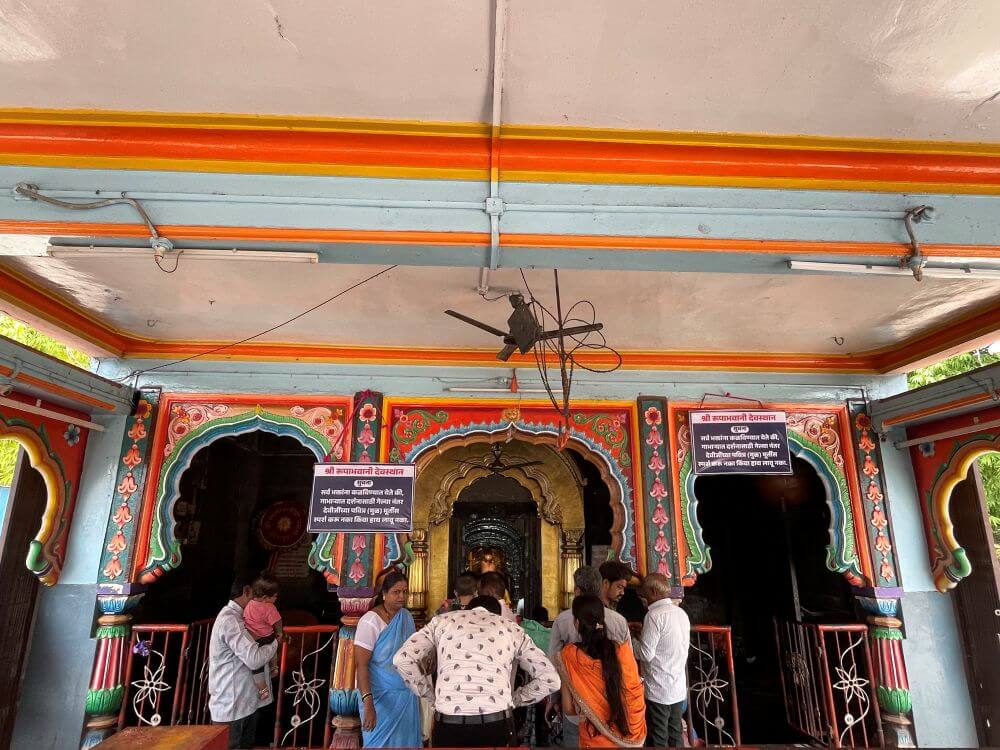
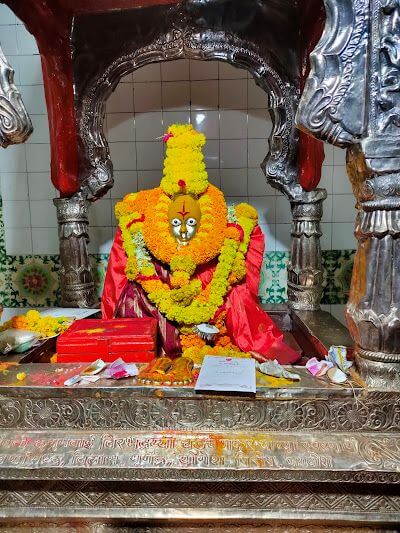
Further ahead is the entrance to the Antarala, featuring three arched gateways supported by four ornate circular pillars. The pillars and their arches are painted in various colors. Here, Padmapadukas and the Utsava Mukhavata (festival mask) of the Goddess are kept on a table. During festival periods, devotees must take darshan from this point. As the Antarala is at a lower level than the Sabhamandapa, one must descend two steps to enter it. Adjoining the front wall of the Garbhagriha are an ancient Shiva Linga and vermilion-smeared stone idols. The Nagara (drum) is also located here. Beyond this is the entrance to the Garbhagriha. The door frames are carved with floral patterns, and the Lalatabimba (lintel) features an idol of Lord Ganesha. There is a Kirtimukha on the architrave. On both sides of the entrance, circular pillars with vertical fluting stand on square bases. Inside the Garbhagriha, the idol of Goddess Rupa Bhavani is placed on a silver throne upon a Vajrapitha. The Goddess wears a silver mask and is adorned with various garments and jewelry. Behind the idol, in a golden Prabhavali (halo), there is a Sheshnaga in the center, topped with a Kirtimukha and a Makara Torana. The roof of the Garbhagriha features a four-tiered Dravidian-style Shikhara (spire). There are monkey sculptures at all four corners of the Shikhara. The first tier of the Shikhara is square and contains five Devakoshtakas (niches) on each side. The second tier features three-layered canopy-like pillars at each of the four corners. The second, third, and fourth tiers of the Shikhara each contain twelve Devakoshtakas. All these niches house idols of various deities. At the pinnacle of the main Shikhara is an Amalaka, topped with a Kalasha and a flag.
Beside the Rupa Bhavani temple are small auxiliary temples. In the temple to the left, there is an idol of Goddess Parvati in black stone on a Vajrapitha. The Goddess holds a trident and a shield in her hands. Beside the idol, there is a Shiva Linga on a Vajrapitha. In the temple to the right, there is a vermilion-smeared idol of Hanuman on a Vajrapitha, along with a Shiva Linga, Nandi, and a Nagashila (serpent stone).
Since Rupa Bhavani is a form of Tulja Bhavani, all daily rituals and festivals of the Tulja Bhavani temple are celebrated here. On Tuesdays and full moon days, the Goddess is taken out in a procession (Chhabina). During the Sharadiya Navaratri festival, the Goddess is taken out in a procession in a different form each day. On Dussehra, the Goddess’s palanquin procession is taken out. At this time, the Goddess goes to the city’s Park Ground, performs Seemollanghan (crossing the boundary), and returns to the temple in the palanquin. The Chhabina is also held on Kojagiri Purnima. Chaitra Navaratri and Shakambhari Navaratri are also celebrated in the temple. All festivals and celebrations throughout the year are observed in the temple.
This sacred temple stands as a testament to deep spiritual devotion, ancient architectural grandeur, and rich local cultural traditions.
The sanctum sanctorum houses the divine idol consecrated according to ancient Vedic traditions, surrounded by serene courtyards and traditional temple architecture.
Navratri, Maha Shivratri, Annual Temple Jatra & Deepotsav
Compare and book flights, secure top-rated local hotels near the temple, hire reliable guides, and rent cars instantly.
Extend your pilgrimage by visiting other highly sacred temples located nearby.

Add ₹999 more to unlock FREE SHIPPING!
Your sacred cart is currently empty.
Shop Photo FramesFill in your delivery details below to place your order.
Add comment