
Add ₹999 more to unlock FREE SHIPPING!
Your sacred cart is currently empty.
Shop Photo FramesThe village of Khardi is renowned for the Samadhi Mandir of Sadguru Sitaram Maharaj Mangalvedhekar, a saint who always remained in the state of Unmani and was a disciple of Swami Samarth. This village, sanctified by the presence of Sitaram Maharaj, is also known as ‘Prati Gangapur’. The Maharaj’s Samadhi Mandir here is considered a Siddha Sthan. Devotees firmly believe that individuals afflicted by spirits are liberated from them upon being brought here. Many devotees also come here to make vows in order to have their heartfelt desires fulfilled.
Regarding Sitaram Maharaj, the information is that he was born in the village of Mangalvedhe, the home of the great saint Damajipant of the Bahmani era, three years before the War of Independence of 1857, on Chaitra Shuddha 9, Shake 1776. His father’s name was Bapurao. He was employed in government service. Sitaram Maharaj lost his mother’s protection in his early childhood. Distressed by the harassment from his stepmother, he left home at the age of twelve. From Mangalvedhe, he came to Akkalkot. A legend regarding this is that when he was 4-5 miles away from Akkalkot, Swami Samarth knew through his divine intuition that he was coming and said to his devotees, “Oh, look, Seetya has come. Bring him here quickly.” After this, Swami kept Sitaram Maharaj with him for about seven years.
It is said that one day, Swami Samarth called Sitaram Maharaj near Him and said, “Now there is nothing left between you and Me. Go back to where you came from. This is the marketplace of Kali Yuga. Live here as mad Sitya.” Following Swami’s command, he returned to Mangalwedha. He resided there for many years. During this period, people considered him to be mad. He had no concern for food or clothing. Swami’s Devotees who have had his direct darshan say that he always remained in a state of Unmani. Even if a person met him five hundred times, he would not retain any recognition of their name or form. He was a Vritti-shunya Yogeshwara, immersed in the experience of eternal bliss. Once, when some mischievous people made him stand for a Kirtan, he spoke only one sentence: “The lamp is inside the house, yet one stumbles at the doorstep.” This sentence gave everyone a realization of his wisdom. During this period, he gave many people proof of his miraculous powers.
Sitaram Maharaj shared affectionate bonds with Gondavalekar Maharaj, Laxmanbuva Vakharkar, and the ruler of Sangli, Shrimant Dhundirao (Tatyasaheb) Patwardhan. Whenever the Patwardhan King came for the Maharaj’s darshan, he would specially bring a dozen kafnis for him. The Maharaj would either give these kafnis to the poor or tear them into rags. He passed away on Kartik Vadya 13, Shake 1825, in the year 1903. At the very place where he renounced his mortal body, Their Samadhi temple has been constructed.
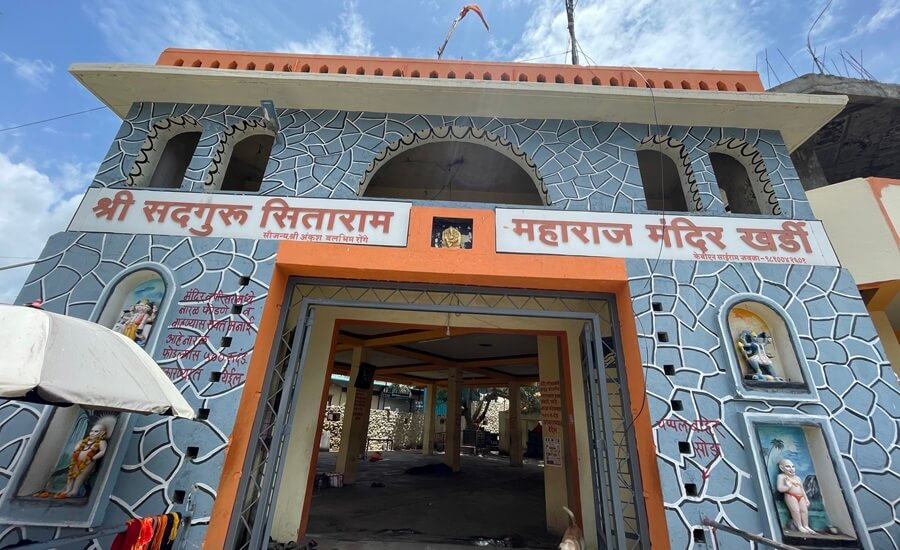
There is a boundary wall around the Samadhi temple of the Maharaj, located along the main road at the entrance of Khardi village. On the upper floor of the two-storied temple entrance gate, there is a Nagarkhana. On both sides of the entrance gate, there are niches containing idols of Dattatreya, Batu Vaman, Kalika Mata, and others. In the niche above the entrance gate, there is an idol of Ganpati. Through the entrance gate, one enters the spacious courtyard of the temple. In the courtyard, there are two platforms with circular Deepmalas that taper towards the top. In this courtyard, in front of the temple, a newly constructed Darshan Mandap has been built, and on the floor above it, there is a hall for cultural programs.
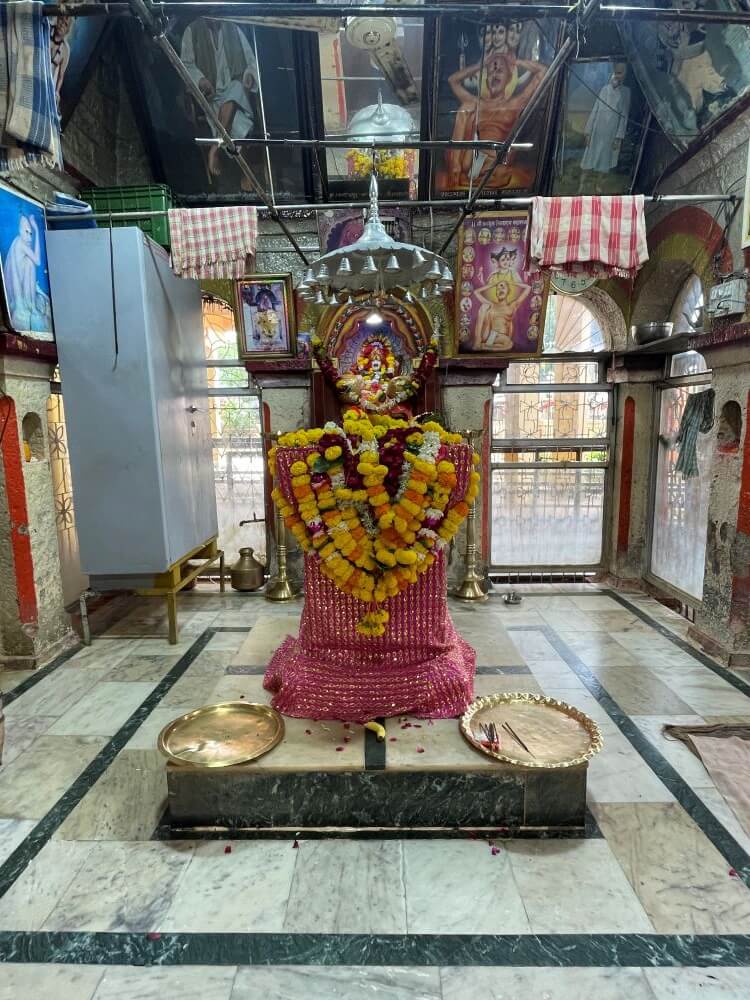
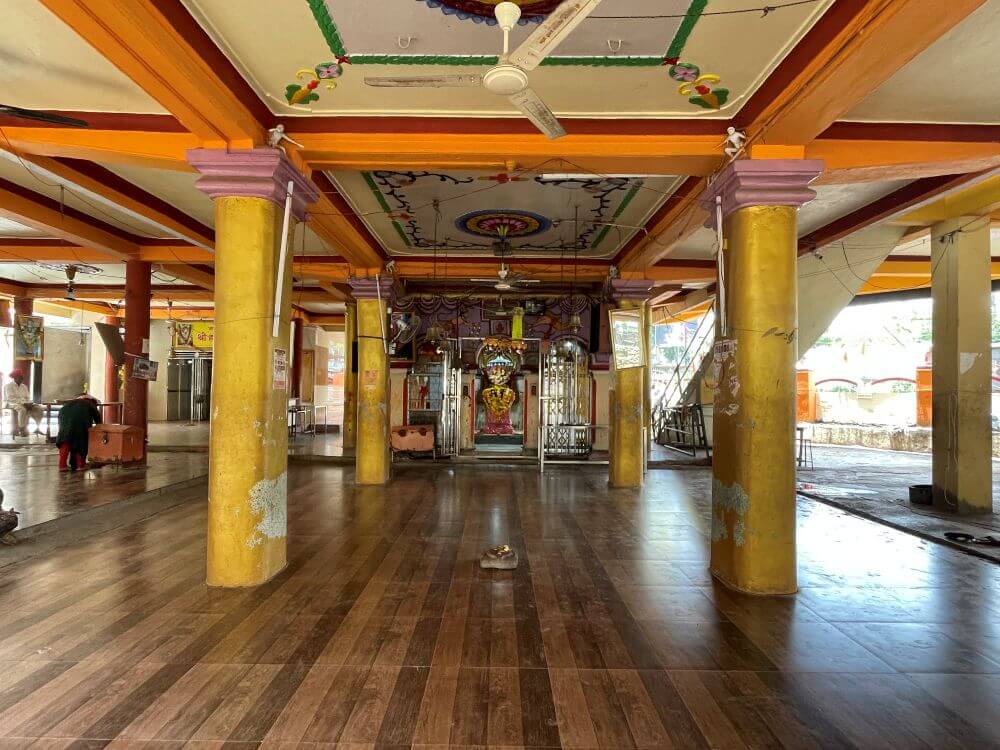
Ahead lies an open-style assembly hall. In the assembly hall, there are four rows of four circular pillars each. Beams rest upon the pillars, supporting the ceiling. Brass bells are hung from the ceiling. There is a circular design on the canopy. In front of the assembly hall is the sanctum sanctorum. In the center of the floor of the sanctum sanctorum is the Samadhi site of Sitaram Maharaj, and in the rear shrine is an idol of Maharaj in a meditative posture. On the roof of the temple, there are four small spires at each of the four corners. Each of these has two Amalakas and a Kalasha. In the center of the roof, the main spire is approximately twenty feet high. This circular spire features pillar carvings. At the apex of the spire, there are two Amalakas and a Kalasha placed one above the other.
Opposite the Samadhi Mandir, on the other side of the Sabha Mandapa, stands an ancient stone temple of Maruti. In the sanctum sanctorum, there is an idol of Maruti carved from black stone. Above the roof of the sanctum sanctorum, there is a spire that is approximately twenty-five feet high and tapers towards the top. In the middle two tiers of the four-tiered spire, there are twelve niches in each, containing idols of various deities. Below In the lower tier, there is a lotus petal ring, and in the upper tier, there are pillar carvings. At the apex of the Shikhara, there are two Amalakas placed one above the other, followed by a Kalasha. Adjacent to the Maruti temple is the Shri Ram temple. In this temple, there are idols of Shri Ram, Lakshman, Sita, and Dasa Hanuman.
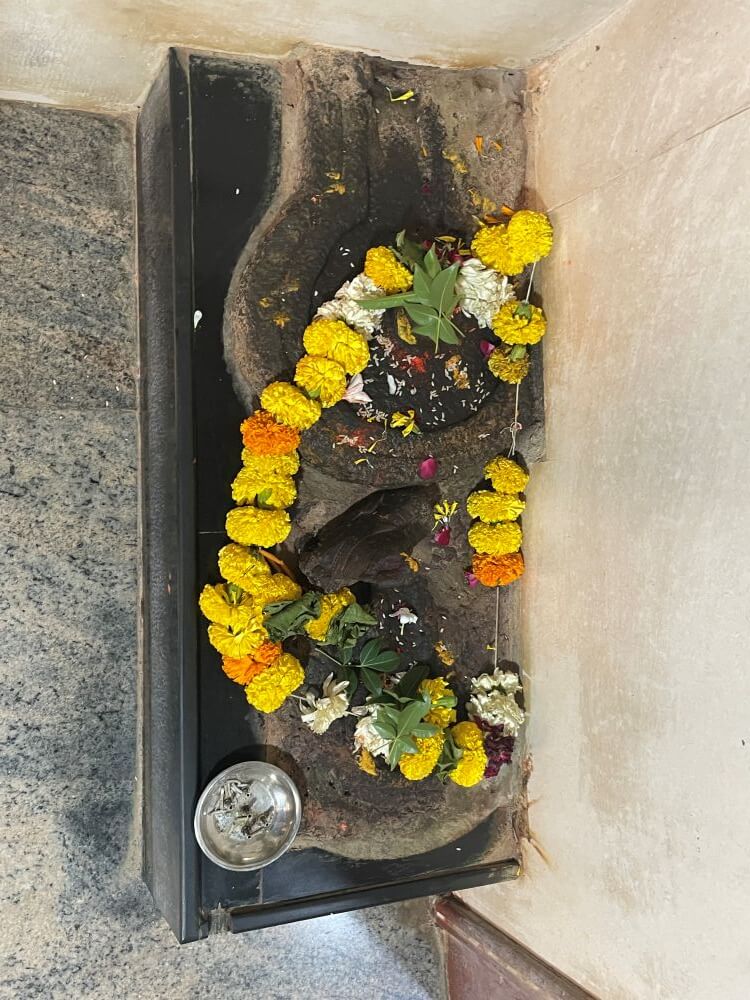
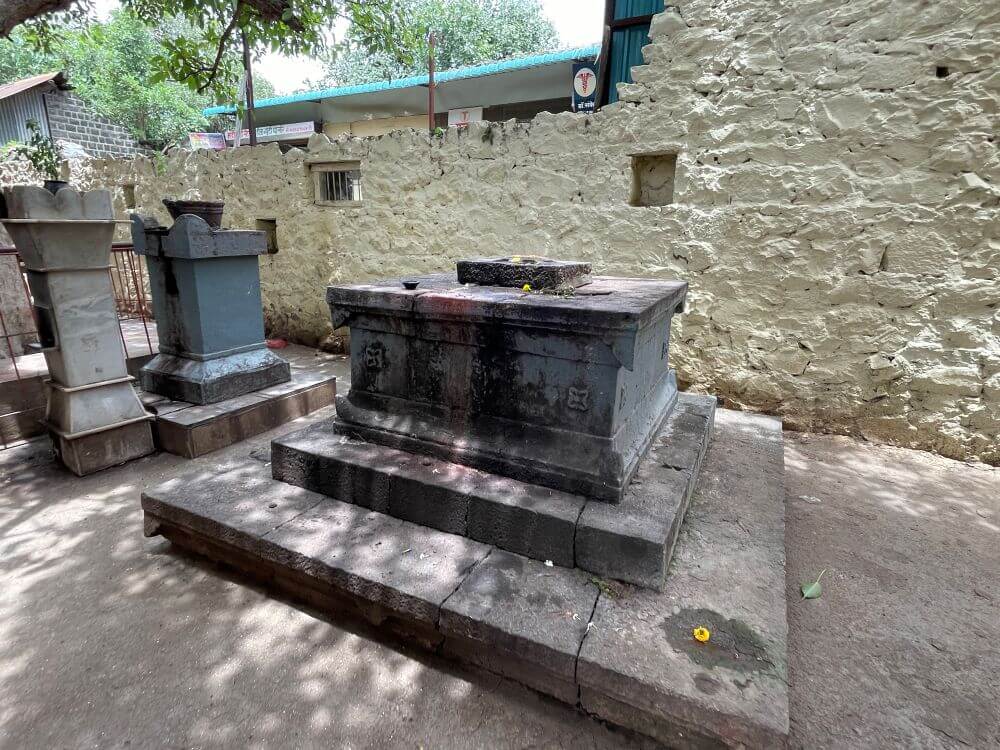
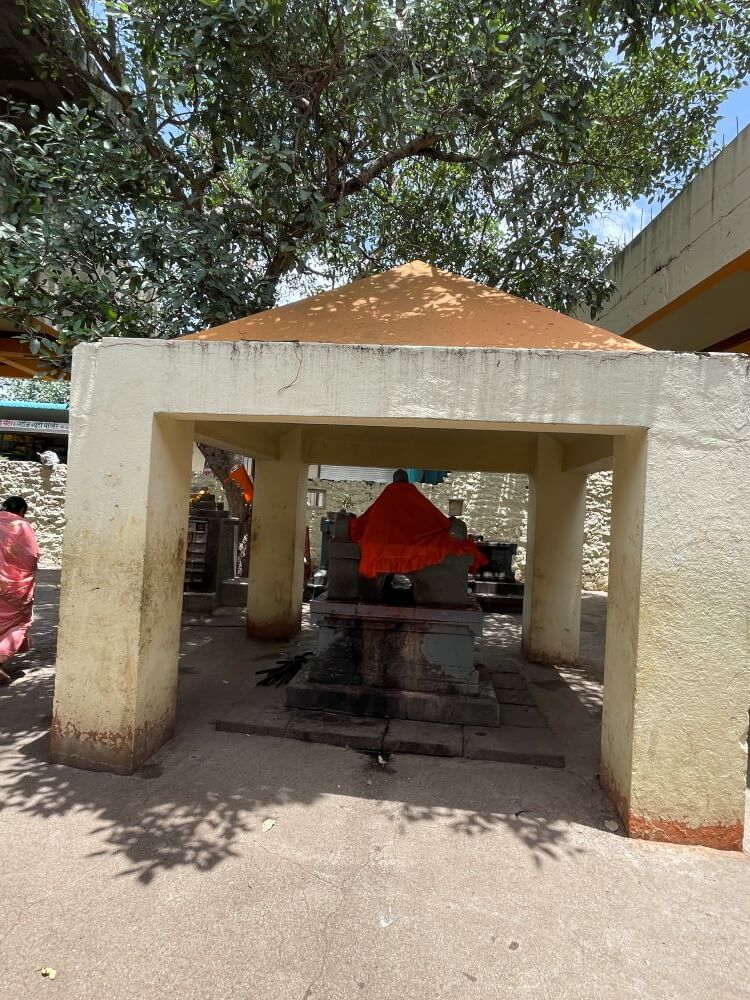
The Samadhi Mandap of Gosavi Maharaj, a disciple of Sitaram Maharaj, is located here. In the center of this Mandap stands the pedestal of Gosavi Maharaj’s Samadhi. The spire-shaped structure above the pedestal features window-like openings on all four sides. Inside these openings are iron tongs. It is believed that when a person possessed by spirits is brought here, they insert their body up to the waist through these openings, causing one of the iron tongs inside to touch their body. Following this, if the person bathes in the Tirtha pond located next to the temple, the tongs fall off, and the spirit possession is cured.
In this temple, the daily routine consists of Puja, Aarti, Naivedya, and Haripath, performed twice a day. The Maharaj’s Palkhi procession continues from Chaitra Shuddha Dwitiya until Vadya Trayodashi. On the occasion of the Maharaj’s Punyatithi, a flower shower is performed at twelve o’clock in the afternoon on the Shri’s Samadhi on Kartik Vadya Trayodashi. Following this, the Palkhi procession takes place. Devotees from the state as well as from regions like Karnataka, Gujarat, and Andhra Pradesh attend here. The Palkhi departs on foot towards Gangapur, marking the conclusion of the Yatra. During this period, an Akhand Harinam Saptah is organized here. Thousands of devotees are present here for the annual Punyatithi ceremony. Festivals such as Guru Purnima Utsav, Nirjala Ekadashi, Guru Dwadashi, Tripuri Purnima Utsav, Datta Jayanti, and Guru Pratipada are also celebrated here.
This sacred temple stands as a testament to deep spiritual devotion, ancient architectural grandeur, and rich local cultural traditions.
The sanctum sanctorum houses the divine idol consecrated according to ancient Vedic traditions, surrounded by serene courtyards and traditional temple architecture.
Navratri, Maha Shivratri, Annual Temple Jatra & Deepotsav
Compare and book flights, secure top-rated local hotels near the temple, hire reliable guides, and rent cars instantly.
Extend your pilgrimage by visiting other highly sacred temples located nearby.


Add ₹999 more to unlock FREE SHIPPING!
Your sacred cart is currently empty.
Shop Photo FramesFill in your delivery details below to place your order.
Add comment