
Add ₹999 more to unlock FREE SHIPPING!
Your sacred cart is currently empty.
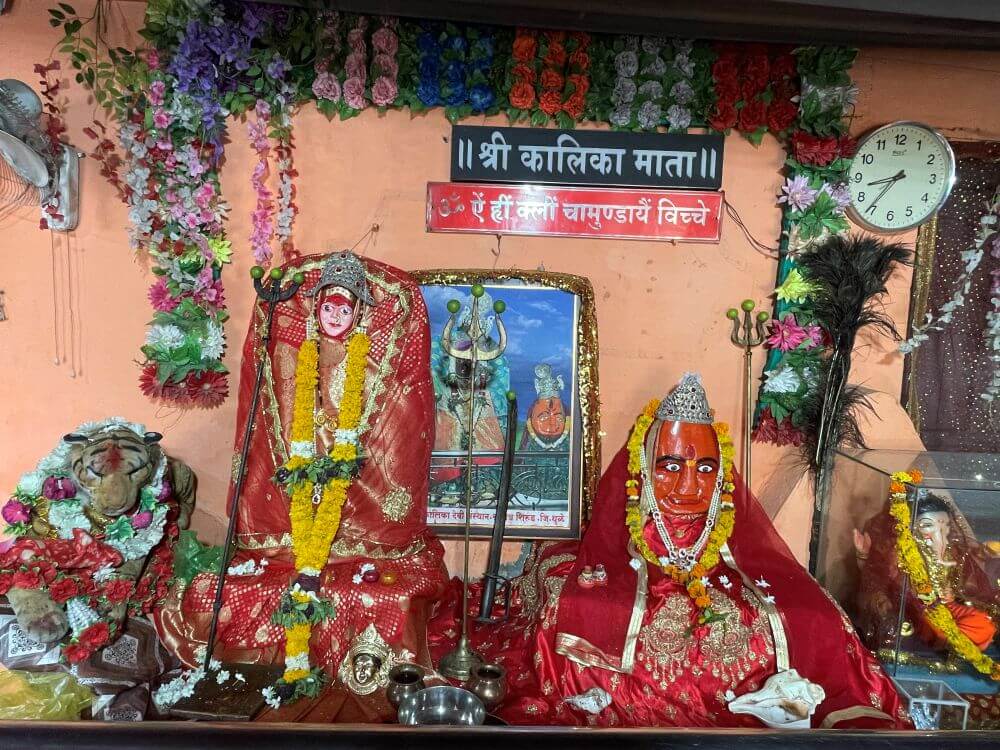
Shop Photo FramesThe region known in ancient times as ‘Rishika’ is the Dhulikapattan of today, which is the village of Dhule. The Dhangar community has a significant presence in the district. It is said that the district derives its name from Dhuloba Deva, the presiding deity of the Dhangar community. Dhuloba is a form of Lord Shiva. The Shaiva and Shakta traditions of worship are complementary to each other; hence, Shiva and Parvati are worshipped together. Kalika Devi is one of the many forms of Goddess Parvati. The ancient and spiritually awakened temple of this Kalika Mata, located in the village of Shirud in Dhule taluka, is famous. This Goddess is considered the Kuldevi (family deity) of 53 clans in this region.
According to mythology, Kalika is a form of Goddess Mahakali. The ‘Kalika Purana’ states that Kalika Devi was born from the womb of Mahamaya. According to references in the Mahabharata, Kalika is the daughter of Daksha Prajapati and the wife of Sage Kashyapa. The ‘Devi Mahatmya’ states that the primordial nature, Adimaya Bhagwati Mahalakshmi, created two forms: Mahakali from Tamoguna and Mahasaraswati from Sattvaguna. Thereafter, Mahalakshmi asked Mahakali and Mahasaraswati to create a pair of male and female beings according to their respective qualities. From this, the universe and creation were formed. Thus, it is believed that Mahakali is not only the destroyer but also the nurturer.
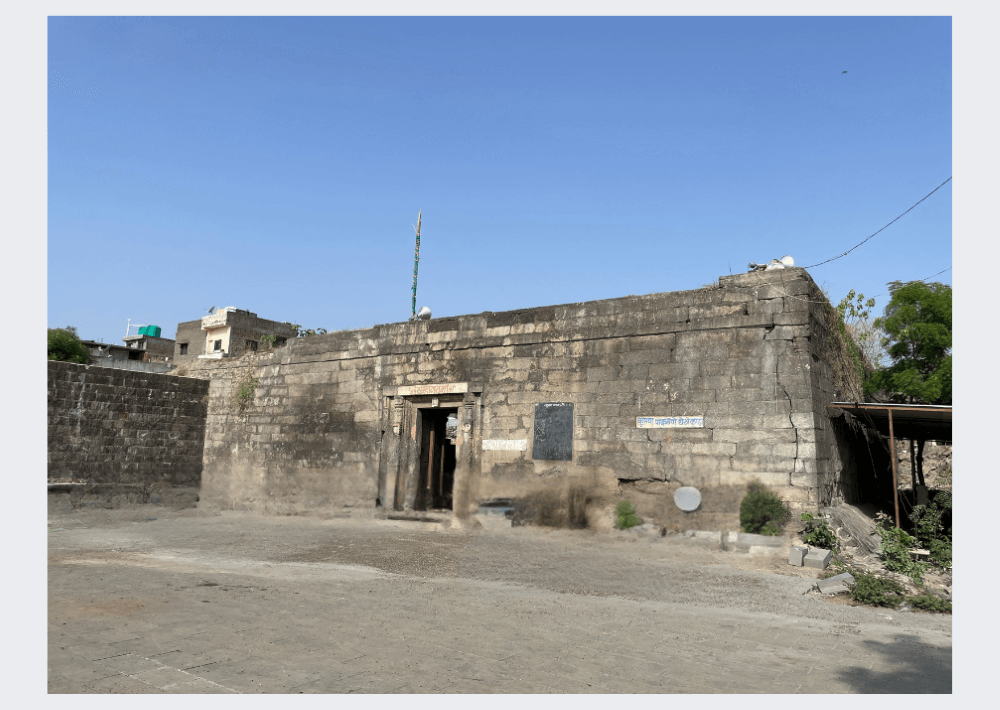
The Kalika Mata temple at Shirud is said to date back to the 12th century. The Hemadpanti architectural style and the intricate stone carvings confirm this. A legend associated with this temple says that gold vessels used to be obtained from a well in the temple courtyard. Devotees visiting the temple would write a list of the vessels required for cooking and drop it into this well. According to the list, gold vessels would emerge from the water of the well. After the devotees finished their cooking, they would return the vessels to the well. Once, a devotee became greedy and took the vessels home instead of returning them to the well. Since then, the vessels stopped appearing from the well. Similar legends are told about three other temples in Maharashtra. Interestingly, all three are temples of the Goddess. One is the Varadayini Mata temple at Walankondi (Taluka Mahad, District Raigad), and the second is the Chilai Devi temple at Bhatwade (Taluka Walwa, District Sangli). Devotees used to receive vessels from the lake at Walankondi and the well in the temple premises at Bhatwade. The third temple is that of Bhagwati Devi at Dhamapur (Taluka Malvan, District Sindhudurg), where it is said that jewelry used to be obtained from the lake.
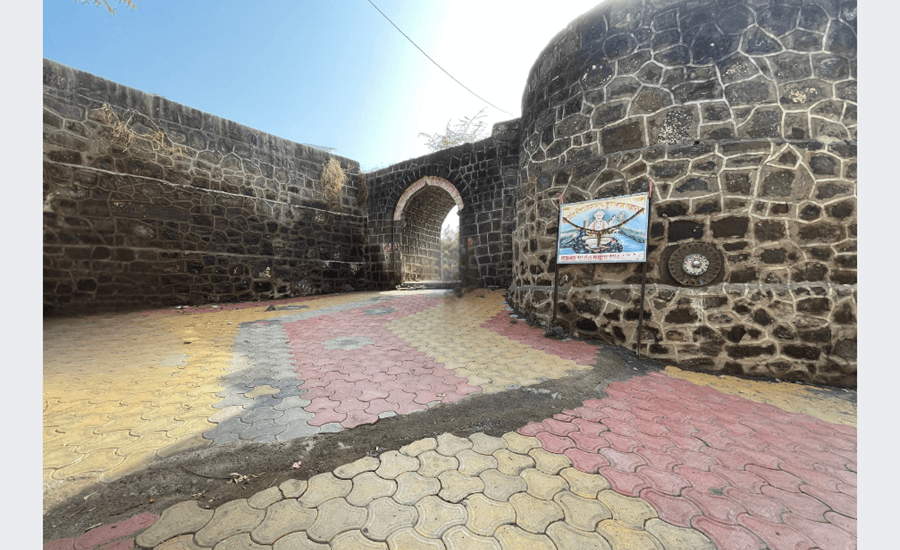
Situated at the confluence of the Bori and Mandur rivers, the first welcome arch of the Kalika Mata temple in this village is about one kilometer away. On the circular pillars on both sides of the road, there is a balcony, topped with tiger sculptures on both sides, and a relief sculpture of Kalika Devi on a crescent-shaped arch in the center. The second welcome arch is in the first stone fortification of the temple. Beyond this is a second boundary wall of the temple, about twelve feet high. On both sides of the temple entrance in this wall, there are ornate pillars and door frames. From here, one enters the temple courtyard. In the courtyard, there are platforms attached to the fortification on both sides of the entrance. On these platforms, there are pillars and brackets attached to the wall. It is said that there might have been a roofed dharmashala (pilgrim rest house) here at one time. Currently, religious rituals are performed on these platforms. In the courtyard, in front of the temple, is a Yajna Kund (sacrificial fire pit). Further ahead is a platform with a tiger sculpture.
The structure of the temple consists of a Mukhamandapa (entrance hall), Sabhamandapa (main hall), Antarala (vestibule), and Garbhagriha (sanctum sanctorum). One enters the Sabhamandapa through the Mukhamandapa, which has three steps and two pillars. There are some ancient sculptures attached to the outer walls of the Sabhamandapa. The Sabhamandapa has four rows of five ornate pillars each. A sculpture of Ganesha is carved on one of the pillars facing the entrance. The pillars are square at the base, hexagonal, octagonal, and circular above. At the top, there is a capital resembling a lotus flower, and above it are ornate brackets. On the brackets are beams, and above them is the roof. Each beam has lotus flower carvings. In the Sabhamandapa, on the left side, there is a vermilion-smeared idol of Ganpati in a niche, while on the right side, there is a face of the Goddess. The ceiling of the Sabhamandapa features an octagonal dome towards the periphery and a circular dome in the center. In the center of this dome, a sculpture with six bodies and one face is carved. The specialty of this sculpture is that a single face is connected to these six bodies. This is a symbol of the ‘Shadaripu’ (the six enemies of the mind). The sculpture suggests that six vices—lust (Kama), anger (Krodha), greed (Lobha), attachment (Moha), pride (Mada), and jealousy (Matsara)—hinder a single mind.
Further ahead is the entrance to the Garbhagriha. On the door frames, there are door guardians at the bottom and floral carvings above. Lord Ganesha is seated on the lintel. Leafy vine patterns are carved on the lintel strip. There are two idols of Kalika Devi in the Garbhagriha. One is a self-manifested (Swayambhu) stone in the form of a ‘Tandala’, and the other is a carved idol of black stone. It is said that this four-foot-tall black stone idol was found in the river. This temple does not have a Shikhara (spire) or a Kalash. At the back of the temple, there is an idol of a local deity in a niche. A short distance away is the ‘Kuber Well’, which is about sixty feet deep. The legend of the vessels being obtained from this well is associated with this very well.
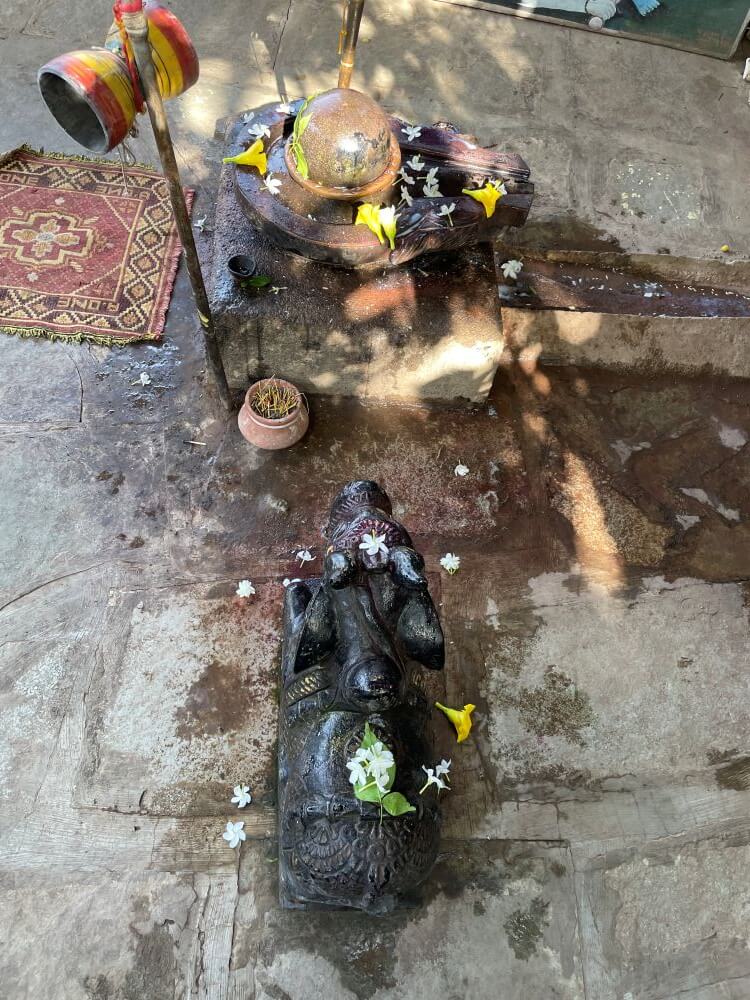
According to another legend, there is an underground tunnel from this well to the village of Parola. It is said that Rani Lakshmibai of Jhansi used to come here from Parola for the Goddess’s darshan through this tunnel. Although Lakshmibai’s father, Moropant Tambe, was originally from Parola, he later moved to Kashi. Lakshmibai, alias Manikarnika, was born in a mansion on the Assi Ghat in Kashi. She spent her childhood in Brahmavarta and went to Jhansi after her marriage. Since she did not reside in Parola, it is said that the story of her coming to the Kalika Mata temple, located about 35 km away, through an underground tunnel is merely a myth. There is a Shiva temple in the courtyard of this temple, which contains a Nandi and a Shiva Linga. Annual festivals like Navratri, Dussehra, and Diwali are celebrated in the temple. The annual Jatrotsav (fair) is celebrated in the month of February. As it is the Kuldevi of 53 clans, there is a constant flow of devotees coming for ‘Kulachar’ (family rituals). There is a tradition of offering sweet ‘Naivedya’ to the Goddess here.
This sacred temple stands as a testament to deep spiritual devotion, ancient architectural grandeur, and rich local cultural traditions.
The sanctum sanctorum houses the divine idol consecrated according to ancient Vedic traditions, surrounded by serene courtyards and traditional temple architecture.
Navratri, Maha Shivratri, Annual Temple Jatra & Deepotsav
Compare and book flights, secure top-rated local hotels near the temple, hire reliable guides, and rent cars instantly.
Add ₹999 more to unlock FREE SHIPPING!
Your sacred cart is currently empty.
Shop Photo FramesFill in your delivery details below to place your order.
Add comment