
Add ₹999 more to unlock FREE SHIPPING!
Your sacred cart is currently empty.
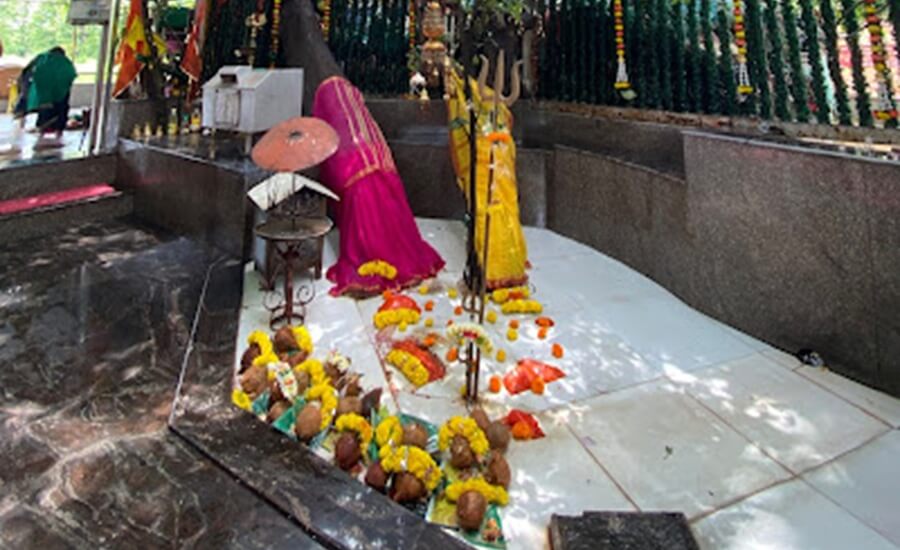
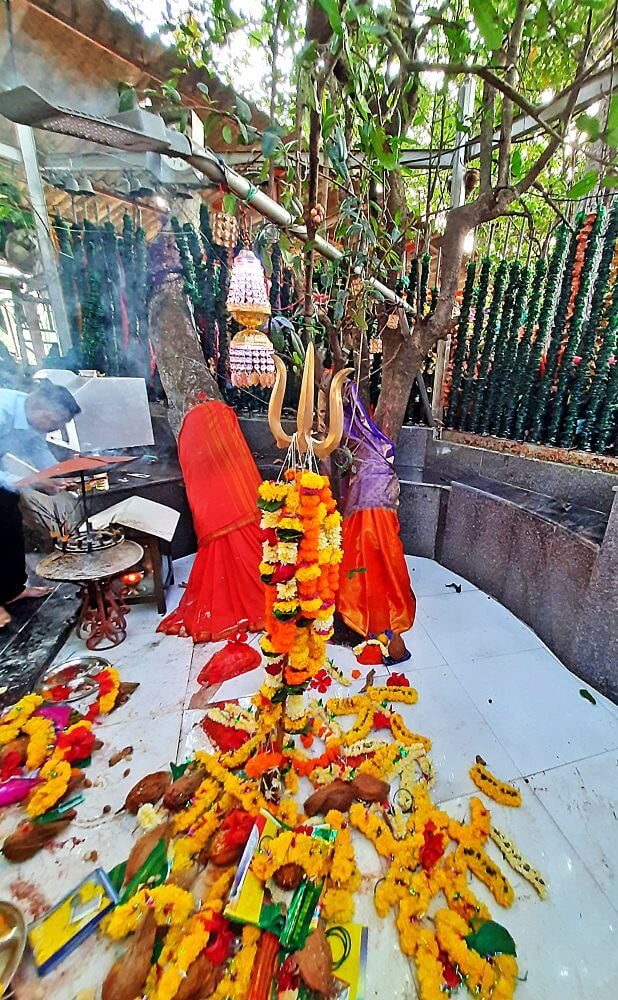
Shop Photo FramesThe village of Taloshi is located ten kilometers away on the road leading from Mahad to Raigad Fort. The awakened abode of Goddess Rangumata situated here is a place of faith for thousands of devotees. The unique feature of this site is that, in the conventional sense, there is no idol or temple of the Goddess. Two tree trunks draped in sarees represent the form of the Goddess here. It is said that the Goddess resides in an invisible form beneath these two trees. Along with the Mahad taluka, thousands of devotees from the states of Maharashtra and Gujarat also come to seek the blessings of the Goddess.
Taloshi is the only village situated at the base of Raigad Fort. Due to its geographical layout, characterized by the abundant waters of the Gandhari River and flat, low-lying plains, Taloshi served as a military encampment during the era of Chhatrapati Shivaji Maharaj. Before embarking on numerous battles, soldiers would gather at this base and depart for their missions from here. Today, this historic village is renowned for the Rangumata Temple located here. The presence of the Goddess Rangumata at this site is self-manifested. However, no official information is available regarding when it first came into existence. It is said that this shrine of Rangumata has been famous since the time of Chhatrapati Shivaji Maharaj. According to local folklore, whenever the Maharaj set out on a campaign from Raigad, he would first seek the darshan and blessings of Rangumata before proceeding further.
The privilege of performing the worship of this Goddess was held by Pilajirao Parte, a commander in the army of Chhatrapati Shivaji Maharaj. Pilajirao was the ancestor of the Parte family. In the past, there were six brothers in the Parte family. Every year on Gudi Padwa, the responsibility for the daily worship of the Goddess was entrusted to one of these families. This tradition has been continuing for hundreds of years. Even today, the responsibility for the daily worship of this Goddess remains with the Parte family.
There is a legend as to why there is no temple at this place. When the ancestors of the Parte family attempted to build a temple here, the Goddess appeared to them in a dream and told them that her temple should be made only from the wood of the Nigadi tree and that it must be constructed in a single night. However, the growth of the Nigadi tree is limited. From it, the pillars required for the construction of the temple or Cutting the planks was a difficult task. Since it was impossible to build a temple from the wood of a Niggadi tree, and that too in a single night, the Parte family concluded that the Goddess did not desire a temple here and abandoned the idea of building one. Consequently, no temple construction has been possible at this site to this day.
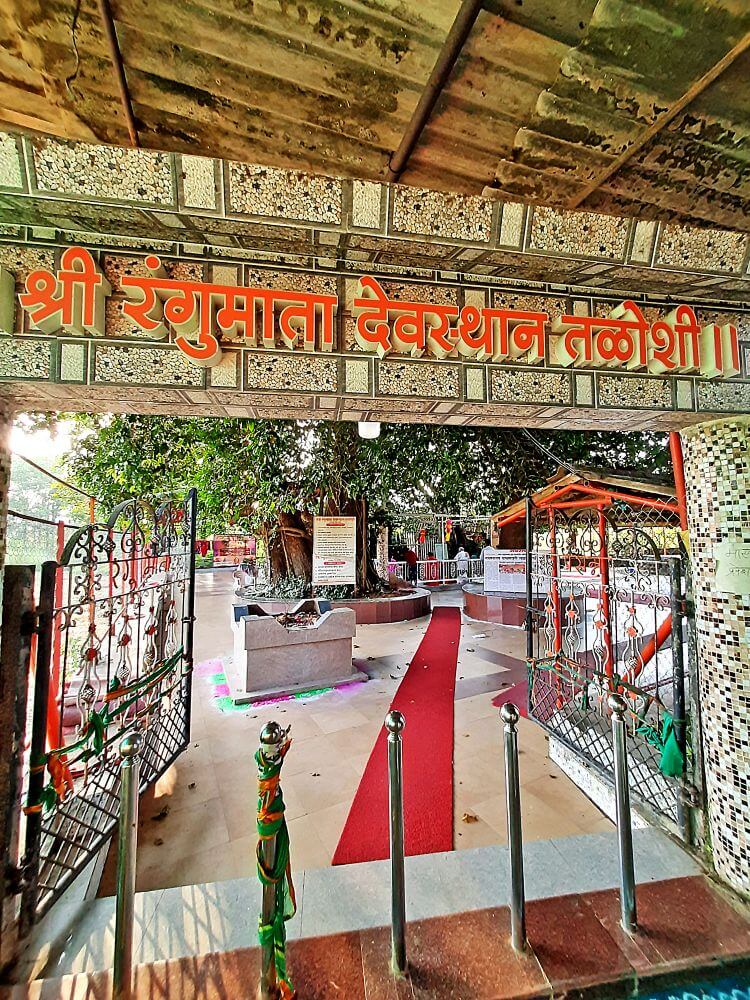
The village of Taloshi is situated approximately 2 kilometers from the Mahad-Raigad road. There is a motorable road leading from this main road to the Rangumata shrine. One enters a spacious courtyard through the archway of this shrine. For the convenience of devotees, a tin shed has been erected and the ground has been paved in this courtyard. Platforms have been built under the large trees in this area. Additionally, there is an ancient well here. In the sanctum sanctorum of the temple, which is the seat of Rangumata, there are two trees with medium-sized trunks. These two trunks are draped in sarees up to a height of two to two and a half feet. There is a two-foot-high wall surrounding this site on three sides. Behind these trees, garlands of green bangles offered to the Goddess by devotees are hung.
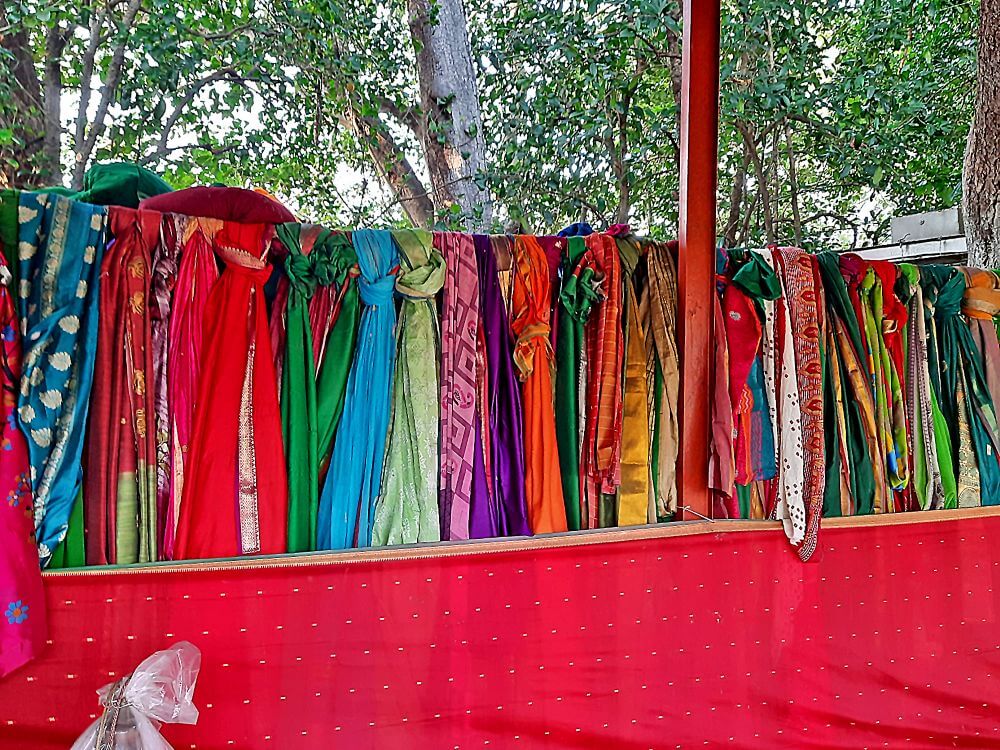
Devotees believe that Rangumata is a deity who fulfills vows and rushes to the aid of those who call upon her. Once a vow made to the Goddess is fulfilled, devotees offer sarees and blouses, brass bells, green bangles, fruits, and meals to mark the completion of their pledge. Seeing the millions of green bangles, thousands of sarees, and hundreds of brass bells offered by devotees around the sanctum sanctorum gives one a profound realization of the devotees’ faith in the Goddess. From the sarees offered by devotees, two are draped daily around the trunks of the two trees that serve as the abode of the Goddess. Many devotees take a vow to offer a non-vegetarian offering to the Goddess. For this, a rooster or a goat is sacrificed. This offering is presented to the Goddess and then consumed by the devotees as prasad. This practice of sacrifice is known as ‘Devichi Rakhan Dene’. Except for the month of Shravan, devotees perform this ‘Rakhan’ on any day of the year according to their convenience.
Every year, the Navratri festival is celebrated here on a grand scale. During these days, there is a large influx of devotees. For this festival, women from Raigad district as well as from Maharashtra, Gujarat, and Rajasthan attend in large numbers. The annual festival of the Goddess is also celebrated here. There is no fixed day for this festival. A day convenient for the devotees, occurring before the 20th of May, is selected for this celebration.
This sacred temple stands as a testament to deep spiritual devotion, ancient architectural grandeur, and rich local cultural traditions.
The sanctum sanctorum houses the divine idol consecrated according to ancient Vedic traditions, surrounded by serene courtyards and traditional temple architecture.
Navratri, Maha Shivratri, Annual Temple Jatra & Deepotsav
Compare and book flights, secure top-rated local hotels near the temple, hire reliable guides, and rent cars instantly.
Extend your pilgrimage by visiting other highly sacred temples located nearby.


Add ₹999 more to unlock FREE SHIPPING!
Your sacred cart is currently empty.
Shop Photo FramesFill in your delivery details below to place your order.
Add comment