
Add ₹999 more to unlock FREE SHIPPING!
Your sacred cart is currently empty.
Shop Photo FramesThe Gayatri Shaktipeeth Temple at Kayavarohan in Gujarat, considered the tapasya (penance) land of Sage Vishwamitra, is a renowned spiritual center. This Shaktipeeth, established under the guidance of Pandit Shriram Sharma Acharya, founder of the All World Gayatri Pariwar and Yug Tirth Shantikunj, Haridwar, is dedicated to Vedamata Gayatri. The temple promotes Vedic lifestyle and offers initiation into Gayatri worship, meditation, yoga and Trikal Sandhya (rituals performed three times a day). Alongside Goddess Gayatri, the temple also houses idols of Adi Shakti Ashtabhuja Ambika Mata (the eight-armed Mother Goddess) and Kundalini Mata.
Pandit Shriram Sharma Acharya, who embraced the principle of Achievement through Practice, is also known as the proponent of scientific spirituality. He was born on September 20, 1911, in a village near Agra, in the home of a royal priest and landowner. ‘Bharat Ratna’ Pt. Madan Mohan Malaviya, a founder of Banaras Hindu University and freedom fighter, initiated him into the Gayatri Mantra at the age of 15. Shriram Sharma Acharya participated in many independence movements led by the Congress and authored numerous books. He established the Gayatri Tapobhumi in Mathura, the Akhand Jyoti Institution in Ghiyamandi and the Brahma Varchaswa Research Institute. Through the Gayatri Mahamantra, considered the supreme Vedic mantra in Hinduism, he worked to transform people’s lives.
Pt. Shriram Acharya’s Gayatri Parivar now has branches in about 76 countries, with more than 4,600 Gayatri centres established in India. When searching for a suitable location to build a Gayatri Shaktipeeth in Gujarat, Pt. Shriram Acharya chose this place, known to be the meditation ground of Maharishi Vishwamitra, the originator of the Gayatri Mantra. It is said that during the consecration of the idols in this temple, Pt. Acharya was in a state of silence at Shantikunj Ashram. He had informed his disciples that he would not attend the consecration ceremony, which disappointed them. However, during the ceremony, the Acharya suddenly appeared, gave darshan to his disciples and then disappeared within moments.
Regarding the Kundalini Mata idol in this temple, it is said that the idol was brought from Jaipur in a wooden box. When the box was opened here, two live snakes were found inside. During the consecration of the idol, one snake came out of the box, while the other merged into the Kundalini Mata idol. These snakes were never seen again afterward.
The village of Kayavarohan in Dabhoi taluka is also known as Karvan. According to ancient legends, Kayavarohan has existed for many ages. This place was known as Icchapuri in Satyuga, Mayapuri in Tretayuga, Meghavati in Dwaparyuga and is known as Kayavarohan in Kaliyuga. Acharya Lakulish was born here either in the latter half of the 1st century BCE or in the 2nd century CE. He is considered the 28th and final incarnation of Lord Shiv. The names of Lord Shiv’s incarnations are mentioned in the Vayu Purana, Linga Purana and Kurma Purana, including the mention of the Lakulish incarnation. During the transition period between the end of Dwaparyuga and the beginning of Kaliyuga, Shiv descended in human form as Lord Lakulish at this place. Hence, this pilgrimage site is called Kayavarohan, according to legend. The Lakulish pilgrimage here is considered the 51st among the 68 pilgrimages of Lord Shiv.
This village is an important archaeological site. During excavations here, many ancient idols and remains were found. These included numerous Hindu idols, many copper coins, a sculpture of a sage’s head, an 8th-century idol of Kartikeya, an Uma-Maheshwar idol leaning against Nandi, a statue of a dancing maiden from the Gurjar Pratihar period, a standing 9th-century idol of Surya and more. The Archaeological Survey of India has listed this village as a heritage site. A special museum has been established for the artifacts and idols found in this area.
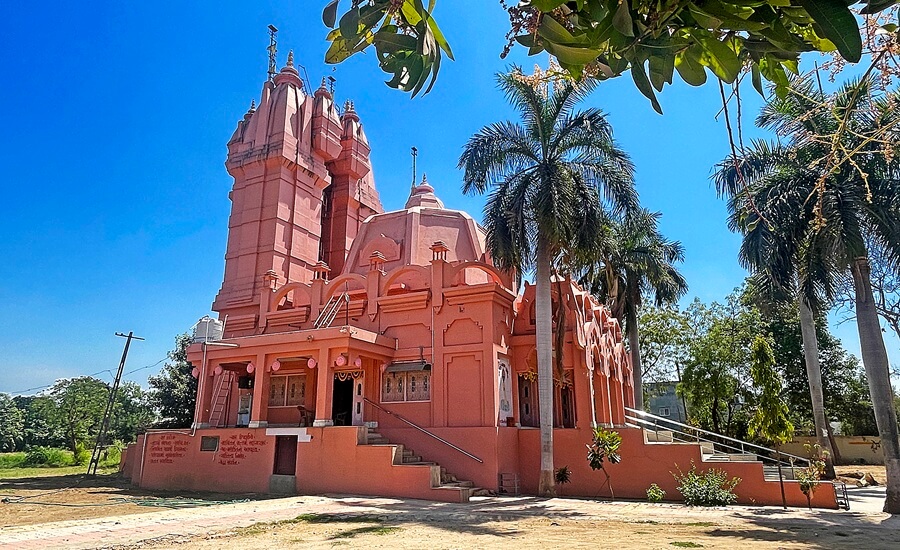
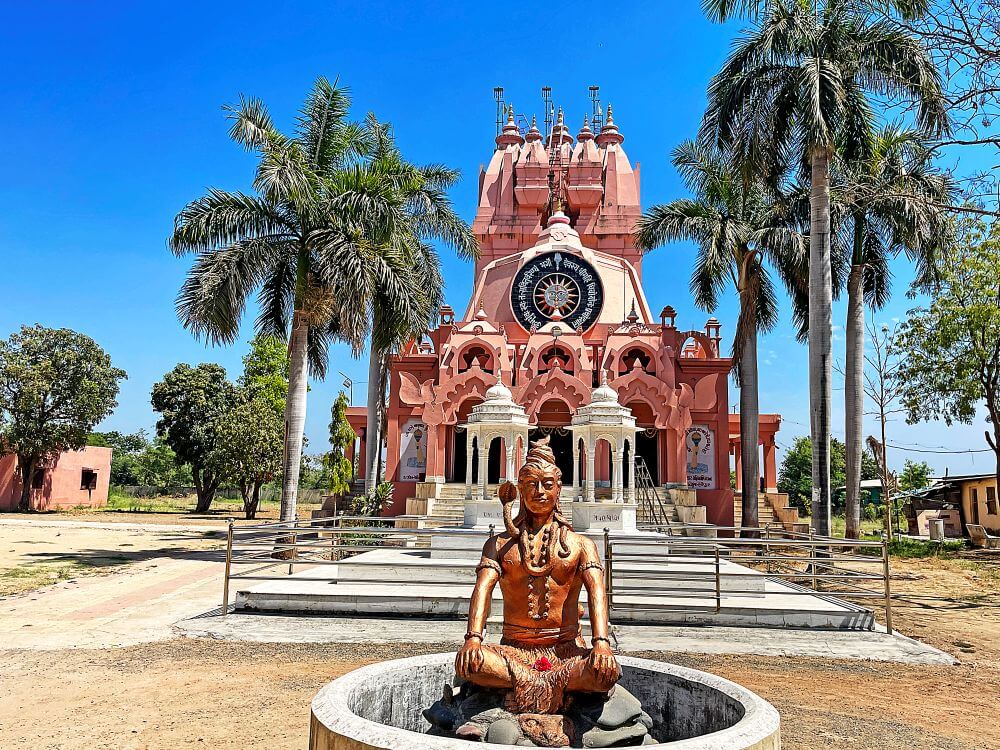
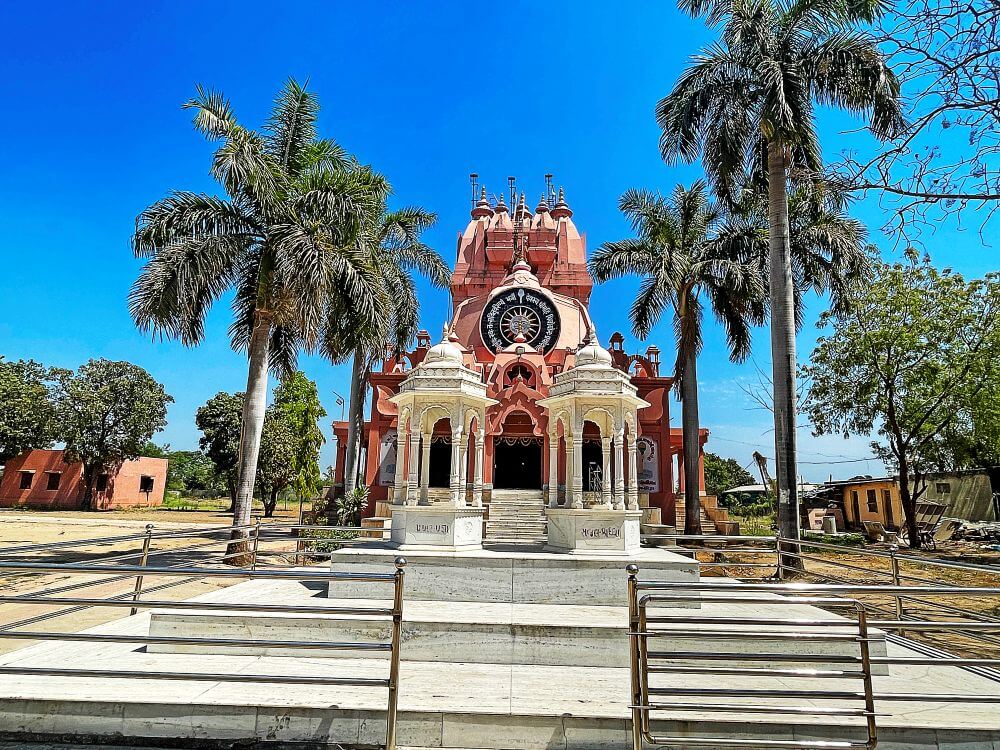
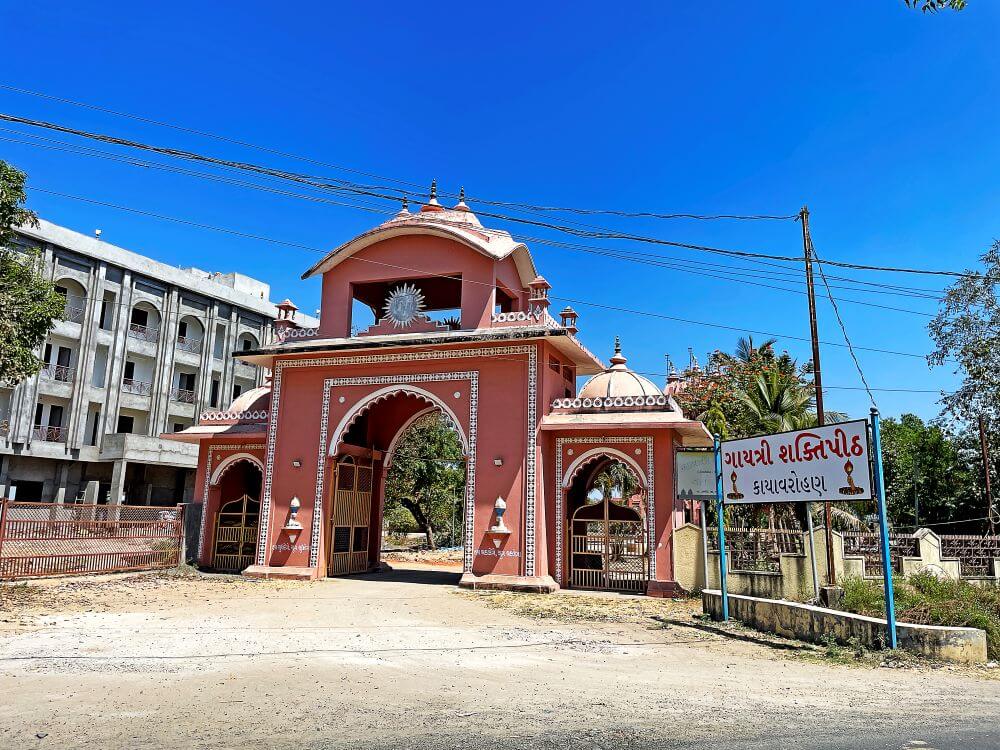
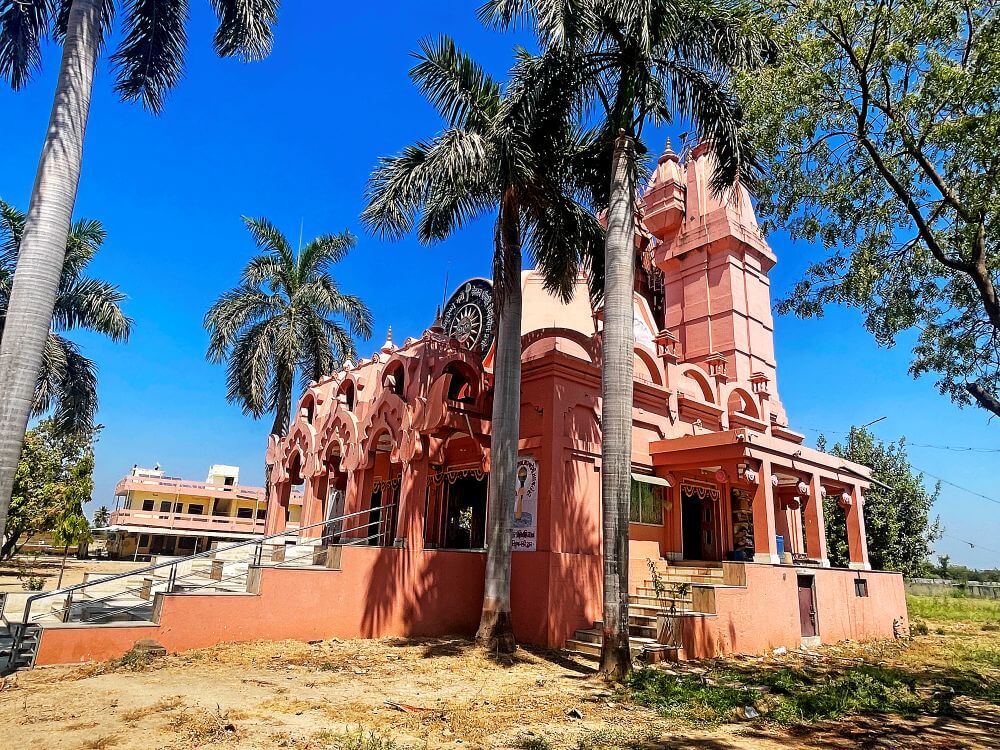
The Gayatri Shaktipeeth is situated in this village. The temple, located in a peaceful environment, has an entrance gate with three arches. In the center of the gate is a Sun image. After entering through the gate, there are gardens on both sides of the courtyard. In the courtyard, directly ahead is a circular platform with a meditating statue of Shankara. Behind this platform are two marble canopies. From here, 12 steps lead up to the temple entrance. Above the entrance is the Gayatri Mantra with a Sun image in the center. The temple structure consists of a viewing hall (darshan mandap), assembly hall (sabhamandap) and sanctum (garbhagriha). The viewing hall has three spires, while the assembly hall has a somewhat square-shaped spire. The spire above the temple’s sanctum is highly distinctive. It consists of a cluster of five spires, each topped with an amalaka and kalash (finial).
The viewing hall has three arched entrances. The assembly hall has three entrances in the front and one large entrance on each side. In the center of this spacious assembly hall, a statue of Goddess Lakshmi is placed on a square platform. Behind this statue are photographs of Acharya Shriram Sharma and Mataji Bhagwati Devi Sharma. On the right side of the assembly hall are bookshelves containing many books written by the Acharya.
The temple has one main sanctum and two subsidiary ones. In the central main sanctum, a marble idol of lion-mounted Gayatri Mata is enshrined in a marble shrine. The idol has a silver crown on its head and a silver canopy above. In front of the idol is a statue of her vehicle, the swan. To the right of the idol is a picture of the Acharya and to the left is a picture of Bhagwati Devi. In the left subsidiary sanctum there is a marble idol of Adishakti Ashtabhuja Ambika Mata and in the right subsidiary sanctum there is a marble idol of Kundalini Mata.
Devotees can have darshan of Gayatri Mata at this temple from 6 AM to 8 PM daily. Aartis are performed at 6:30 AM and 6:30 PM. According to the rules set by Pandit Shriram Sharma Acharya, daily Trikal Sandhya rituals are performed at the temple. Programs of Dhyan Yoga at 6 AM, Jyoti Avadharana Yoga at 1:30 PM and Nad Yoga at 6 PM are conducted here. Sanskar (sacramental) workshops are held every Sunday, providing information about all the sacraments from conception to the final rites.
This sacred temple stands as a testament to deep spiritual devotion, ancient architectural grandeur, and rich local cultural traditions.
The sanctum sanctorum houses the divine idol consecrated according to ancient Vedic traditions, surrounded by serene courtyards and traditional temple architecture.

Navratri, Maha Shivratri, Annual Temple Jatra & Deepotsav
Compare and book flights, secure top-rated local hotels near the temple, hire reliable guides, and rent cars instantly.
Extend your pilgrimage by visiting other highly sacred temples located nearby.


Add ₹999 more to unlock FREE SHIPPING!
Your sacred cart is currently empty.
Shop Photo FramesFill in your delivery details below to place your order.
Add comment