
Add ₹999 more to unlock FREE SHIPPING!
Your sacred cart is currently empty.
Shop Photo FramesAccording to Ramayana, when Ravana requested Lanka, Kuber, following the advice of his father, Rishi Vishrava, relinquished Lanka and established Alkapuri on Mount Kailash. But before that, as per legend, Kuber performed penance to Lord Shiv in a cave along the Narmada River, at Chanod-Karnali in Dabhoi Taluka. This sacred site is believed to be where Shiv blessed Kuber, making him the treasurer of all gods and granting him a place beside him. Ancient scriptures state that this temple was built by Lord Shiv himself. Kuber, the deity of wealth, is worshipped here in the form of Kubereswar with Shiv’s blessings.
This temple holds a significant place in the Narmada Parikrama (circumambulation) pilgrimage. Devotees believe that worshipping Kuber Bhandari for five consecutive new moon (Amavasya) days fulfills desires and brings prosperity. It is also said that no one returns empty-handed after visiting on Dhanteras (Dhantrayodashi), attracting thousands of pilgrims from across India.
According to one mythological story about this temple, once while wandering, Shiv and Parvati stopped when Parvati felt hungry. She requested Shiv to bring water and food. Despite searching extensively, they couldn’t find anything. While searching for food and water, they stopped at the Narmada banks. To ensure devotees wouldn’t remain hungry in such a remote place, they created this temple. Hence, this pilgrimage site is also known as the temple that provides food.
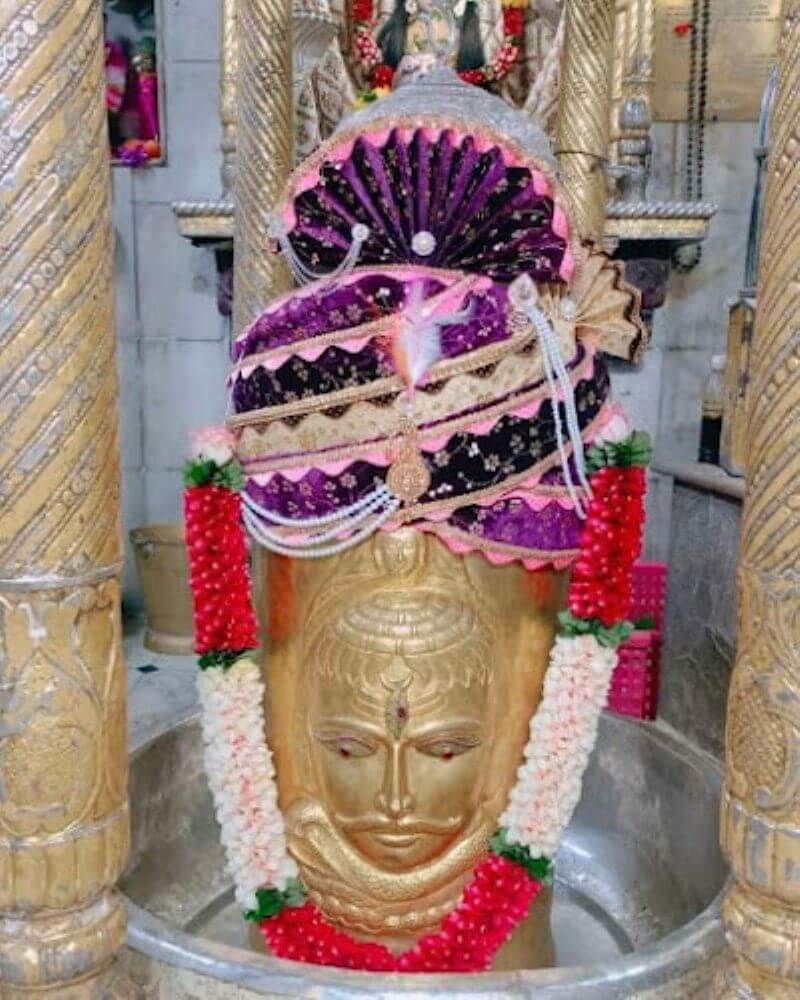
Kuber, the deity of wealth, is considered the king of Yakshas. Also known as Dhanapati (master of wealth), Kuber is one of the ten guardian deities. As one of the Ashtadikpalas (guardians of the eight directions), he rules the north and is worshipped as the lord of Yakshas and as a folk deity who bestows power, prosperity and welfare. Kuber is also known by names like Yakshraj, Vaishravana, Paulastya, Aidavida, Dhanad and Nidhipati. The Valmiki Ramayana’s Uttarkand narrates Kuber’s birth story. According to it, Kuber was the son of Vishrava Rishi and Bharadwaja’s daughter Devavarini. Ravana was his stepbrother. Vishrava Rishi had asked Kuber to live in Lanka. Ravana requested Kuber to allow him to live in Lanka. However, since Ravana was arrogant and cruel, Vishrava advised Kuber to leave Lanka to avoid trouble. Accordingly, Kuber went to Mount Kailash and established Alkapuri. However, according to local legend, Ravana attacked Kuber and snatched Lanka from him. Distressed, Kuber came to the Narmada banks on Narada Muni’s advice and worshipped Shiv. Since Ravana was also his devotee, Shiv expressed inability to help Kuber regain Lanka. However, seeing Kuber’s devotion, he appointed him as the treasurer of all deities. Learning this, an enraged Ravana came here and started troubling Kuber. Kuber again appealed to Lord Shiv, but Shiv said, “Since both of you are my devotees, I am helpless,” and advised him to worship Goddess Jagdamba. Accordingly, Kuber pleased Goddess Mahakali through penance. When the goddess offered a boon, Kuber said, “I don’t want anything. Just protect me while I worship Shiv.” Thereafter, he started meditating in a nearby cave. He established a Shivalinga representing Brahma-Vishnu-Mahesh and named it ‘Rinamukteswara’. Lord Shiv was pleased with his devotion. At that time, Kuber said, “I don’t want anything. Just bless me so that devotees will remember my name while worshipping here.” So Shiv gave him a place beside himself. Due to Mahadev’s blessing, Kuber is worshipped by his name as ‘Kubereshwar Bhandari’.
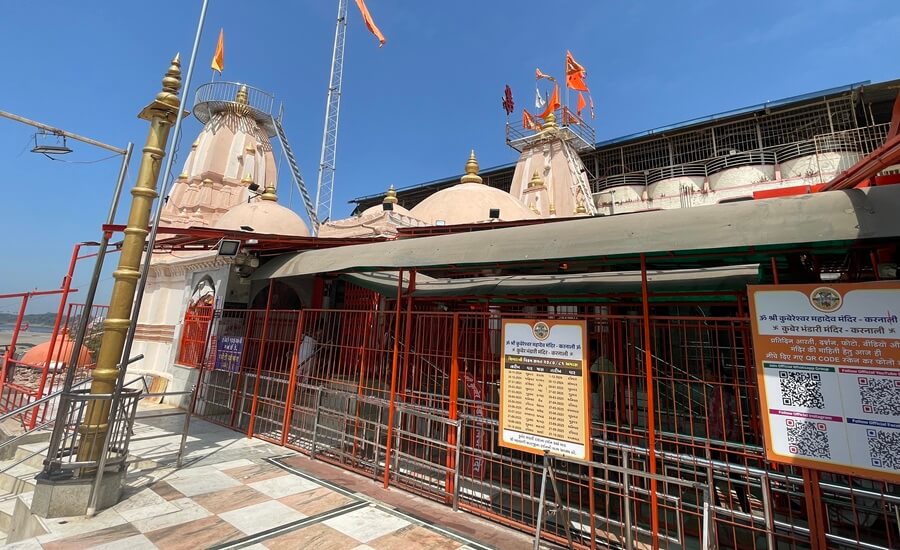
Located about 60 km from Vadodara and 26 km from Dabhoi, the Kuber Bhandari Temple stands 80 feet above the Narmada River. It can be reached by road or by boat through the river.
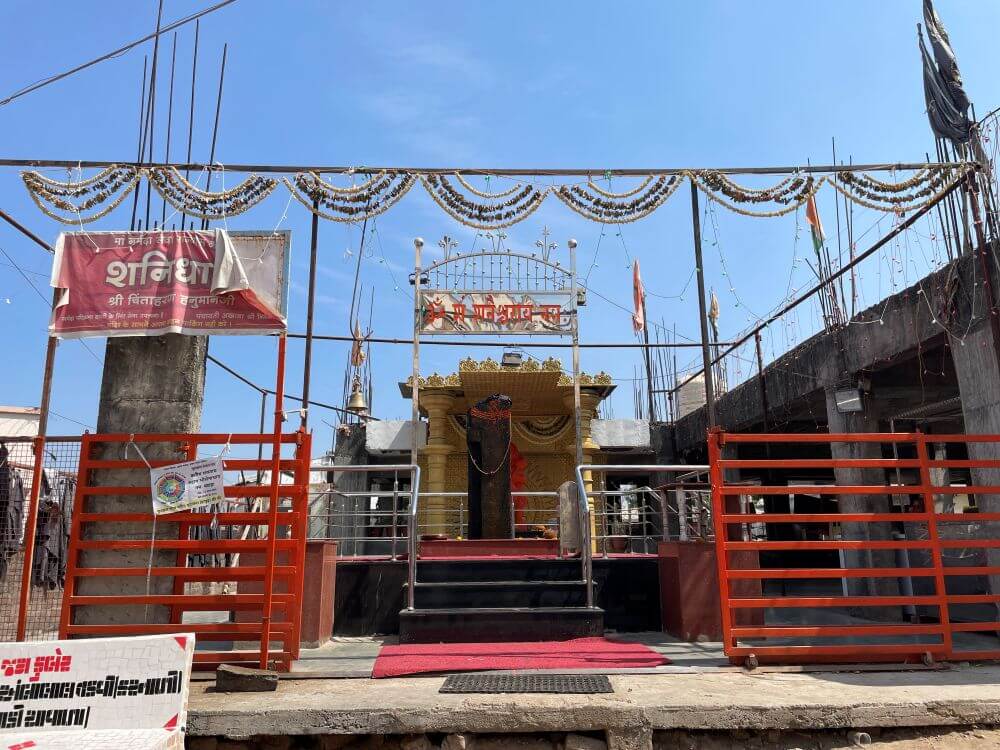
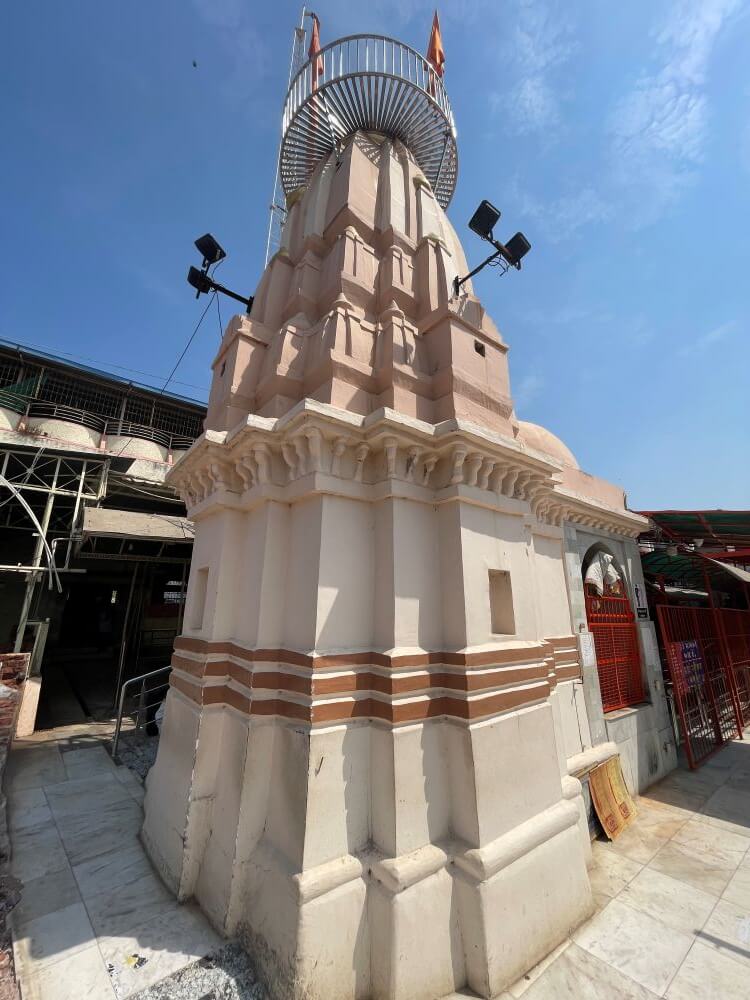
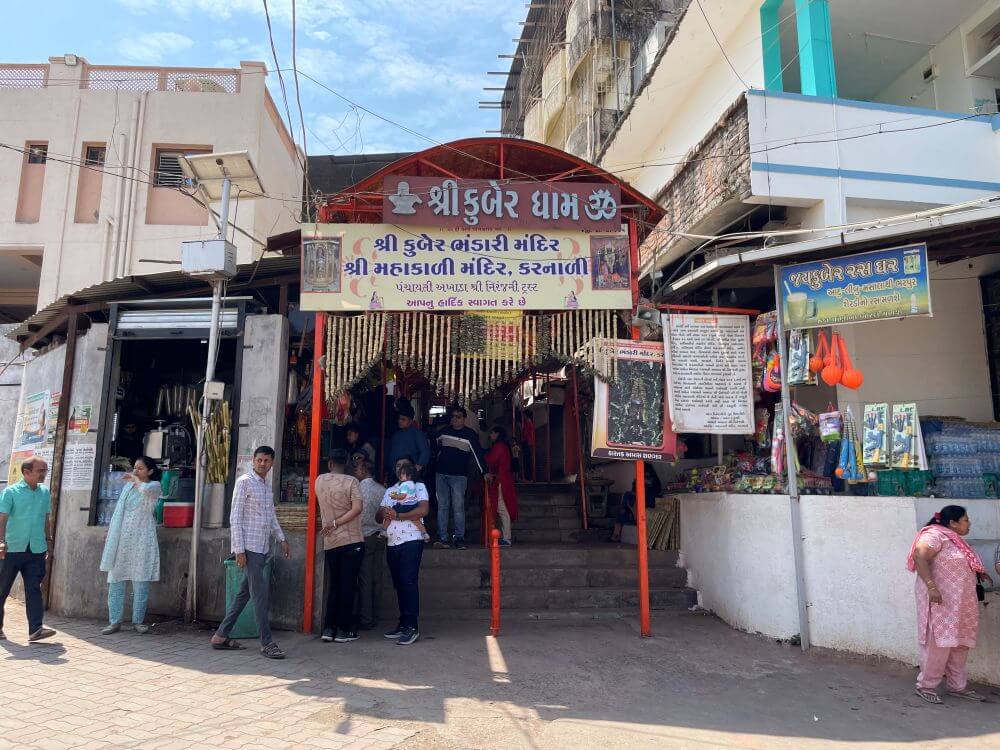
Upon entering the main gate, railings guide devotees through a queue system. After climbing several steps, you reach the main temple complex, where the temple’s shikhara (spire) comes into view. Near the temple’s entrance, under a Peepal tree, are 12 Jyotirlingas, where devotees perform Jalabhishek (ritual water offering). Idols of Ganesha, Nagdevta and Shiv-Parvati are also present nearby. Close by is the Sankatmochan Hanuman Temple.
Inside the complex is a glass case containing Kuber’s ceremonial crown, which is placed on Kuber Bhandari’s Shivling during festivals. There are dharamshalas (lodging) and a prasadalaya (community kitchen) for pilgrims.
Just a few steps away is the shrine of Angareshwar Mahadev and further on, Siddhanath Mahadev. Near the sanctum walls are the idols of Rishis Dadhichi and Gautam. Not far from here is a temple of Lord Ranchhodray, flanked by idols of Dattatreya (left) and Sai Baba (right) at the entrance.
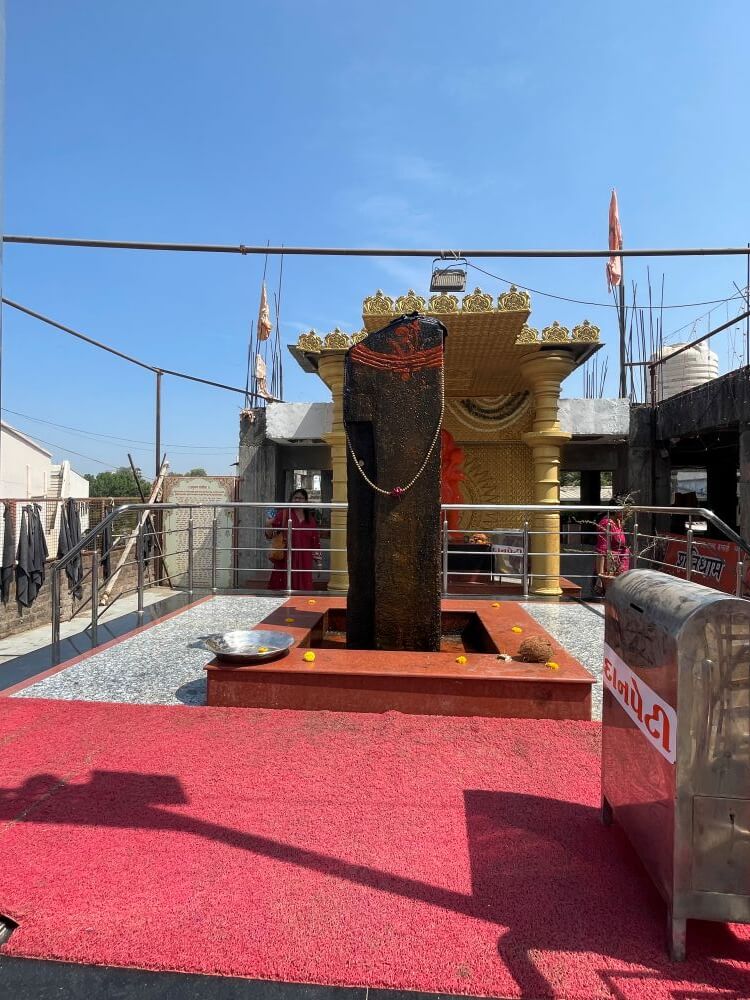
The temple is also known as Kuber Bhandari Nij Mandir. Two elephants guard the sabhamandap entrance and a gold-plated Nandi idol is placed before the sanctum. On both sides of the sanctum’s doorway are carvings of Jay-Vijay. The dome-shaped ceiling inside features delicate glass art and a large central chandelier. A golden railing surrounds the Shivling. Previously, water from the Narmada flowed under the Shivling, but the flow stopped after a dam was built.
After visiting Kuber Bhandari, devotees proceed to the Mahakali temple near the riverbank and the Rinamukteshwar Mahadev cave, believed to be Kuber’s site of penance. Along the path are small shrines with ancient Shivlings. Inside the Mahakali Temple, shops sell flowers and offerings. The temple houses idols of Amba Mata, with a smaller shrine nearby crowned by a dome. Beside it lies the sacred cave, accessible by descending stairs, where the walls and floors are tiled. Inside, devotees encounter Kuber’s idol, an image of Saint Rang Avdhoot and three Shivlings.
After exiting the temple, a short walk down the steps leads to the Narmada River, where many devotees take a holy dip before darshan. Managed by the Shri Kubeshwar and Someshwar Mahadev Trust, the Kuber Bhandari Temple is open daily from 5:30 AM to 8:00 PM. On the day of Mahashivratri, the temple remains open from 4:00 AM to 10:00 PM. Aarti is performed here at 7:00 AM and again at 7:00 PM. On Amavasya, devotees can begin darshan from midnight (12:00 AM) onward. On such days, devotees stand in queues over 2 km long for 4–5 hours for darshan. They offer milk, bael leaves, honey, incense, fruits and flowers.
On Mahashivratri, the temple draws massive crowds and hosts various religious events. During Navratri, the Mahakali idol is decorated in different forms daily and bhajans and Garba/Dandiya take place throughout the nine days.
During Diwali, the temple is illuminated beautifully. In the four days leading up to Dhanteras, Kuber Bhandari is offered different bhogs daily. On Dhanteras, millions of devotees come believing that darshan will bring wealth and blessings. It’s also believed that keeping soil from the temple in one’s locker brings the grace of Goddess Lakshmi. Many also believe that childless couples are blessed with children through dedicated worship here. Free meals are served to devotees at the Prasadalaya between 11 AM and 1 PM daily.
This sacred temple stands as a testament to deep spiritual devotion, ancient architectural grandeur, and rich local cultural traditions.
The sanctum sanctorum houses the divine idol consecrated according to ancient Vedic traditions, surrounded by serene courtyards and traditional temple architecture.
Navratri, Maha Shivratri, Annual Temple Jatra & Deepotsav
Compare and book flights, secure top-rated local hotels near the temple, hire reliable guides, and rent cars instantly.
Extend your pilgrimage by visiting other highly sacred temples located nearby.


Add ₹999 more to unlock FREE SHIPPING!
Your sacred cart is currently empty.
Shop Photo FramesFill in your delivery details below to place your order.
Add comment