
Add ₹999 more to unlock FREE SHIPPING!
Your sacred cart is currently empty.
Shop Photo FramesBhudargad Taluka, nestled in the valley of the Wainganga River, is renowned for its dense forests and deep valleys. Patgaon gained recognition as the ‘Village of Honey’ in this taluka due to its pristine natural resources. In ancient times, this region of dense forests fostered a tradition of worshipping Lord Shankar and Devi Bhavani, leading to the construction of magnificent temples that continue to captivate devotees and architectural scholars alike. The Bhadrakali Temple in the village, built in the Hemadpanti architectural style, along with the Nandi within the temple, are distinctive features here. Devotees hold a firm belief that the awakened Devi Bhadrakali fulfills their vows.
Scholars suggest that the stone construction of this temple dates back to approximately the thirteenth century. According to temple scriptures, a sculpture of the main deity’s vehicle is installed in front of the sanctum sanctorum of each temple. However, it is noteworthy that this is a Devi temple, yet it houses a sculpture of Nandi, the vehicle of Lord Shankar. Regarding this, a legend recounts that in ancient times, while Lord Shankar and Devi Parvati were playing a game of dice in this dense forest, Lord Shankar was defeated. Devi Parvati laughed at Lord Shankar’s loss. Angered by Parvati’s jest, Lord Shankar departed and went to a grove some distance away to perform penance. When Mahadev left, He commanded Nandi to stay with Parvati for her protection. Thus, Nandi is enshrined here in the temple of Mother Parvati.
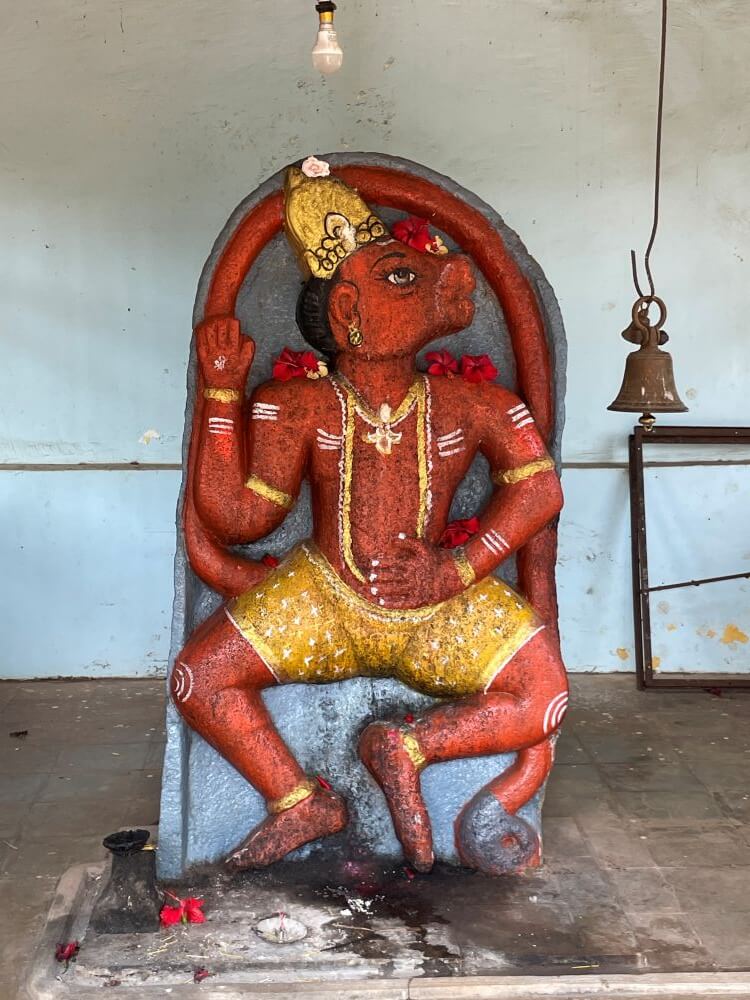
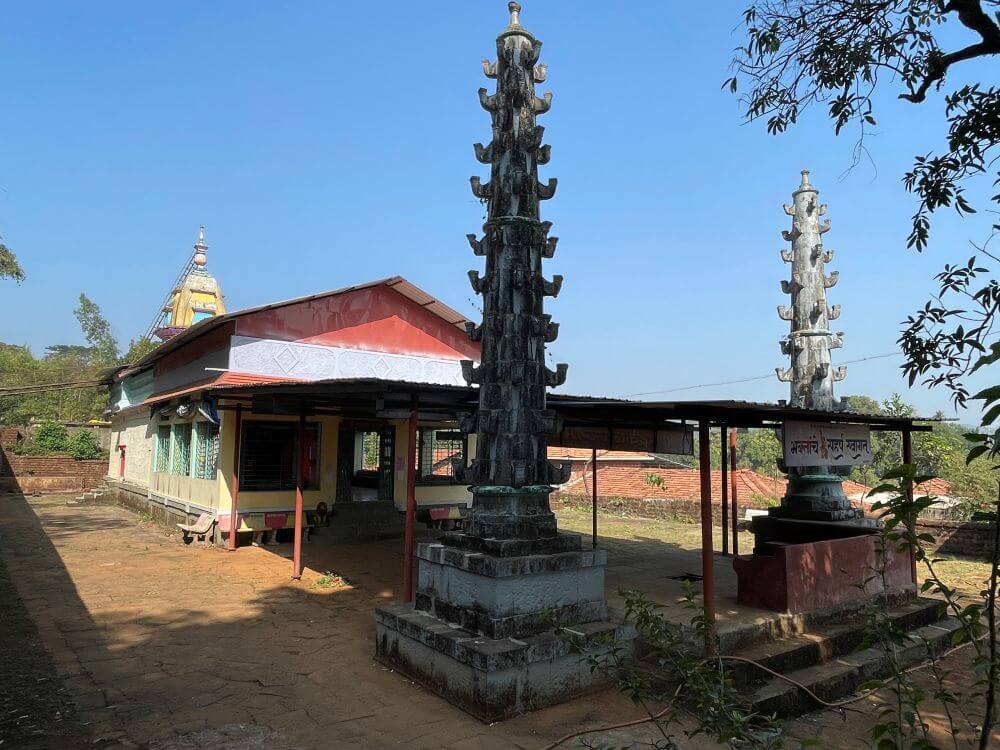
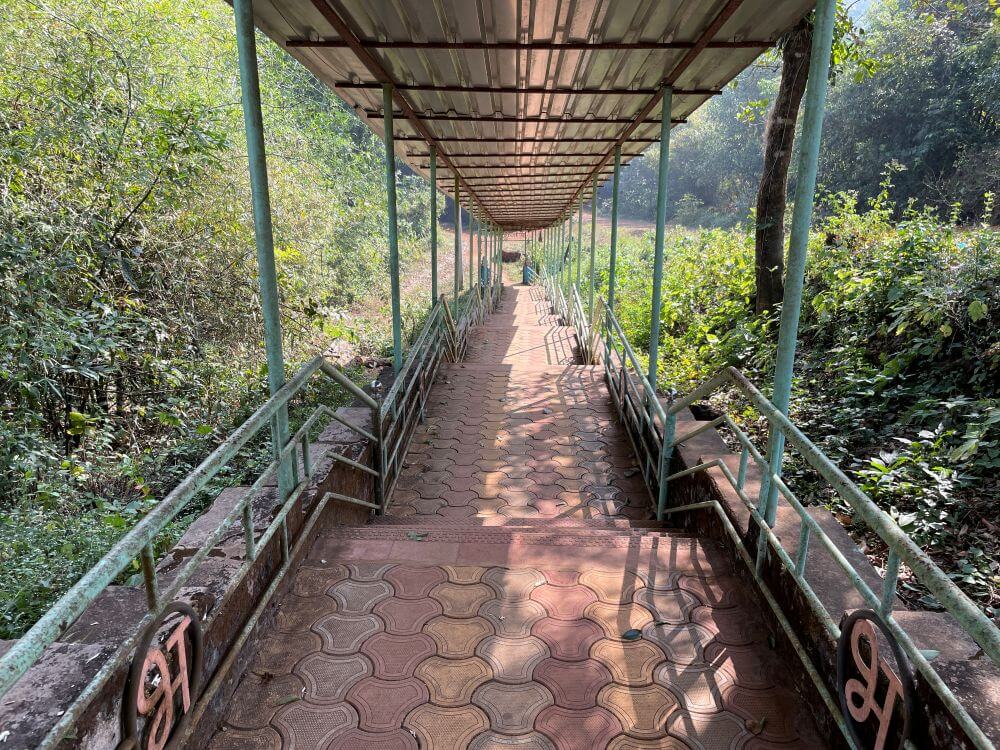
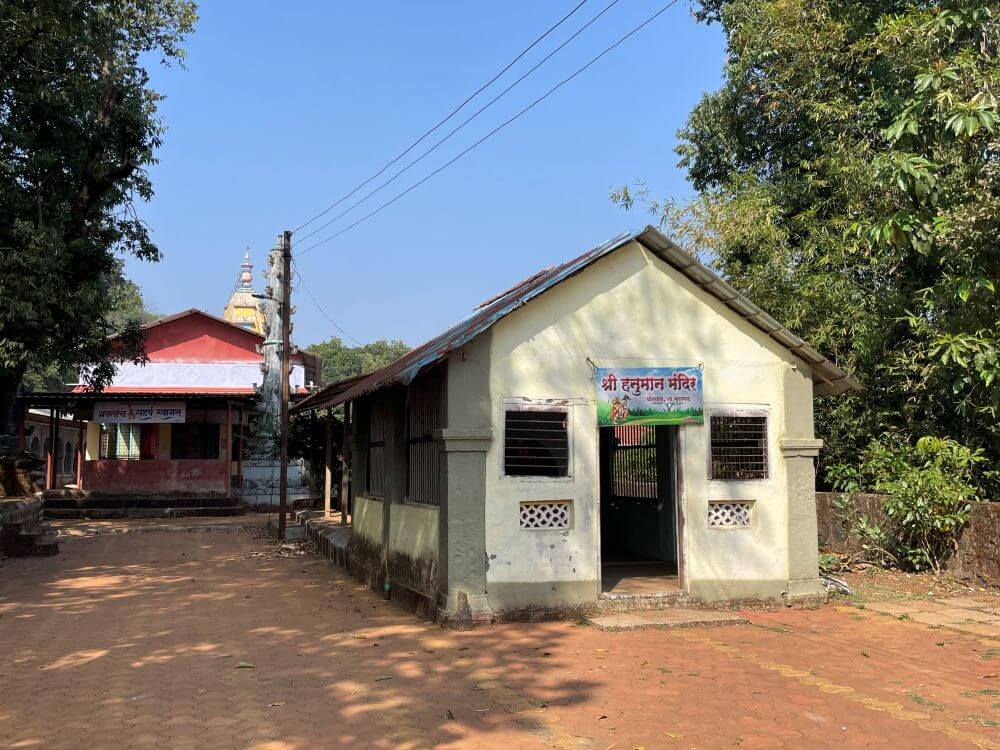
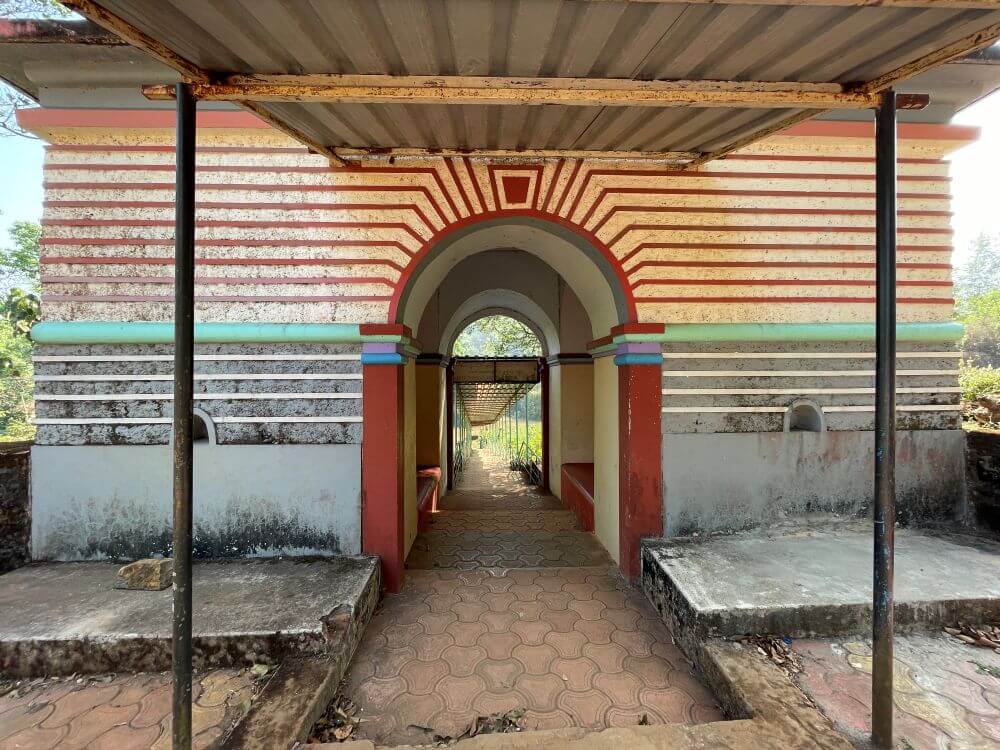
To reach this temple, situated at the foothills of a mountain on the border of Patgaon, one must ascend approximately fifty steps. A tin shed has been erected along this stairway for the convenience of devotees. At the end of the steps, a sturdy two-storied entrance, resembling the gateway of a fort, leads into the temple complex. A Nagarkhana (drum house) is located on the upper floor of this stone gateway. Small lamp niches adorn both sides of the entrance. Inside this gateway, on both sides, are Devdyas (guard rooms). From here, one enters the expansive temple courtyard, paved with paver blocks. This courtyard is enclosed by a stone boundary wall. As one proceeds towards the temple from here, the Maruti Temple is seen first. Here, there is a sculpture of Lord Maruti in a resting posture. Lord Maruti is seated on a stone slab here. One of His hands rests on His stomach, while the other is in a posture of blessing. Moving further, behind the temple, are two ancient tall Deepmalas (lamp towers) and an open ‘Bhadrakali Rangamanch’ (stage). Kirtimukha sculptures are carved at the base of these Deepmalas.
There are five steps leading into the Sabhamandap (assembly hall) of the Bhadrakali Devi Temple, which is situated on a high Jagati (platform) above the ground. The temple’s structure comprises a Sabhamandap, Antarala (vestibule), and Garbhagriha (sanctum sanctorum). The stone construction of the Antarala and Garbhagriha is in the Hemadpanti architectural style.
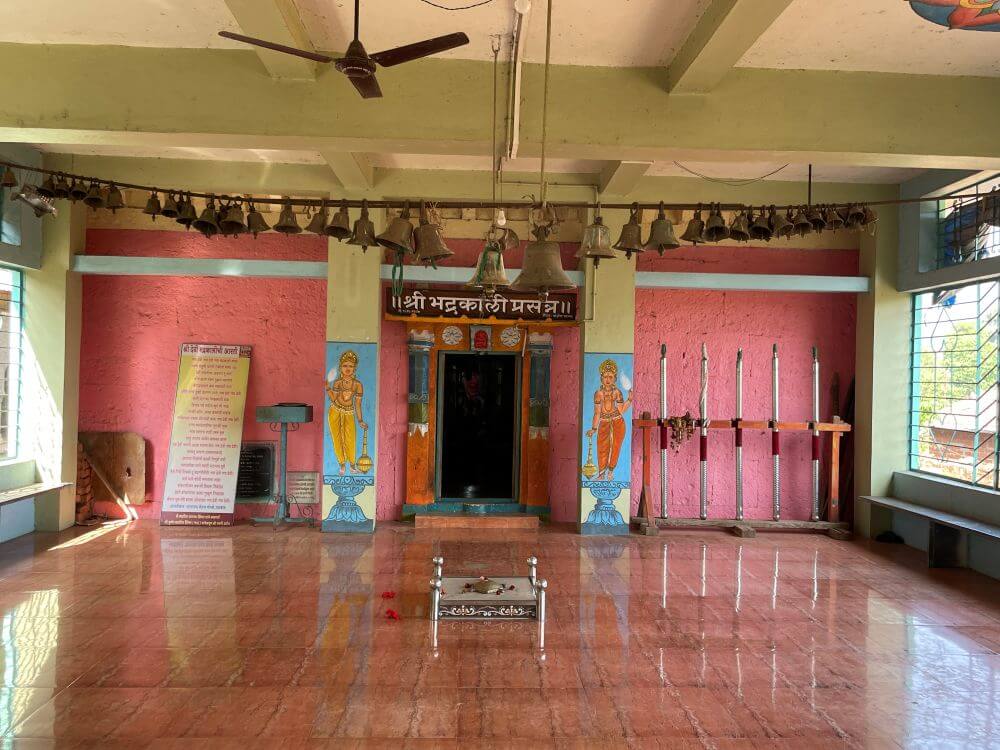
Lion sculptures adorn both sides of the steps at the entrance of the Sabhamandap. The semi-open Sabhamandap features arrangements of Kaksasanas (stone benches) for devotees to sit. The Sabhamandap is paved. A tortoise sculpture is located in the center. Near the frontal wall of the Antarala in the Sabhamandap, five deity processional staffs are kept. The entrance to the Antarala is made of stone, with pilasters flanking the doorframe. A Ganesha sculpture is at the Lalatabimba (lintel) of the doorframe. Lotus flower motifs are carved on both sides of this Ganesha and on the crescent-shaped Mandaraka. Images of female doorkeepers are painted on the pillars on both sides of the door. The enclosed Antarala houses the Devi’s palanquin, used during festivals. In front of the Garbhagriha’s entrance, on a platform, is a stone sculpture of Nandi. This colored Nandi has a decorative cloth (Jhool) on its back. The intricate details of the fabric, its patterns, and the tassels attached to it are all meticulously carved. Nandi wears four different types of ghungroo (bell) necklaces around its neck. In front of the Nandi sculpture, there is a tortoise image carved in stone. The ceiling of the Antarala features a circular dome formed by a specific arrangement of stones.
The doorframes of the Garbhagriha’s entrance are adorned with carvings of Garuda, Hanuman, doorkeepers, and lotus flower motifs. A Ganesha sculpture is at the Lalatabimba. Similarly, to the right of the entrance, near the wall, a black stone sculpture of Ganesha is also enshrined on a small platform. The Garbhagriha houses the self-manifested stone idol of Devi Bhadrakali. Beside this idol, there is a brass Utsavamurti (processional idol) of the Devi. On the Vajrapitha (pedestal) behind Devi Bhadrakali, there are ancient black stone idols of some local deities. The temple’s roof features a two-tiered square Shikhara (spire). Both tiers of the Shikhara have Devakoshthakas (niches for deities). The Shikhara is topped with a Shirshakamala (lotus finial), above which is an Amalaka (fluted disc), then a Chauk (square block) on the Amalaka, and finally a Kalasha (pot finial) on the Chauk.
Adjacent to the temple is a Dharmashala (rest house) built with dressed stones in the Hemadpanti architectural style, comprising १३ rooms. The Shiva temple, located approximately two kilometers from the Devi Bhadrakali Temple, is nestled in a dense forest. Annual festivals such as Chaitra Navratri, Sharadiya Navratrotsav, Dussehra, Diwali, and Shakambhari Navratri are celebrated with great fervor at the Devi Bhadrakali Temple. During festivals, the Devi’s palanquin visits Lord Mahadev. During the annual festivals, programs like Abhishek (ritual bathing), Bhajan (devotional singing), Kirtan (devotional discourse), and Jagaran-Gondhal (all-night vigil and folk performance) are organized. Mahaprasad (sacred food offering) is also arranged for devotees. Thousands of devotees visit here during festivals for Darshan (sacred viewing) of the Devi and to fulfill their vows.
This sacred temple stands as a testament to deep spiritual devotion, ancient architectural grandeur, and rich local cultural traditions.
The sanctum sanctorum houses the divine idol consecrated according to ancient Vedic traditions, surrounded by serene courtyards and traditional temple architecture.
Navratri, Maha Shivratri, Annual Temple Jatra & Deepotsav
Compare and book flights, secure top-rated local hotels near the temple, hire reliable guides, and rent cars instantly.
Extend your pilgrimage by visiting other highly sacred temples located nearby.


Add ₹999 more to unlock FREE SHIPPING!
Your sacred cart is currently empty.
Shop Photo FramesFill in your delivery details below to place your order.
Add comment