
Add ₹999 more to unlock FREE SHIPPING!
Your sacred cart is currently empty.
Shop Photo FramesThe shrine of Ambabai in Hupari, renowned throughout the country as Maharashtra’s ‘Silver City’ (Chandinagari), is extremely ancient. This Goddess is the presiding deity (Gramdevata) of Hupari village. It is said that in the thirteenth-fourteenth century, this was a resting place on the banks of the Panchganga river, along the trade route from Bijapur to Konkan. Due to the constant movement of traders here, people naturally began to settle down for their convenience. After the establishment of Ambabai, the settlement here grew, leading to the formation of Hupari village. The devotees here believe that the village attained its glory solely due to this Goddess.
Ambabai is considered a form of Jagannmata Parvati. Regarding Her idol here, a legend is told that Chandur village is located close to Hupari, across the Panchganga river. Once, this idol was carried away by the floods of the Panchganga. Some people from Hupari went to see it. A dispute arose between the people of Chandur and Hupari over taking possession of the idol. To resolve this, it was decided to bring a horse-drawn cart and place the idol in it. Wherever the horse would take the idol, it should be installed there. That horse, wandering around, brought this idol to Hupari. Thus, as decided, the idol was installed here. Furthermore, considering Chandur as the Goddess’s maternal home (Maher), the honor of performing puja was granted to the Patils of Chandur. Since then, on occasions like Navratri and Yatra, clothes (vastra) and offerings (naivedya) for the Goddess come from Chandur.
Previously, this area of Hupari was a large forest. In the nineteenth century, when this area came under the control of the Kolhapur princely state, Rajarshi Chhatrapati Shahu Maharaj created a garden here in the name of his daughter-in-law, Princess Indumati Devi. This area was reserved for hunting. Indumati Devi became a widow at the age of twelve. Shahu Maharaj educated and raised her as his own daughter. Later, Indumati Devi did significant work for women’s education. She was the President of Montessori International in India. The memories of this garden, named after her, still endure today. Even today, people know this area by the name Indumati Park. Within this very area, the Ambabai Temple is situated in a fort (gadhi) on a hillock. It is said that this fortified gadhi, with its bastions, was originally built by the Patwardhan Kings of Sangli. This fortification has two entrances. There is a Nagarkhana (drum house) above the main northern entrance.
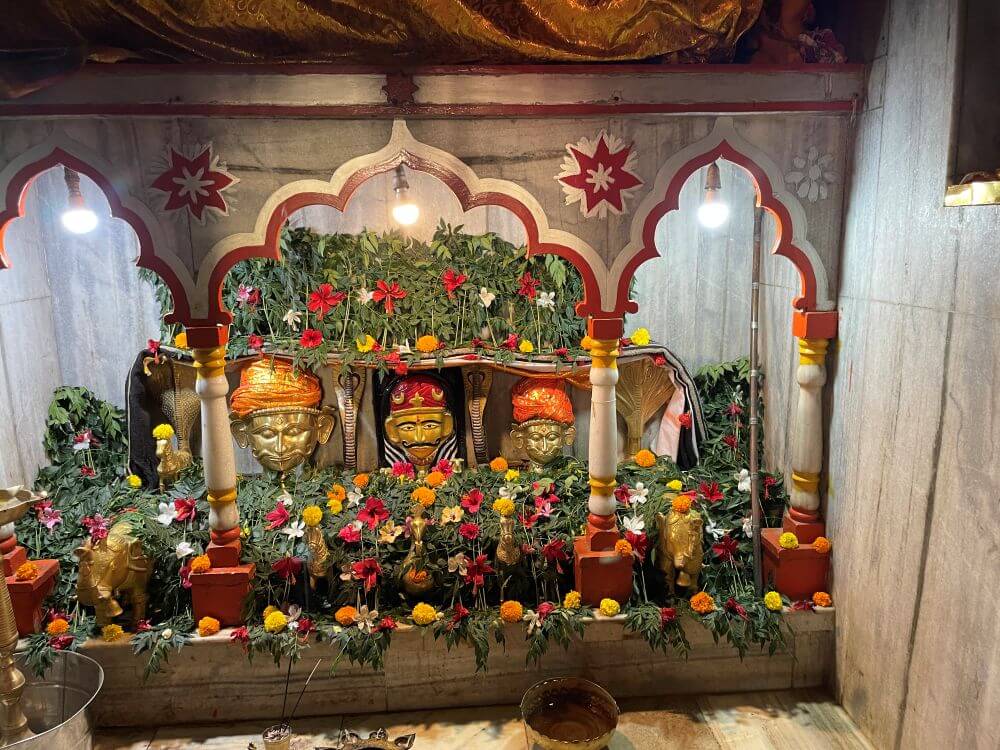
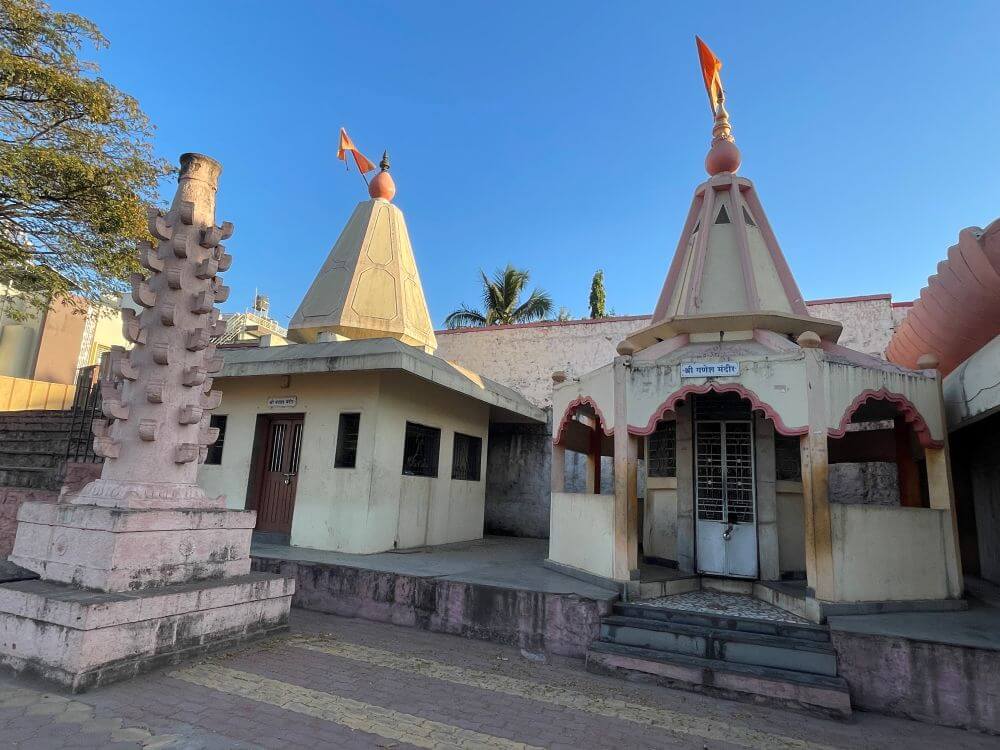
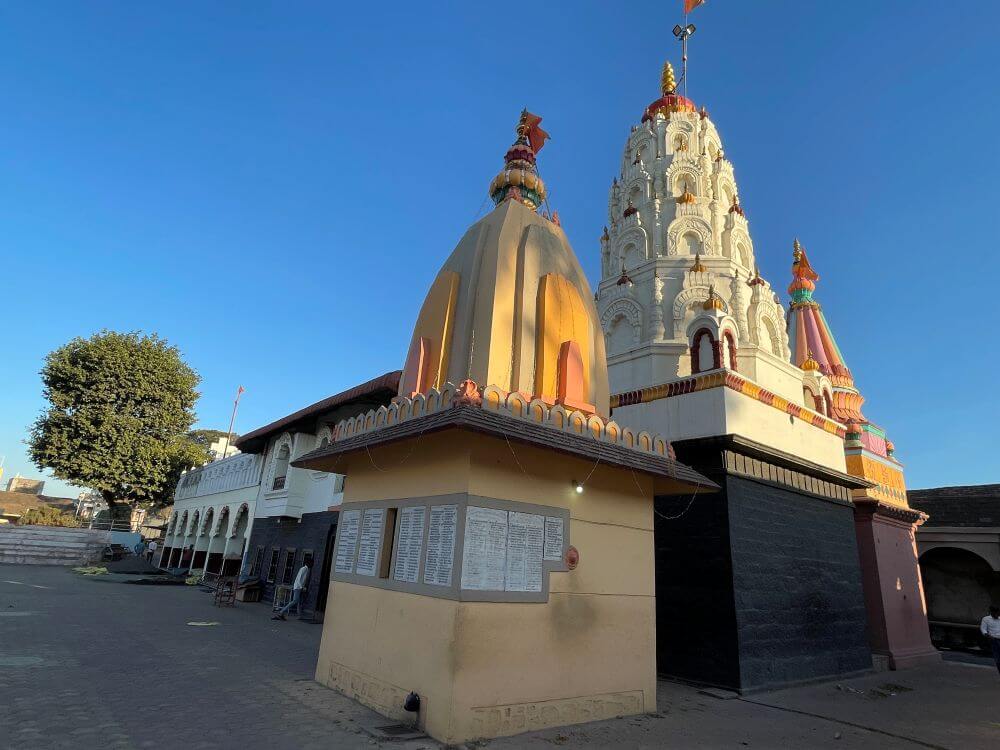
The temple courtyard is expansive. On the way from the entrance to the main temple, one encounters small but exquisitely crafted temples of Biroba, Lakshmi, Krishna, Ganpati, Navagraha, and Balaji. All these original temples were built of stone. During renovation, they were rebuilt using modern techniques.
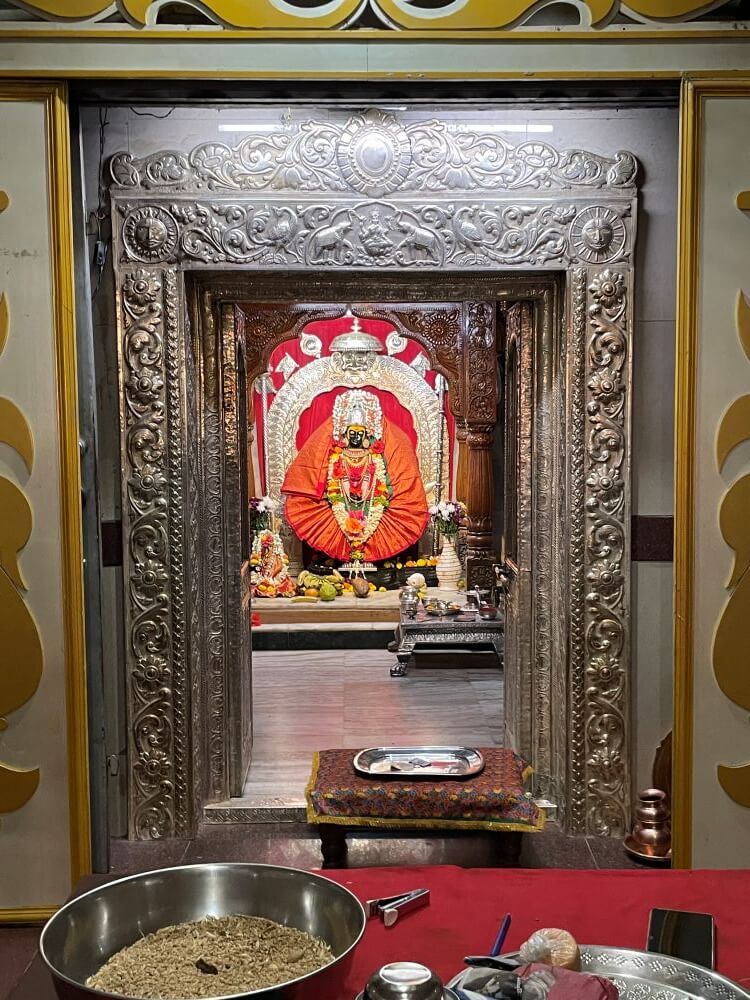
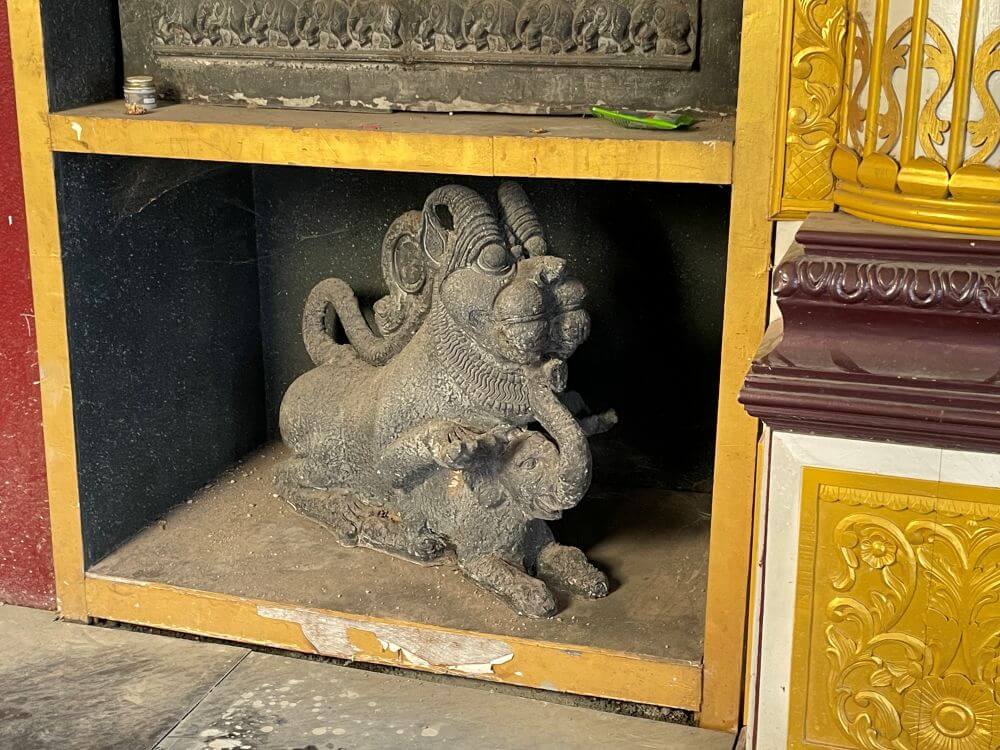
The main temple’s structure comprises a Sabhamandap (assembly hall), Upasabhamandap (subsidiary assembly hall), Antaral (vestibule), and Garbhagriha (sanctum sanctorum). The temple’s spire (shikhar) is tall and built in the Maratha architectural style. The main Sabhamandap is open-plan and spacious. The Upasabhamandap and Garbhagriha are constructed using stone and cement. The ornate windows (sajjayukta khidkya) of this two-storied Upasabhamandap give it the appearance of an ancient mansion. On both sides of the wide entrance to the Upasabhamandap, within the wall niches (devkoshthak), stand vertical stone idols of Pratihari Devatas (guardian deities). In their lower sections are Sharabh sculptures. In ancient literature, Sharabh is considered a form of Lord Shiva. It is a mythical composite creature resembling a tiger, possessing horns and wings. Often, it is depicted catching an elephant with its paw. Sharabh sculptures are generally found on forts. Since this shrine of Ambabai is located within a ground fort (bhuikot killa), these sculptures are visible here.
The temple’s Upasabhamandap is spacious. Inside, there are carved square wooden pillars. Above two of these pillars are silver horses. Inside, beneath the beams, various forms of the Goddess are carved in golden sheets on all four sides. The Goddess’s silver palanquin is kept here. It is said that this palanquin weighs 60 kilograms.
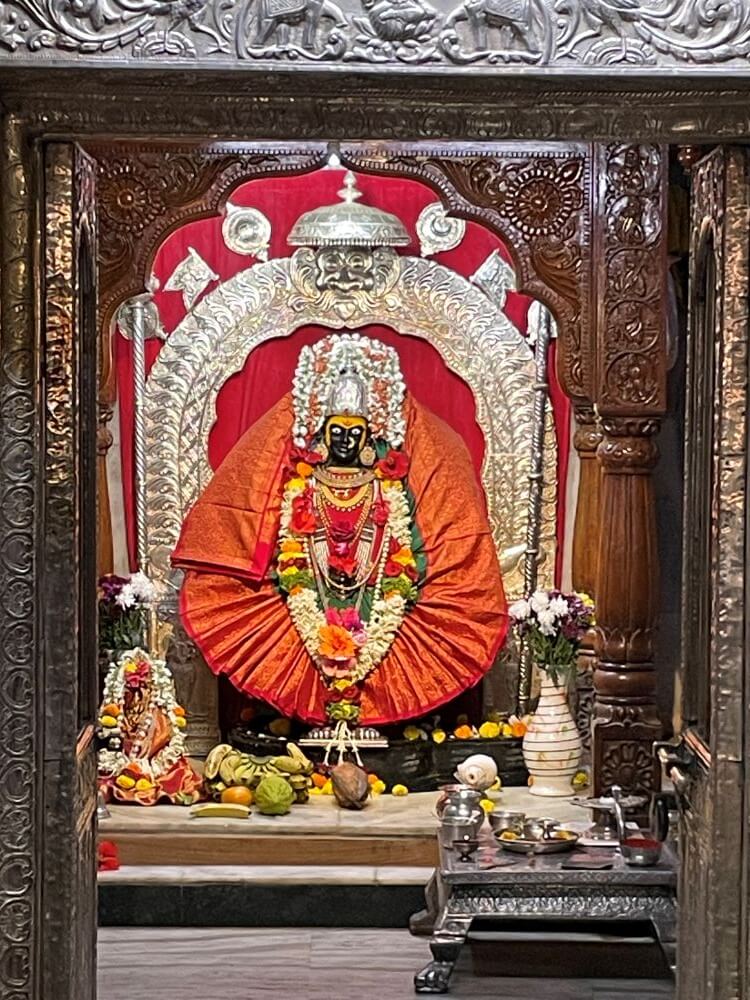
In the Garbhagriha, the stone idol of Ambabai is enshrined within a grand rosewood shrine (devhara). Here, the Goddess is in the form of Mahishasuramardini. She has four arms. Mahishasura lies at the feet of the Goddess, who holds a conch, trident, and dagger. Behind the idol is a beautiful silver arch (mahirap) with intricate carvings. Regarding this idol of the Goddess, it is said that previously, silver moustaches were affixed to the Goddess. According to some, a devotee might have offered them to the Goddess to fulfill a vow, while others believe the Goddess had assumed a male disguise to slay certain demons. Subsequently, at the request of devotees, She remained here in that very form. As a remembrance of that, devotees might have later affixed those moustaches. On August 24, 1995, a Vajralep (protective coating) was applied to the Goddess’s idol. For this, the idol was moved. At that time, a Shivalinga was found in place of the Goddess. The idol had been placed by making a groove on the Shivalinga. During the Vajralep of the idol, Gurudev Nijalingeshwar Swami of the Nidsoshi Math in Karnataka was present. As per his suggestion, the Goddess’s moustaches were removed, and the idol was re-installed in such a way that the Shivalinga would be visible.
This Ambabai Temple is not only a religious center but also the social and cultural hub of Hupari village. Within the temple premises, there is a small amphitheater. In front of it, there is also a circular wrestling arena. During the Yatra (fair), wrestling bouts are held there. Within the temple complex, some old bastions of the fort (gadhi) and remnants of other bastions are visible. Every year, on the day the Anuradha Nakshatra falls in the month of Magha, the Goddess’s annual Yatra (festival) takes place. During Navratri, there is a grand festive atmosphere here. Each day, different forms of the Goddess are depicted through decorations.
This sacred temple stands as a testament to deep spiritual devotion, ancient architectural grandeur, and rich local cultural traditions.
The sanctum sanctorum houses the divine idol consecrated according to ancient Vedic traditions, surrounded by serene courtyards and traditional temple architecture.
Navratri, Maha Shivratri, Annual Temple Jatra & Deepotsav
Compare and book flights, secure top-rated local hotels near the temple, hire reliable guides, and rent cars instantly.
Add ₹999 more to unlock FREE SHIPPING!
Your sacred cart is currently empty.
Shop Photo FramesFill in your delivery details below to place your order.
Add comment