
Add ₹999 more to unlock FREE SHIPPING!
Your sacred cart is currently empty.
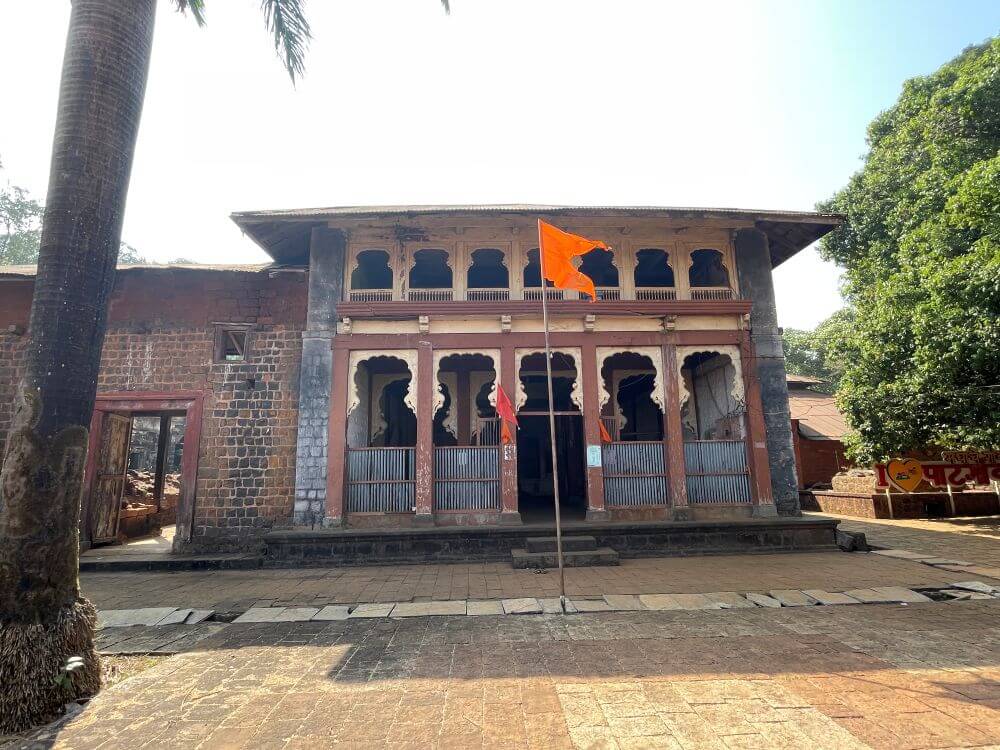
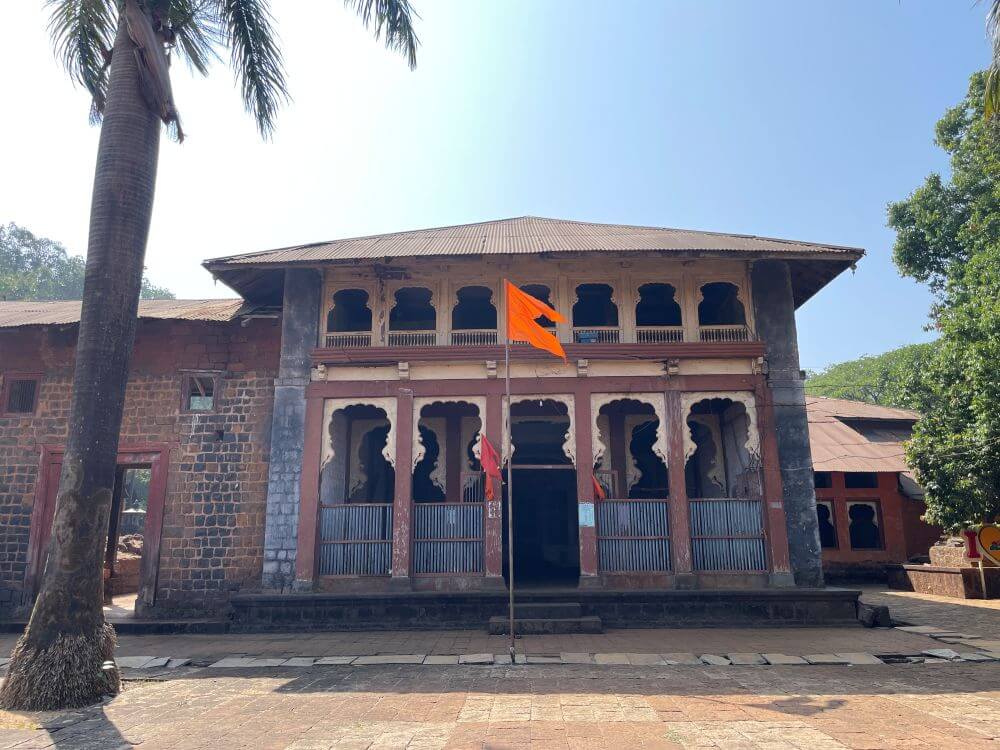
Shop Photo FramesPatgaon, the last major village in the Bhudargad taluka, is well-known as the “Village of Honey.” Surrounded by lush forests, this village produces 8 to 10 tons of pure honey annually. Another identity of this village is that it houses the Math (monastery) and Samadhi temple of Mauni Maharaj, the spiritual guide of Chhatrapati Shivaji Maharaj. This Math, which is approximately 300 years old, is a fine example of Marathi architectural style. Although the building does not feature flashy paintwork, its religious and historical significance draws a large number of devotees and history enthusiasts.
Chhatrapati Shivaji Maharaj’s Hindavi Swarajya was built upon the principles of religious tolerance and liberal thought. Religious tolerance was the moral foundation of Shivraya’s kingdom. This is why he held in high regard saints and noble souls like Samarth Ramdas Swami, Morya Gosavi, Chintamani Dev, Siddheshwarbhat Brahme, Gopalbhat, Shridharbhat Bapat of Pule, as well as Baba Yakut of Kelshi in the Konkan. One of the names in this list is that of Mauni Maharaj. Shivaji Maharaj considered all the saints and noble souls of his kingdom as his gurus. Accordingly, he also regarded Mauni Maharaj as his guru. His early life remains unknown, and scholars speculate that he may have belonged to the Avadhut sub-sect of the Nath Panth or the Giri sect of the Gosavis. Uttur in the Ajara taluka of Kolhapur district was his native village. From there, he moved to Patgaon near Rangana Fort and resided there.
According to entries in the ‘Marathi Vishwakosh,’ Mauni Maharaj used to preach through stories and kirtans. Because he expressed the wisdom of the Vedas just like Tukaram Maharaj, he was harassed by the religious orthodoxy of that time. Tired of this harassment, he took a vow of silence, which earned him the name “Mauni Buwa.” Among the sources of Shiv-history, ‘Shri Shivadigvijaya’ and ‘91 Kalmi Bakhar’ contain historical references regarding Mauni Maharaj and Chhatrapati Shivaji Maharaj. In ‘Shri Shivadigvijaya,’ it is noted, “…in the Maharaja’s kingdom, noble yogis who were manifestations of God himself were living, their names and details are…” and it further records, “Mauni Bawa came and stayed at Patgaon.” The account of Shivraya meeting Mauni Bawa in 1676 AD before his southern expedition is given in clause 76 of the ‘91 Kalmi Bakhar.’ The story is as follows: “Afterwards, he (Shivaji Maharaj) came to the place. There, he gathered Moropant, Antajipant, and all the sardars. Entrusting the administration of the entire kingdom to the elders, he took Kesopant and Nilopant Mujumdar with him. Keeping the political affairs of Bijapur in mind, he went to have darshan of Mohani Bawa who was at Patgaon. He gave a bouquet and garland of champa flowers into the hands of Moropant. The panchapatri was in the hands of the Pant. He gave coconuts and various floral items into the hands of other attendants. The Maharaj stood there contemplating, wishing for a blessing as he was heading towards the kingdom of Chandi. He stood there for seven hours. Thereafter, he performed the puja. Taking a cup of sugar in his hand, he placed sugar in his mouth…” It is further stated that at this time, Mauni Maharaj took the bouquet of flowers from Moropant’s hand and placed it on the Maharaja’s head. It is also said that Mauni Maharaj was present at a saint’s conference organized by Shivaji Maharaj at Raigad. Shivaji Maharaj had issued a sanad (decree) providing an annual grant of 18 hons for the Puraniks, Hardas, and others at Mauni Maharaj’s Math, as well as provisions for rations sufficient for a thousand people every year.
Like many other saints, Mauni Maharaj also assisted Shivraya in the task of building Swarajya. In the August 1908 issue of the magazine ‘Itihas Sangraha,’ edited by Dattatray Balwant Parasnis, a historical article by historian V. K. Rajwade regarding Shivraya’s image in Malvan was published. In it, Rajwade stated, “Two men were responsible for establishing Shivaji’s (Shivaji Maharaj’s) rule in the Konkan: Mauni Swami of Patgaon and Baba Yakub of Ratnagiri. Both of them had immense love for Shivaji Raja. At their behest, the people of the Konkan became willing and agreeable to Shivaji Raja’s rule. Mauni Swami’s influence extended from Goa to Rajapur…” After Shivraya, Chhatrapati Sambhaji Maharaj, Rajaram Maharaj, and Maharani Tarabai also took appropriate care of Mauni Bawa’s Math.
Chhatrapati Sambhaji Maharaj had ordered Ganoram, the Deshadhikari of the Kudal province, to give 125 hons to Turutgiri, a disciple of Mauni Maharaj, for the musicians and the palanquin of the Patgaon Math. Mauni Maharaj took living samadhi at Patgaon on Magh Shuddha Ekadashi in 1686 AD. Thereafter, with the support of Chhatrapati Sambhaji Maharaj, Turutgiri became the Peethpati of the Mauni Math. When Chhatrapati Rajaram Maharaj had a stone statue of Shivraya prepared to be installed in the temple of Shivaji Maharaj at Sindhudurg, he also had a statue of Mauni Maharaj prepared at that time. 700 hons were given from the government for the annual expenses of the Patgaon Math; however, due to the situation created by the Mughal invasions, these were not being received. At that time, the head of the Patgaon Math had gone to Jinji to present his grievance to Chhatrapati Rajaram Maharaj. On that occasion, instead of hons, Rajaram Maharaj gifted two villages to the Math as inam (grant). Maharani Tarabai Saheb also gifted the village of Kodosi in Khanapur Tarf to this Math on 25 May 1701 for food and festivals. Similarly, Hindu Rao Ghorpade gifted the village of Baledhol to the Math. This clarifies the close relationship the Chhatrapati family had with this Math.
It is said that the sanctum sanctorum of the current temple at the Math was built by Chhatrapati Shivaji Maharaj while Mauni Maharaj was still alive. After Mauni Maharaj’s samadhi, Turutgiri remained the Peethpati until 1728 AD. He built the assembly hall (sabhamandap) and the drum house (nagarkhana) in front of the samadhi. In this way, the current temple here was established during the seventeenth and eighteenth centuries.
This Matha-Temple is situated in a spacious area in the heart of Patgaon. Before entering its courtyard, one encounters a sturdy stone Mahadwara (main gate). It is said that this gate was built by Maharani Tarabai Saheb. The entire courtyard is paved with stone. In the center stands the Matha-Temple structure, which resembles an old Peshwa-era mansion. The Sabhamandapa (assembly hall) of this temple is two-storied and is constructed using stone and extensive woodwork. The Sabhamandapa has a closed, veranda-like space in the front. The pillars are made of carved wood and are connected to each other by intricately carved wooden arches. This Sabhamandapa was added to the main temple structure in the eighteenth century. The original temple is built entirely of stone. Its structure consists of a spacious Sabhamandapa and a Garbhagriha (sanctum sanctorum).
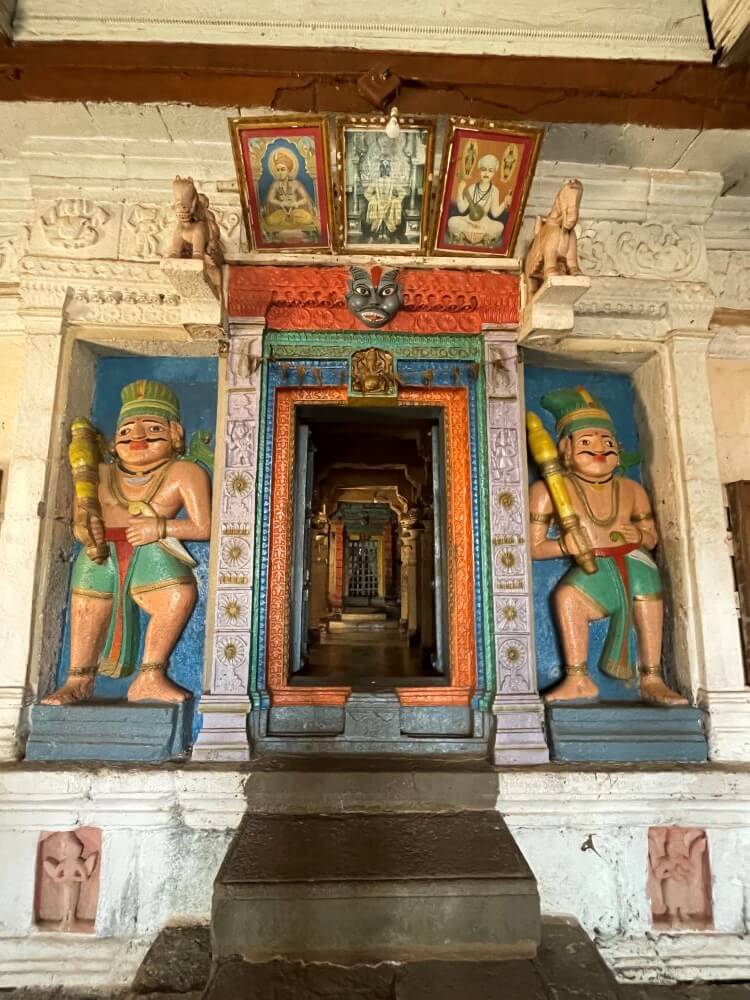
The entrance to the Sabhamandapa features a stone door frame, decorated with floral and leaf motifs. On the upper part of the door jambs, two small sculptures of Dvarapalas (gatekeepers) are carved. A unique feature is that one of these Dvarapalas holds a bow and arrow. At the lintel of the door frame, there is a carved image of Lord Ganesha, with a Kirtimukha carved above it. On both sides of this entrance, there are approximately five-foot-tall statues of Dvarapalas in the distinct Maratha sculptural style. These Dvarapalas wear a type of headgear similar to that worn by the Koli community. They are dressed in knee-length, trouser-like garments and carry a mace-like weapon, with a dagger tucked into their waistbands. One of these Dvarapalas has a parrot sculpture on his shoulder. On the projecting parts of the beam above the door frame, horse sculptures are mounted. Recently, murals have been installed on the walls on both sides of the entrance. One of these murals depicts the meeting between Mouni Maharaj and Chhatrapati Shivaji Maharaj, while the mural on the right side shows the court of Shahu Chhatrapati seated on his throne.
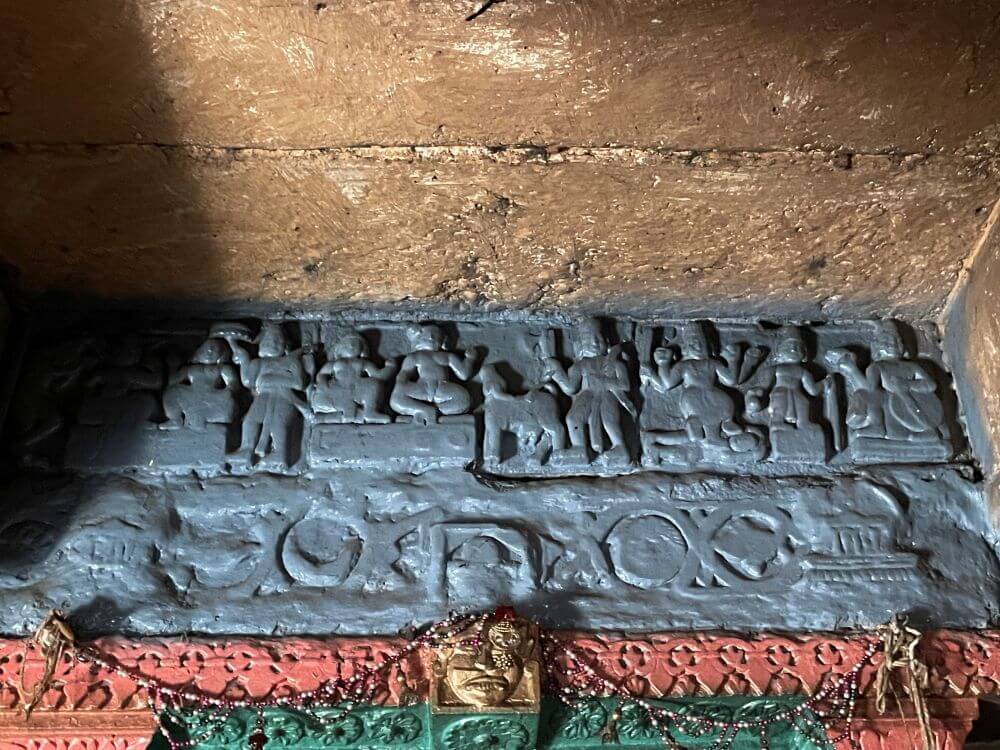
Above this wall, towards the ceiling, is a horizontal frieze of sculptures. These sculptures appear to be related to the life story of Mouni Maharaj. On the plinth of the Sabhamandapa, on both sides of the steps, are sculptures of Garuda and Hanuman, as well as a highly distinctive Sharabha sculpture. Here, the Sharabha is shown capturing six elephants. A similar but more prominent Sharabha sculpture is also found on the outer wall of the temple. Many such sculptures can be seen on the outer walls of the temple, including images of elephants, horses, camels, palanquins, and warriors. This is considered a special attraction of this temple.
One enters the Sabhamandapa of the temple through this entrance. The Sabhamandapa is enclosed and has two small doors on the left and right sides. Additionally, small windows are provided for light. Leaving some space from the side walls of the hall, there are rows of four pillars on both sides. These octagonal, wide stone pillars have bracket capitals at the top, featuring Kichaka sculptures. In some places, there are also sculptures of warriors and wrestlers. There are also sculptural friezes on the upper part of the walls of the Sabhamandapa.
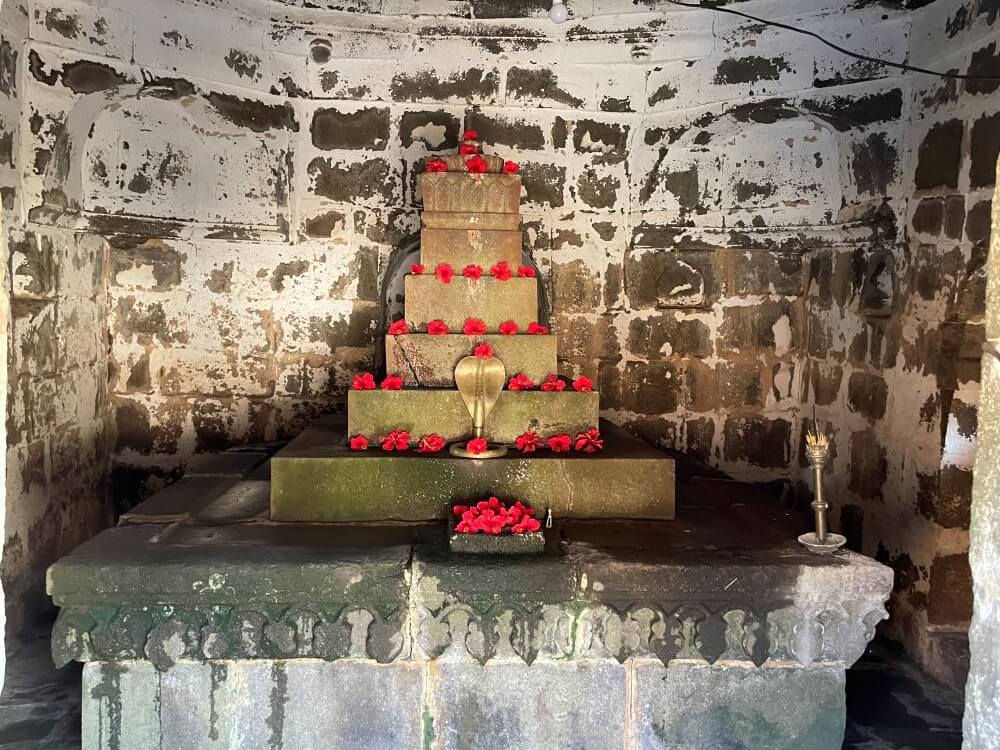
The Garbhagriha has a stone door frame. The door jambs are carved with motifs of wheels and flowers, as well as images of Dvarapalas. At the lintel is an image of Lord Ganesha, with a Kirtimukha above it. Some sculptures are carved on the wall above the door frame, that is, on the Uttaranga. In the center of the Garbhagriha is the Samadhi of Mouni Maharaj. There is a high black stone platform here, upon which sits a tiered structure of five squares resembling steps. On the top square, amidst carved lotus petals, is a Shiva Linga. Above the Linga is a brass cobra hood, and above that is a copper Galantika (vessel for ritual bathing). It is said that this tiered square structure is carved from a single monolithic slab.
Behind this Samadhi temple, there is a long, two-storied building on three sides. The thick wooden pillars of the veranda of this building, the carvings on them, the arches between these pillars, and the design of the wooden beams all bear witness to the old glory of the Matha. On the upper part of one of the door frames here, the wooden carving of Rama, Lakshmana, Sita, and Hanuman is eye-catching.
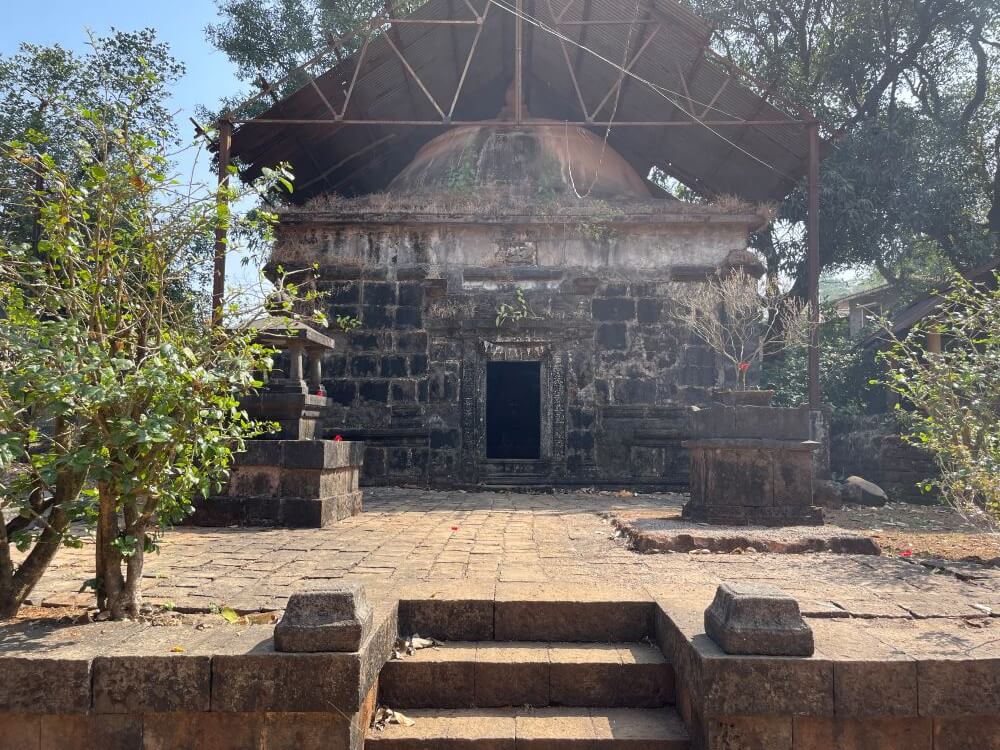
In this same courtyard, on the left side of the temple, is a small stone Samadhi-temple with a dome-shaped spire. Here lies the Samadhi of Turutgiri Maharaj, the successor of Mouni Maharaj. In front of this Samadhi-temple is a small stone Chhatri (canopy) and a Tulsi Vrindavan. There is a small Shiva Linga inside this Chhatri. The inscription “Shri Kshatrajagadguru Nidhan 5-7-1982” is carved on the Chhatri. To the left of this Samadhi-temple, another Samadhi can be seen built on a high platform. The structure of these Samadhis is similar to the one inside the temple. These are likely the Samadhis of the later heads of the Matha. There is no record available here regarding this.
Every year, the Punyatithi (death anniversary) festival of Mouni Maharaj is celebrated for five days in this Samadhi temple, starting from Ratha Saptami. Tourists and scholars constantly visit this place, which is associated with the history of Maharashtra, to witness the site and observe the unique sculptures carved in wood and stone.
This sacred temple stands as a testament to deep spiritual devotion, ancient architectural grandeur, and rich local cultural traditions.
The sanctum sanctorum houses the divine idol consecrated according to ancient Vedic traditions, surrounded by serene courtyards and traditional temple architecture.
Navratri, Maha Shivratri, Annual Temple Jatra & Deepotsav
Compare and book flights, secure top-rated local hotels near the temple, hire reliable guides, and rent cars instantly.
Extend your pilgrimage by visiting other highly sacred temples located nearby.


Add ₹999 more to unlock FREE SHIPPING!
Your sacred cart is currently empty.
Shop Photo FramesFill in your delivery details below to place your order.
Add comment