
Add ₹999 more to unlock FREE SHIPPING!
Your sacred cart is currently empty.
Shop Photo FramesIn the land of Maharashtra, which is blessed with a great spiritual heritage, many great saints and sages have lived. Even in modern times, this land continues to witness the incarnations of saints and sages. One such realized and miraculous saint in this lineage is Sant Balumama. A saint who preached a straightforward theism, stating, “To those who say I exist, I exist; to those who say I do not, I do not,” Balumama was born into the Dhangar community; however, today he has thousands of devotees not only from Maharashtra but also from all castes and communities in other states. Thousands of devotees come to bow their heads every day at the grand Samadhi temple of Sant Balumama in Adamapur.
Balumama was born during the same era when miraculous and realized figures like Gajanan Maharaj of Shegaon, Gondavalekar Maharaj, Gulabrao Maharaj, and Bhagwan Baba were present in Maharashtra. When he was eighteen years old, Gajanan Maharaj of Shegaon concluded his incarnation. Brahmachaitanya Gondavalekar Maharaj of Gondavale in Satara district, Tembe Swami of Mangaon, and Chile Maharaj of Paijarwadi were his contemporary miraculous saints. These saints, who took incarnation during the difficult times of slavery when the entire country was being crushed under the heels of British rule, blossomed the garden of devotion here and guided many onto the righteous path. Balumama is considered one of the great saints in this lineage.
Balumama was born on October 3, 1892 (Monday, Ashwin Shuddha Dwadashi, Shake 1814), the year before Swami Vivekananda, the great son of Mother India, went to America and hoisted the flag of Hinduism. There are some important historical records of Balumama in the research paper titled ‘Shri Kshetra Adamapur – A Study of a Pilgrim Center’ published by researcher Varsha Chavan in the ‘Review of Literature’ released by Shivaji University, Kolhapur, in October 2013. Accordingly, the ancestors of Balumama belonged to the Desai family. In the year 1156, a person from this family received the Patilki of Torvi village near Bijapur. The heirs of that family later migrated to Arbhavi in the Gokak taluka of Belagavi district. They received the Patilki there as well. They held the rights to perform worship at the Maruti temple there. In the year 1656, the family migrated to Akkol. During that period, they acquired the surnames Arbhave and Arbale.
Balumama was born to the virtuous couple Mayappa Arbhave and his wife Satyabhama, belonging to this very lineage. It is said that in his childhood, he was solitary, serious, and at times displayed the nature of an Avadhuta. To keep him occupied with work, his parents placed him as a cattle herder at the home of Chandulalsheth Jain. There, Chandulalsheth’s wife witnessed a vision of a Jain temple in the plate of food served to him. Consequently, she kept that plate for herself. Displeased by this, Balumama left that job. Following this, Balumama was sent to the home of his sister, Gangubai Hiryappa Khilare. There, her children called him ‘Mama’ (maternal uncle). Thus, he became ‘Mama’ to everyone. At approximately the age of twenty, Balumama was married to his niece, Satyavva. Despite his reluctance, he had to undergo this marriage solely due to the insistence of his parents. However, his mind was not inclined towards worldly life; his inclination was towards the path of spiritual liberation. Meanwhile, one day, while taking the sheep to graze as usual, Balumama met Mule Maharaj. Balkrishna Jayram Mule Maharaj of Solankur in the Radhanagari taluka of Kolhapur was a detached saint. He bestowed grace upon Balumama. From that day on, Balumama’s life was transformed. He renounced worldly life and embraced the arduous path of spirituality. Gradually, due to his teachings, the miracles he performed, and his prophecies that later proved to be true, people began to be drawn towards him. It is the firm faith of his devotees that he possessed the power of Vachasiddhi (the power of his words coming true).
Balumama’s attire consisted of a clean dhoti, a full-sleeved shirt, a headscarf, a woolen blanket draped over his shoulder, traditional wooden sandals on his feet, and a Dhangari staff in his hand. His complexion was dark, and he possessed a lean physique. He spoke in both Kannada and Marathi. He would travel across various places in Karnataka and Maharashtra with his flock of sheep, eventually becoming known as a wandering saint. During these travels, he performed miracles in many places for the welfare of his devotees and guided countless people on the path of spirituality. Believing that the offering of food is a sacred act, he initiated the ‘Bhandara Utsav’ in the year 1932. This festival continues to be held in Adamapur even after Balumama’s Samadhi. Balumama used to spend much of his time at the Margubai Temple in Adamapur. It was in this very temple that he attained Mahanirvana on 4 September 1966, at the age of 74. Over time, a magnificent Samadhi temple was constructed in this village.
The legend regarding Balumama’s temple here is that a few days before he took Samadhi, some of his close devotees and followers gathered and decided to build a temple for him. They collected some money for this purpose; however, Balumama did not approve of building a temple using money collected from the public. He instructed his devotees to return the money to those from whom it had been collected. The devotees obeyed Balumama’s command. After Balumama departed from this world, his Samadhi temple was built using his own money. Naturally, voluntary donations given by some devotees were also utilized for this purpose.
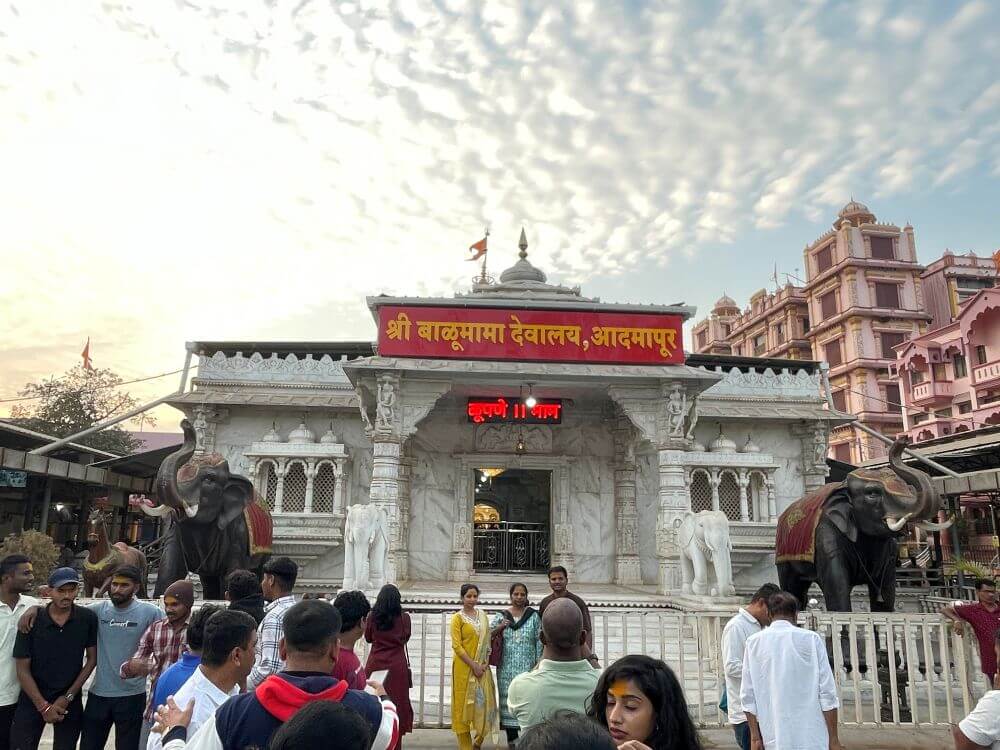
This Samadhi temple stands on a vast expanse of land in Adamapur. The layout consists of two spacious tin-roofed pavilions supported by iron pillars on both sides to provide shelter for the thousands of devotees who arrive daily, with Balumama’s grand and beautiful temple situated in the center.
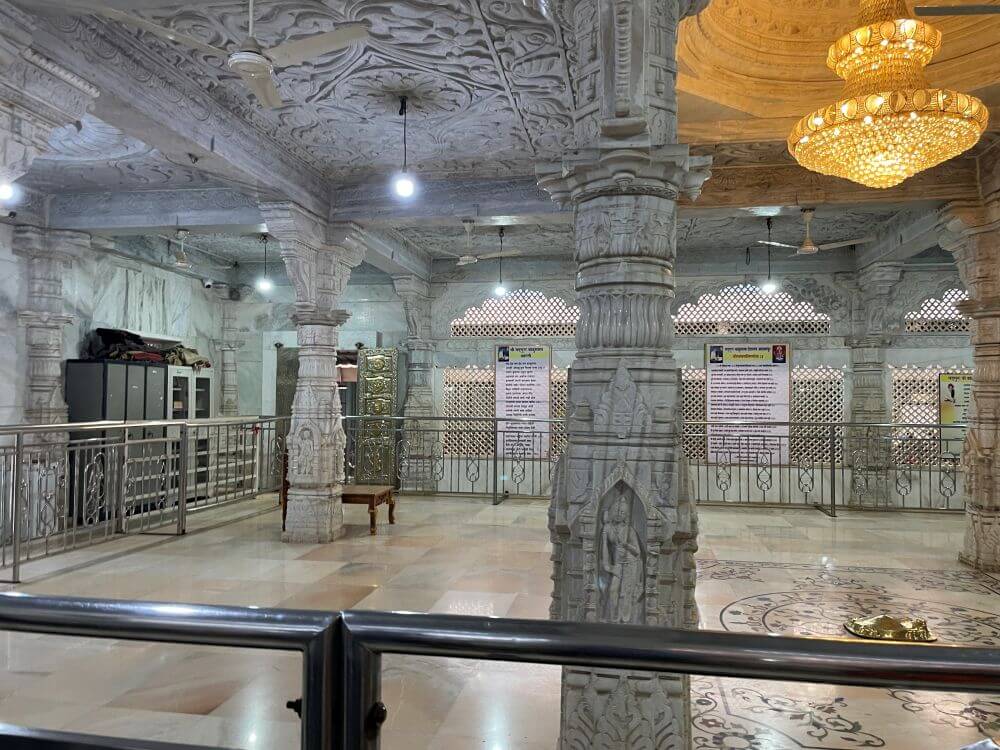
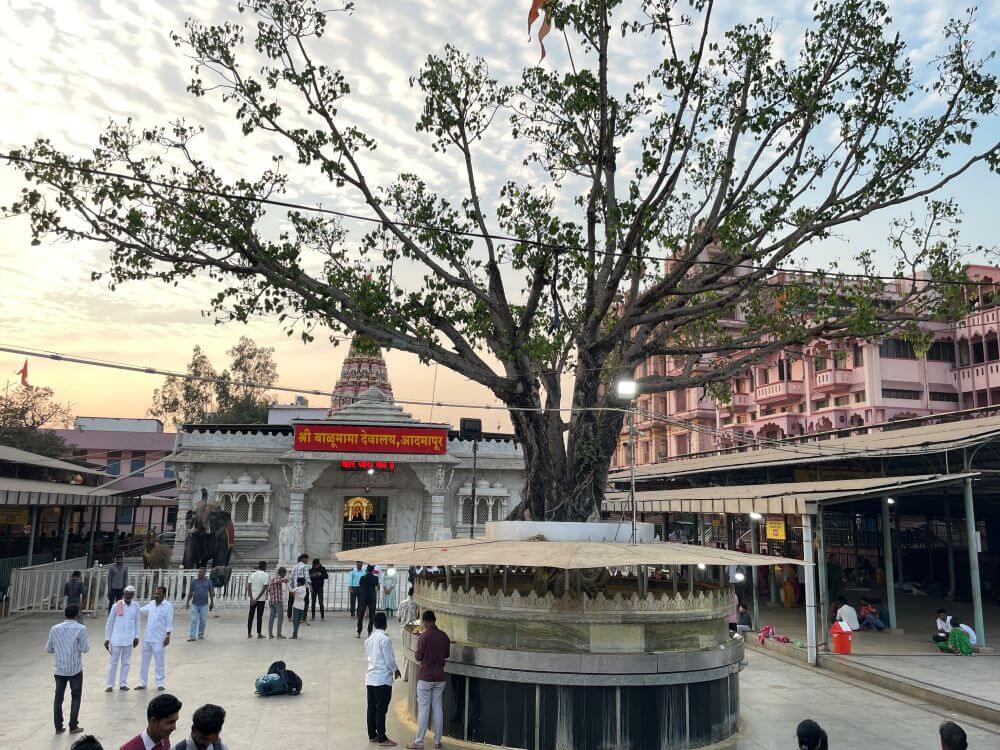
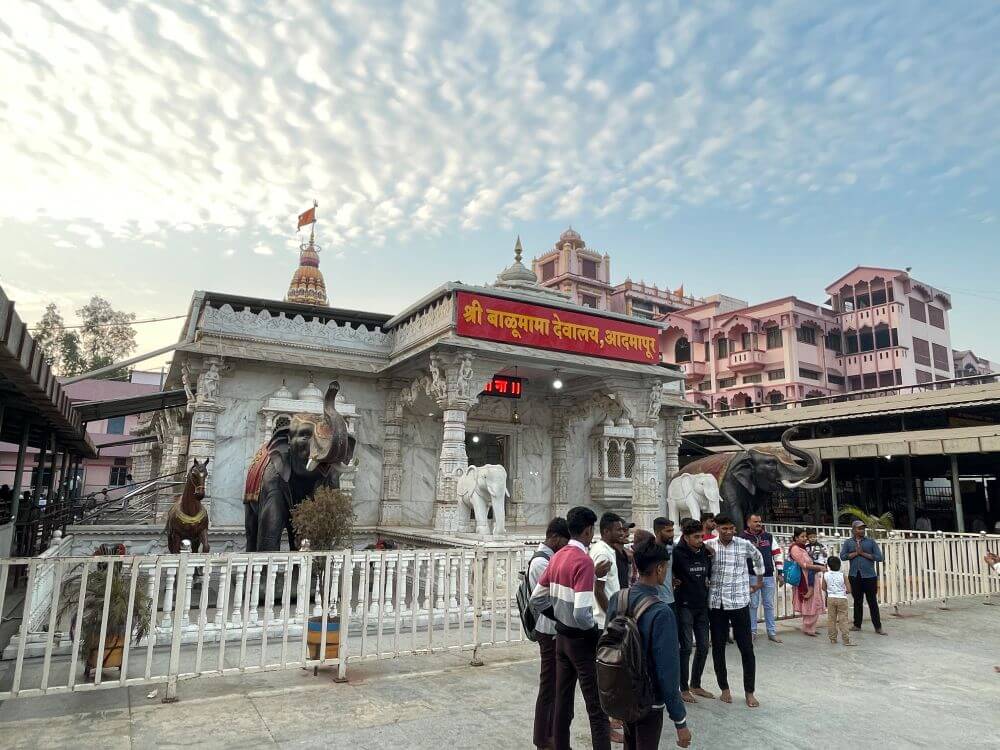
The temple courtyard is paved with marble throughout. Upon entering, one immediately sees a platform built under an ancient Pipal tree. Devotees stick coins onto the wall above this platform. It is the belief of the people that if the coin sticks, the wishes in their hearts will be fulfilled. A short distance from here, facing forward, is the Samadhi temple. The structure of the temple is built entirely of marble. It bears a clear influence of the Gurjar architectural style. The temple, which is designed with a Mukhamandapa (entrance porch), Sabhamandapa (assembly hall), and Garbhagriha (sanctum sanctorum), features a Shikhara (spire) in the Maratha architectural style. This Shikhara, which is circular and tapers towards the top, consists of five tiers. In the niches on all four lower tiers, statues of various deities and saints are carved. The fifth tier is the Amalaka. Its structure consists of an Amalaka set within lotus petals atop a dome-like shape, crowned by a Kalasha.
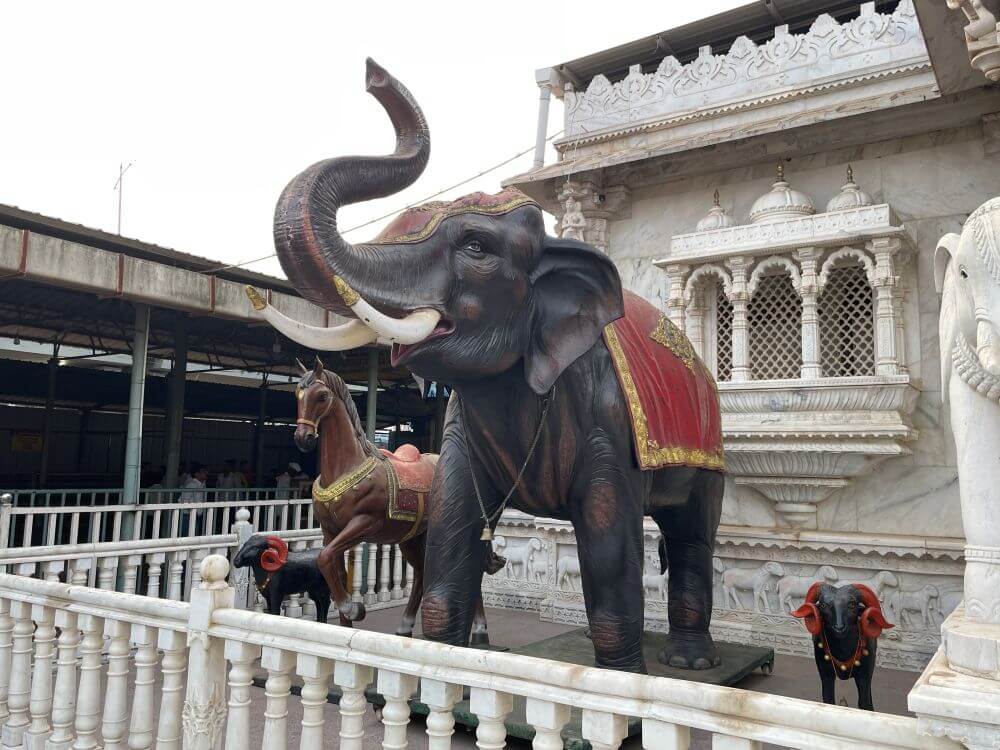
The Mukhamandapa and the Sabhamandapa have pillars with intricate carvings. The temple is adorned with sculptures of Surasundaris on the pillars, Makartoranas (archways with mythical sea creatures), elephant figures, sculptures of door guardians, and various types of carvings on the walls and ceilings. Here, there are two marble elephants on the railings of the steps of the Mukhamandapa. Additionally, there are full-sized elephant statues on both sides of the Mukhamandapa. Horses and sheep hold an important place in Dhangar life. Their statues are also placed here. Instead of the Mukhamandapa, entry into the temple’s Sabhamandapa is through a side entrance. Thousands of people come daily for the Darshan of Balumama. Apart from that, during pilgrimages and other festival periods, the crowd here reaches into the hundreds of thousands. To manage this, a large queue complex has been built here, and for this reason, entry into the Sabhamandapa is provided through the entrance on the left instead of the Mukhamandapa.
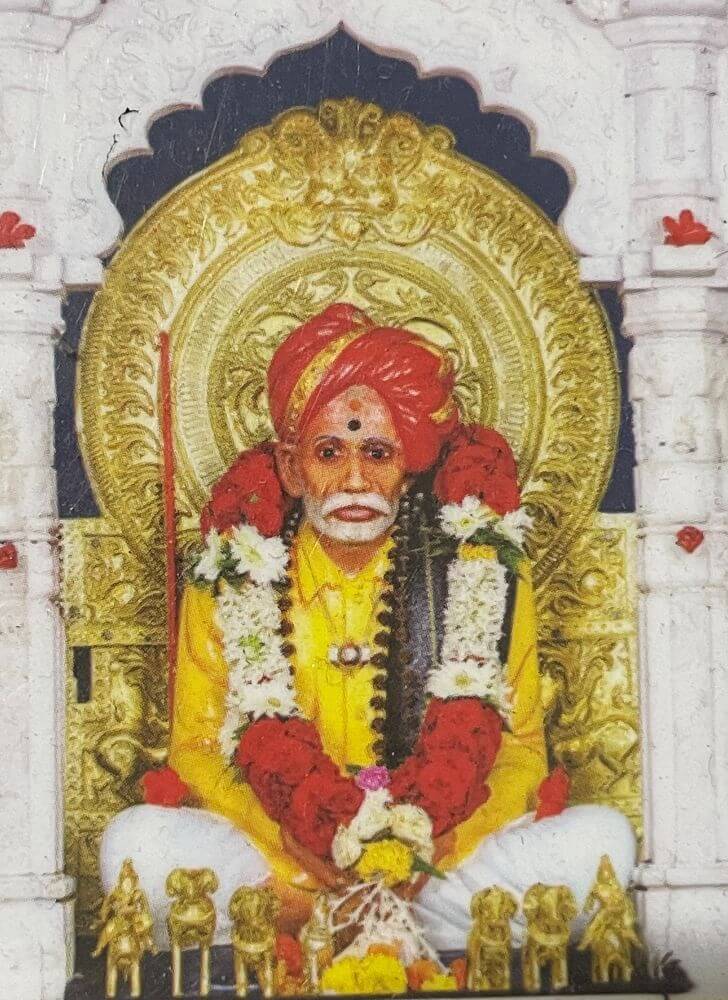
The temple’s main assembly hall is spacious. The walls of the hall feature latticed windows, which allow for abundant light and ventilation. This arrangement has been made specifically keeping the crowds in mind. In the sanctum sanctorum lies the Samadhi of Balumama, upon which his Padukas are placed. In front of them are his wooden sandals. Right there, on a high pedestal within a large marble shrine, stands the idol of Balumama. The serene idol is depicted wearing a tunic and dhoti, with a red turban on his head, a woollen blanket draped over his shoulder, sitting cross-legged with both hands resting on his lap. On one side of his idol is the idol of Sadguru Mule Maharaj, and on the other side are the idols of Vitthal-Rukmini. Behind these idols is a beautifully carved archway plated with gold leaf. After taking darshan here, one exits through the door on the right to find a temple of Dattatreya beneath an Audumbar tree.
Within the temple premises, there is a museum housing items used by Balumama, which serves as a center of attraction for devotees. Furthermore, the temple trust has constructed a grand hospital as well as a pilgrim residence here. Countless people benefit from these facilities every day.
At the Balumama Samadhi Temple, Puja and Aarti are performed daily at 5 in the morning. Naivedya is offered at 9 in the morning, followed by Aarti and Naivedya between 7 and 7:30 in the evening. Every month on Amavasya, lakhs of devotees come here for Darshan. On that day, Ambil is served to the devotees as Prasad. Additionally, Amti-Bhat and Kheer Prasad are also distributed. Major religious festivals are celebrated at the temple on Balumama Jayanti (Ashwin Shuddha Dwadashi), Punyatithi (Shravan Vadya Chaturthi), Bhadrapad Amavasya, and Ekadashi. On Diwali Padwa, a heap of sheep droppings is created near the Margubai Temple here, which is worshipped as Lakshmi. On this day, the sheep are also worshipped. The largest festival at the temple is the Bhandara Mahotsav held on Gudi Padwa. On this day, Dindis from various villages arrive here. It is a jubilant event featuring lakhs of devotees chanting ‘Balumamacha Navane Changbhala’, the showering of Bhandara, Kirtan, Bhajan, the Palkhi procession, the resonating sounds of Dhangari Dhol and Kaita, as well as Lezim and Dandpatta performances, and the procession of Balumama’s horse.
This sacred temple stands as a testament to deep spiritual devotion, ancient architectural grandeur, and rich local cultural traditions.
The sanctum sanctorum houses the divine idol consecrated according to ancient Vedic traditions, surrounded by serene courtyards and traditional temple architecture.
Navratri, Maha Shivratri, Annual Temple Jatra & Deepotsav
Compare and book flights, secure top-rated local hotels near the temple, hire reliable guides, and rent cars instantly.
Extend your pilgrimage by visiting other highly sacred temples located nearby.


Add ₹999 more to unlock FREE SHIPPING!
Your sacred cart is currently empty.
Shop Photo FramesFill in your delivery details below to place your order.
Add comment