
Add ₹999 more to unlock FREE SHIPPING!
Your sacred cart is currently empty.
Shop Photo FramesKagal Taluka in Kolhapur District was formerly the princely state of Kagal. In the year one thousand five hundred and seventy-two, this state, comprising seventy villages, was granted as an *inam* (gift) by Sultan Muhammad Badshah of Bijapur to Piraji Raje Ghatge. The Dudhganga River, flowing through the taluka, makes this region fertile and prosperous. The taluka is renowned for its agricultural and dairy production. The largest milk production cooperative society, which collects the most milk in the taluka, is located in Sake village. The awakened shrine of Gramdevat Bhairavnath in Sake village is a place of faith for thousands of devotees. The continuous flow of water from the *gomukh* (cow’s mouth spout) in this temple is a unique feature here.
The legend associated with this temple states that the original shrine of Bhairavnath was located on a cliff of a hill near the village. However, due to the difficult path up the hill, many devotees, despite their desire, could not go there for *darshan*. Then, Bhairavnath descended to the middle of the hill. Yet, devotees did not discover this spot. One day, a cowherd saw a cow spontaneously releasing milk at this very spot. Out of curiosity, he cleared away the leaves and debris from the area. There, he saw a *pindi* of the deity. He informed the villagers about this, and all the villagers then built a temple at this location. After seeking the deity’s divine will (*kaul*), Gosavi Giri from the village was appointed as the priest, and since then, many generations of the Giri family have been serving the deity.
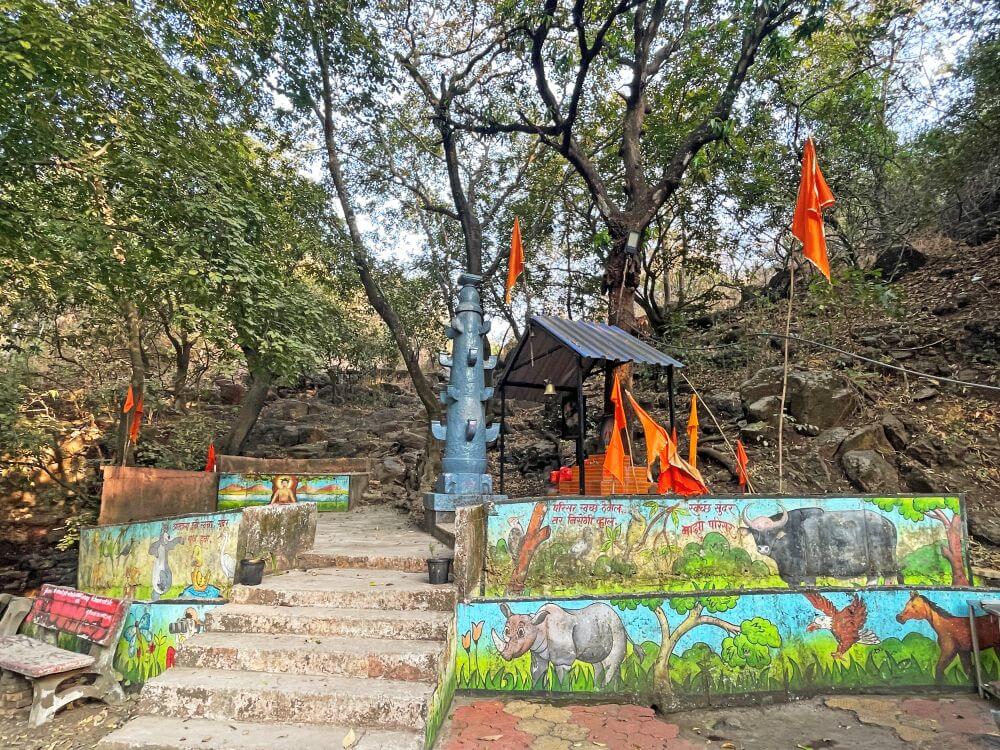
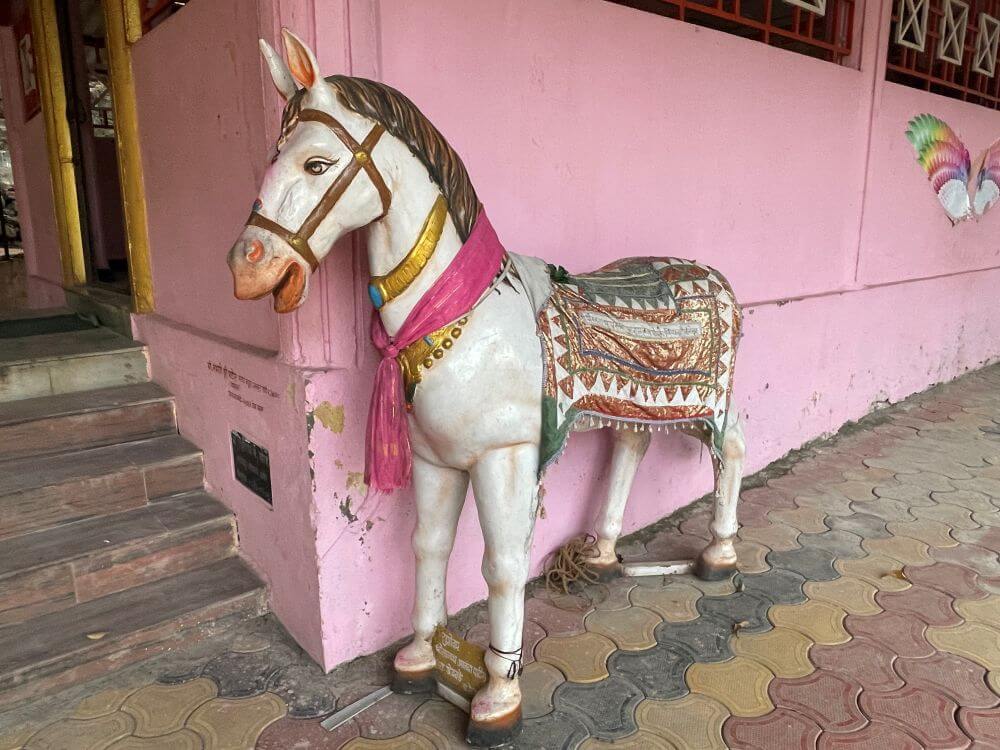
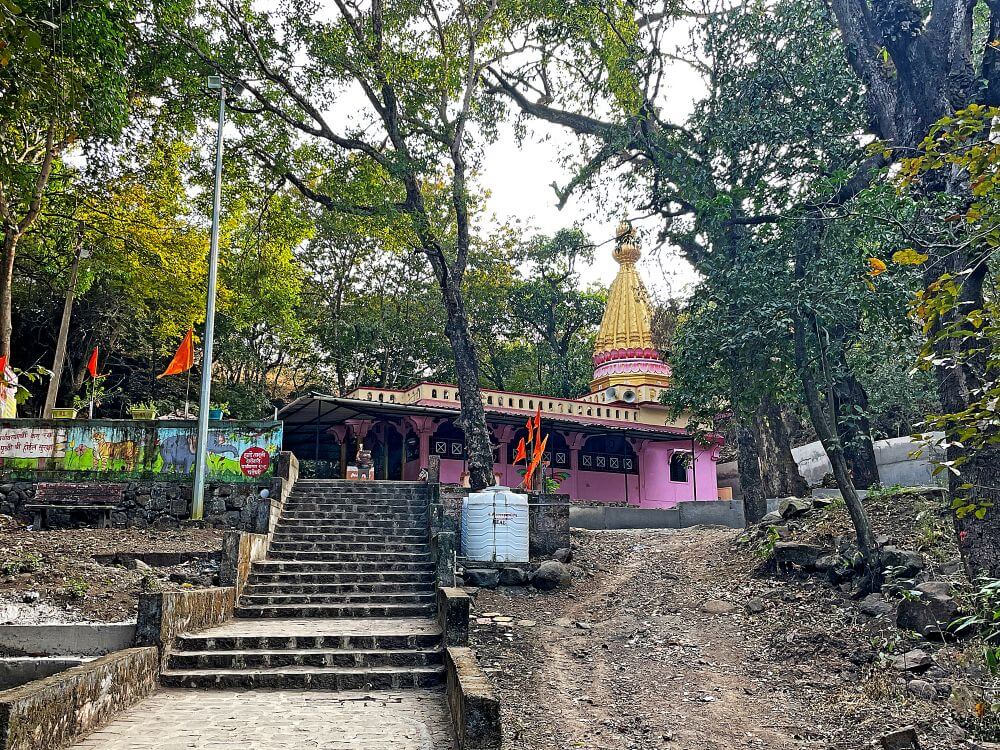
The welcome arch of this temple, nestled in the lap of the hill, is located at the foot of the stairs that begin the ascent. From here, one can reach the temple by climbing approximately fifty steps. As one ascends the steps, the dense green foliage on both sides provides a cool breeze. During the monsoon, many waterfalls can be seen here. In the temple courtyard, which is paved with paver blocks, there is a brass idol of Bhairavnath’s horse on a platform. Villagers believe that Bhairavnath rides his horse to protect the village.
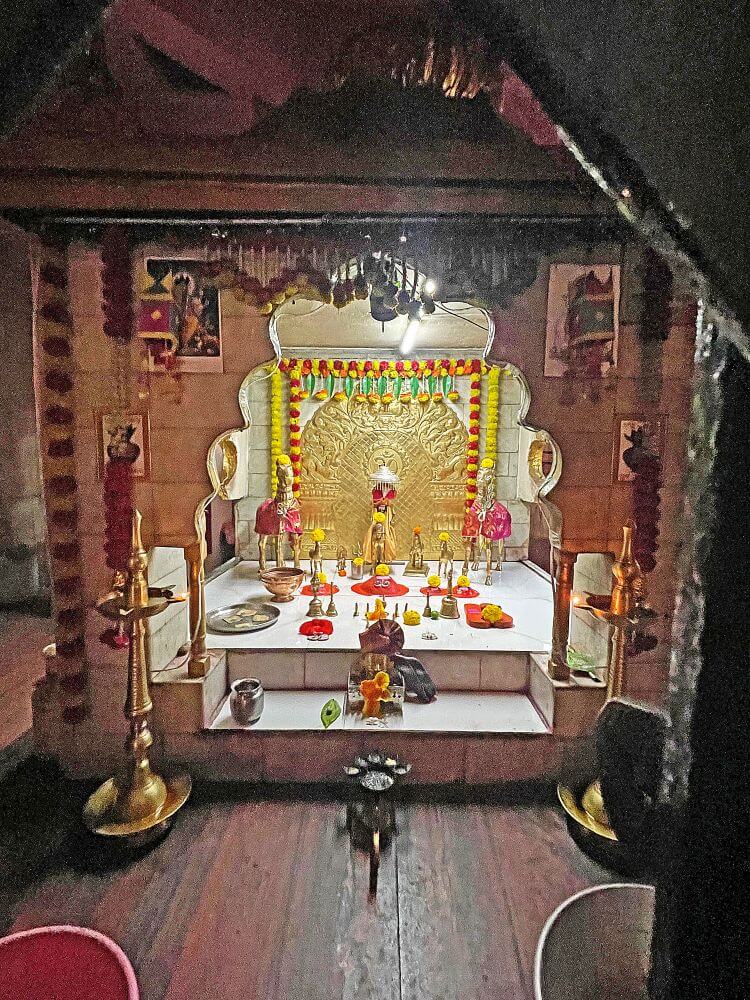
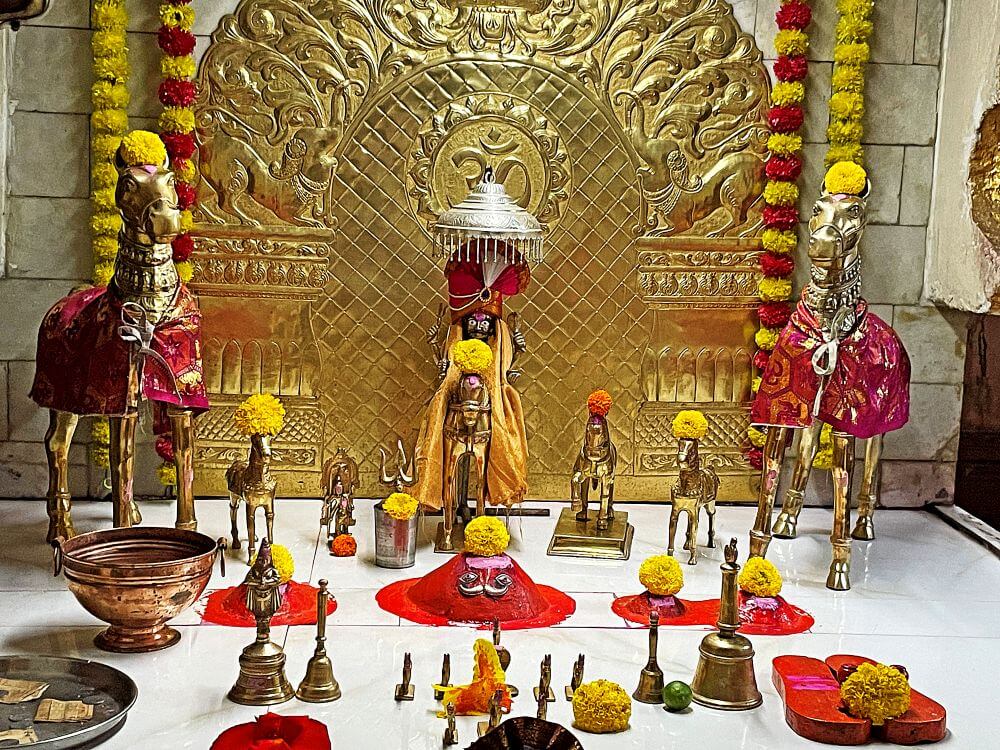
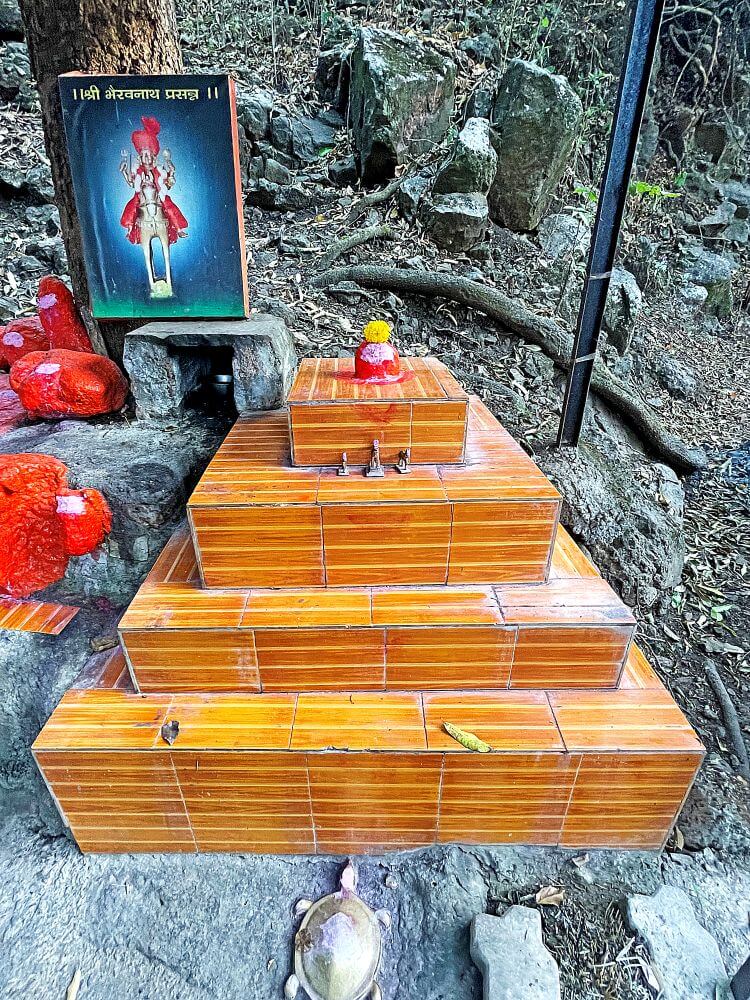
In front of the temple, beneath a tiled roof without walls, there is a *yagnakunda* (sacrificial fire pit). This *yagnakunda* blazes during annual festivals and other rituals. Behind it, on a platform, stands a circular *deepmala* (lamp tower) that tapers upwards. Beside the *deepmala* are the *sanjeevan samadhi* (living tomb) of Bhairavnath’s devotee Yamaji Buwa Giri Gosavi, and stone idols of other local deities. In front of the *yagnakunda*, before the temple’s assembly hall, there are two smaller *deepmalas*. The lower part of the *deepmala* has projections for lighting lamps, and the upper part has a square carved with a lotus design. Each tier of the *deepmala* is made of a single stone, making its structure appear unique. The temple’s layout consists of a *mukhmandap* (entrance hall), a *sabhamandap* (assembly hall), and a *garbhagriha* (sanctum sanctorum). One must climb five steps to enter the *mukhmandap*, which is elevated from the ground. The *sabhamandap* here is semi-open, and all its pillars are connected by arches. Inside the *garbhagriha*, on a *vajra-pitha* (diamond throne) within the *makhar* (shrine), are the *pindis* of Bhairavnath and his Shaktis. Behind these *pindis* is a brass, two-armed *utsav murti* (processional idol) of Bhairavnath on horseback. The idol holds a *trishul* (trident) and a *pasha* (noose) in its hands. On both sides of the idol are two brass horses, and on the brass *prabhavali* (aura) behind, there are *gajraj* (elephant kings) on both sides.
To the left side of the temple is the *gomukh*, from which a continuous stream of water flows. Beside this *gomukh* is a stone idol of Jogai Devi. Festivals such as Mahashivratri, Chaitra Padwa, Navratri, Dussehra, Diwali, Tripurari Pournima, and others are celebrated in the temple. A large *yatra* (fair), known as *Mahi*, takes place here on the Sunday and Monday following Magh Pournima. This is considered a major *yatra* in Kagal Taluka. At this time, thousands of devotees gather for the *darshan* of Bhairavnath and to fulfill their vows. During Dussehra and the *yatra* festival, Bhairavnath performs a village circumambulation seated in a *palkhi* (palanquin). Many tourists, along with devotees, visit this place situated amidst dense greenery and a nature-rich environment.
This sacred temple stands as a testament to deep spiritual devotion, ancient architectural grandeur, and rich local cultural traditions.
The sanctum sanctorum houses the divine idol consecrated according to ancient Vedic traditions, surrounded by serene courtyards and traditional temple architecture.
Navratri, Maha Shivratri, Annual Temple Jatra & Deepotsav
Compare and book flights, secure top-rated local hotels near the temple, hire reliable guides, and rent cars instantly.
Extend your pilgrimage by visiting other highly sacred temples located nearby.


Add ₹999 more to unlock FREE SHIPPING!
Your sacred cart is currently empty.
Shop Photo FramesFill in your delivery details below to place your order.
Add comment