
Add ₹999 more to unlock FREE SHIPPING!
Your sacred cart is currently empty.
Shop Photo FramesKalba Devi is the primordial deity of Malvan, a town that flourished under the shelter of the Sindhudurg Fort, the foundation of which was laid by Chhatrapati Shivaji Maharaj in 1664 AD. Kalba Devi is one of the deities in the series of the ‘Barapach’ (the twelve and five) deities of Malvan, which includes Dev Rameshwar, Dev Narayan, Sateri, Jarimari, as well as Giroba and Gangoba. The shrine of the Goddess here is considered ancient and spiritually awakened. It is believed that Kalba Devi is the sister of Rameshwar, the presiding village deity of Malvan. Consequently, the festival of Bhau Beej is celebrated here with great enthusiasm during Diwali.
There is a legend about the Goddess that she was previously located in Mangaon, in the Kudal region. Once, a great infestation of evil spirits occurred in that village. Terrified, the people there migrated to other places. The Dhuri family was among them. They came to Malvan and settled there. They purchased lands. Once, while a farmer was ploughing one of those fields, the ploughshare struck the left side of a stone. Blood began to ooze from it. Seeing this, he was terrified. He The information was conveyed to the Dhuri community of the village. They narrated this incident to the village deity, Rameshwar. In response, Rameshwar declared that this Goddess, who had manifested in the form of a stone, is Kalbadevi, and she is my sister.
There is another legend regarding this, which narrates the second part of the first legend in a different way. The legend goes that when Chhatrapati Shivaji Maharaj laid the foundation of Sindhudurg Fort, the foundation stone would not stay in place. In the book ‘Chhatrapati Shivaji Maharajanchi Bakhar’, written by Raghunath Yadav Chitre alias Chitragupta between 1682 and 1692 A.D., an account of this is given as follows: “Efforts were made in various ways to construct a bastion against the onslaught of the water at Sindhudurg; however, no solution worked. Because of this, Maharaj fell into an ocean of worry.” It is clear from this that there were difficulties while building the foundation of the bastion. According to the legend of the Goddess, at that time, the Maharaj’s camp was on the plains of Kandalvan. There, the King had a dream. In it, Kalbadevi appeared. She told him the location of where she was and said to Shivraya in the dream, “Build my temple, then the stone of your fort will hold, and the construction of the fort will be completed.” Second In the morning, the Maharaja, accompanied by his soldiers, began searching for the site. The soldiers of Shivraya noticed a farmer ploughing a field in the Medha region. When they went to bring him, he started to run away. Eventually, he was caught and brought before the Maharaja. After assuring him of his safety, the Maharaja asked him to show the place where the Goddess had manifested. The farmer then led them to that spot. There, they found a stone, and the entire area was covered in blood. Seeing this, the Maharaja built a small temple for the Goddess there. As a form of daily worship, Shivaji Maharaj granted annual stipends (varshasan) to the temples of Dev Narayan, Sateri, Gangoba, and Kalbadevi. It is said that even today, the Kalbadevi temple, which is the family deity of the Dhuri family, receives an annual sum of 13 rupees and 37 paise.
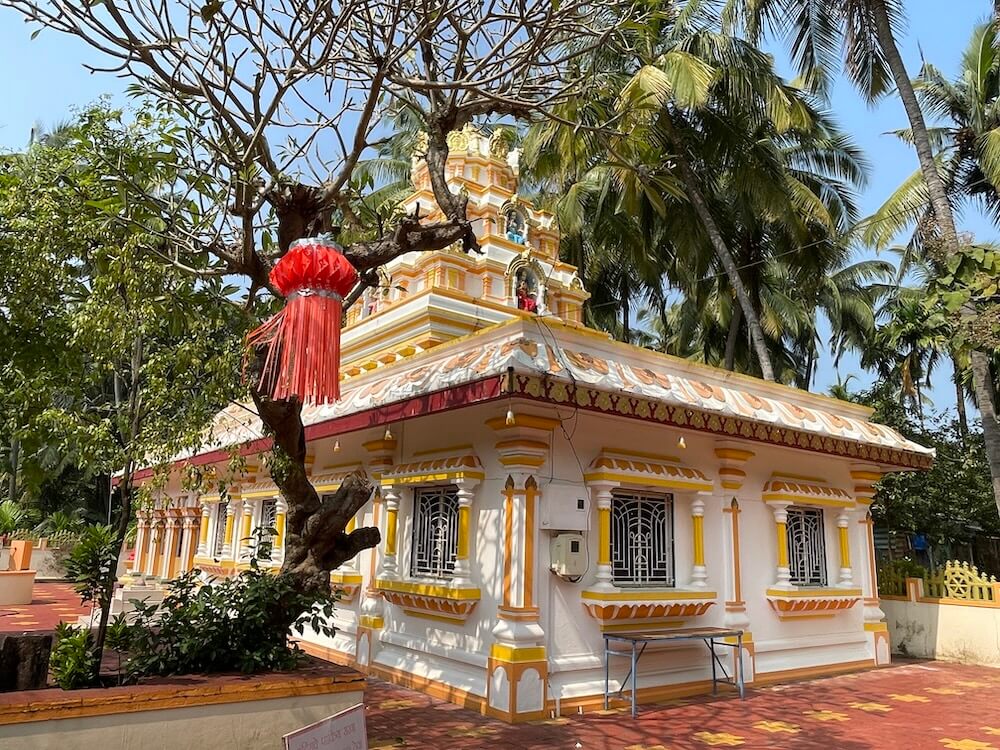
The ancient tiled temple of Kalbadevi, built during the era of Chhatrapati Shivaji Maharaj, has undergone periodic renovations. In the year 1909, the temple’s sabhamandap (assembly hall) was constructed by the goddess’s devotee, Baburao Awdoji Paradkar. Later, on 23 August 2007, the temple was renovated. Today, a magnificent temple of Kalbadevi stands here.
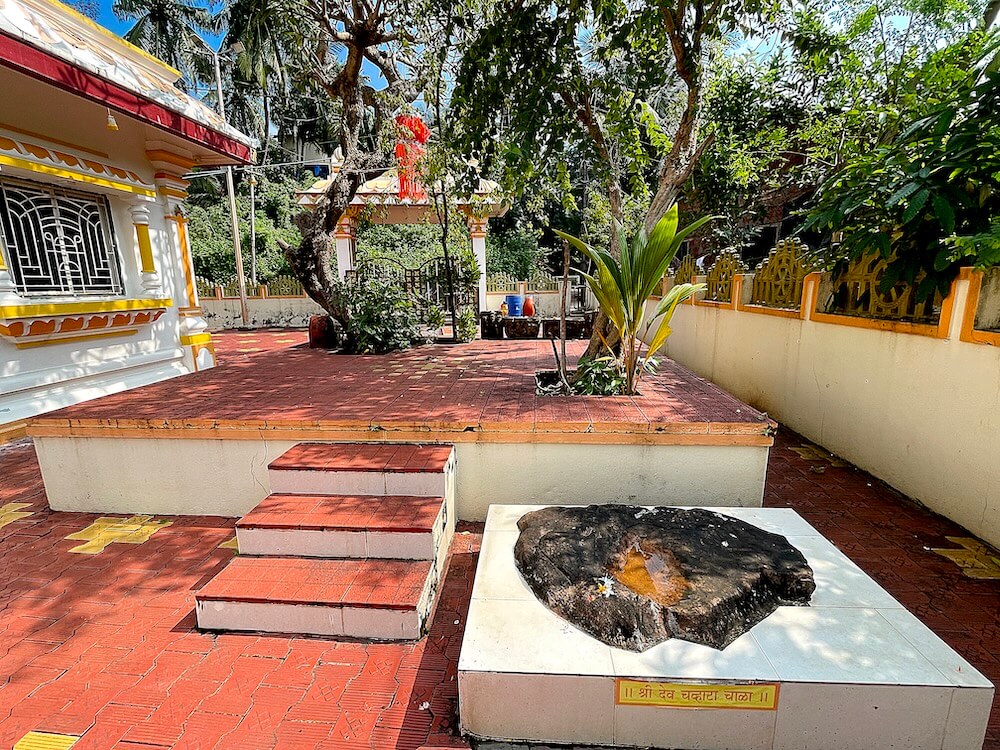
The temple courtyard features an entrance gate supported by four intricately carved pillars. Its roof is adorned with three shikhara (spires) and a kirtimukha. Upon entering, one finds a large platform directly ahead, where several ancient, fragmented sculptures are displayed. Among them is a broken sculpture of a goddess with a serene countenance. The goddess is seated on a throne. She wears a distinctive crown on her head and large earrings in her ears. Since the parts representing her arms, legs, and waist are broken, Its exact nature is not clear. At this location, there is a similar male figure, approximately two feet in height. This idol, carved onto a square stone slab, wears a crown on its head and has a mustache on its lips. It appears that this idol is four-armed (Chaturbhuja). It is seated in a posture with one leg folded and the other hanging down. Between these two idols, there are carved stone slabs approximately one and a half feet in height and two and a half to three feet in width. Both the front and back sides of these slabs feature carvings. One of these slabs depicts an elephant and a mace-bearing male figure, while its reverse side shows two horsemen setting out for battle. The spear in the hand of one of the riders is clearly visible. The slab placed beside it also features carvings of an elephant and a female figure, while the back of this slab depicts warriors riding galloping horses. The elephants on these slabs appear to be charging. It seems that these slabs were part of a large pillar and the carvings on them represent a battle scene. These sculptures are remnants of the ancient temple here, from which this shrine’s The antiquity is evident.
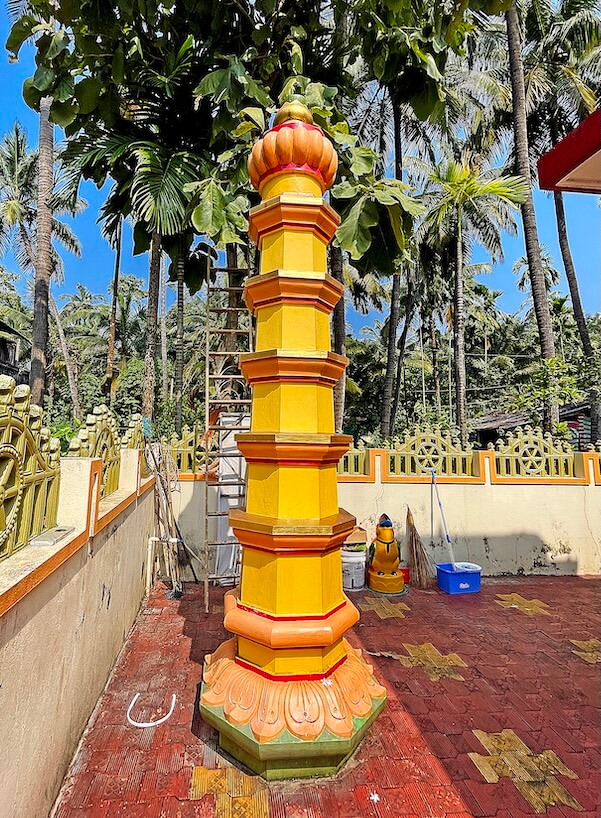
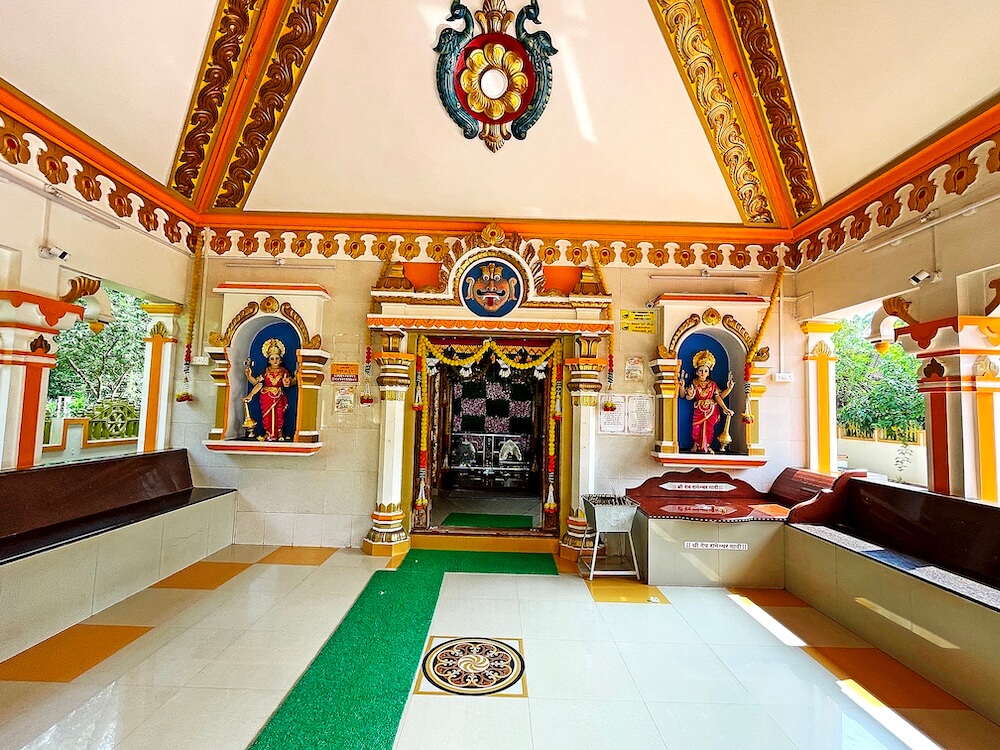
Beyond this platform, there is a stone idol of the local deity on a stepped plinth. A well is situated right beside it. In front of the temple stands a seven-tiered lamp pillar (Deepastambha), with an Amalaka at its top. Nearby is the Tulsi Vrindavan. The temple is structured with a Mukhamandapa (entrance porch), Sabhamandapa (main assembly hall), Antarala (vestibule), and the Garbhagriha (sanctum sanctorum) situated within the Antarala. There are shikhars (spires) above the Mukhamandapa, Sabhamandapa, and the Garbhagriha. The shikhara above the Antarala is shaped like a Gopura, with idols of the Goddess enshrined in niches (Devakoshthas) on all four sides. The roof of the Sabhamandapa features a series of receding steps placed one above the other, topped by a high, disc-shaped shikhara. The shikhara above the Garbhagriha consists of square carved pillars, niches containing idols of the Goddess in various forms, a dome-shaped Amalaka, and a Kalasha atop it.
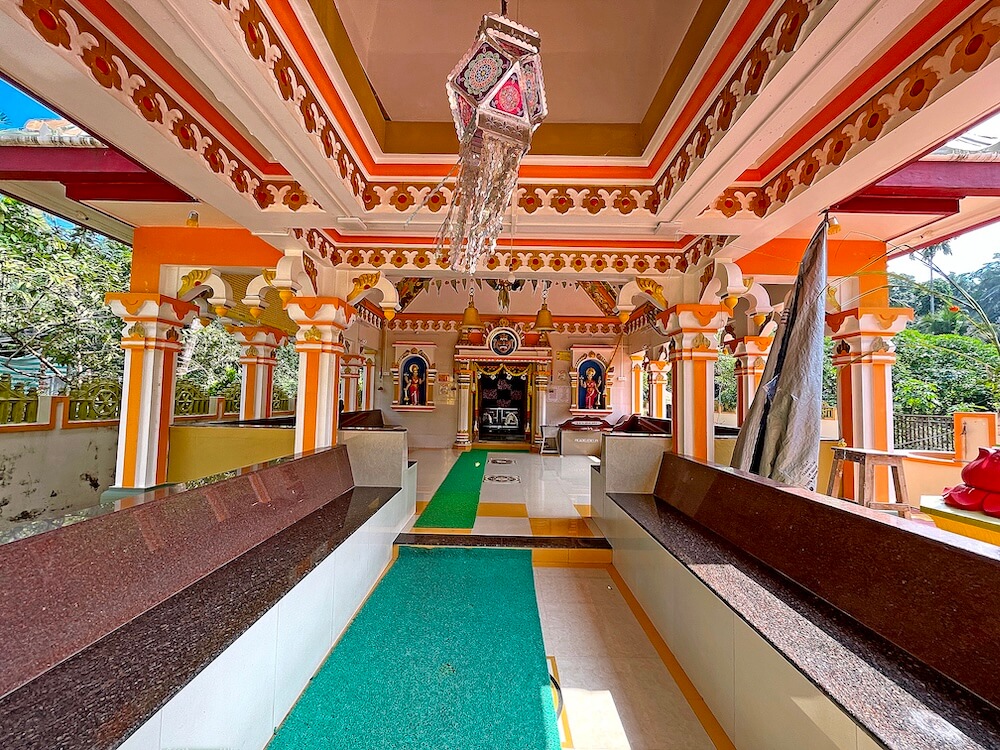
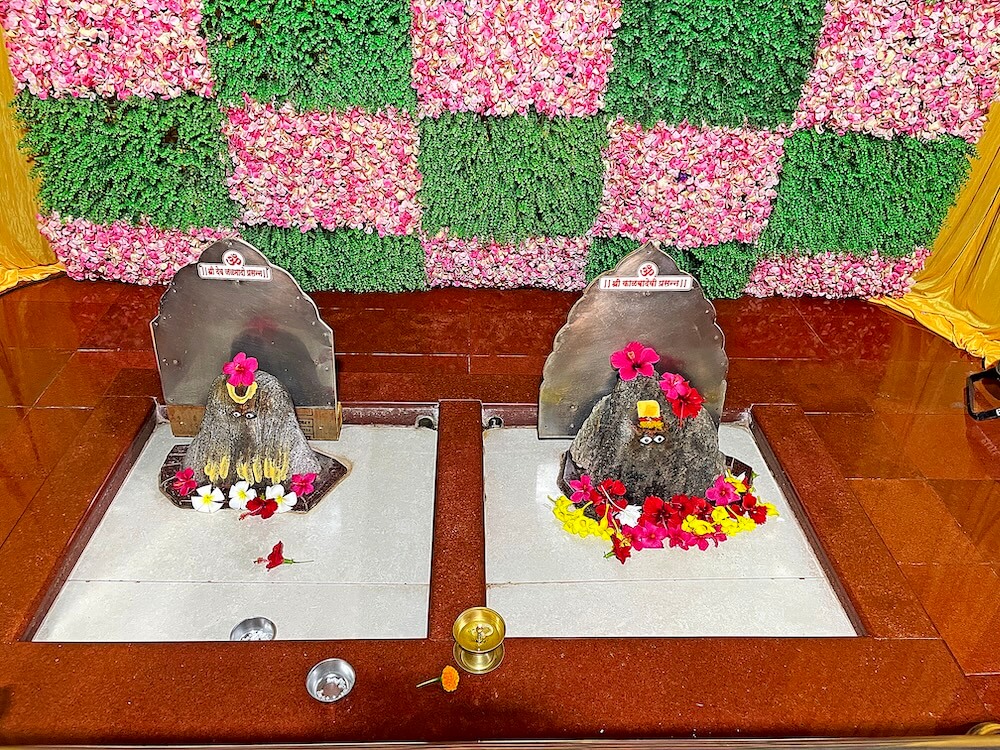
The Mukhamandapa (front hall) and Sabhamandapa (main assembly hall) of this temple are open-style structures. Both halls feature marble seating along the periphery. On the front wall of the Antarala (vestibule), there are two niches containing statues of female door guardians (Dvarapalas), and the entrance, adorned with pillars, features a Kirtimukha at the Lalatabimba (lintel) position. Adjacent to this front wall is a high platform dedicated to the throne of Lord Rameshwar. When the Palkhi (palanquin) of Lord Rameshwar arrives at the temple, it is placed here. There is a circumambulatory path (Pradakshina path) around the Garbhagriha (sanctum sanctorum) accessible from the Antarala. On the front wall of the Garbhagriha, there is an elegant idol of Radha-Krishna in a small niche on the right, and an idol of Lord Ganesha in a niche on the left. Inside, upon a Vajrapitha (stone pedestal), are two sacred stones; one represents Goddess Kalbai and the other represents the deity Jalmado.
A grand fair is held at this temple on the second or third Tuesday of the holy month of Shravan. The day of this fair is decided by the mankaris (traditional honorary officials). During the first three Tuesdays of Shravan, a saree is draped over the stone idol of the Goddess, while on the fourth Tuesday, the standing idol of the Goddess is adorned with ornaments. Every Diwali, a grand festival is celebrated at the Rameshwar and Dev Narayan temples in Malvan, featuring a ceremonial procession of the deity’s palanquin. On the day of Bhaubeej, Lord Rameshwar travels by sea to visit his sister, Kalbadevi. The temple’s anniversary is also celebrated here with religious fervor. This anniversary ceremony takes place in April or May, on an auspicious date determined by the mankaris. A grand festival is also held during the nine days of Navratri, with the Aarti of the Goddess being a significant part of the celebrations.
This sacred temple stands as a testament to deep spiritual devotion, ancient architectural grandeur, and rich local cultural traditions.
The sanctum sanctorum houses the divine idol consecrated according to ancient Vedic traditions, surrounded by serene courtyards and traditional temple architecture.
Navratri, Maha Shivratri, Annual Temple Jatra & Deepotsav
Compare and book flights, secure top-rated local hotels near the temple, hire reliable guides, and rent cars instantly.
Extend your pilgrimage by visiting other highly sacred temples located nearby.


Add ₹999 more to unlock FREE SHIPPING!
Your sacred cart is currently empty.
Shop Photo FramesFill in your delivery details below to place your order.
Add comment