
Add ₹999 more to unlock FREE SHIPPING!
Your sacred cart is currently empty.
Shop Photo FramesLocated in Parule of Vengurla Taluka, the nearly 800-year-old Shri Dev Adinarayan Temple is a sacred center of faith for thousands of devotees. Lord Adinarayan here is the Kuldaivat (ancestral deity) of certain Saraswat families as well as families belonging to the Dhananjay Gotra among Gaud Brahmins. It is said that people who migrated to this region from Odisha brought their revered deity Adinarayan along with them. The idol of Adinarayan in this temple is seated upon a chariot. Therefore, the festival of Ratha Saptami is celebrated here with great grandness on Magha Shukla Saptami. Thousands of devotees gather here for this auspicious festival.
Nestled in the lap of nature, the village of Parule comprises 32 wadas (hamlets). On one side of this village lies the vast ocean, while on the other flows the Karli creek. Blessed abundantly with natural beauty, Parule boasts laterite hills, coconut and betel nut groves, and red-soil trails winding through lush greenery. In this picturesque village stand ancient temples dedicated to the Gramdaivat (village deity) Dev Vetoba, Ravalnath, Gauri Shankar, Devi Varathi, and Dev Adinarayan. It is believed that the construction of all these temples and the consecration of their idols took place between 1201 and 1225 CE. Among these magnificent temples, the idol of Surya Deva currently enshrined in Shri Dev Adinarayan Temple was consecrated in 1851 CE. Two ancient idols worshipped prior to this can still be seen within the temple premises. These older idols bear a striking resemblance to the Adinarayan idol presently in the Garbhagriha (sanctum sanctorum).
According to historical references, a copper-plate inscription (Balipatan Tamrapata) from Sake 932 (1010 CE) belonging to King Ratta of the Shilahara dynasty mentions that a betel nut plantation towards the western part of ‘Paladare’ village was donated to a Brahmin. Scholars believe that this reference pertains to the village of Parule. Another copper-plate inscription from Sake 1313 (1391 CE) mentions ‘Paraulyagrama’, which is also believed to refer to Parule village. From the 11th century to the 16th century, the region was ruled by the Samants and Desais. In the latter part of the Sahyadri Khanda in the holy text ‘Kokanakhyaan’, there is a reference to the Adinarayan temple of Parule: “Then the Devalikar established their revered deity in Parule village. They call Him Kanakaditya, and His name is Adinath. The Devalikar joined the regional council and made their home in Manjarde Wada, hence they came to be known as Manjardekar, belonging to the Dhananjay Gotra. From this event onward, know that a distinction arose among the Kudawal Deshiyas, and they drifted apart due to pride…” The sacred text refers to the idol of Surya Deva by various names such as Adinarayan, Kanakaditya, Adinath, and Adityanarayan.
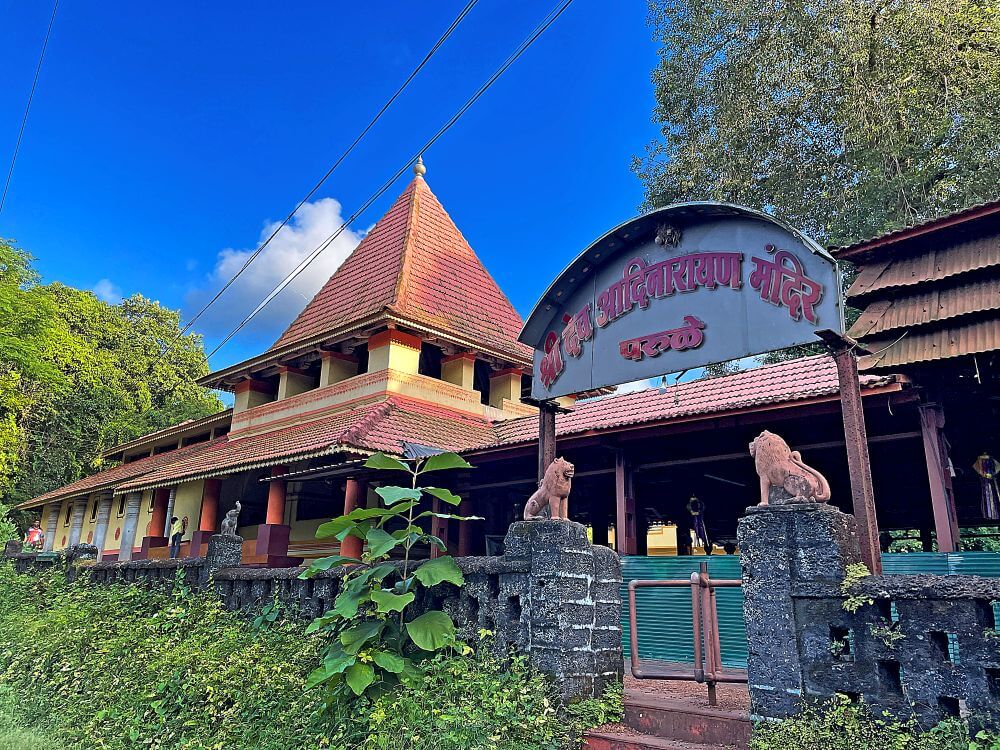
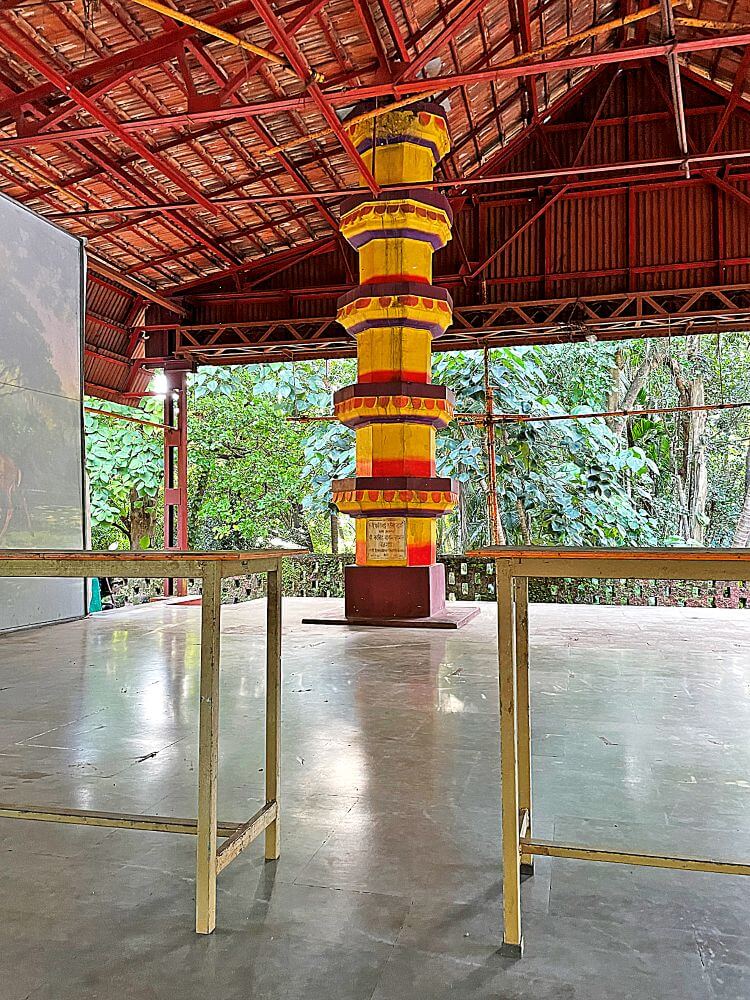
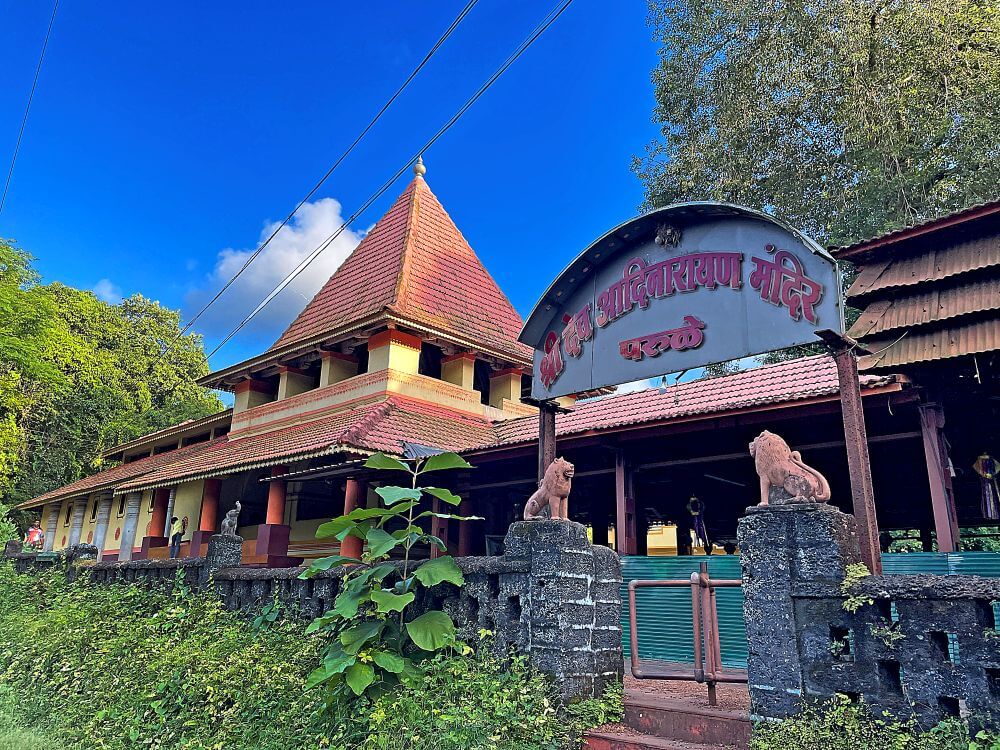
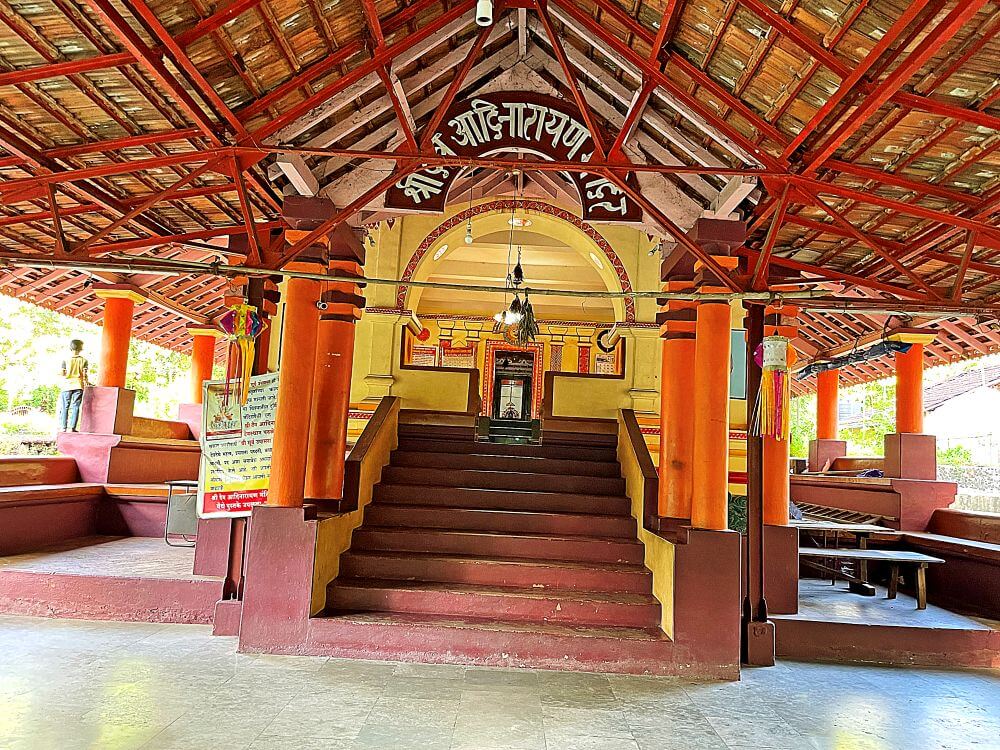
The Adinarayan Temple at Parule faces west. Situated at a slight elevation from the road, the temple is enclosed by a stone fortification wall. Entrance to the temple courtyard is through a gateway in this fortification. Statues of lions adorn both sides of the main entrance. The layout of the temple comprises a Mukhamandapa (front porch), two Sabhamandapas (assembly halls), an Antarala (vestibule), and a Garbhagriha (sanctum sanctorum). The temple acquired its current divine form after renovation work conducted in 2003. A Deepastambha (lamp tower) stands in front of the temple, followed by a stage constructed for cultural programs. Climbing 11 steps from the Mukhamandapa leads into the temple’s Sabhamandapa. Both rectangular Sabhamandapas feature Kakshasanas (benched seating areas) on either side for devotees to sit. Instead of the Garbhagriha, it is the Sabhamandapa that features a pyramid-shaped tiled, conical Shikhara (spire).
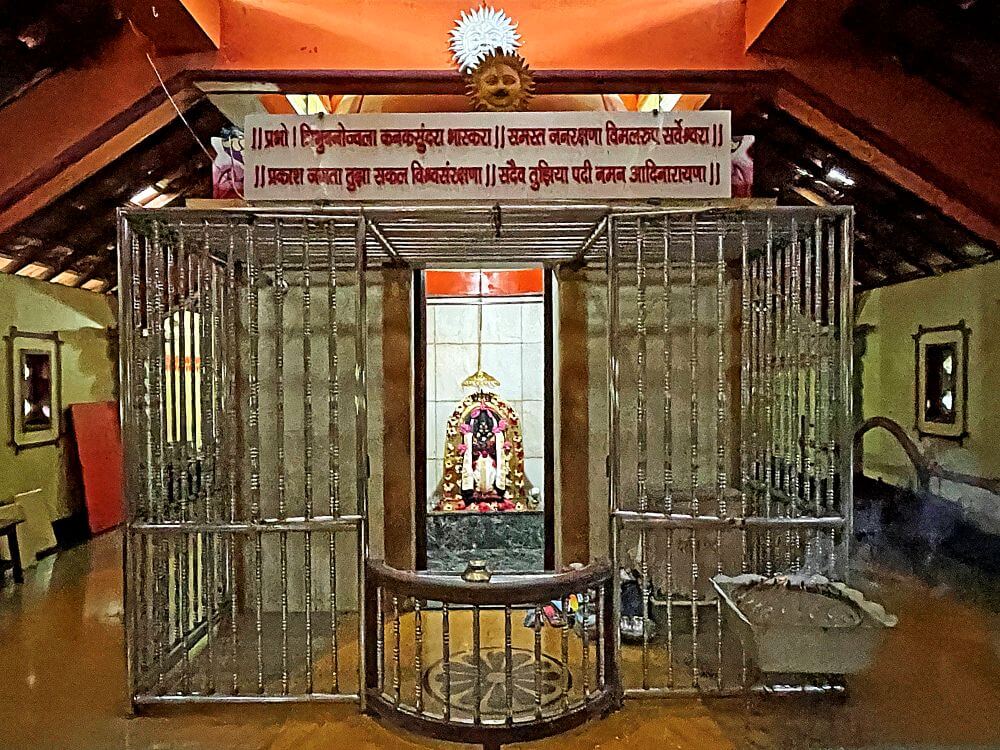
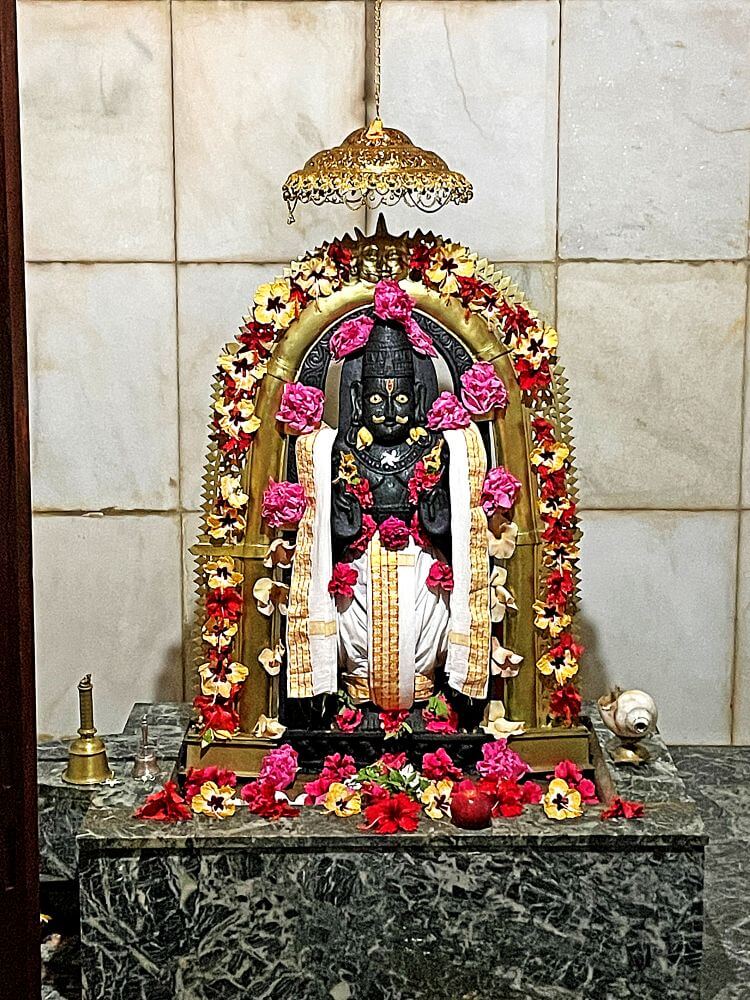
Beyond the Antarala lies the Garbhagriha, leaving space for a Pradakshina Marga (circumambulation path). Steel grills are fitted along the front wall of the Garbhagriha. Above the lintel of the sanctum doorway are two idols of Surya Deva. On a stone Vajrapitha (pedestal) inside the Garbhagriha, a two-armed (Dvibhuja) idol of Shri Dev Adinarayan is consecrated. At the base of this black stone idol, seven horses are carved—three on the left, three on the right, and one in the center. Seated on the chariot drawn by seven horses, Lord Adinarayan is adorned with a Mukuta (crown) on His head, Karnabhushana (earrings), Keyura (armlets) on His arms, and a Manimekhala (jeweled waistbelt). Both arms of Adinarayan are folded at the elbows, holding lotus flowers in both hands. Surrounding the idol is a beautifully crafted brass Makhar (arch/frame). Near the left foot of the deity is a small idol holding an inkpot in its left hand and a pen in its right hand; this is said to be the idol of Pingala. Similarly, near the right foot is a small idol holding a staff (danda), representing Dandi. The Tilak (sandalwood mark) on the forehead, the eyes, and the mustache of the main idol are overlaid in gold.
An inscription inside the sanctum of the temple records that the idol of Adinarayan was consecrated here on Jyeshtha Shukla Dwitiya, Sake 1773 (1851 CE). Lord Adinarayan’s divine vehicle is the chariot, which is why the Ratha Saptami festival is celebrated here on a grand scale. According to Hindu tradition, Ratha Saptami marks the birth of Surya Deva. This festival is celebrated here over three days and is the grandest among the annual festivals held at the temple, attended by thousands of devotees. Sacred rituals such as Abhishek, Ekadashani, Laghu Saura, Maha Saura, Samaradhana, Laghu Saura Samaradhana, Satyanarayan Puja, and Munj (sacred thread ceremony) are performed at the temple for a nominal fee. (Contact: Sameer Samant, Priest, Mob. 8605353167). Within the temple complex lies the Uma-Maheshwar Temple, housing an idol of Vasudeva carved from black stone, standing about three feet tall. Adorned with Rudraksha garlands, it features Aruna, the charioteer of the seven horses, near the feet. The temple premises house two Bhakta Niwas (pilgrim rest houses) offering both standard and air-conditioned rooms for devotees.
This sacred temple stands as a testament to deep spiritual devotion, ancient architectural grandeur, and rich local cultural traditions.
The sanctum sanctorum houses the divine idol consecrated according to ancient Vedic traditions, surrounded by serene courtyards and traditional temple architecture.
Navratri, Maha Shivratri, Annual Temple Jatra & Deepotsav
Compare and book flights, secure top-rated local hotels near the temple, hire reliable guides, and rent cars instantly.
Extend your pilgrimage by visiting other highly sacred temples located nearby.


Add ₹999 more to unlock FREE SHIPPING!
Your sacred cart is currently empty.
Shop Photo FramesFill in your delivery details below to place your order.
Add comment