
Add ₹999 more to unlock FREE SHIPPING!
Your sacred cart is currently empty.
Shop Photo FramesKashi is considered an extremely holy place in the Hindu religion. However, according to religious scriptures, there is not just one Kashi, but five. These five Kashis are: Varanasi or Kashi, Uttarkashi in Uttarakhand, Guptakashi near Uttarkashi in Dodital, Shivakashi near Madurai, and Tenkashi near Kadayanallur (Ten means south, so Tenkashi means South Kashi). Paithan in Maharashtra was also formerly glorified as the South Kashi. The spatial greatness (sthana mahatmya) of the Mahadeva Temple at Anwa is said to be connected with these five Kashis. In local dialects, this temple is referred to as ‘Madh’.
According to local legend, the village of Anwa is located in Bhokardan, which was once the capital of Bhaumasura—the enemy of Lord Sri Krishna—and for some time the capital of the Rashtrakutas. Tailapa, the husband of Jakavva, the daughter of Karka the last king of these Rashtrakutas, was a feudatory of the Rashtrakutas. This son-in-law of Karka rebelled against him and plundered the Rashtrakuta capital of Manyakheta, which is modern-day Malkhed. The Rashtrakuta empire was reduced to dust, and Tailapa’s rule—that of the Western Chalukyas of Kalyani—began here. This dynasty ruled over Maharashtra and Karnataka between the period of AD 973 and AD 1150. Shiva, Vishnu, Mahalakshmi of Kolhapur, and Kartikeya were their principal deities of worship. The Chalukya kings built many magnificent temples. The Mahadeva Temple at Anwa in Bhokardan taluka is one of them.
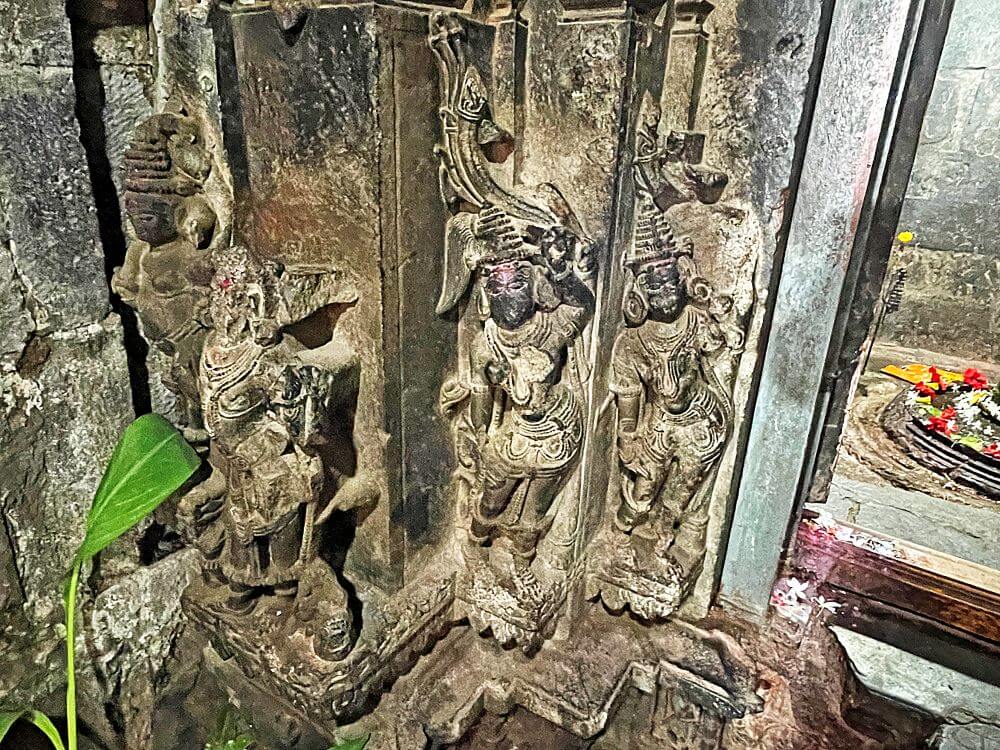
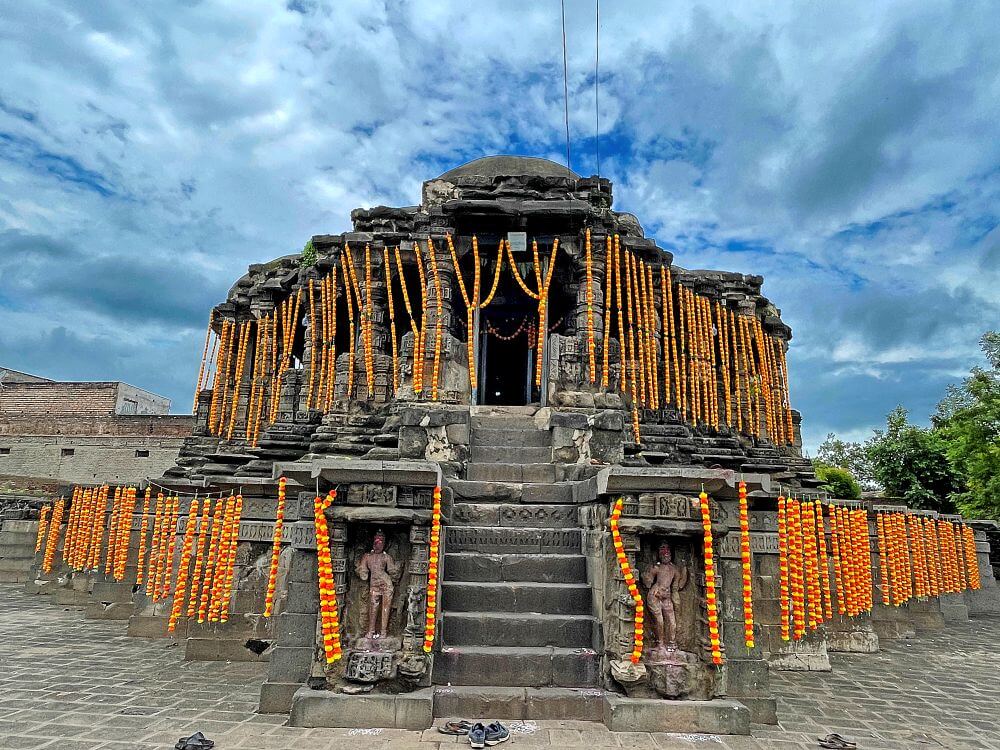
Built between AD 1000 and AD 1100, this temple stands in the middle of the village and faces east. The temple stands on a plinth (joti) approximately four feet high. The plinth has bands of intricate carving. The architectural layout of the temple consists of a mukhamandapa (porch), an open sabhamandapa (assembly hall), an antarala (vestibule), and a garbhagriha (sanctum sanctorum). One enters the mukhamandapa from the plinth by climbing eight steps. Near these steps are the statues of the Vaishnavite guardian deities (dvarapalas), Jaya and Vijaya. The plinth is sculptured and constructed with corners matching the angular projections of the temple. The plan of the temple is star-shaped (starkriti). The circumambulation platform (ota) is of the same shape. However, since the platform is four to five feet larger than the temple footprint, it allows devotees to perform pradakshina (circumambulation) around the temple.
The sculpted portion of the temple wall is called the jangha. Every single inch of the lower tier of this jangha part is exquisitely carved. Vaishnavite divine images are sculpted here in small niches or rathikas. This section features hamsapattika (swan bands) and simhapattika (lion bands). There are three large devakoshtha (wall shrines) in this area. Two of these wall shrines house the sculptures of Gajalakshmi and Varaha. Although parts of these sculptures are broken today, they can be clearly identified. Above the row of wall shrines is another frieze of small niches, which also contain numerous divine images.
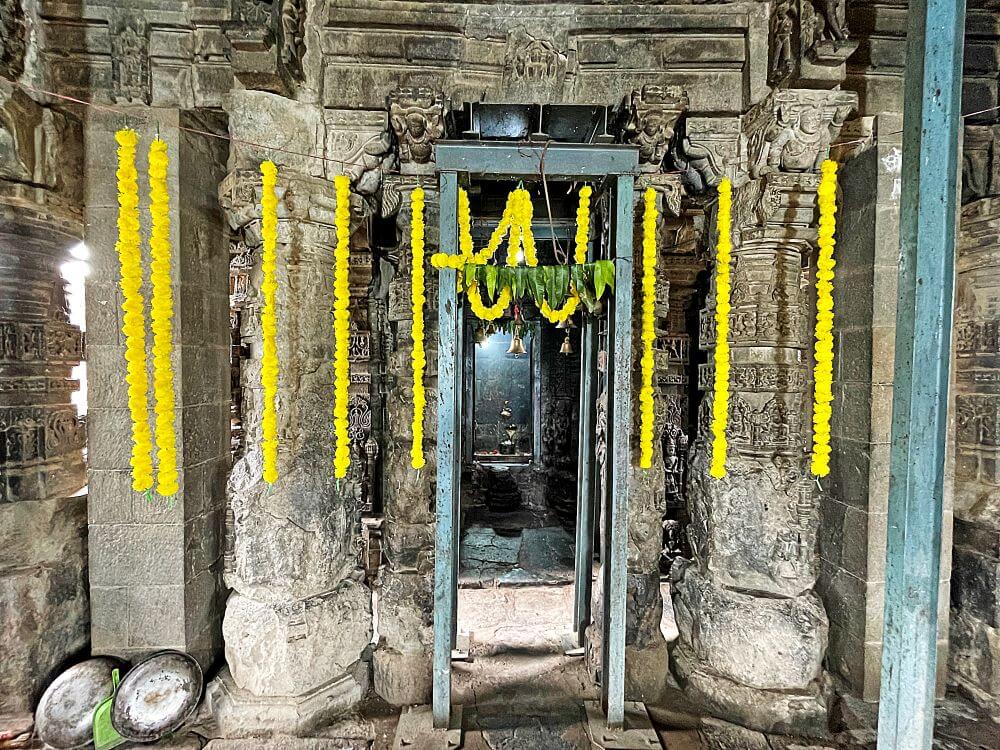
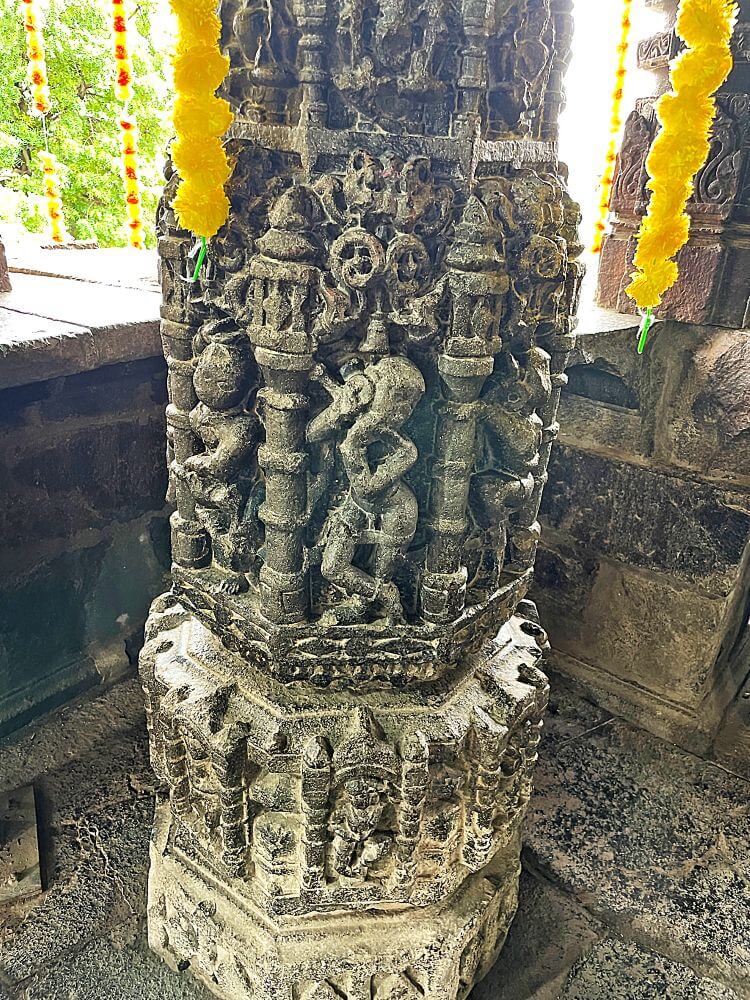
The assembly hall (sabhamandapa) of the temple is square in plan. It has half-pillars and a low, half-height wall, which has carved bands on the outer side. This temple stands on a total of fifty carved pillars, of which twelve are principal pillars. Eight pillars are located near the entrances on three directions, while thirty pillars support the ceiling. The delicate carvings and sculpted figures on these pillars are distinctive. The arrangement of the pillars in the assembly hall is such that wherever one sits in the hall, one can clearly see what is happening in the center. In the middle of the hall is the rangashila (dance slab). This rangashila is slightly elevated from the floor, leading historians to surmise that in earlier times, services of dance and music might have been offered here. Today, an idol of Nandi is seen on this rangashila. The ceiling of the hall is also intricately ornamented. The ceiling is circular and dome-like, of the karotaka vitana type, where beams create an octagonal shape. Right at the top center of the ceiling is a lotus carving. Surrounding it are seven concentric circles that progressively grow larger one after another.
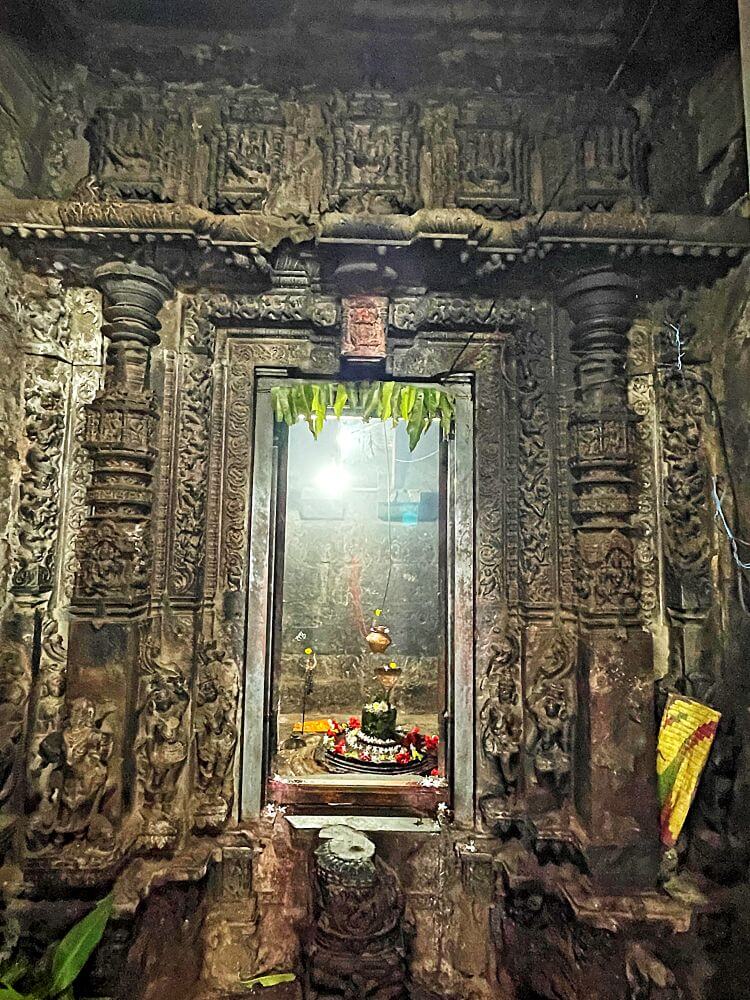
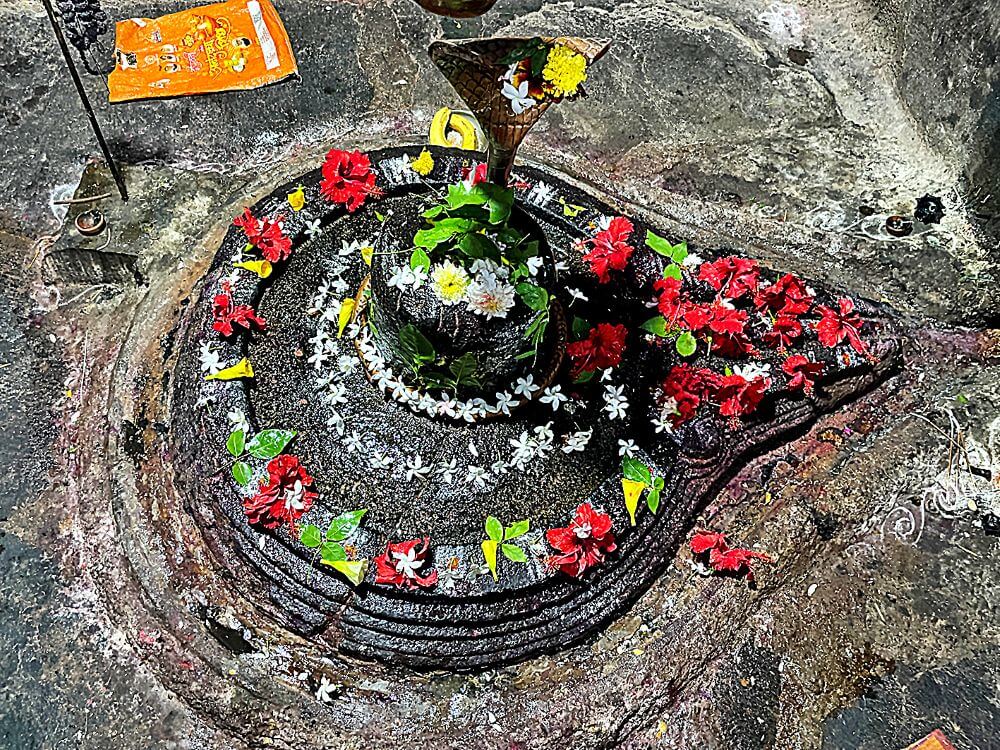
The antarala (vestibule) of this temple is also square in shape, topped with a circular shikhara (spire). The doorway of the sanctum sanctorum is pancha-shakhya (having five vertical bands on the doorframe). Images of shardulas, floral motifs (pushpa), pillars, floral motifs, and vidyadharas are carved on each respective band. At the base of these bands are Vaishnavite figures. The lalatabimba (central lintel piece) features an image of Lord Ganesha, and on the upper band above it—the uttara row—are five small niches. These contain the images of Vishnu along with Garuda, Brahma, Brahmani, Shiva, and Maheshvari. On the high threshold (mandaraka) of the doorway is a Kirtimukha (glory face). The inner sanctum (garbhahara) measures eight by eight square feet and houses a Shiva Linga, over which a metal hood of a serpent (nagapratima) has been placed.
On the exterior of this temple are sculptures representing the shakti forms—the female aspects—of Lord Vishnu. These include sculptures of Lakshmi, Kirti, Sugandha, Shraddha, Uma, Lajja, Tushti, Vidya, Pushti, Harsha, Shanti, Saraswati, Shuddhi, Daya, Vidyuta, and Kanti as the shakti manifestations of Vishnu. Religious historians state that considering these Vaishnavite sculptures, the Vaishnavite guardian deities Jaya and Vijaya, the sculptures of Varaha and Narasimha, and the Vishnu images on the upper frieze, this original temple belonged to the Vaishnavite sect. Over time, it was converted into a Shaivite temple, and a corresponding spatial greatness (sthana mahatmya) was subsequently created for it.
The Department of Archaeology has now constructed a protective wall around this magnificent temple. Stone paving has been laid throughout the temple premises. Additionally, iron pillars have been provided for support in places like the mandapa to prevent the temple from collapsing. A large stream of tourists and devotees regularly visits this place to witness this ancient heritage of Maharashtra and to have the darshana of Lord Mahadeva.
This sacred temple stands as a testament to deep spiritual devotion, ancient architectural grandeur, and rich local cultural traditions.
The sanctum sanctorum houses the divine idol consecrated according to ancient Vedic traditions, surrounded by serene courtyards and traditional temple architecture.
Navratri, Maha Shivratri, Annual Temple Jatra & Deepotsav
Compare and book flights, secure top-rated local hotels near the temple, hire reliable guides, and rent cars instantly.
Extend your pilgrimage by visiting other highly sacred temples located nearby.


Add ₹999 more to unlock FREE SHIPPING!
Your sacred cart is currently empty.
Shop Photo FramesFill in your delivery details below to place your order.
Add comment