
Add ₹999 more to unlock FREE SHIPPING!
Your sacred cart is currently empty.
Shop Photo FramesChhatrapati Sambhajinagar district is considered significant both historically and religiously. Among the ancient Shiva temples in this district, the Khadkeshwar Mahadev Temple in the Naralibag area is renowned as the second most important place of worship after the Grishneshwar Temple at Verul, which is one of the twelve Jyotirlingas. Khadkeshwar is the presiding deity (Gram-Daivat) of this city. There are records indicating that the temple was renovated by Punyashlok Ahilyabai Holkar in the eighteenth century. The fair held here on the occasion of Mahashivratri is considered one of the major pilgrimages in the district.
The former name of Chhatrapati Sambhajinagar city was Khadki. It is said that the city was named after the Khadkeshwar Mahadev Temple. In the literature of Sant Dnyaneshwar and Sant Eknath Maharaj, this city is found to be referred to as Khadki. The king of this city, which was situated on the banks of the Khadki river, was Malik Ambar. Even Malik Ambar, who built modern water supply structures like ‘Nahar-e-Ambari’, did not change the name of this city. Records indicate that this temple existed even during his reign. Later, Malik Ambar’s son, Fateh Khan, renamed the city Fatehnagar after himself. After the Mughal Emperor Aurangzeb captured the city of Khadki, he renamed it Aurangabad, a name that remains in use today. Recently, this city has been renamed Chhatrapati Sambhajinagar.
The legend regarding the temple states that in ancient times, this area was a dense forest. One day, a hunter came to this forest in search of prey. After some time, he spotted a doe frolicking nearby. Just as he was about to hunt her, the doe began to speak to him, saying, “You may certainly hunt me, but if you are compassionate, please let me meet my fawns before you do so. I will surely return.” Hearing her plea, a sense of compassion awakened in the hunter’s heart. Trusting her promise to return, he let her go to meet her fawns. Believing in the doe, he sat on a nearby tree and began to wait for her. While sitting on the tree, after some time, his mind became restless with the doubt, “Will the doe really return?” Lost in this thought, he began plucking leaves from the tree and dropping them below. Coincidentally, there was a Swayambhu Shivling beneath that tree, and the tree was a Bel tree. The Bel leaves he was dropping from above began to fall onto the Shivling. Thereafter, feelings of compassion and mercy for the doe and her fawns began to awaken in his heart. After some time, keeping her word, the doe returned. However, the hunter released her from her promise and let her go. That day was Shivratri. On this sacred day, as he sat on the tree, the Bel leaves he dropped fell onto the Shivling, earning him great merit, and he was also blessed with a vision of Lord Shiva. Over time, the villagers built a small temple around this Swayambhu Shivling. Since then, after undergoing several renovations and restorations, the temple has attained its present form.
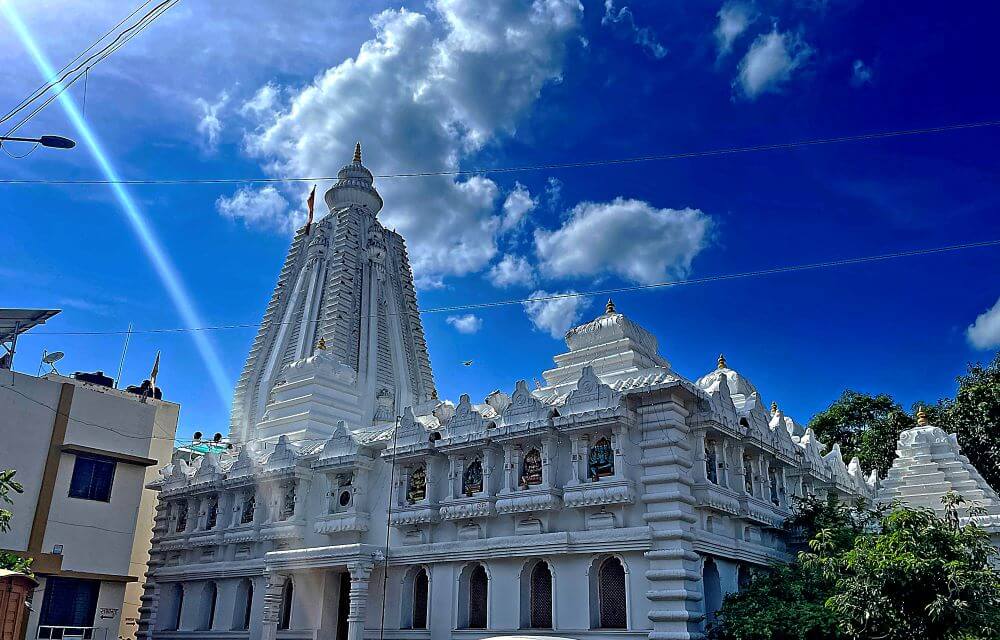
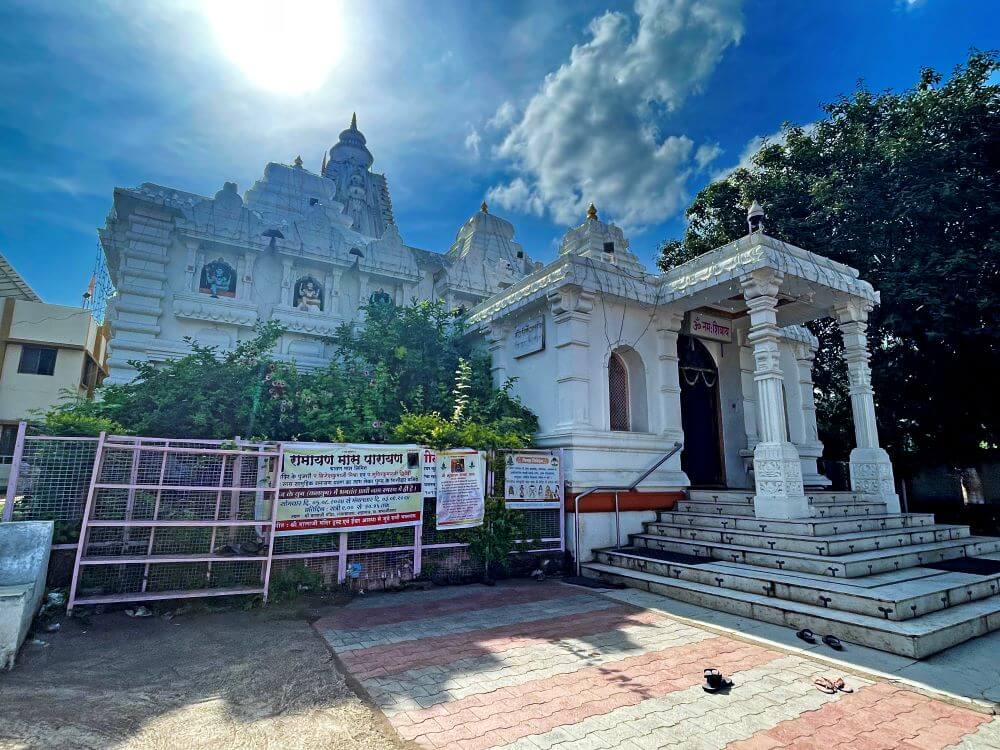
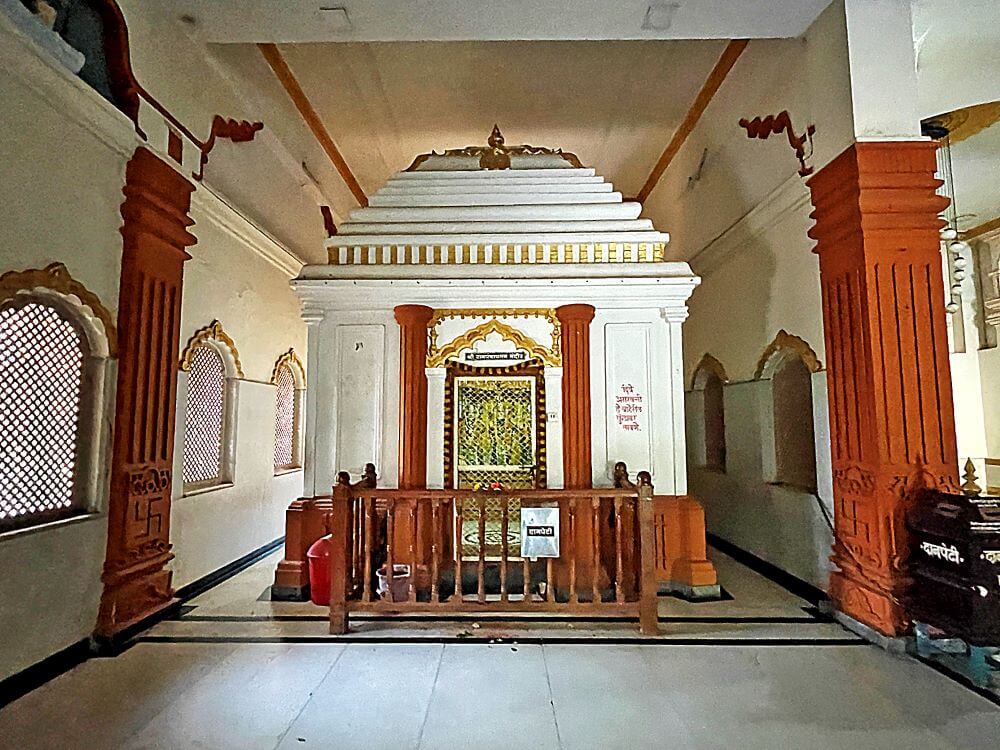
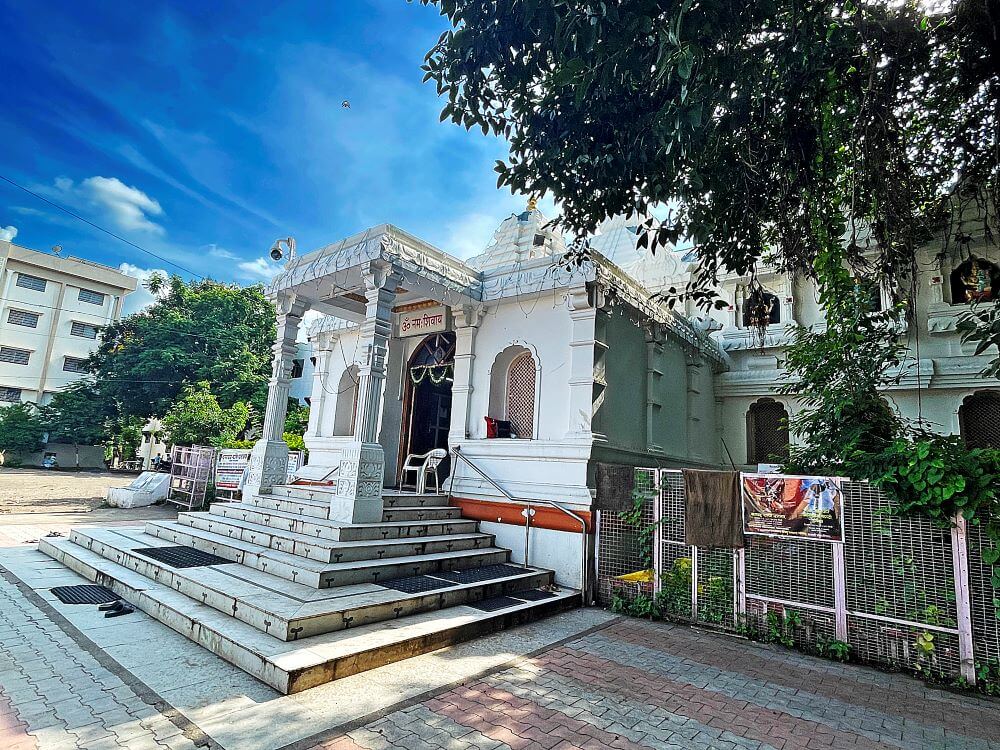
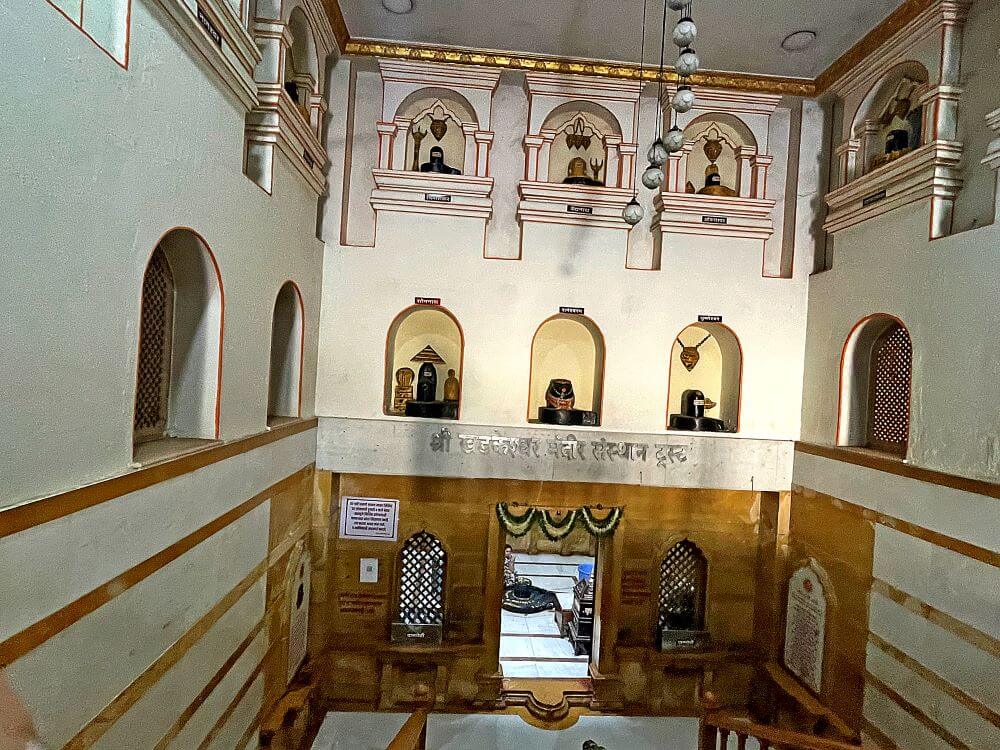
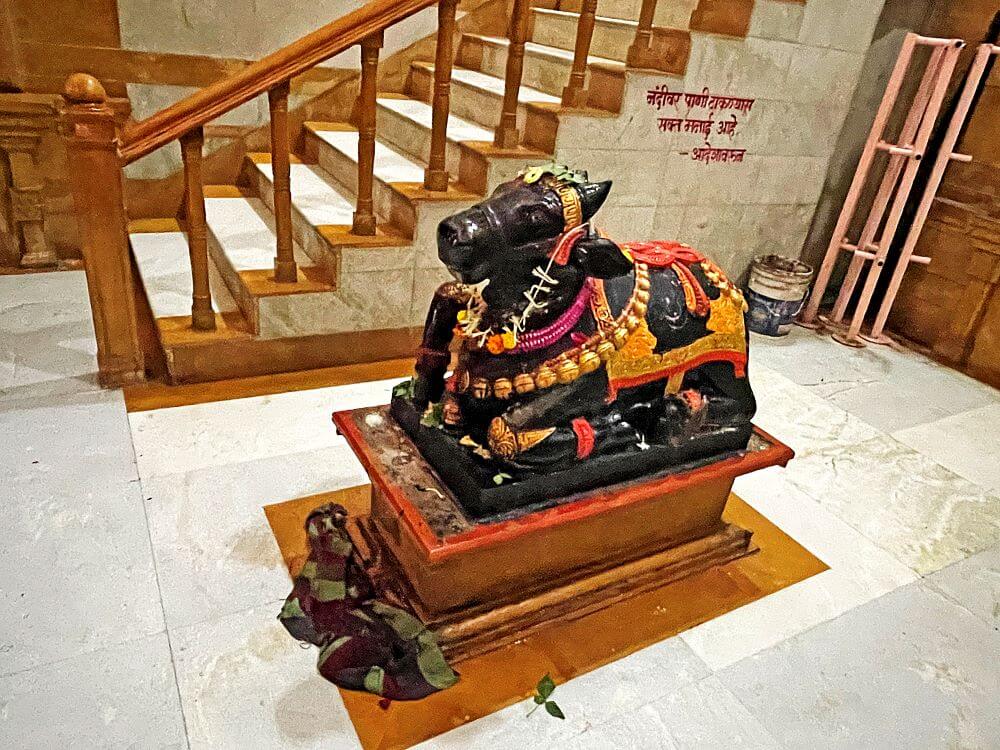
As one travels from the central Gulmandi market through Aurangpura towards Mill Corner, the tall, magnificent, pristine white, and beautiful structure of the Khadkeshwar Temple comes into view. This temple is situated at a slight elevation from the ground. One enters the Darshan Mandap after climbing about seven to eight steps. Upon entering through the main gateway, one reaches a spacious Sabha Mandap. This assembly hall is adorned on all sides, and the underside of the ceiling features depictions of mythological episodes through intricate sculptures. The temple’s layout consists of the Darshan Mandap, the Sabha Mandap, and the Garbhagriha. The Garbhagriha here is located in a slightly sunken area, which is reached by descending about 15 steps. While moving from the Sabha Mandap to the Garbhagriha, there are shrines dedicated to Shri Rama on the right and Lakshmi-Narayana on the left. Upon descending the steps from there, one gets the darshan of Nandi, carved from a single monolithic stone, right in front. This Nandi is seated on a raised platform. Furthermore, one can also see the twelve Jyotirlingas above the sanctum sanctorum (Garbhagriha). In the center of the Garbhagriha lies the Swayambhu Shivling made of black stone. On the wall behind the Shivling is an idol of Goddess Parvati. The numerous distinctive shikhars (spires) atop the two-storied temple structure capture one’s attention. Sculptures of various deities are also carved into the niches on the outer walls of the temple.
On the occasion of Mahashivratri, a fair is held in the large courtyard in front of the temple. At this time, lakhs of devotees from Marathwada come here for darshan. Devotees begin standing in queues from the previous day. Following the puja and aarti at midnight on Mahashivratri, the darshan of Khadkeshwar commences. Thousands of devotees also visit here on Shravani Mondays. On this day, darshan begins after the abhishek and puja at five o’clock in the morning. In the evening, Rudrabhishek is performed on the Shivling. This is followed by the shringar and maha-abhishek. There is a crowd of devotees here from early morning until late at night.
This sacred temple stands as a testament to deep spiritual devotion, ancient architectural grandeur, and rich local cultural traditions.
The sanctum sanctorum houses the divine idol consecrated according to ancient Vedic traditions, surrounded by serene courtyards and traditional temple architecture.
Navratri, Maha Shivratri, Annual Temple Jatra & Deepotsav
Compare and book flights, secure top-rated local hotels near the temple, hire reliable guides, and rent cars instantly.
Extend your pilgrimage by visiting other highly sacred temples located nearby.


Add ₹999 more to unlock FREE SHIPPING!
Your sacred cart is currently empty.
Shop Photo FramesFill in your delivery details below to place your order.
Add comment