
Add ₹999 more to unlock FREE SHIPPING!
Your sacred cart is currently empty.
Shop Photo FramesBlessed with natural beauty, the village of Devle in Sangameshwar Taluka is known as the village of temples. This village is home to not just one or two, but ten large temples and several smaller ones. Among these, along with the ancient and famous Bhavani Khadgeshwar Temple, the prominent temples include Gavdevi Kaleshwari, Vitthal Temple, Bhairi Bhavani, Ravalnath, Shrikrishna, Ganpati, Maruti Par, Kalika, and Dattatreya Temple. Because of the presence of many temples, the village was named Devle. The Khadgeshwar Temple here is one of the major temples in the district and a place of faith for many devotees.
The legend of the temple is that the Shilahar King Gandaraditya of Kolhapur once ruled this region. During his travels, he discovered this shrine in the forest. He then entrusted the management of the shrine to a person named Ballalpant Dixit and allocated a territory of ๔๘ villages, stretching from the Bavnadi River in the north to the Muchkundi River in the south, for the upkeep of the shrine. Some time later, in a battle between the Yadava King Singhan of Devgiri and Gandaraditya at Khidrapur, Gandaraditya was defeated. Following this, Dixit offered his Khadga (sword) to Lord Shiva. Since then, this temple has been known as Khadgeshwar. Furthermore, there is a mention in a copper plate from the year ๑๐๙๔ that the Shiva-devotee King Jhanj, who ruled at Chaul in the district of Kulaba (present-day Raigad), had built ๑๒ Shivalayas (Shiva temples), which include the temples of Khadgeshwar and Dhutpapeshwar.
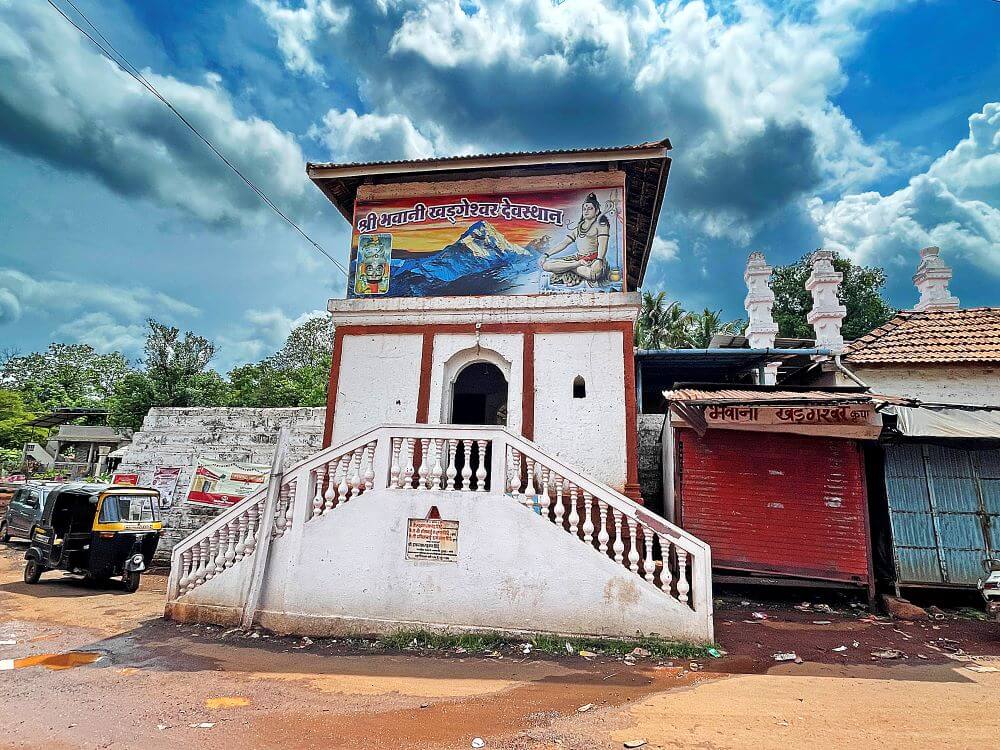
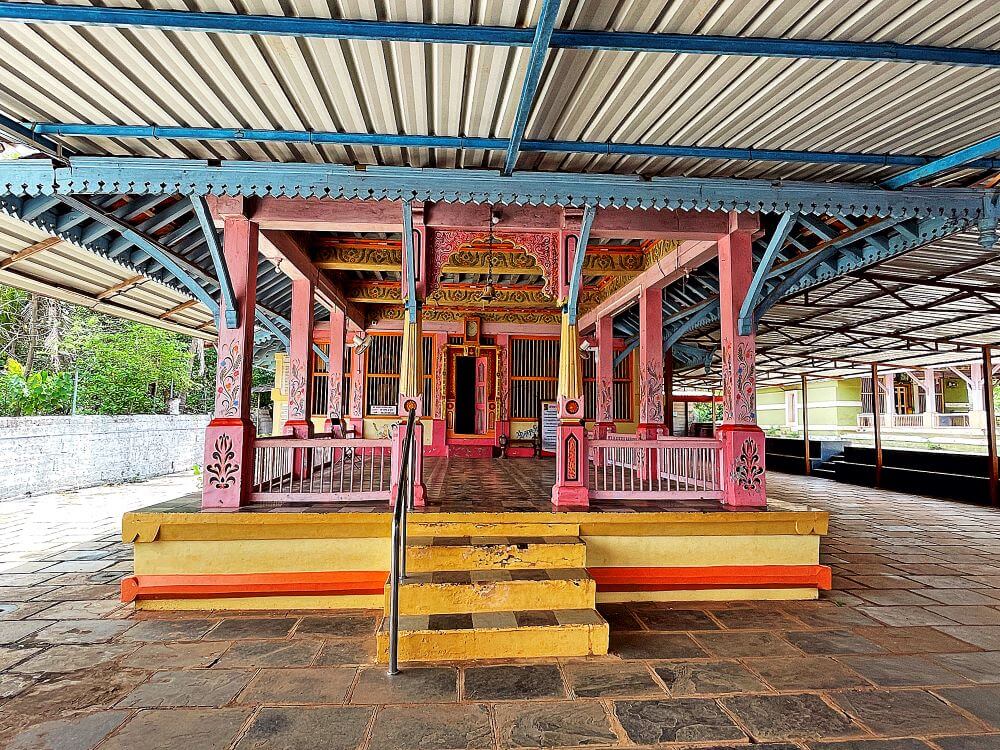
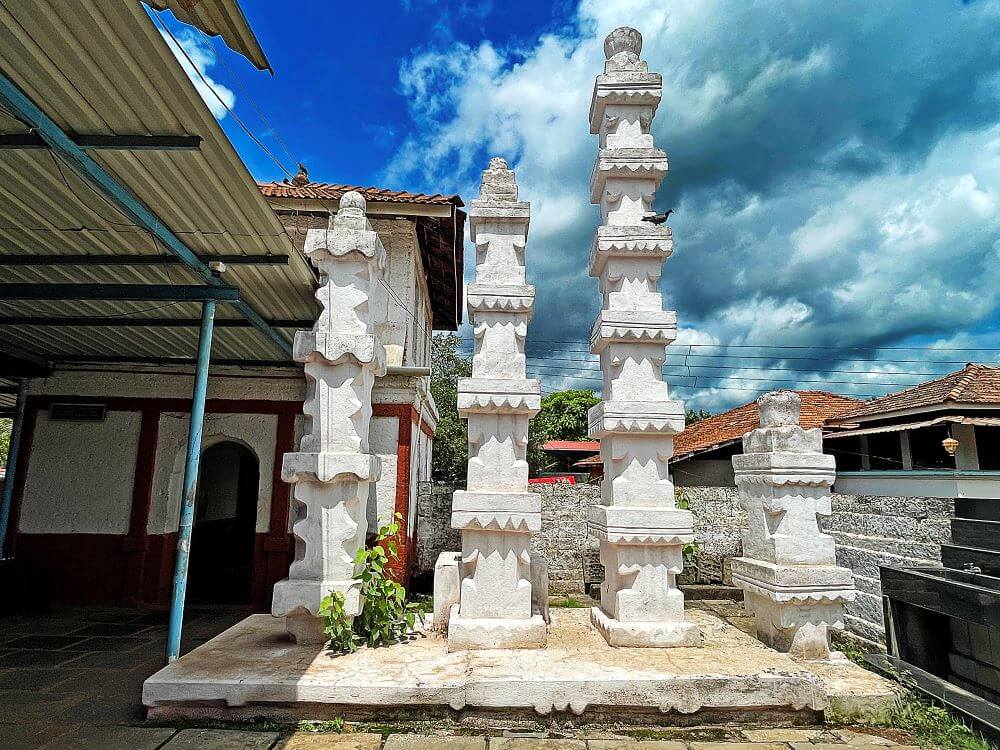
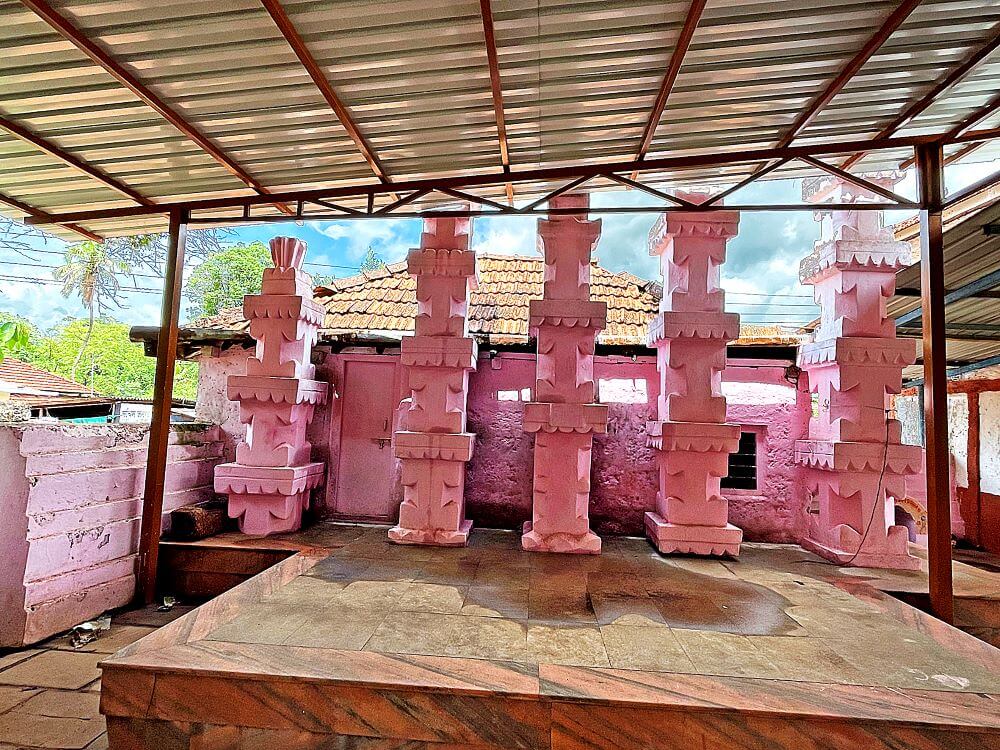
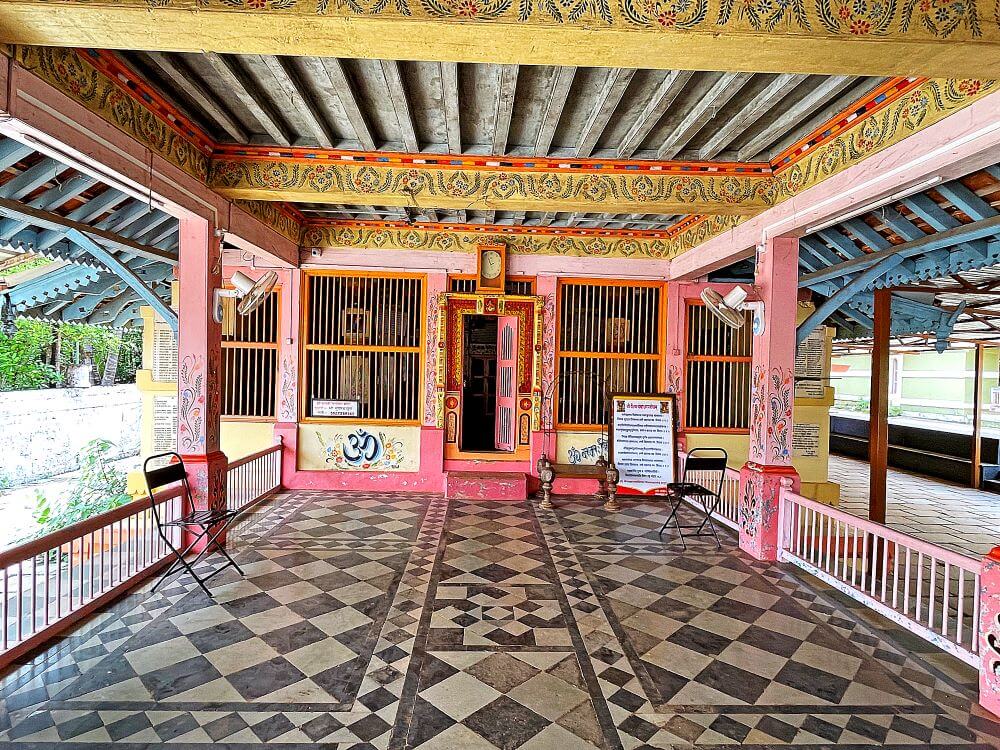
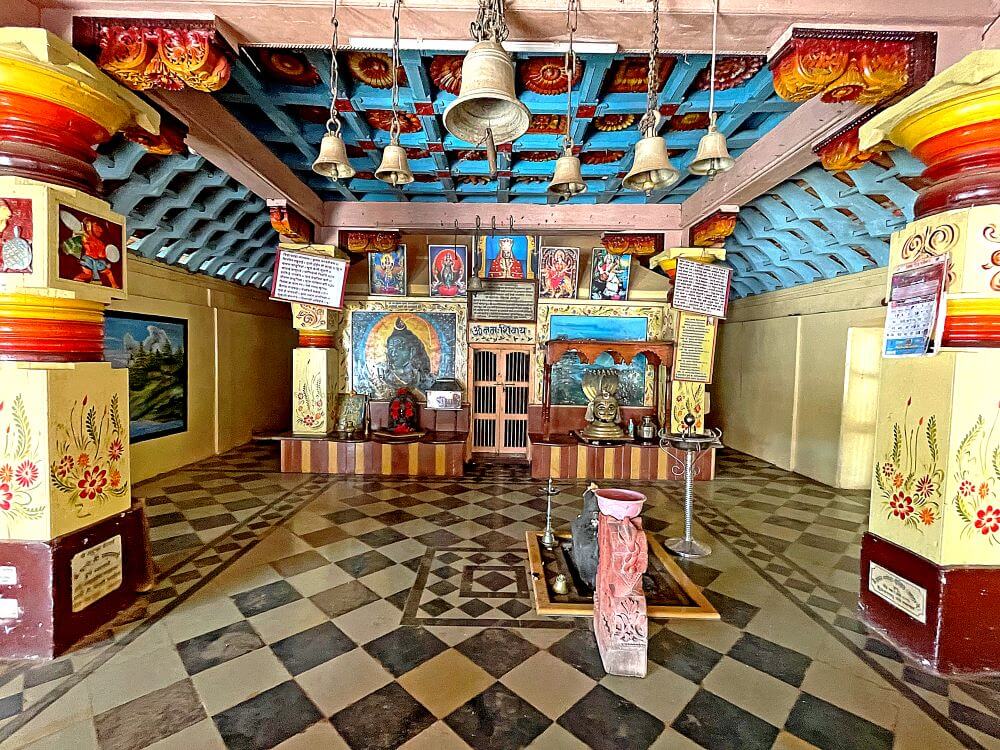
After crossing the Dabhole Ghat on the Ratnagiri-Kolhapur road, there is a path that leads to Devale village. One can reach the temple via this route. Upon climbing a few steps from the road adjacent to the temple, one arrives at the entrance gate. Above the entrance gate is the Nagarkhana. The temple is enclosed by stone fortifications on all four sides. The temple structure consists of an open Sabha Mandap (assembly hall), an Antarala (vestibule), and a Garbhagriha (sanctum sanctorum). In the courtyard of this east-facing temple, there are eight Deepmalas (lamp towers) adjacent to the entrance. The Sabha Mandap of the four-sided temple, which stands on a plinth approximately three feet high, is constructed of wood, and its pillars as well as the inner arches feature intricate carvings. On the Lalatbimba (lintel) of the decorative door frame of the Antarala, there is an image of Lord Ganesha. In the Antarala, on a platform to the left adjacent to the Garbhagriha, there is a Shiva mask with a serpent hood, and on the right side, there is an image of Lord Ganesha. In front of the entrance to the Garbhagriha, there is a Nandi carved from a single stone. Inside the Garbhagriha, in a slightly sunken area, lies the Shiva Linga made of black stone. It is said that when this Shiva Linga was being unearthed from the ground, a pickaxe strike caused a chip to break off from its top. Even today, this detached piece can be seen on the Shiva Pindi.
Some hero stones can be seen in the temple premises. In this village, previously some Battles had taken place here. These are the memorial stones (Virgals) of the heroes who fell in the line of duty. Originally situated in an open field, these memorial stones were moved into the temple over time. Some of the memorial stones feature intricate carvings. Behind the temple, in the Harihar Dharmashala, there is an Annapurnagriha (a place for serving food). The Dharmashala provides accommodation for approximately 50 devotees. There is a well adjacent to the Dharmashala. Festivals are celebrated at the temple on the days of Tripuri Purnima, Mahashivratri, Kojagiri Purnima, and Ramnavami. With the intention of giving these festivals a structured form, the villagers established a committee named ‘Shri Khadgeshwar Sanstha Vardhak Mandali’ in the last century, under the guidance of the renowned litterateur N. C. Kelkar. This committee completed 125 years in 2020.
The Shivratri festival, held here from Magh Vadya Navami to Amavasya, is the primary festival of this place. A grand fair takes place during these six days. The festival commences with Shodashopachar Puja after traditionally invoking Lord Shankara. On the first day, following the Mantrajagar and Aarti, the mask of Mahadeva is placed in a palanquin. Thereafter, accompanied by the sounds of drums and cymbals, the palanquin circumambulates the temple five times. The deity is then re-enthroned in the temple. The day’s proceedings conclude with a Kirtan at night . Following this, various programs are held in the temple for the next five days. On the day of Shivratri, Rudravartan and other rituals are performed. At night, the temple is circumambulated eleven times. Subsequently, the Mahapuja is arranged in different forms of the deity. Among these, the rice Mahapuja performed at midnight is a major attraction for devotees. The celebration of that day concludes with a Kirtan at dawn.
To the south of the temple lies the temple of the village deity, Kalika Kaleshwari. A festival is held there during Holi. In the Vitthal-Rukhumai temple located to the north of the temple, a festival is observed from Kartik Vadya Dashami to Kartik Amavasya. The Kalika temple here is said to have a direct connection with the Kalika temple in Kolkata. It is said that several attempts were made to construct this temple, which remains in an open state, but the structures did not last. The Shimgotsav here is also famous. During the festival, a ceremony takes place where the palanquins from the villages of Dabhole, Meghi, Karanjari, and Chafavali meet. Thousands of villagers from the surrounding five-village radius attend this event. There is an old stone-built well in the village that is elliptical, or shaped like a Pindi. Known as the Bhokari well, it contains abundant water even during the summer.
In historical times, there was a palace of temples in Sangameshwar. The office of the palace, which served as the headquarters of the province, was located in the central part of the village. During the era of Chhatrapati Shivaji Maharaj, the village of Devale held great significance. The administration of about ๔० surrounding villages was conducted from this village. Consultations between the chieftains and administrators used to take place in the council chamber (khalbatkhana) of the village. Even today, the remains of the platform of this council chamber can be seen here. There are records of Chhatrapati Shivaji Maharaj visiting this village many times. There is a mountain pass on the border of Devale and Meghi villages, which is famous as Ghodkhind. It is said that during his stay in Sangameshwar, the cavalry of Chhatrapati Sambhaji Maharaj used to patrol this area. The cavalry would stop at this pass for rest, which is why it came to be known as Ghodkhind.
This sacred temple stands as a testament to deep spiritual devotion, ancient architectural grandeur, and rich local cultural traditions.
The sanctum sanctorum houses the divine idol consecrated according to ancient Vedic traditions, surrounded by serene courtyards and traditional temple architecture.
Navratri, Maha Shivratri, Annual Temple Jatra & Deepotsav
Compare and book flights, secure top-rated local hotels near the temple, hire reliable guides, and rent cars instantly.
Extend your pilgrimage by visiting other highly sacred temples located nearby.


Add ₹999 more to unlock FREE SHIPPING!
Your sacred cart is currently empty.
Shop Photo FramesFill in your delivery details below to place your order.
Add comment