
Add ₹999 more to unlock FREE SHIPPING!
Your sacred cart is currently empty.
Shop Photo FramesConsidered the pride of Konkan, the village of Anjarle in Dapoli taluka is renowned for its Kadyavarcha Ganpati Temple. Along with a vast coastline, this village is blessed with a rich historical and cultural heritage. Situated at the center of the village, the ancient temple of Goddess Durgadevi is regarded as the main shrine of this region. A beautiful masterpiece of Konkan temple architecture, this shrine is approximately 400 years old. Celebrated since the Peshwa era, the annual Rathotsav (chariot festival) held here is one of the grandest events in Dapoli taluka.
According to legend, a revered Yogi Baba founded the villages of Anjarle, Kelshi, and Murud, around the 16th century. This temple has been in existence ever since that period. The Goddess appeared in a dream vision to Yogi Baba and revealed: “I reside amidst a heap of *harkina* in the backyard of the Pardule family on the plateau (sadya). Bring Me from there and consecrate Me in the village.” Following Her divine guidance, Yogi Baba searched the spot and discovered an idol of the eight-armed Goddess in Her Mahishasuramardini form, sculpted from Gandaki stone (Gandaki Shila). He then built a modest temple and consecrated the sacred idol there. Later, in Shake 1653 (5 July 1731), during the reign of Thorale Baji Rao Peshwa, the temple underwent major renovation, acquiring its present sacred form.
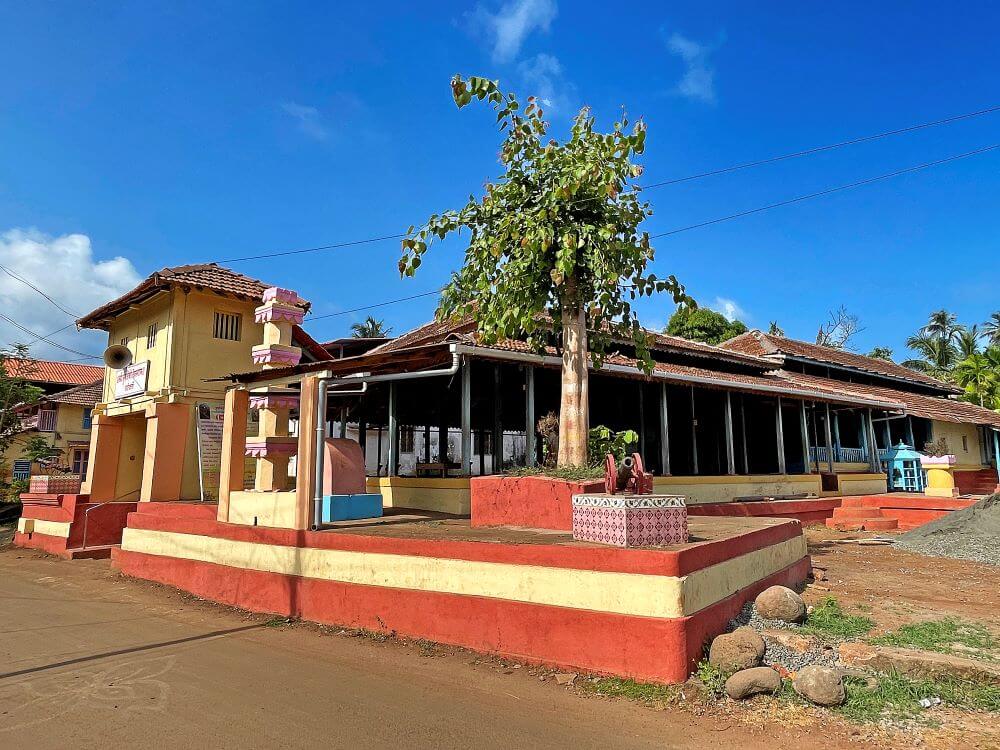
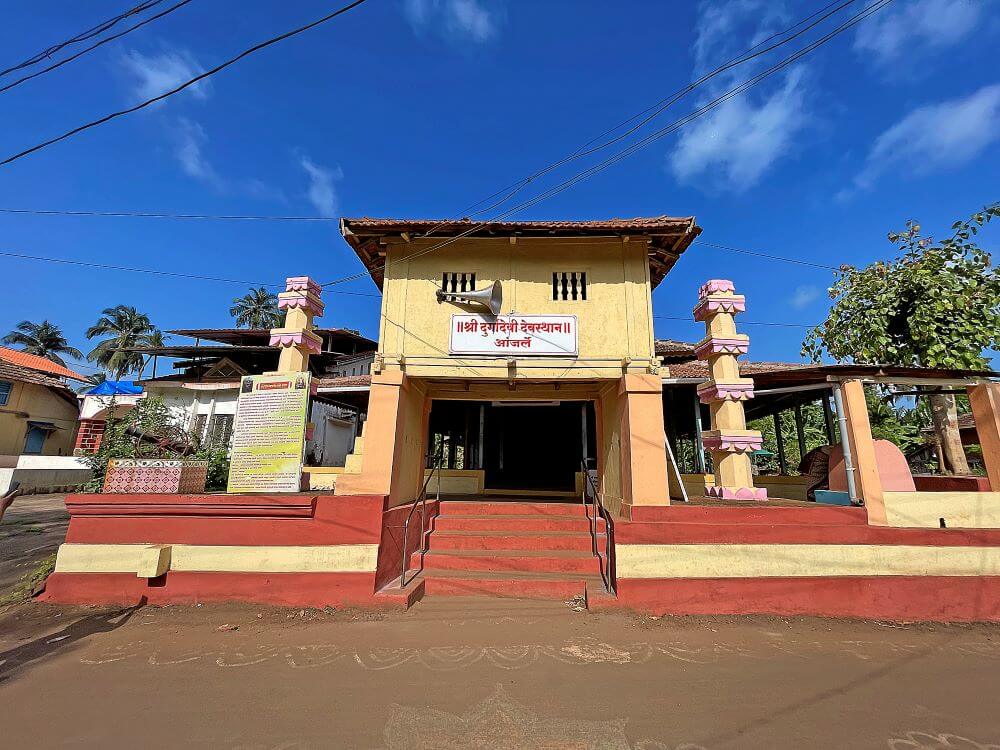
The Durgadevi Temple is situated along the main road of Anjarle village, approximately two kilometers downhill from the Kadyavarcha Ganpati Temple. This fortified temple structure features a traditional Nagarkhana (drum house) on the second story of its main gateway. A flight of steps near the entrance leads up to the Nagarkhana. In earlier days, the auspicious sounds of the Sanai (shehnai) and Choghada (drums) resounded from the Nagarkhana every morning and evening. This sacred tradition continues to this day, though in keeping with changing times, a audio recorder plays the melodies of the Sanai and Choghada. Deepmalas (lantern towers) stand proudly on either side of the entrance, flanked by two historical cannons.
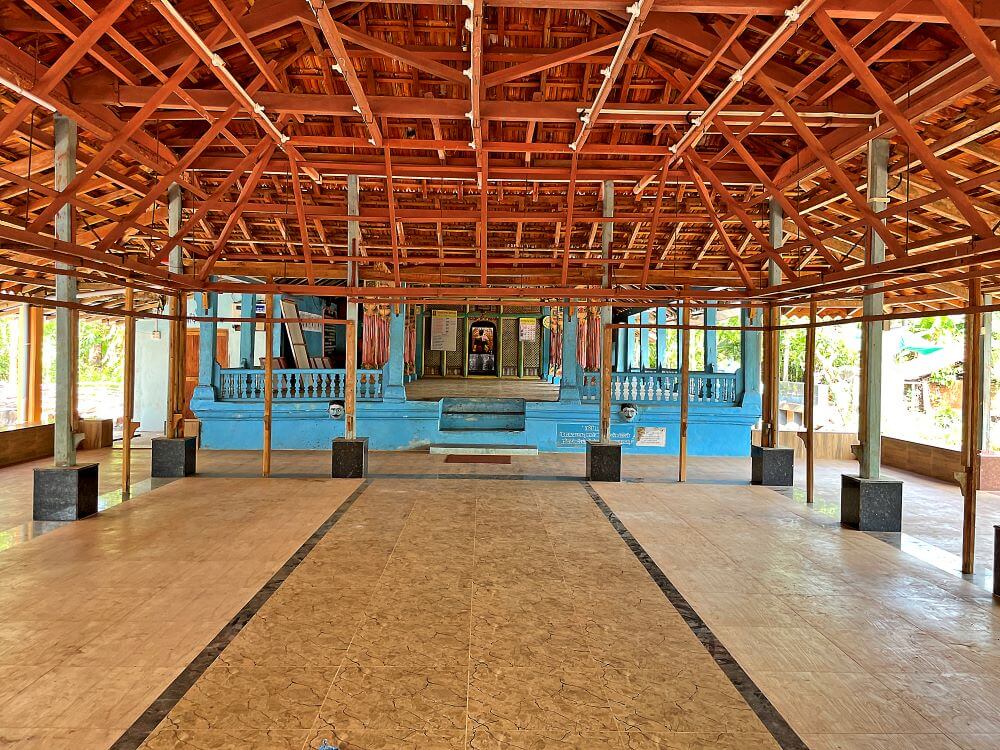
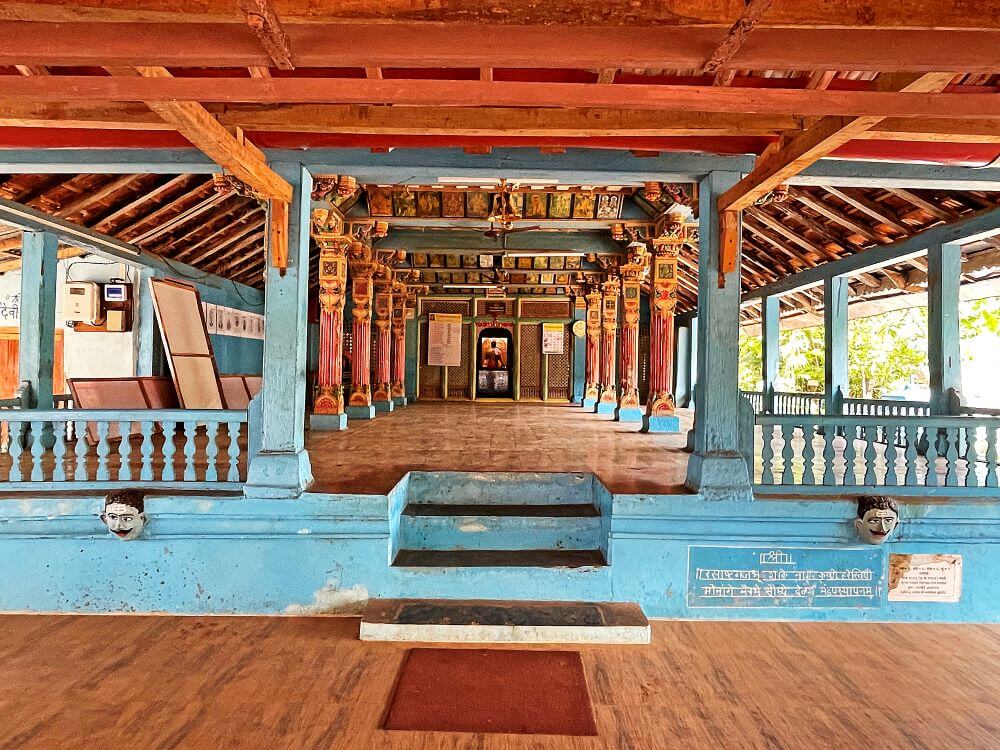
Ascending five to six steps from the gateway brings devotees into the main courtyard of the Durgadevi Temple. The entire temple is constructed out of fine teakwood. In line with the traditional architecture of Konkan temples, it features a tiled roof layout comprising two Sabhamandaps (assembly halls) and a Garbhagriha (sanctum sanctorum). The outer Sabhamandap appears to have been added in a later period. These open assembly halls are built entirely of wood, and the intricate interlocking woodwork offers a magnificent glimpse into ancient Konkani architectural brilliance.
In the main temple’s Sabhamandap and Garbhagriha, only the plinth base is constructed of stone, while the structure above is crafted entirely of wood. Out of the 12 teakwood pillars in this hall, eight feature exceptional traditional carvings. They showcase exquisitely detailed artistry depicting birds, flowers, and foliage . The painted finish on these pillars highlights the delicate craftsmanship even further. Such ornate wooden carvings are a rare sight in other temples of Konkan. Portraits of various gods and goddesses adorn the upper walls of this hall.
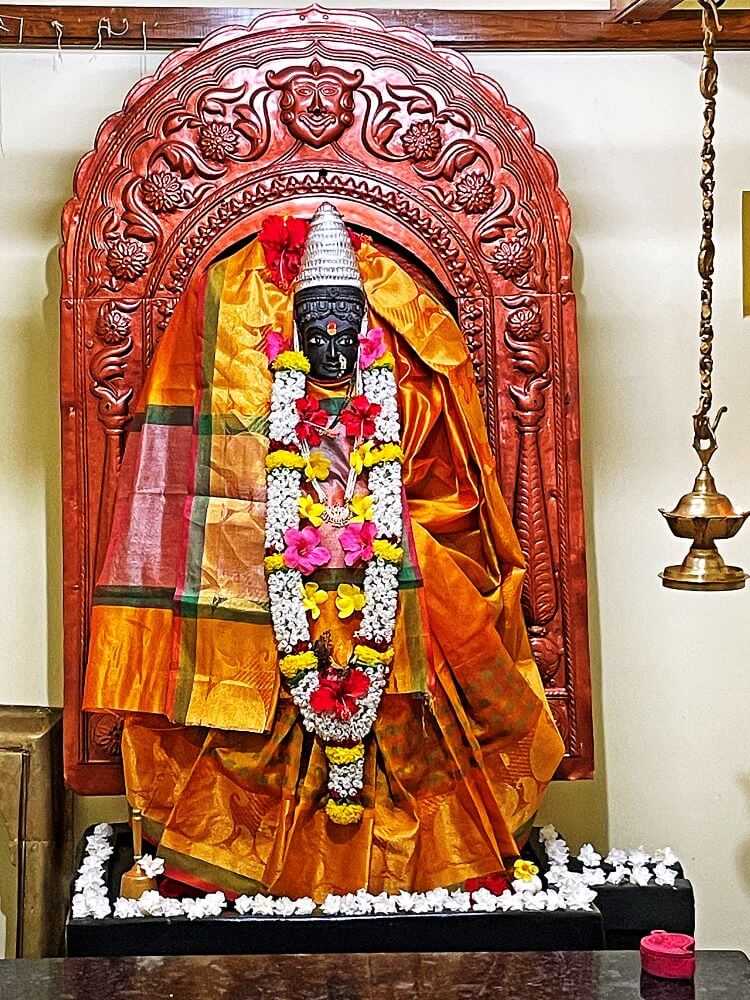
Carved Kirtimukhas (glory faces) grace both sides of the outer plinth of the main hall. While Kirtimukhas are typically featured outside Shiva temples, the reason for their presence here becomes clear upon entering the sanctum sanctorum. The rare eight-armed idol of Goddess Mahishasuramardini Durgadevi is seated directly upon a sacred Shivlinga (Shivpindi), signifying that Lord Shiva also resides at this holy spot. Adorned with a silver crown on Her head, holy kumkum on Her forehead, a pearl nose-ring (nath), fine ornaments, and sacred garments, the divine idol looks breathtakingly beautiful. A intricately crafted copper Prabhavali (halo frame) behind the idol enhances Her divine splendor. The Shivlinga on which the Goddess rests is carved from a single, square block of natural stone.
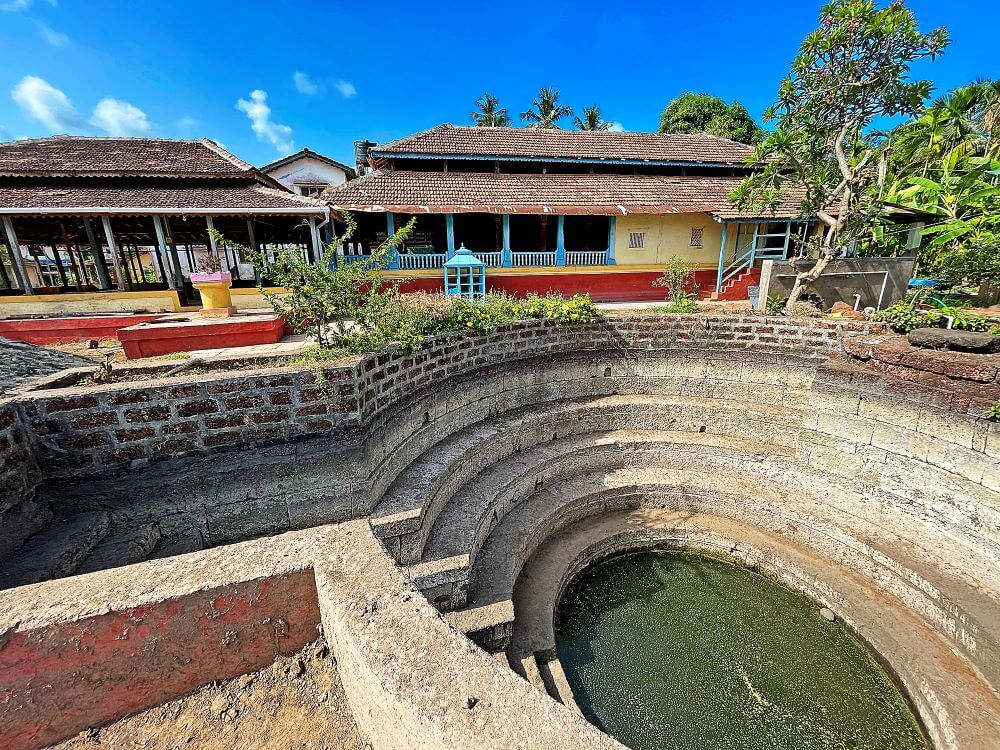
Adjacent to the temple lies a circular pond shaped like a Shivlinga, with stone steps built from the eastern side leading down to the water. The steps are designed to allow devotees to perform circumambulation (pradakshina) inside the pond. It is said that this pond and the nearby well were constructed alongside the main temple. The 18-day Durgadevi Rath Yatra, celebrated from Chaitra Shuddh Pratipada (Gudi Padwa) to Chaitra Vadya Chaturthi, is the principal festival of Anjarle village. The entire village is colorfully decorated for the festival; rangolis adorn every doorstep, and sacred banners and flags are raised. Intricate rangoli carpets welcome the procession along its entire route, with local women enthusiastically taking part in the celebrations. A major fair is held for three days, from Chaitra Vadya Pratipada to Tritiya. On Pratipada at 4:00 PM, a sacred silver mask (Mukhavas) is adorned upon the Goddess, drawing crowds of devotees seeking Her blessings. Mahaprasad is distributed on Dwitiya, followed by the grand Rathotsav on Tritiya, during which the divine chariot of the Goddess is carried on the shoulders of devotees across the entire village. Thousands of pilgrims gather to witness this glorious Rathotsav ceremony. Instituted during the Peshwa era, this festival is celebrated with the same devotion today. According to the traditional *Bara Balutedar* system, various ceremonial responsibilities are assigned to specific local communities, who have faithfully fulfilled their duties for generations. In addition, the grand festival of Navratri is celebrated here for nine days starting from Ashwin Shuddh Pratipada.
Apart from the Durgadevi Temple and the Kadyavarcha Ganpati Temple, Anjarle village is home to several other shrines, among which the temple of the village deity (Gramdevta) Savanekarin is widely famous. In Konkan, the northern part of a village is traditionally known as *Savane*, where this shrine is situated. Villagers hold deep faith that Goddess Savanekarin protects the village from all afflictions arriving from the north. Nestled among mango and cashew orchards along the banks of a stream, this beautiful north-facing tiled-roof temple belongs to Goddess Savanekarin. Her annual festival takes place on Margashirsha Shuddh Pratipada, when the sacred silver mask (Mukhavas) is reverently adorned upon the Goddess.
This sacred temple stands as a testament to deep spiritual devotion, ancient architectural grandeur, and rich local cultural traditions.
The sanctum sanctorum houses the divine idol consecrated according to ancient Vedic traditions, surrounded by serene courtyards and traditional temple architecture.
Navratri, Maha Shivratri, Annual Temple Jatra & Deepotsav
Compare and book flights, secure top-rated local hotels near the temple, hire reliable guides, and rent cars instantly.
Extend your pilgrimage by visiting other highly sacred temples located nearby.


Add ₹999 more to unlock FREE SHIPPING!
Your sacred cart is currently empty.
Shop Photo FramesFill in your delivery details below to place your order.
Add comment