
Add ₹999 more to unlock FREE SHIPPING!
Your sacred cart is currently empty.
Shop Photo FramesThe Ramvaradayini Devi of Choravane, situated near the source of the Vashishti River in Khed taluka, is considered one of the most awakened (Jagrut) deities in the district. The Goddess is called Ramvaradayini because Goddess Parvati, the Adi Shakti, bestowed a boon upon Lord Rama here. Devotees believe that this Goddess, the family deity (Kuldaivat) of the Shinde clan, fulfills their prayers. The main attraction of the annual fair held on Chaitra Shuddha Pournima at this temple, located at the foothills of the Shiv-era Vasota Fort, is the performance of the ‘Lat’ (Bagad) dance.
The legend of the temple states that after Ravana abducted Sita, Lord Rama was distraught and searched for her everywhere. At that time, Mother Parvati decided to test Lord Rama and sat near the source of the Vashishti River, assuming the form of Sita. Lord Rama arrived here while searching for Sita. Upon seeing her, he recognized that it was Mother Parvati herself in the guise of Sita. Overjoyed at meeting the Mother of the Universe, Lord Rama touched her feet. Parvati was moved by the immense power of Lord Rama. Lord Rama requested her, “Mother, now that you have come, please reside here for the salvation of your devotees.” Mother Parvati accepted this request and blessed him, saying, “You will be successful in your mission.” Since then, the Goddess has resided here.
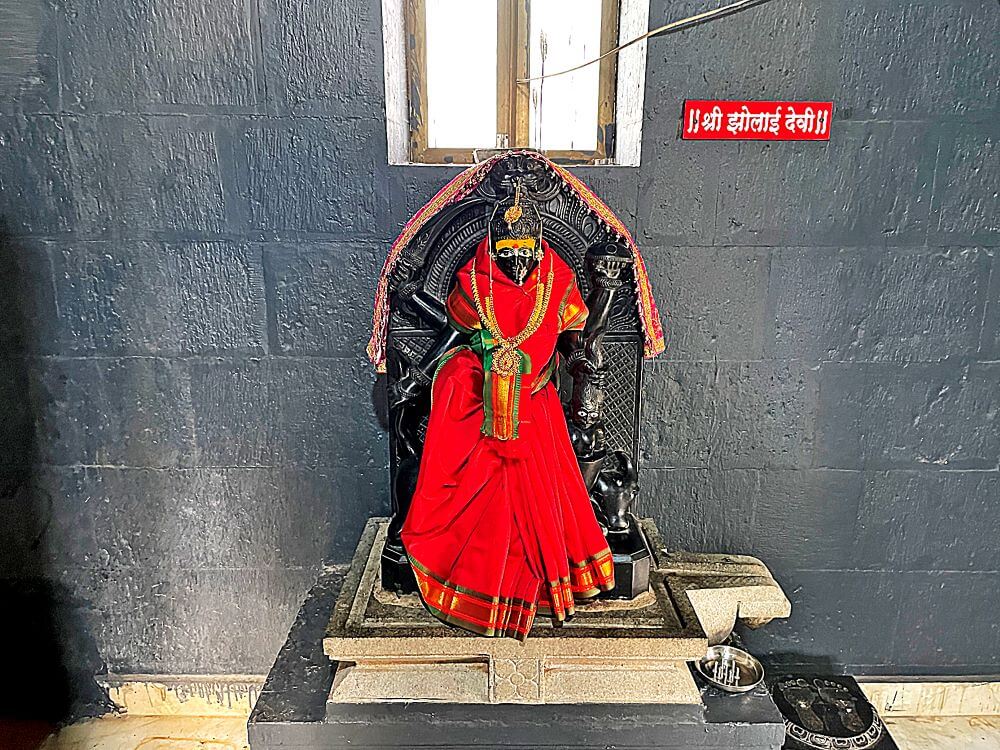
Before the year 1929, for about five decades, this temple was located in the dense forest adjacent to the Choravane village site. At that time, the temple was very small and simple. To protect the Goddess and the culture from the then-invading Mughals, the British, and local thieving tribes, the Goddess’s wealth, idols, and sacred offerings (Take) were kept safe in a cave. In 1935, a cloudburst caused a flood in the area, and the entire Choravane village was relocated down to Shindewadi by the riverbank. The villagers then decided to move the Goddess’s seat down to the village as well. It is said that at that time, among the deities present here—Shri Navasheri Devi, Shri Manara Devi, and Shri Zolai Devi—it was Zolai Devi who offered her place to Shri Ramvaradayini, and the Goddess was installed at the location where the temple stands today.
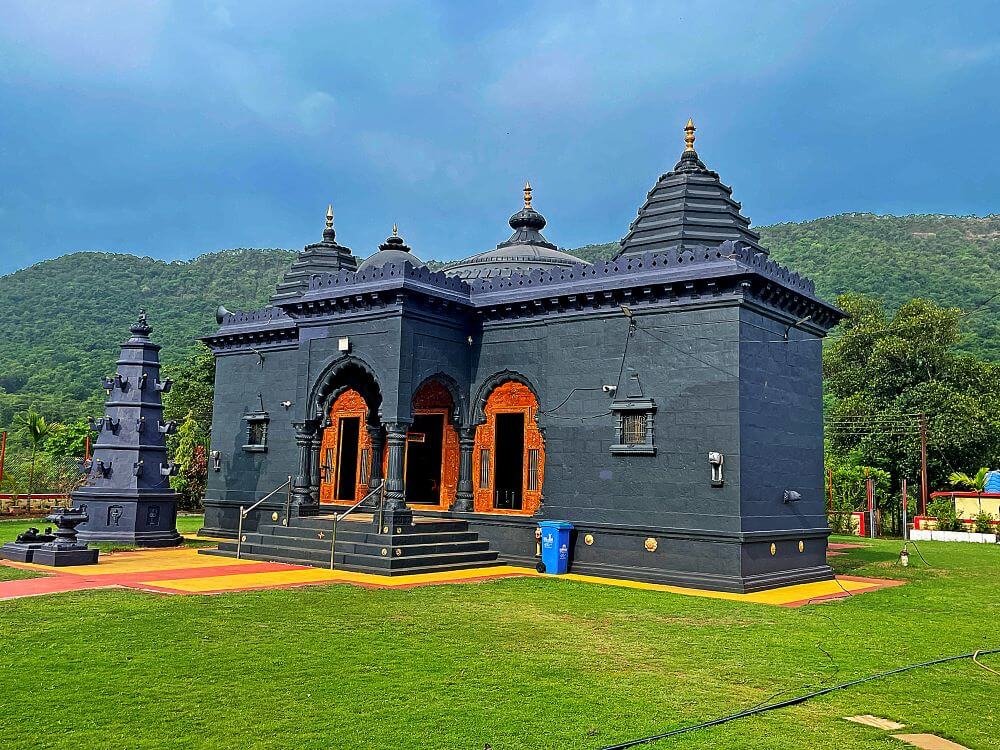
A few years ago, the villagers decided to build a new temple for the Goddess. After seeking the Goddess’s divine consent (Kaul), it was decided to construct the temple in stone. Accordingly, some members of the village visited many historical temples. Finally, after the sculptor from Kolhapur, Shri Pathrud, agreed to work on the temple, the foundation was laid based on his vision. Consequently, although most temples in Konkan are tiled and made of laterite stone, this temple is built entirely of black stone. After the ground-breaking ceremony in 2007, the construction of the temple was completed in 2017. The stone required for this Hemadpanti-style temple was brought from mines in Kolhapur and Nipani in Karnataka. Artisans were brought from Kolhapur for the construction. The temple was originally made of stone, and the new temple was constructed around the original foundation without disturbing it.
The temple, spread over about 35 Gunthas of land, is surrounded by a four-foot-high fortification. The entrance gate of the temple, made of stone, is a replica of the entrance to the Mysore Palace and was crafted by local artisans. A beautiful garden has been developed in the temple courtyard, with a small paved path leading from the entrance to the temple. The unique lamp tower (Deepmal) in front of the main temple was also built by the locals.
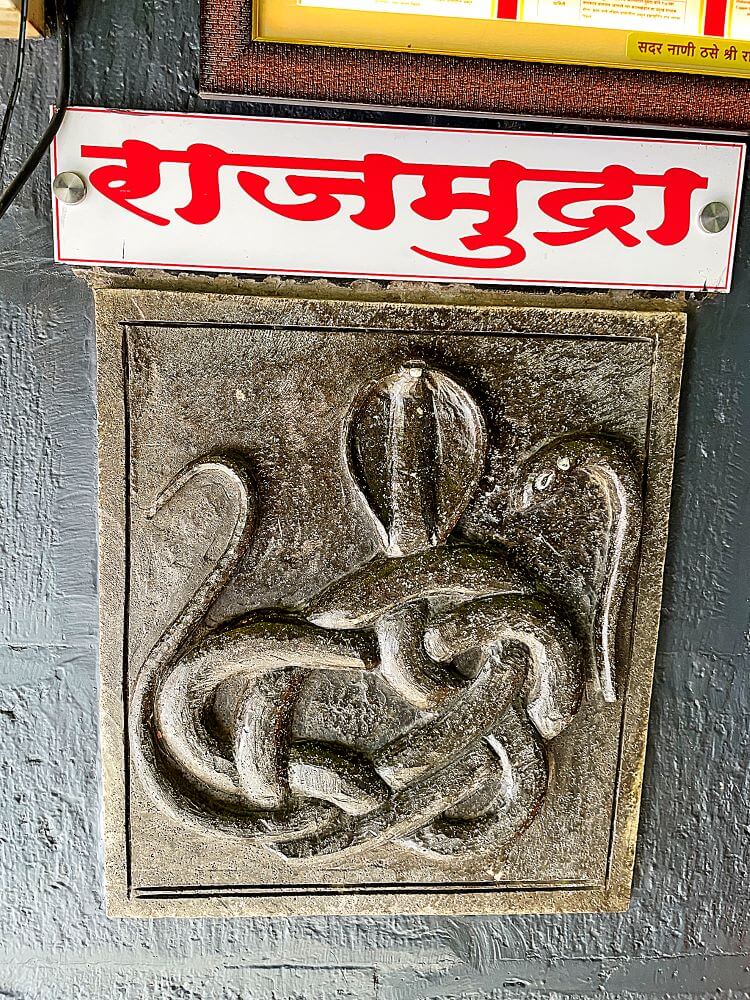
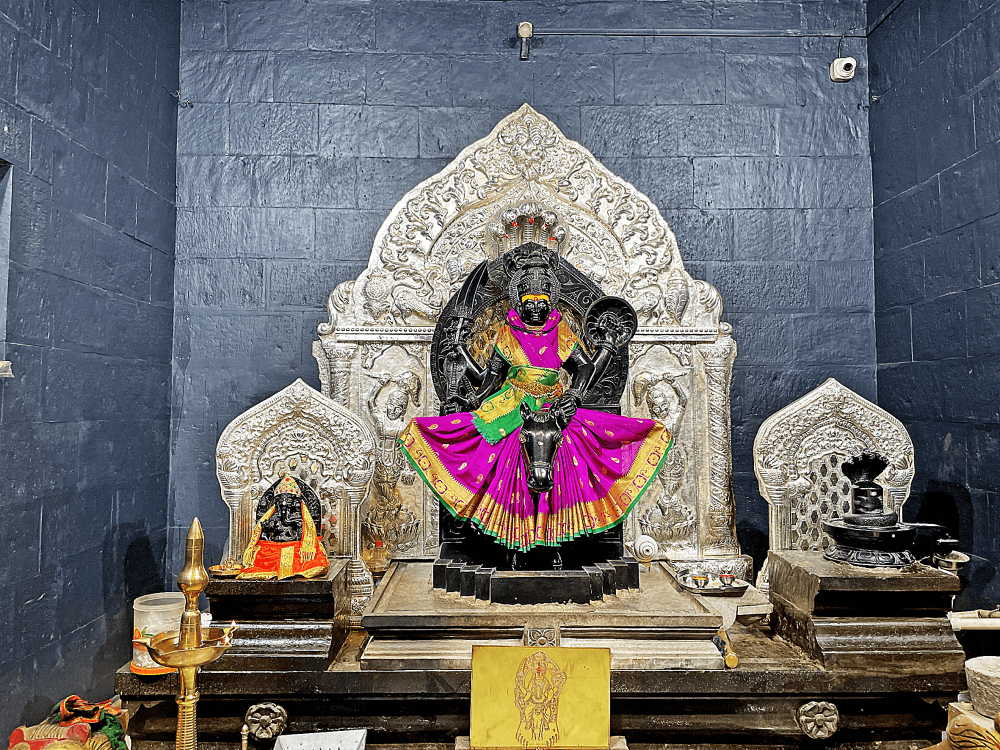
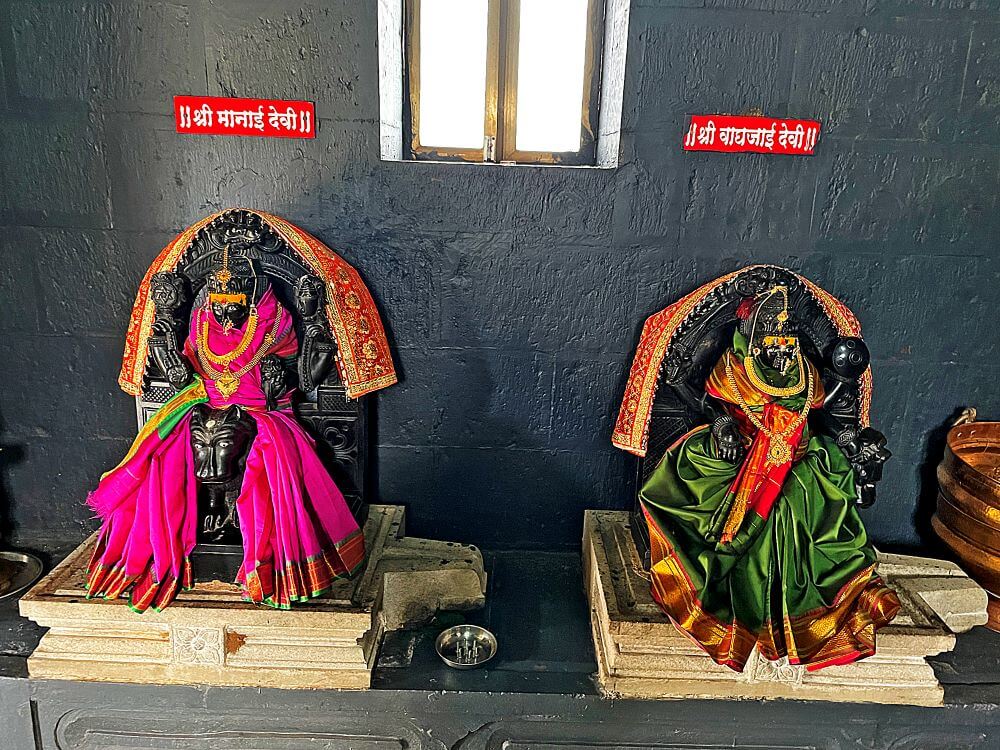
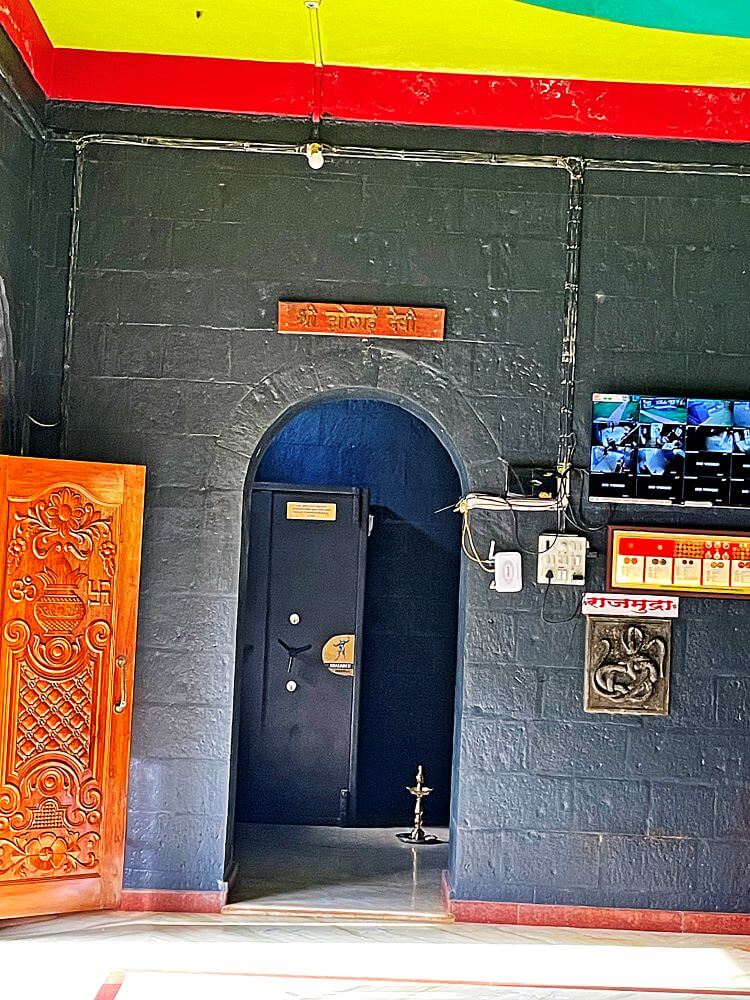
The temple structure consists of a Sabha Mandap (assembly hall) and three Garbhagrihas (sanctum sanctorum). The entrance to the Sabha Mandap features intricate carvings, including an image of Lord Ganesha. In the sanctum to the left of the spacious Sabha Mandap is the idol of Zolai Devi, while Manai-Waghjai are seated in the sanctum to the right. Outside the main sanctum, on the right, the royal seal (Rajmudra) of the Shinde clan is carved. Additionally, various coins dating back to the 15th century and information about them are displayed in the Sabha Mandap. This includes the ‘Shivrai’ coin minted by Chhatrapati Shivaji Maharaj at the time of his coronation. In the main sanctum, there is an idol of the horse-riding Ramvaradayini Devi, adorned with various clothes and ornaments, housed in a silver arch (Makhar), with a serpent in one hand. To her left is an idol of Ganesha, and to her right is a Shiva Linga. The temple spire is topped with a golden finial (Kalash).
The Ramvaradayini Devi fair is held on Chaitra Shuddha Pournima. On the day of the fair, at dawn, the village carpenter cuts a tree selected for making the ‘Bagad’ and crafts the ‘Lat’. Amidst the sound of Shehnai and drums, the villagers bring the ‘Lat’ and place it in the space in front of the Goddess. After the worship of the ‘Lat’, devotees who have come for the pilgrimage offer their prayers and, chanting “Devichya Navacha Changbhala,” dance with the ‘Lat’ through the courtyard to a pillar behind the main Sabha Mandap. The ‘Lat’ is then placed on a 30-foot-high wooden structure. Following this ritual, the village carpenters hang from this Bagad by hooking a special type of iron hook into their backs and take five rounds. Besides this, festivals like Mahashivratri, Shimga, Hanuman Jayanti, Navratri, and Dev Diwali are celebrated in the temple. Devotees can seek the Goddess’s divine guidance (Kaul) by providing prior notice. (Contact: Priest, Mobile: 8275058085)
Devotees can have the Goddess’s Darshan from 6 AM to 9 PM. Free Mahaprasad is provided to devotees every day between 12:30 PM and 2 PM. Furthermore, a state-of-the-art Bhakta Niwas (pilgrim accommodation) has also been built here for the convenience of devotees.
This sacred temple stands as a testament to deep spiritual devotion, ancient architectural grandeur, and rich local cultural traditions.
The sanctum sanctorum houses the divine idol consecrated according to ancient Vedic traditions, surrounded by serene courtyards and traditional temple architecture.
Navratri, Maha Shivratri, Annual Temple Jatra & Deepotsav
Compare and book flights, secure top-rated local hotels near the temple, hire reliable guides, and rent cars instantly.
Extend your pilgrimage by visiting other highly sacred temples located nearby.


Add ₹999 more to unlock FREE SHIPPING!
Your sacred cart is currently empty.
Shop Photo FramesFill in your delivery details below to place your order.
Add comment