
Add ₹999 more to unlock FREE SHIPPING!
Your sacred cart is currently empty.
Shop Photo FramesRenowned as the Kailash of the South, the Shambhu Mahadev Temple located at Shikhar Shingnapur in Man Taluka is a place of deep faith for millions of devotees. According to historical records, as Shambhu Mahadev is the family deity of the Bhosale dynasty, Maloji Raje (father of Shahaji Maharaj and grandfather of Shivaji Maharaj), Shahaji Raje, and Chhatrapati Shivaji Maharaj used to visit this place for darshan. Situated in the mountain ranges on the border of Satara, Solapur, and Pune districts, this sacred site is believed by devotees to be one that fulfills their prayers and vows.
The Shambhu Mahadev Temple at Shinganapur is situated on a hill at an altitude of 3445 feet above sea level, which is why it is known as ‘Shikhar Shinganapur’. The legend regarding this temple states that once, Lord Mahadev and Goddess Parvati were playing a game of dice on Mount Kailash. At that time, Sage Narada arrived there and suggested that whoever lost the game should embrace asceticism. In this game, Lord Mahadev lost three times. As planned, renouncing worldly attachments, their journey began through the Sahyadri mountain ranges, with Mahadev in the lead and Parvati following behind. Upon arriving at Shinganapur, Mahadev hid in a certain place, and Parvati beheld Him in eight different forms in eight distinct locations. Accordingly, eight Lingas were established here. It is believed that by having the darshan of these Ashtalingas in a single day, one earns the merit equivalent to circumambulating the Earth. It is said that Mahadev and Parvati remarried here on Chaitra Shuddha Ashtami. Therefore, their wedding ceremony takes place here on this date every year, and millions of devotees arrive at Shinganapur at this time to participate in this festival.
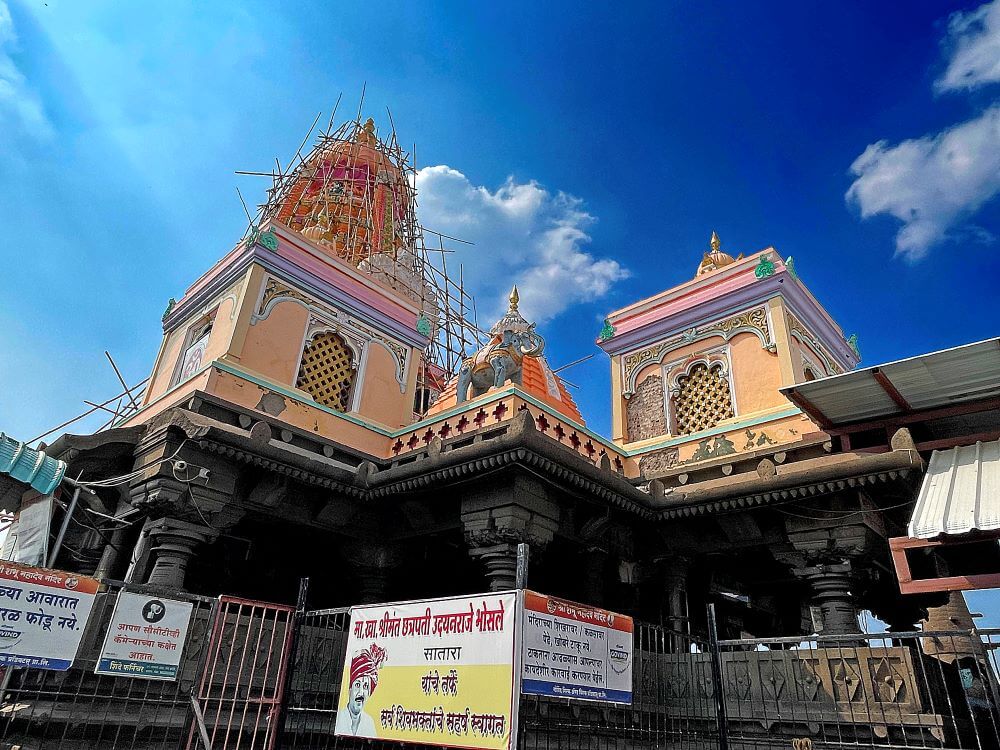
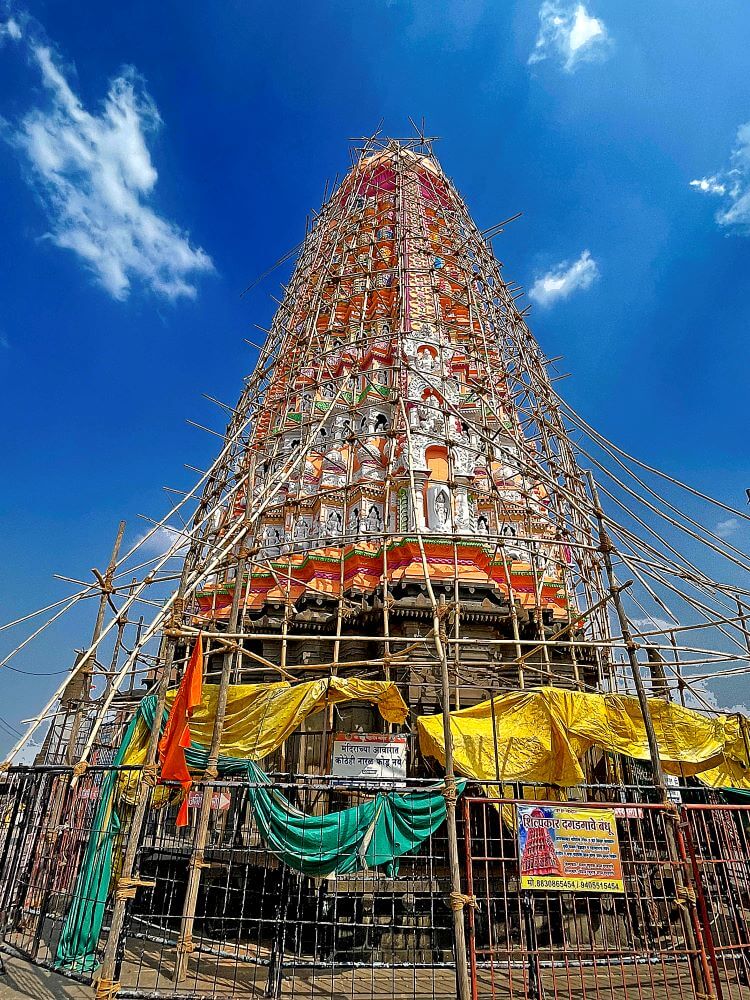
Devotees visiting Shikhar Shinganapur were suffering due to the scarcity of water. At that time, Maloji Bhosale constructed a large lake in the village, which is known as Pushkar Tirth. Images of various animals are carved onto the stone walls of this lake. It is said that the original temple here was built by the Chakravarti Sindhandev Raja of the Yadava era. In the year 1735, Chhatrapati Shahu Maharaj [restored/renovated] this temple. The renovation was carried out. At this time, he constructed memorial temples for the three—Shahaji Maharaj, Chhatrapati Shivaji Maharaj, and Sambhaji Maharaj—to the west of the main temple. These memorials, built in black stone, house Shiva Lingas. In the year 1978, the spire and the temple underwent repairs once again. This temple of Shambhu Mahadev is under private ownership and is currently held by Udayanraje Bhosale, the 13th descendant of Chhatrapati Shivaji Maharaj.
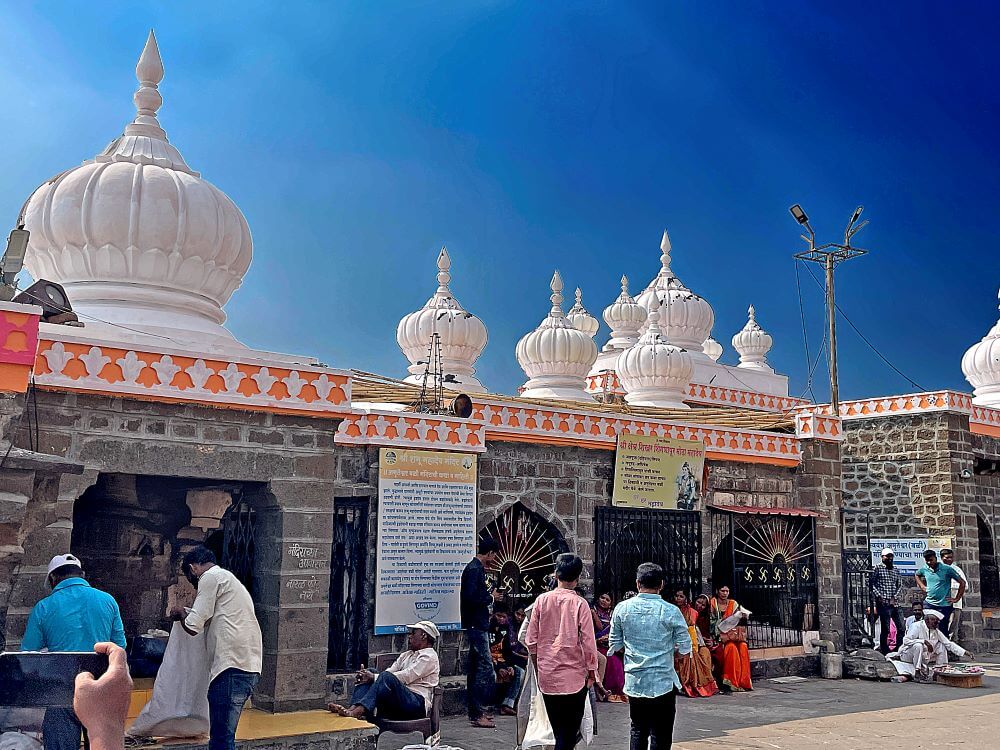
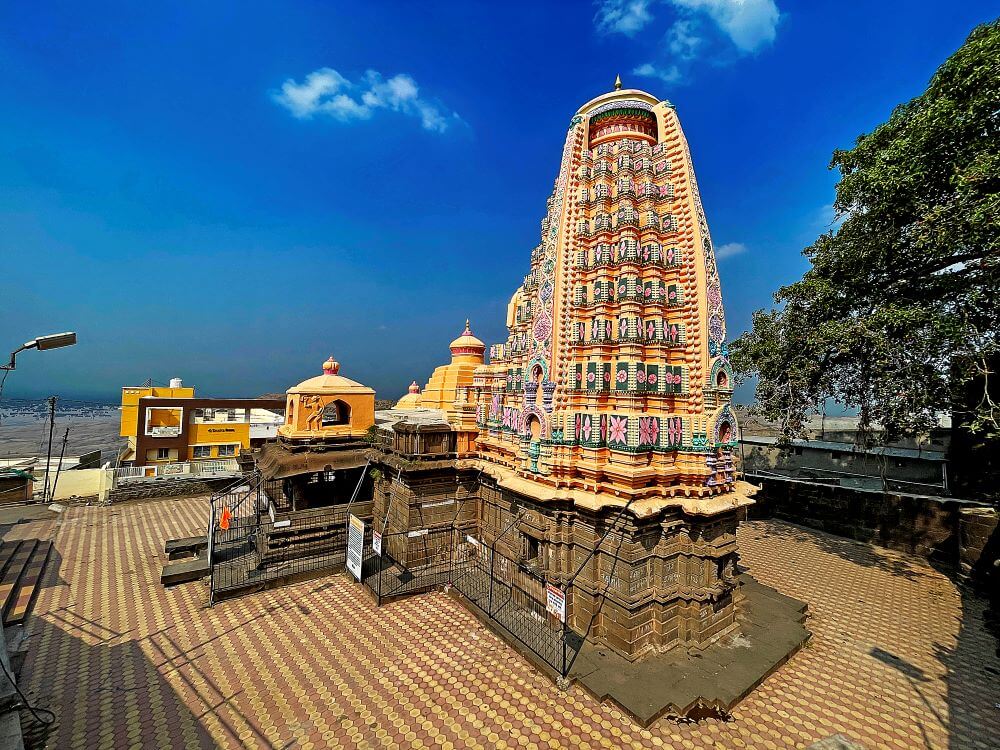
There is an ancient flight of stairs to reach this temple situated on the hill. A new motorable road has also been constructed a few years ago, through which one can go directly to the temple. There are 150 steps to climb if one chooses the stairway path. On this path, there is a magnificent gate 16 meters in height, which is known as the Shendge Gate. It is said that this gate was built by a devotee 200 years ago. Through the arch of this gate, one can get a glimpse of the temple on the peak. The temple of Shambhu Mahadev is surrounded by a fortification made of black stone. To enter this temple, which is built in the Hemadpanti style, there are four entrances through the fortification. Of the temple Within the premises, there is a Nagarkhana (drum house), corridors, as well as small temples of Lord Ganesha and Lord Shri Krishna. There is a tradition of beating a drum in the name of ancestors in front of the Shri Krishna temple here. In front of the temple, there are tall lamp towers (Deepmalas) on the left and right sides, with steps to climb them. Apart from this, there are two more small lamp towers.
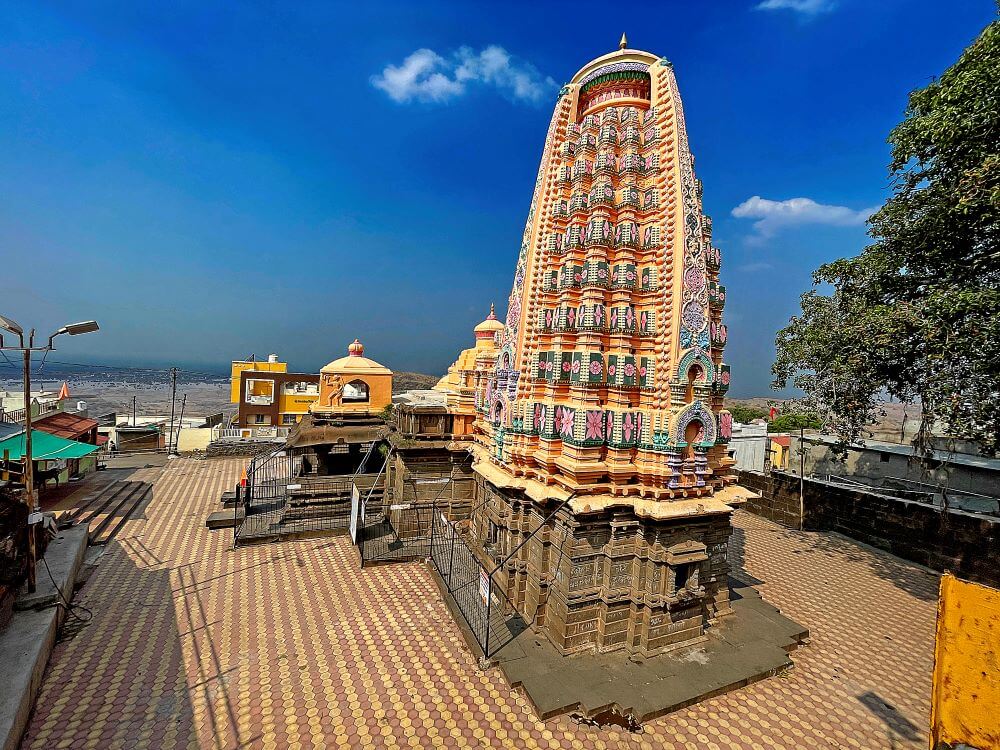
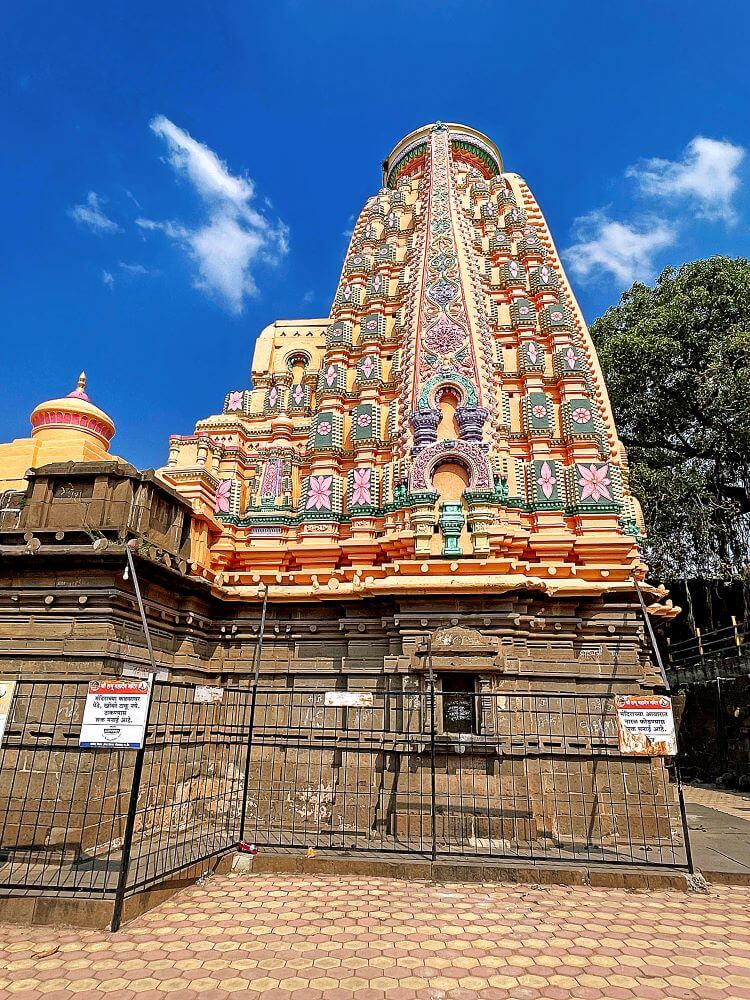
The foundation of the main temple is star-shaped, upon which the temple stands. The temple structure consists of the Nandi Mandapa, Sabha Mandapa, Antarala, and Garbhagriha. There are three entrances to enter this temple. In front of the Nandi Mandapa, there is an idol of Goddess Parvati, covered in silver plating, depicted as having sought refuge in Lord Mahadeva. The Sabha Mandapa here is somewhat small in size, and its pillars feature distinctive carvings. These include various episodes from the Puranas, hunting scenes, and erotic sculptures. On the upper sections of these pillars are load-bearing Yakshas. The open-style Sabha Mandapa features Kakshasanas (stone benches built along the edges for seating). In front of the Garbhagriha, there are five metal Nandi statues and two large bells. The years 1670 and 1720 are inscribed on these bells. An octagonal figure is carved into the stone in front of the Nandi. It is said that in the year 1651, Chhatrapati Shivaji Maharaj performed the purification of Netaji Palkar, who had been forcibly converted to Islam, and brought him back into the Hindu religion. A large lotus with 100 petals is carved onto the ceiling of the Sabha Mandapa.
The door of the sanctum sanctorum is plated with silver sheets, and its arch features distinctive craftsmanship. Since the sanctum sanctorum is situated at a slightly lower level, one must descend steps to reach it. The square-shaped Shiva Linga here is considered to be self-manifested (Swayambhu), and it has two bases (Shalunkas) upon it. It is regarded as a symbol of Shiva and Shakti. On the outer walls and the spire of the temple, there are sculptures of various deities, sages, dancers, and celestial nymphs (Apsaras). Due to the painting, all these sculptures appear even more vibrant. The main pinnacle (Kalash) atop the temple spire is made of gold, and there are four additional pinnacles on its sides.
Starting from Gudi Padwa (Chaitra Shuddha Pratipada), the Shikhar Shinganapur Yatra is held for 12 days at Umavan, located at the foothills of the mountain. During this, the wedding ceremony of Mahadeva and Parvati takes place at 12 midnight on Chaitra Shuddha Ashtami. On this day, a thick rope of 550 feet is tied from the pinnacle of the Shambhu Mahadeva temple to the pinnacle of the Amriteshwar temple, which is known as ‘Pagote’. This rope is considered to be the wedding gift for Mahadeva. In Umavan, one tree is designated for each village. During the pilgrimage period, villagers gather near their respective trees and enjoy the festivities. This is likely a rare pilgrimage where a tree is assigned to each village in this manner.
On the final day of the pilgrimage, Chaitra Shuddha Dwadashi, water is brought in ‘Kavads’ (yokes) from Mungi Ghat through a difficult path filled with pits, crevices, and stones to perform the Abhishekam of Lord Mahadeva. Among these, the ‘Manachi Kavad’ (the honorary yoke) belongs to Telya Bhutya. (Saint Telya Bhutya, a devotee of Shiva from Saswad in the Purandar taluka of Pune district, used to bring a Kavad here). This Kavad has two large earthen pots attached to it. While carrying the Kavad towards the deity, the devotees call out, “Mhadya (Mahadeva), run to me, protect me.” As the Kavad is carried up, the devotees become absorbed in the rhythm of the Halgi, Ture, and Lezim and dance with devotion. Millions of devotees gather here to witness this ceremony with their own eyes. At midnight, Shambhu Mahadeva is anointed with the water from this Kavad. Following this, the pilgrimage concludes.
Devotees can have the darshan of Shambhu Mahadeva here every day from six in the morning until eight at night. In the temple premises, Mahaprasad is provided daily at noon to the visiting devotees.
This sacred temple stands as a testament to deep spiritual devotion, ancient architectural grandeur, and rich local cultural traditions.
The sanctum sanctorum houses the divine idol consecrated according to ancient Vedic traditions, surrounded by serene courtyards and traditional temple architecture.
Navratri, Maha Shivratri, Annual Temple Jatra & Deepotsav
Compare and book flights, secure top-rated local hotels near the temple, hire reliable guides, and rent cars instantly.
Extend your pilgrimage by visiting other highly sacred temples located nearby.


Add ₹999 more to unlock FREE SHIPPING!
Your sacred cart is currently empty.
Shop Photo FramesFill in your delivery details below to place your order.
Add comment