
Add ₹999 more to unlock FREE SHIPPING!
Your sacred cart is currently empty.
Shop Photo FramesThe town of Shirwal is situated in the region where five rivers—the Neera, Kanadi, Velvandi, Gunjavani, and Shivganga—converge. Chhatrapati Shivaji Maharaj, the founder of the Hindavi Swarajya, fought the first battle of his kingdom here at the Subhanmangal Fort, securing both victory and significant wealth for the Swarajya. This historic town of Shirwal is home to many ancient temples, among which the pre-Shivaji era Kedareshwar Temple stands as a revered place of faith for devotees. Historical records indicate that Chhatrapati Shivaji Maharaj visited this temple multiple times to offer his prayers.
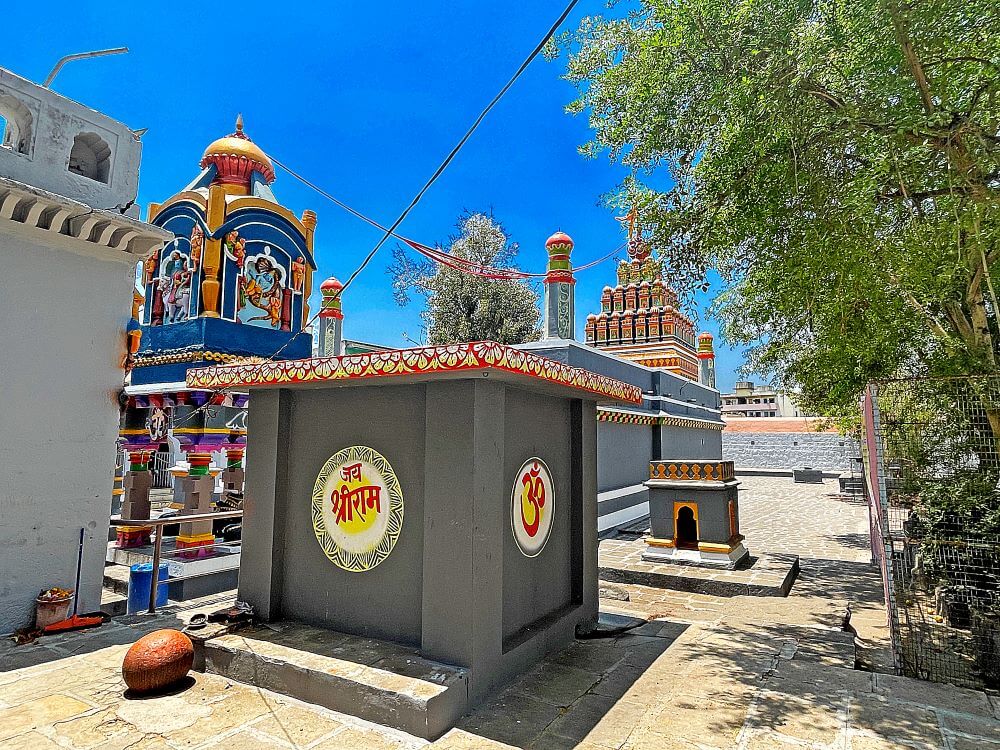
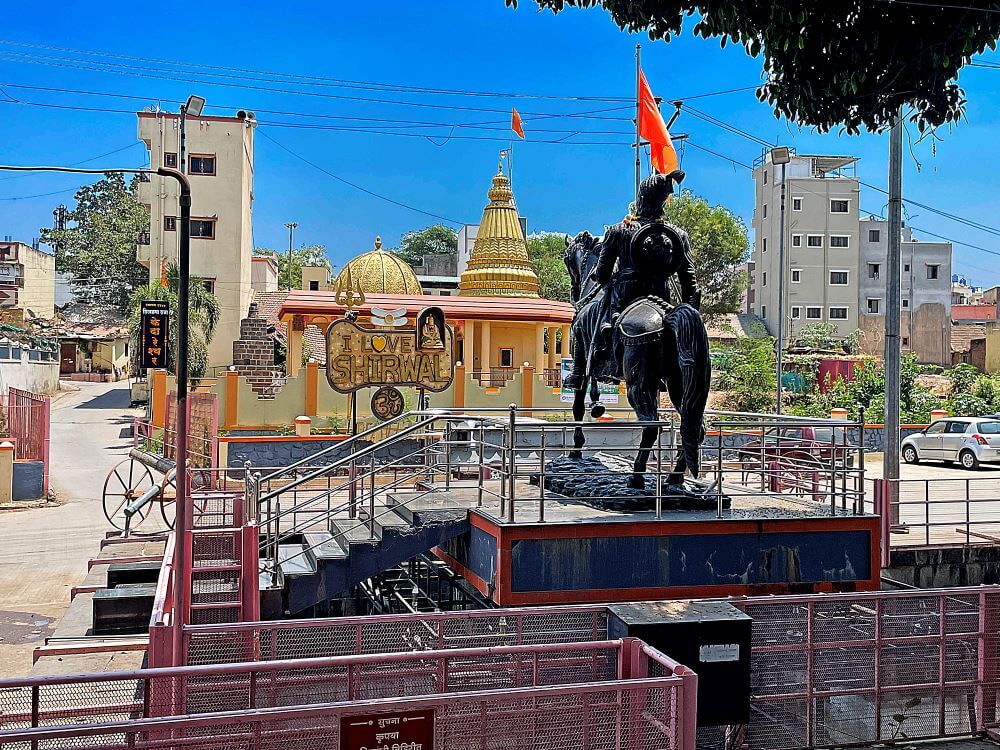
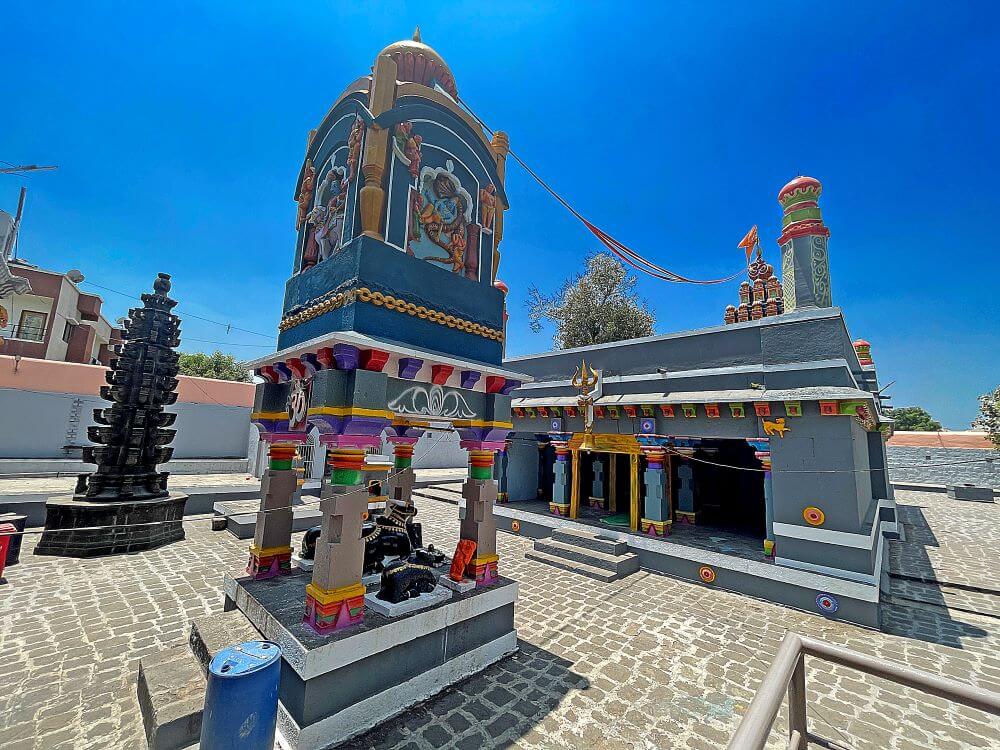
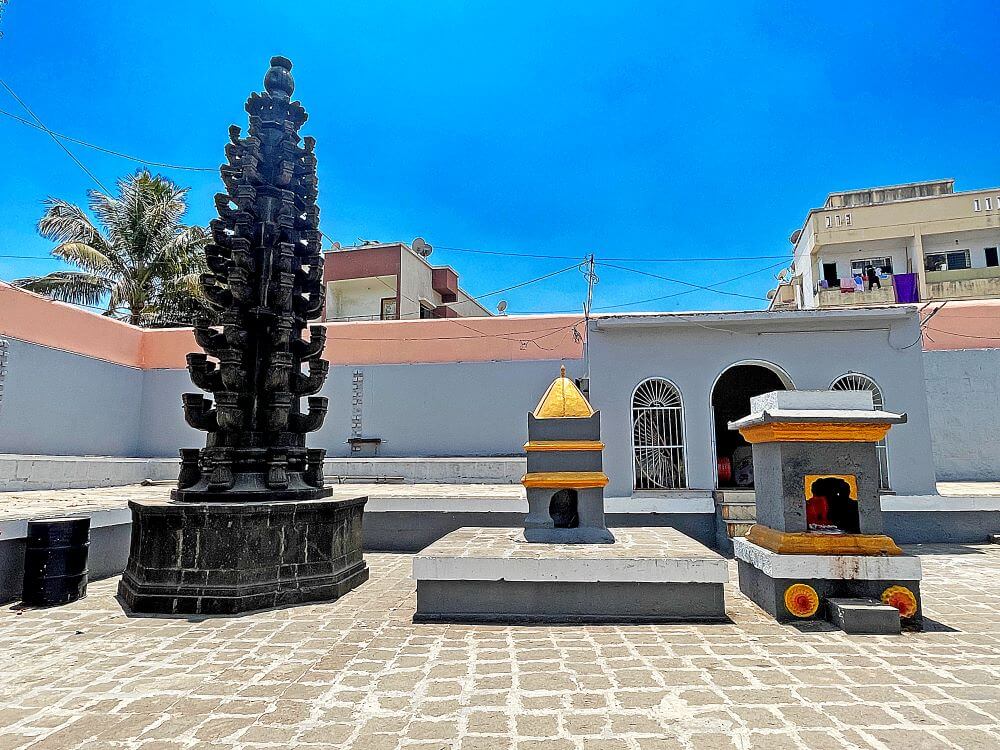
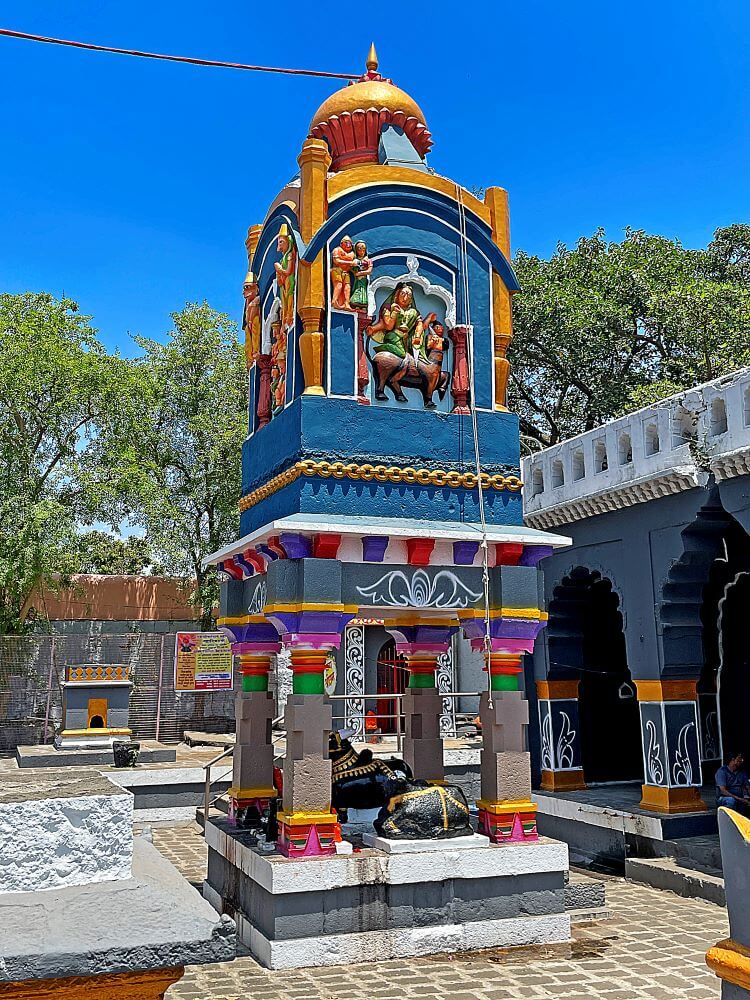
In front of the Kedareshwar Temple, located in the heart of Shirwal, lies a well built of dressed stone. A unique feature of this well is its shape, which resembles a Shiva Linga, and it includes steps for descent. An equestrian statue of Chhatrapati Shivaji Maharaj has been installed in the center of the well. Behind this well, the Kedareshwar Temple is surrounded on all four sides by an 18-foot-high stone fortification. One can enter the temple premises through the gateway in this wall. Inside the entrance, there are arched corridors (ovaris) built into the fortification. In front of the main temple stands a two-story Nandi Mandapa, which houses three Nandi statues. The spire on the second floor is adorned with intricate carvings of various deities. On both sides of this Nandi Mandapa, there are two tall stone lamp towers (deepmalas) standing on four-foot-high octagonal platforms, showcasing exquisite craftsmanship.
The main temple complex consists of a Darshan Mandapa, a Sabha Mandapa, and the Garbhagriha (sanctum sanctorum). Built in the Hemadpanti style, the Darshan Mandapa and Sabha Mandapa feature numerous stone pillars with elaborate carvings. The paintings on these pillars and walls enhance the beauty of the Darshan Mandapa and Sabha Mandapa. In the center of the Sabha Mandapa, there is an idol of Goddess Kalika housed in a niche. Beside the entrance to the Garbhagriha, there is an idol of Lord Ganesha, with another Ganesha carving on the lintel and a Kirtimukha carved at the base. Inside the Garbhagriha, there is a large Shiva Linga made of black stone. It is said that this Shiva Linga is Swayambhu (self-manifested) and was discovered when it became struck by a farmer’s plow. A mark on one side of the Shiva Linga is believed to be the impression left by the plowshare. In a niche opposite the Shiva Linga, there is an idol of Goddess Parvati, also carved from black stone.
Apart from the main temple, the premises include shrines dedicated to Lord Ganesha, Lord Hanuman, and Goddess Durga. The spire atop the Garbhagriha is unique; besides the main finial (kalash), it is adorned with over fifty smaller finials and numerous sculptures of deities. A month-long fair is held at this temple during the holy month of Shravan. Additionally, a one-day fair is held on the occasion of Mahashivratri. During the Mahashivratri festival, devotees begin lining up for darshan from the midnight of the previous day. Devotees can visit and seek the blessings of Kedareshwar Mahadev at this temple daily from 5:00 AM to 11:00 PM.
Beyond the Kedareshwar Temple, 5 km to the north of Shirwal lies a hamlet called Shindyachi Wadi, home to the famous Layangiri Caves. On the Pune-Satara highway, two kilometers before reaching Shirwal, one takes a right turn at Lokim Phata, from where the Layangiri (Pandavdara) hill becomes visible. The caves can be reached by a 15 to 20-minute trek from the foothills. Several small caves have been carved into the black rock here. It is believed that the Pandavas created these caves and stayed here during their period of exile (Agyatvas), which is why they are known as the Pandavdara Caves.
The layout of the viharas (monastic cells) in the caves consists of a veranda on the outside and a room on the inside. The inner rooms feature bench-like structures, and there are designated spaces where Buddhist monks used to keep their belongings. A small pit is also visible, likely used for placing oil lamps. The main vihara of these caves houses a Shiva Linga, which is worshipped regularly. Hundreds of devotees visit this ‘Layangiri Mahadev’ during Mahashivratri and the month of Shravan.
This sacred temple stands as a testament to deep spiritual devotion, ancient architectural grandeur, and rich local cultural traditions.
The sanctum sanctorum houses the divine idol consecrated according to ancient Vedic traditions, surrounded by serene courtyards and traditional temple architecture.
Navratri, Maha Shivratri, Annual Temple Jatra & Deepotsav
Compare and book flights, secure top-rated local hotels near the temple, hire reliable guides, and rent cars instantly.
Extend your pilgrimage by visiting other highly sacred temples located nearby.


Add ₹999 more to unlock FREE SHIPPING!
Your sacred cart is currently empty.
Shop Photo FramesFill in your delivery details below to place your order.
Add comment