
Add ₹999 more to unlock FREE SHIPPING!
Your sacred cart is currently empty.
Shop Photo FramesThere are 12 famous seats (thani) of Khandoba across Maharashtra and Karnataka. Among these, Pal, situated on the banks of the Tarali River, is considered the most important and vibrant seat of Khandoba after Jejuri. It is believed that the marriage of Khandoba and Mahalasa Devi took place here. This seat is famous as Khandoba’s Pal. A grand fair is held here on Paush Purnima. On this day, the wedding ceremony of Khandoba and Mahalasa Devi is celebrated in the presence of lakhs of devotees. The original name of this village was Rajapur, but it became famous as Pal after the name of Khandoba’s beloved devotee, Palai.
The legend of the temple states that a shepherdess named Palai from Rajapur village used to go to the nearby hill every day to graze her cows. She would serve Khandoba in a temple located there. This became her daily routine. Later, due to certain reasons, she could no longer go to the hill, so she prayed earnestly for the deity to descend from the hill. Pleased with Palai’s devotion, on the auspicious occasion of Champashasthi, the Lord appeared to her in a dream and said, “I will grant you my vision at the place where your Kapila cow begins to lactate.” Following this, when Palai, with the help of the villagers, searched for the Kapila cow, it began to lactate at a spot near the village. When the villagers excavated the site, they found the Pindi of Khandoba. This is the present-day Khandoba temple of Pal.
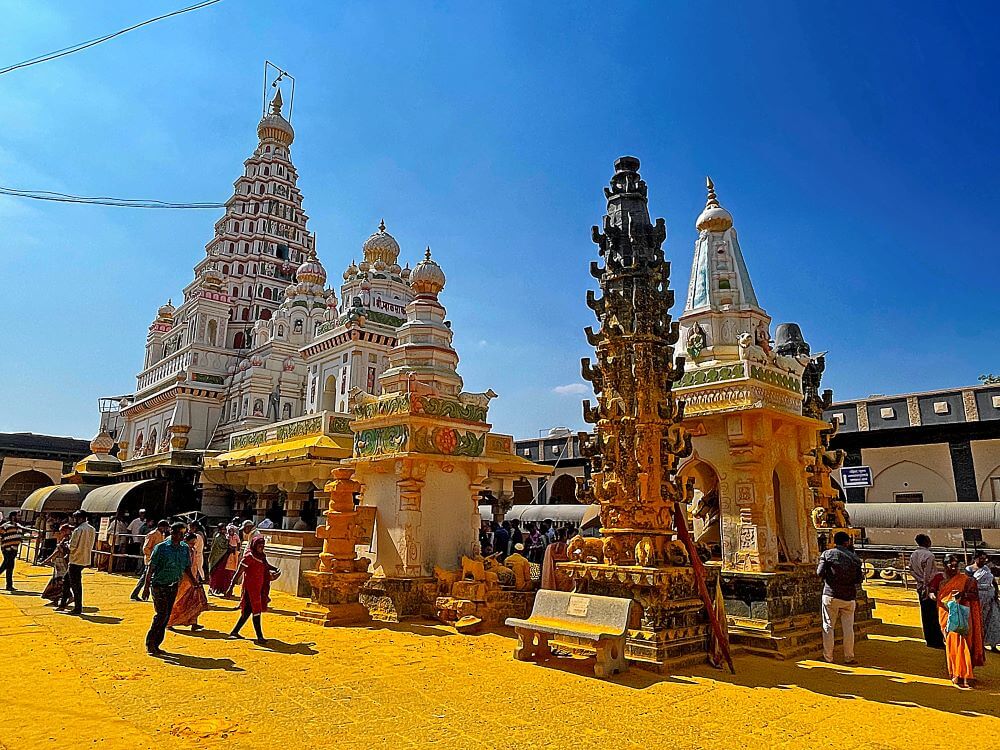
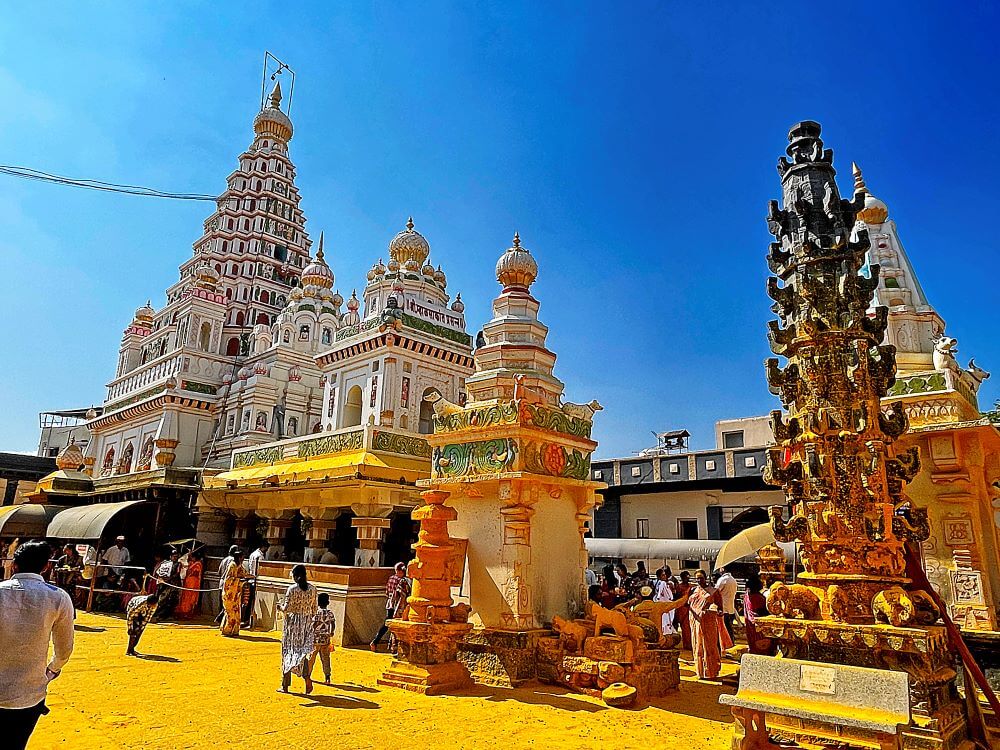
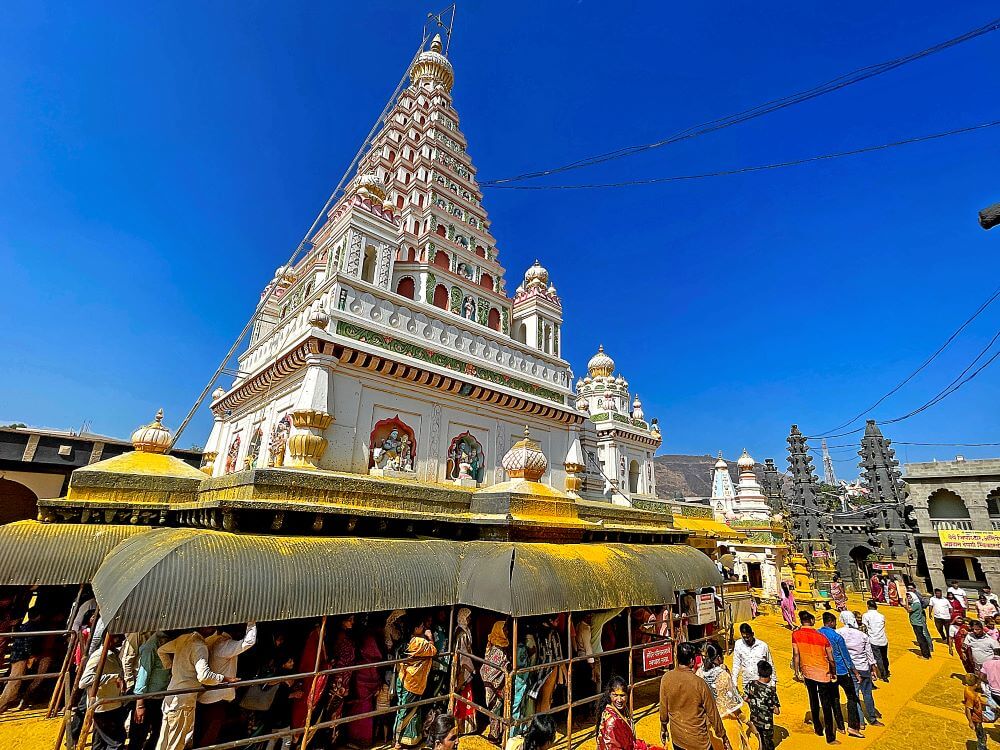
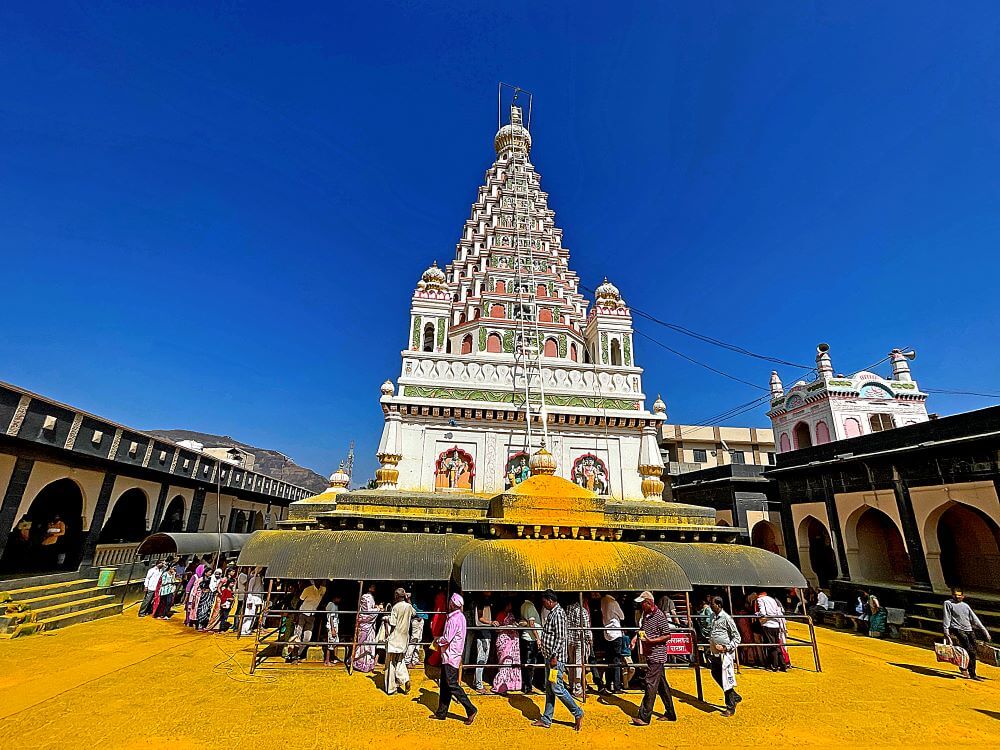
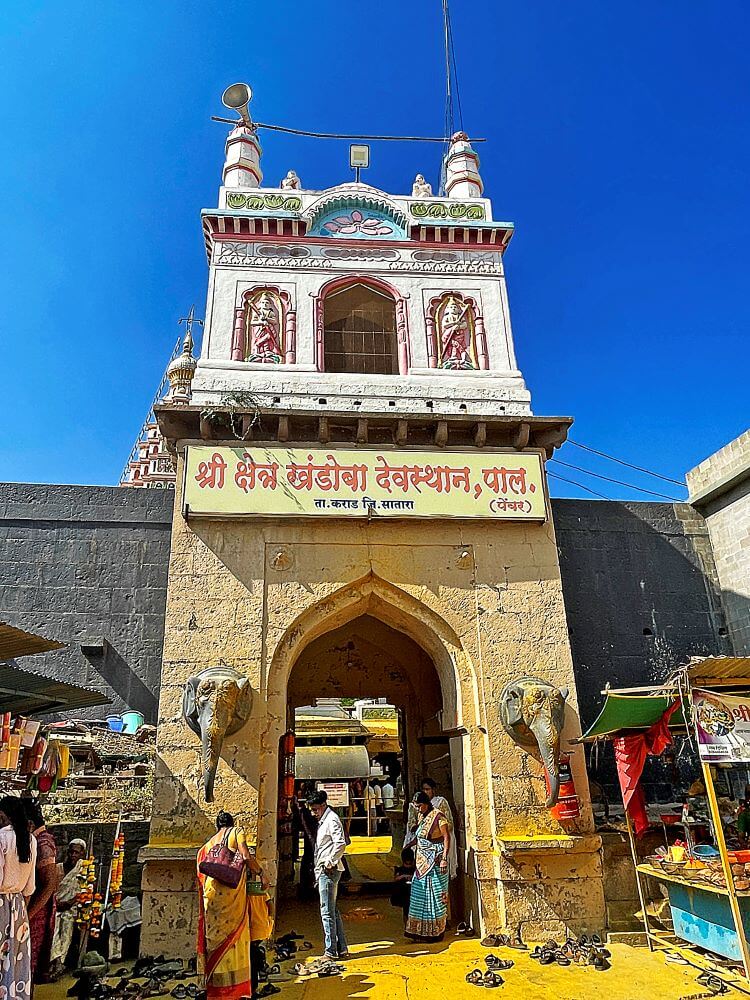
Located in the central part of Pal village, this temple is fortified on all four sides. Upon entering the temple premises through the grand entrance in the fortification, one finds the Gajmandir on the right, which houses a massive stone elephant . Before the entrance, there are hundreds of shops selling worship materials on both sides. The entire temple premises appear bright yellow due to the scattering of Bhandara (turmeric powder). This temple is 500 to 550 years old and was built by a merchant named Aba Binshetty Padide. Dhanajirao Jadhav, the commander of Rajaram Maharaj, built the Sabha Mandap (assembly hall) of this temple. Due to the disturbances caused by the Mughals, Khando Pargaonkar built the fortification around the temple in 1772. It is said that during the war between Chatursingh and Sardar Raste in 1799, Chatursingh visited this place and performed rituals before departing.
According to a mention in the text ‘Samarth Sadhak’, in 1666, when Samarth Ramdas Swami was traveling from Sajjangad to Chaphal, he heard the ‘Sawal-Jawab’ (questions and answers) of some Shahirs (folk poets) during the Khandoba fair at Pal. Samarth noticed that both poets were proud of their knowledge, so he took a tambourine (daf) in his hand and posed a question: ‘How much is the weight of the Earth? How much is the expanse of the sky? Tell me the volume of the ocean. How much is the wind in the sky? How much are the drops of rain? Tell me the number of blades of grass on the earth, friend?’ Hearing these questions from Samarth, both poets were left speechless.
Due to periodic renovations, the original form of the temple has changed. There are cloisters (ovaris) on all four sides of the temple. In one of these cloisters, there is a magnificent Khanda (sword) of Khandoba. Within the temple premises, there are small shrines dedicated to Jyotirlinga, Vitthal, and Martand Bhairav. Additionally, Shivalingas, tortoise sculptures, and idols of Nandi and Nagas are carved everywhere. Some of these idols are covered with brass sheets.
In front of the main temple are the Nandi Mandap and lamp towers (Deepmalas). Among these, the lamp tower near the Nandi Mandap is adorned with various sculptures and intricate carvings. The temple is built in the Hemadpanti style, and the Shikhar (spire) features distinctive paintings. The main entrance has a beautifully crafted wooden door, and the Sabha Mandap contains 12 stone pillars. There are chambers on three sides of this assembly hall with stone seating for devotees . On one of the stones, the name ‘Dhanaji Dinas Daji Jadhav’ is carved, honoring the builder of the Sabha Mandap.
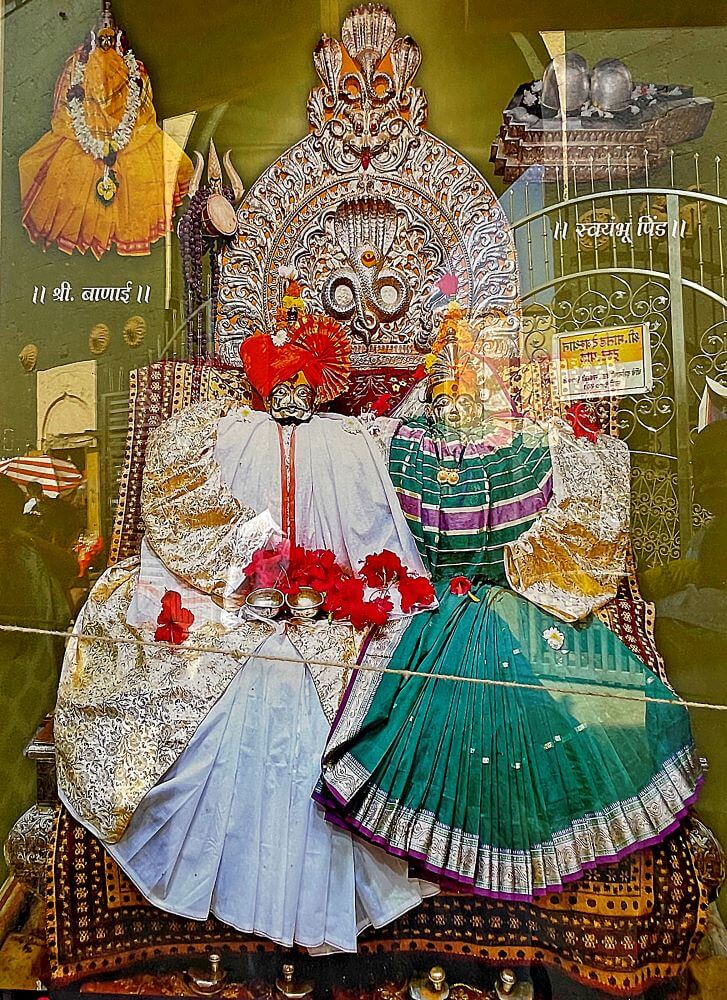
The entrance to the sanctum sanctorum is covered with brass sheets. The idol of Khandoba is four-armed, holding a sword, a damaru, a trident, and a bowl. Beneath the feet of the idol are the heads of the demons Mani and Malla. In the sanctum, there is a Swayambhu (self-manifested) Shivalinga with two Shalunkas (bases). On one, there is a brass mask of Khandoba, and on the other, a brass mask of Mahalasa. To their right stands the idol of Khandoba’s second wife, Banai. The entire sanctum appears colored in yellow Bhandara. The temple spire is carved with the idols of many gods and goddesses.
Every year on Paush Purnima, the Khandoba fair is held here. On this day, the wedding ceremony of Khandoba and Mahalasa is celebrated. For this ceremony, representatives (mankaris) of Khandoba from various villages arrive in a procession, bringing honorary carts and ceremonial poles (sasankathis). At 3:00 PM, the chief mankari arrives in a chariot. After completing all the rituals in the temple, at 4:00 PM, the mankaris carry the idols of the deities to the ‘Andhar Darwaja’ (dark gate) here. After they are seated in the chariot, the main procession begins. The procession moves slowly through the Maruti temple route and reaches the wedding altar (bohla) by 6:00 PM. At this time, the atmosphere resonates with the chants of ‘Khanderayacha Vijay Aso’. Upon reaching the pavilion, the deities are bathed. The chief mankari places the deities on the wedding altar. Then, in the traditional manner and in the presence of lakhs of devotees, the wedding ceremony of Khandoba and Mahalasa is performed. During this time, devotees shower Bhandara and dry coconut.
Apart from this ceremony, there is a six-day festival during Champashasthi. In this festival, like Navratri, Ghatasthapana is performed for six days. The fair begins on the fifth day of Champashasthi, i.e., Panchami. Thousands of devotees participate in this. The temple trust has provided accommodation facilities for devotees here.
This sacred temple stands as a testament to deep spiritual devotion, ancient architectural grandeur, and rich local cultural traditions.
The sanctum sanctorum houses the divine idol consecrated according to ancient Vedic traditions, surrounded by serene courtyards and traditional temple architecture.
Navratri, Maha Shivratri, Annual Temple Jatra & Deepotsav
Compare and book flights, secure top-rated local hotels near the temple, hire reliable guides, and rent cars instantly.
Extend your pilgrimage by visiting other highly sacred temples located nearby.


Add ₹999 more to unlock FREE SHIPPING!
Your sacred cart is currently empty.
Shop Photo FramesFill in your delivery details below to place your order.
Add comment