
Add ₹999 more to unlock FREE SHIPPING!
Your sacred cart is currently empty.
Shop Photo FramesNandgaon in Murud Taluka is historically known as ‘Nandgram’ or ‘Nandigram’. Located on the Alibaug-Murud road, this village is widely renowned for its spiritually awakened Siddhivinayak Temple. It is believed that this deity, seated with his two divine consorts Riddhi and Siddhi, bestows happiness, prosperity, and fulfillment upon the lives of devotees. Significantly, there is a firm belief among Ganesha devotees that the Ashtavinayak pilgrimage is considered incomplete without a visit to this temple. Therefore, after completing the Ashtavinayak pilgrimage, a large number of devotees come to this temple for darshan.
The legend of the temple states that several centuries ago, this temple and the Ganesha idol were not at their current location. The Siddhivinayak deity was originally situated in a Ketaki grove in the nearby Kumbharwada. A scholar named Keshav Daivajna, who lived there, was a devout worshipper of this Ganesha. He never broke his vow of daily darshan. There was a creek on his path. Once, due to a high tide and the turbulent sea, it became impossible for him to cross the creek. Consequently, he could not have darshan of Ganesha that day. Distressed by breaking his daily ritual, he received a divine vision in his dream where Ganesha said, “I am ready to come to you; bring me to a place that is convenient for you.” The very next day, the water in the creek receded, and he brought the Ganesha idol with him. Today, the temple stands at that very spot.
Keshav Daivajna was not only known as a Ganesha devotee but was also a great scholar of astronomy. Siddhivinayak Ganesha was the presiding deity of his family. It was out of his devotion to Ganesha that he named his son Ganesh. The famous 16th-century almanac maker and astrologer Ganesh Daivajna was also a great devotee of Ganesha. He authored the important treatise ‘Grahalaghava’. Many of its formulas are considered accurate even today. Nandgaon is also mentioned as ‘Nandigram’ in that text.
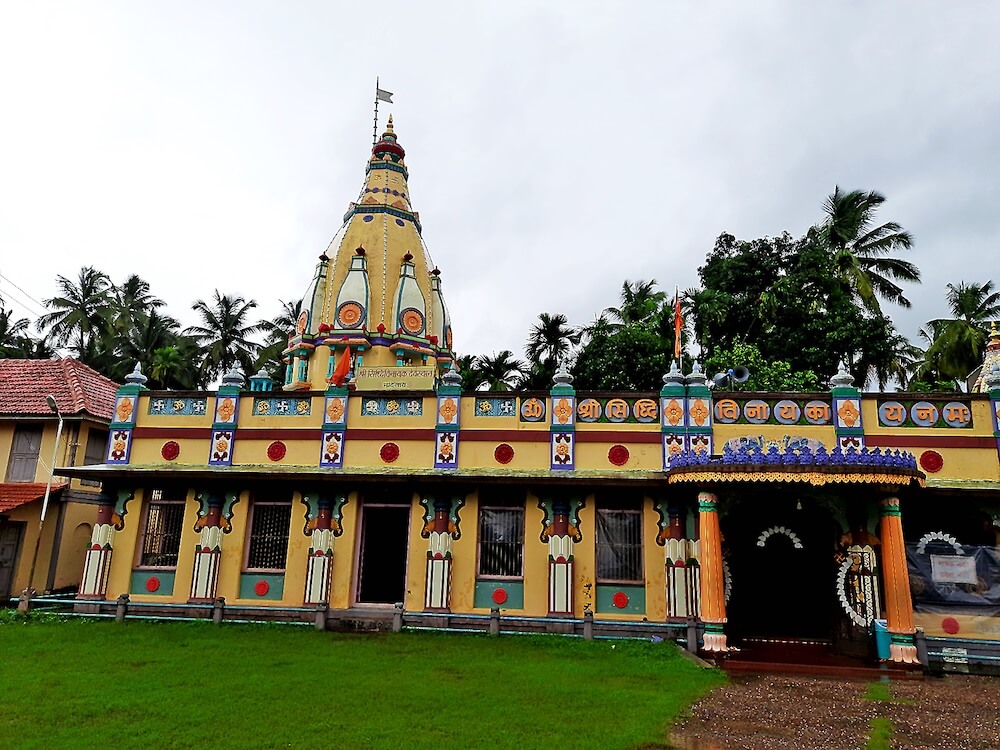
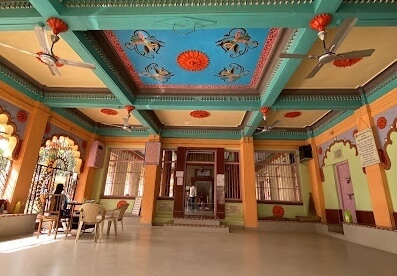
Upon entering Nandgaon, one sees coconut and betel nut orchards everywhere. It is felt that nature is as blessed as the Siddhivinayak deity in this village. In historical times, Nandgaon was a major trading port on this coast under the Siddi rule, but today it is famous for the awakened Siddhivinayak Temple. The temple is located in the center of the village, and it is said to have been built in the year 1134. There is a record of the temple’s first renovation between 1963 and 1966. After a renovation carried out a few years ago, the temple attained its current form. There is a large courtyard in front of the temple from where one enters the assembly hall (sabhamandap). This east-facing temple is structured with an assembly hall, an antarala (vestibule), and a sanctum sanctorum (garbhagriha). The assembly hall here is spacious. There is a brass bell in the assembly hall, which bears the year 1912 and a record that it was offered by a devotee named Palji Fakir. On one side, there is an idol of Hanuman, and on the other, an idol of Kalbhairava carved from a single stone. Unique craftsmanship can be seen on the ceiling of the assembly hall.
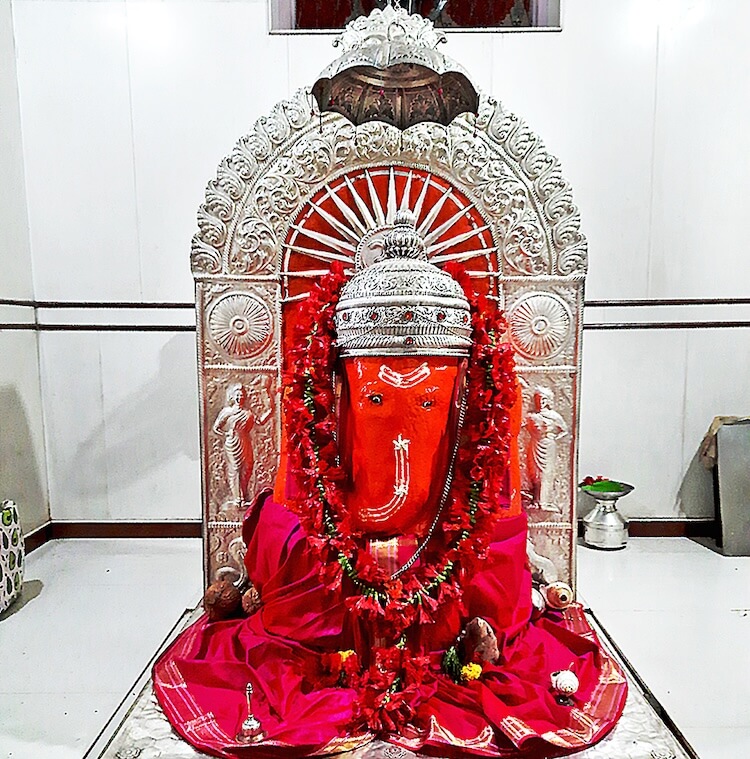
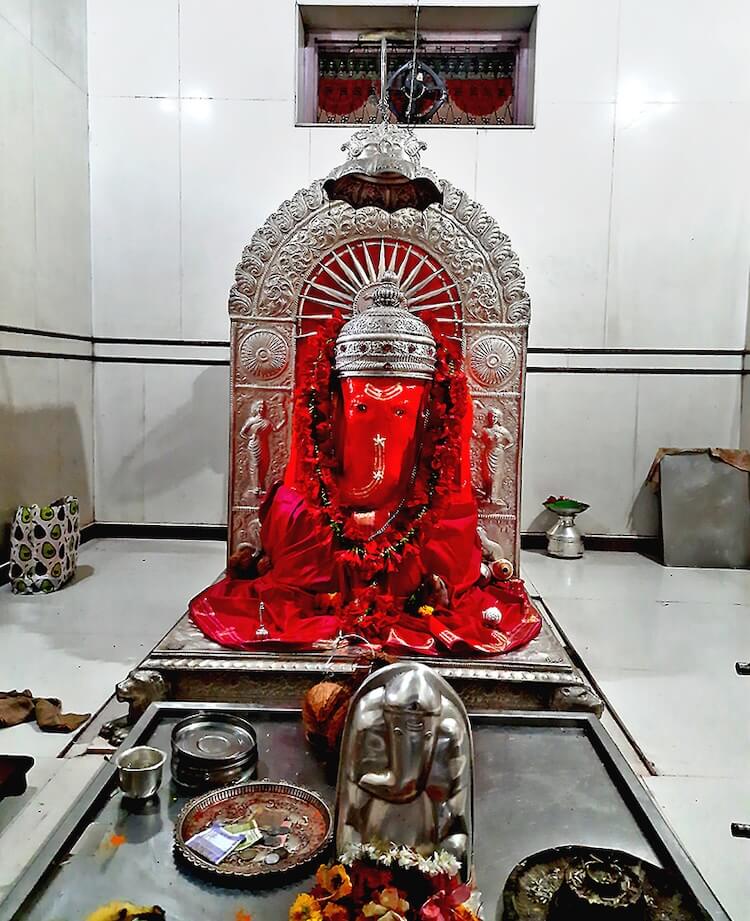
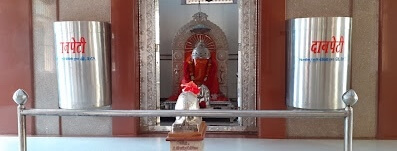
A separate circumambulation path (pradakshina marg) has been provided in the design of the sanctum sanctorum. Near the entrance, there is a silver-plated Mushakraj (the mouse vehicle). In the center of the sanctum, on a diamond-shaped pedestal (vajrapitha), is a two-foot-tall, self-manifested (swayambhu) Ganesha idol with a trunk turned to the right. The hands of this seated idol are somewhat indistinct. There is a silver crown on the head of the idol, and the back slab is decorated with silver sheets. It features a beautiful halo (prabhaval) and attendants carved on both sides of the idol. Diamonds are set in the forehead and navel of the idol. In front of the main idol is a silver processional idol (utsavmurti). Additionally, there is a marble idol of Ganesha in the temple, which is said to have been found near the ramparts of Janjira.
There is a staircase outside the assembly hall to go to the second floor of the temple. From here, one can see the ornate spire (shikhara) of the temple up close. This spire is 30 feet high. Sculptures of the Ashtadikpalas, who guard the eight directions, are installed on it. Hundreds of devotees visit daily for the darshan of this wish-fulfilling Siddhivinayak.
Various religious programs are held in the temple throughout the year, but the Maghi Ganesha Jayanti festival, held on Magh Shuddha Chaturthi, is the grandest celebration. This festival lasts for five to seven days, and a large fair is held here during this time. On the main day, a special abhishek and alankar puja of Ganesha are performed. Thousands of devotees from the surrounding areas participate in the palanquin procession held in the afternoon. Special grand worship (mahapuja) and bhajan programs are also held here on Ganesh Chaturthi in the month of Bhadrapada and on every Sankashti Chaturthi. A large pilgrimage (yatra) takes place here in the month of Magh. It is recorded that the first President of the country, Dr. Rajendra Prasad, also visited this temple. The temple is open for darshan daily from 8 in the morning to 8 at night.
This sacred temple stands as a testament to deep spiritual devotion, ancient architectural grandeur, and rich local cultural traditions.
The sanctum sanctorum houses the divine idol consecrated according to ancient Vedic traditions, surrounded by serene courtyards and traditional temple architecture.
Navratri, Maha Shivratri, Annual Temple Jatra & Deepotsav
Compare and book flights, secure top-rated local hotels near the temple, hire reliable guides, and rent cars instantly.
Extend your pilgrimage by visiting other highly sacred temples located nearby.


Add ₹999 more to unlock FREE SHIPPING!
Your sacred cart is currently empty.
Shop Photo FramesFill in your delivery details below to place your order.
Add comment