
Add ₹999 more to unlock FREE SHIPPING!
Your sacred cart is currently empty.
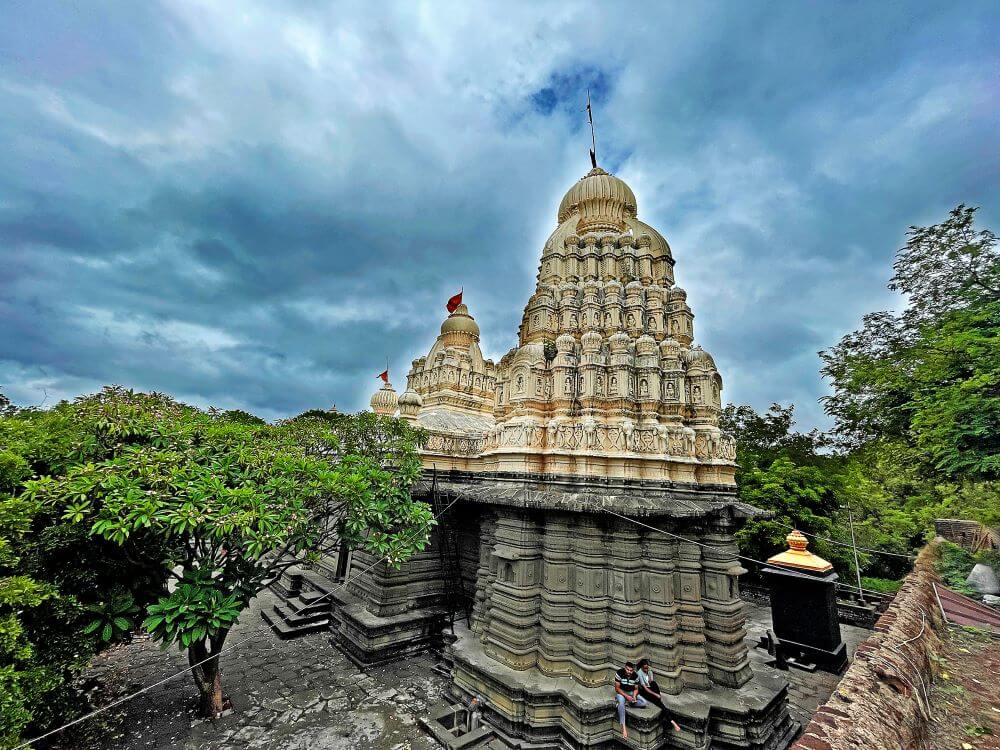
Shop Photo FramesIn Saswad, Pune District, on the banks of the Karha River, stands the twelfth-century Shri Changawateshwar Temple. Situated on the Saswad-Narayanpur road, this temple was originally built in the Hemadpanti style. In the eighteenth century, Sardar Ambajipant Purandare undertook the renovation of this sacred edifice. The residence of Saint Changdev Maharaj bestowed upon this place immense religious and historical significance. The main temple was erected upon a spacious plinth, rising a remarkable ५० feet above the ground. This temple is protected by strong fortifications, much like a fort.
The history of the Changawateshwar Temple is intertwined with two significant periods in Maharashtra: the Yadava and Maratha eras. Observing the original construction style of the temple, scholars estimate that it was likely built during the twelfth century, under the reign of the Yadava kings of Devagiri. The construction of this temple, crafted from black stone and without the use of lime, clearly reflects the influence of the Hemadpanti architectural style prevalent during the Yadava period. Later, in the eighteenth century, when the administration of the Saswad region was under the Purandare family, this edifice underwent renovation. Around the year १७०० CE, Sardar Ambajipant Purandare erected a Maratha-style brick and lime shikhara (spire) upon the temple’s original stone structure.
Saint Changdev Maharaj is revered as an exceptionally influential and accomplished yogi within Maharashtra’s Warkari tradition. According to ancient texts, Changdev attained a high level in Hatha Yoga and achieved complete mastery over nature. He lived a remarkably long life of १४०० years. The most crucial document detailing his spiritual transformation is the ‘Changdev Pasashti,’ composed by Saint Dnyaneshwar. When Changdev decided to relinquish his ego and surrender to Dnyaneshwar, Dnyaneshwar composed ६५ Ovis (verses) to introduce him to self-realisation. Through the teachings in this text, Changdev acknowledged that devotion and knowledge were superior to the path of yoga. As mentioned in ‘Sant Lilamrut,’ Changdev, despite his advanced age, accepted the young Muktabai as his Guru. Saint Namdev’s Abhangas also describe this profound spiritual change in Changdev.
It is said that Saint Changdev Maharaj would reside in Saswad every year during the Chaturmas period. During this time, he would observe a vow of silence and meditate with closed eyes. One of his disciples would daily prepare a clay Shivling for his worship. Maharaj would place this Shivling on the palm of his left hand and worship Shiva in a meditative posture. One day, during the monsoon season, due to continuous rain, the disciple could not find good clay to make a new Shivling. He smeared some clay on an inverted earthen pot and presented it as a Shivling for Maharaj’s worship. When Maharaj tried to place the Shivling down from his hand after the puja, it would not move. Upon opening his eyes, Maharaj realised this was a divine sign. He consecrated the Shivling at that very spot and built a temple. He then performed long-term penance there. As Changdev established this Shivling in the vicinity of a ‘Vat’ (banyan) tree, it came to be known as ‘Changawateshwar.’ According to another legend, Lord Brahma, the creator of the universe, performed penance here to please Lord Shiva. Hence, this bank of the Karha River is also known as ‘Brahmakshetra.’
The temple complex, known as the sacred land of accomplished ascetics, is enveloped by various trees. This temple is built on a large plinth, rising ५० feet above the ground. A strong fortified wall surrounds the temple. To reach the temple from the courtyard, one must ascend २५ stone steps. The sanctum sanctorum of this east-facing edifice has a star-shaped plan. Entry into the paved courtyard of the temple is through the main gateway in the fortification. Along all four sides of this courtyard, adjacent to the protective walls, are rows of small chambers (ovaryas). In ancient times, these chambers were used for the accommodation of pilgrims and for performing rituals and religious ceremonies. In front of the temple stand two large Deepmalas (lamp towers). Beside these Deepmalas is a carved stone Tulsi Vrindavan. It is six feet tall, and its intricate carvings match the style of the main temple. The minute details in the construction of this Tulsi Vrindavan bear witness to Maratha-era art.
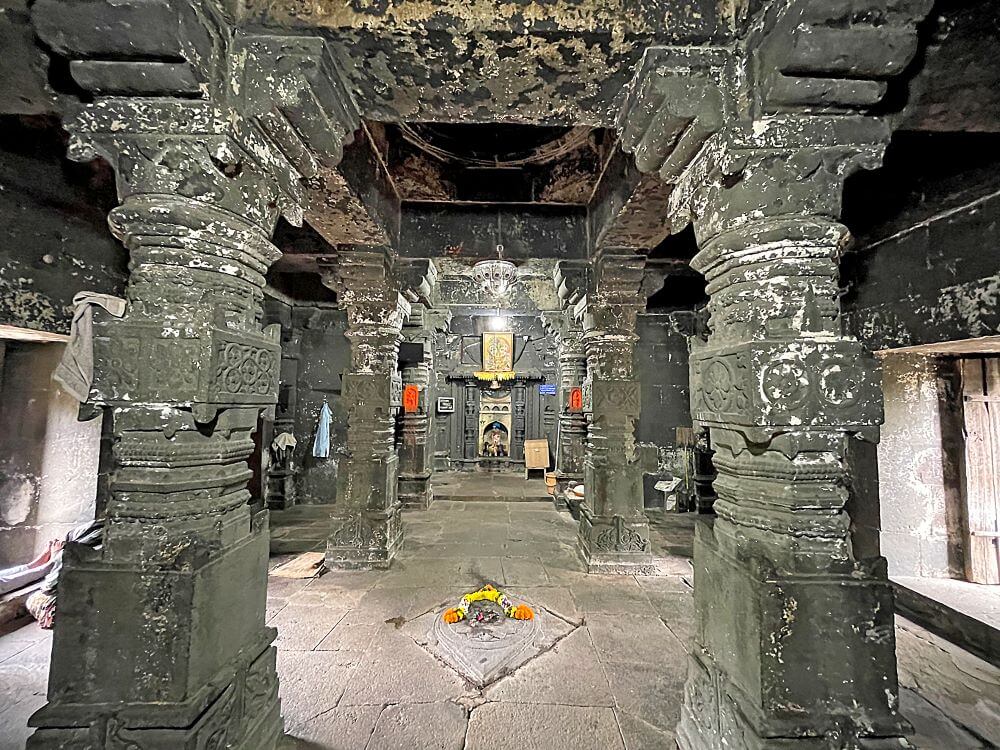
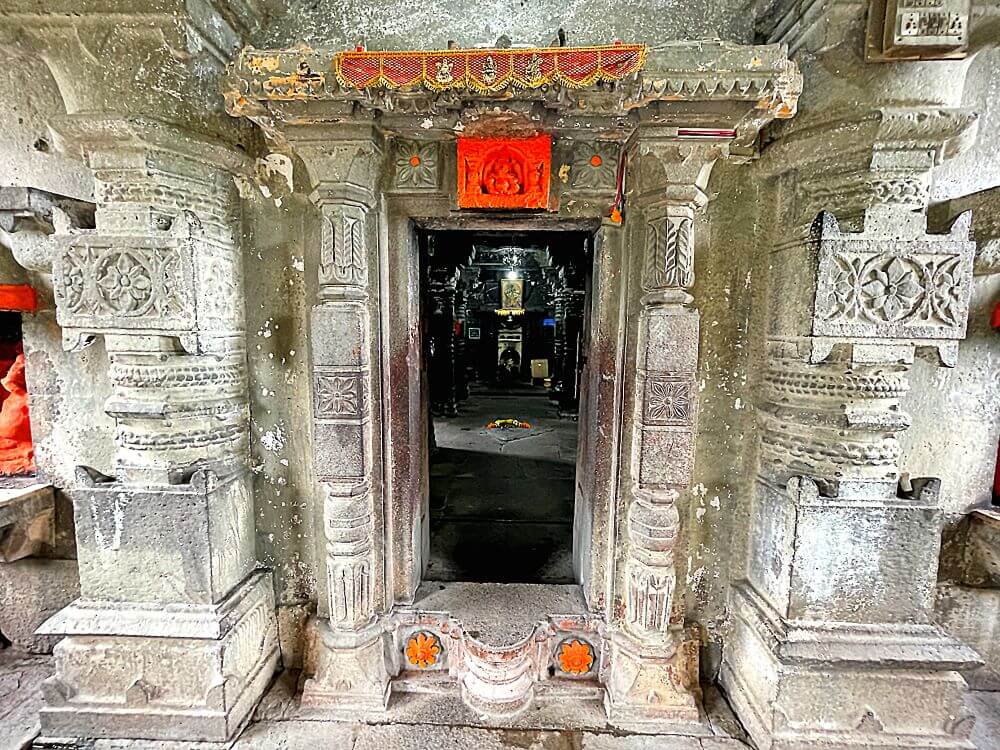
The temple’s structure comprises a Nandi Mandapa, Sabha Mandapa, Antarala, and Garbhagriha. In the Nandi Mandapa, which is an integral part of the temple, there is a large idol of Nandi on a plinth. This Nandi is carved from a single, unbroken black stone. The ornaments on its body, the bells around its neck, and the knot of the rope around its neck show extremely fine craftsmanship. After the Nandi Mandapa, one enters the main Sabha Mandapa. The Nandi Mandapa and Sabha Mandapa contain approximately ३० stone pillars of mixed circular and square shapes. These pillars are adorned with carvings depicting various scenes from human life, including a woman churning buttermilk and wrestlers demonstrating their skills. Additionally, the carvings on the pillars also feature animals and birds, including elephants, horses, rhinoceroses, and peacocks, along with the mythical creature ‘Sharabh.’ This mythical creature, with the body of a tiger and the trunk of an elephant, is considered a symbol of power. On the floor of the Sabha Mandapa, there is a carved stone tortoise idol. Further on, one enters the Garbhagriha through the Antarala.
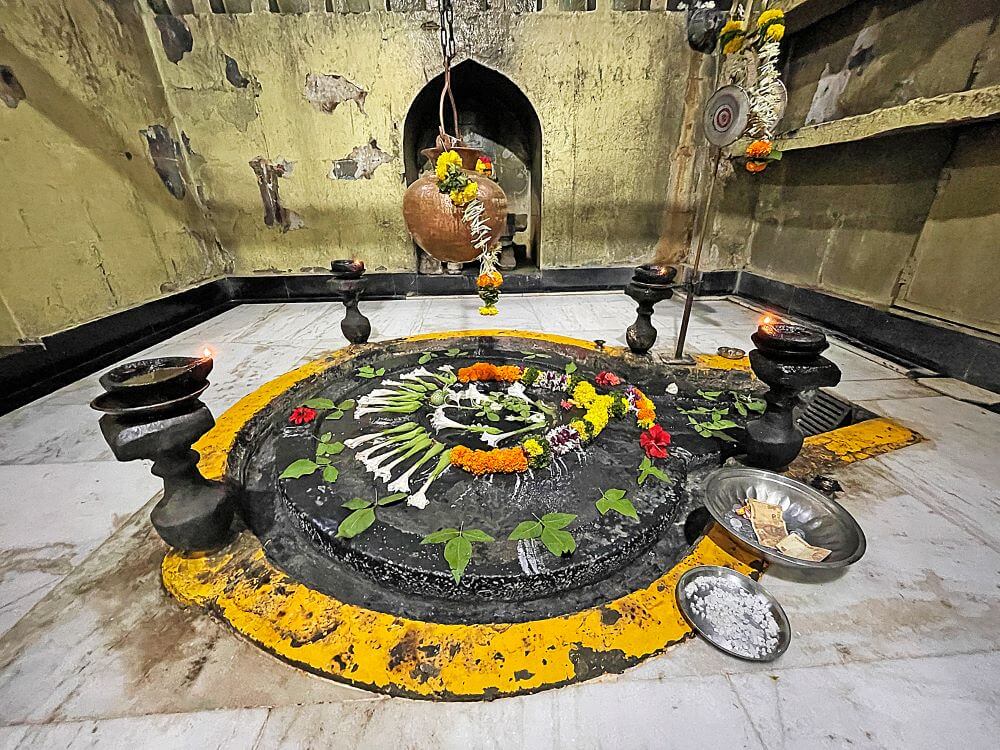
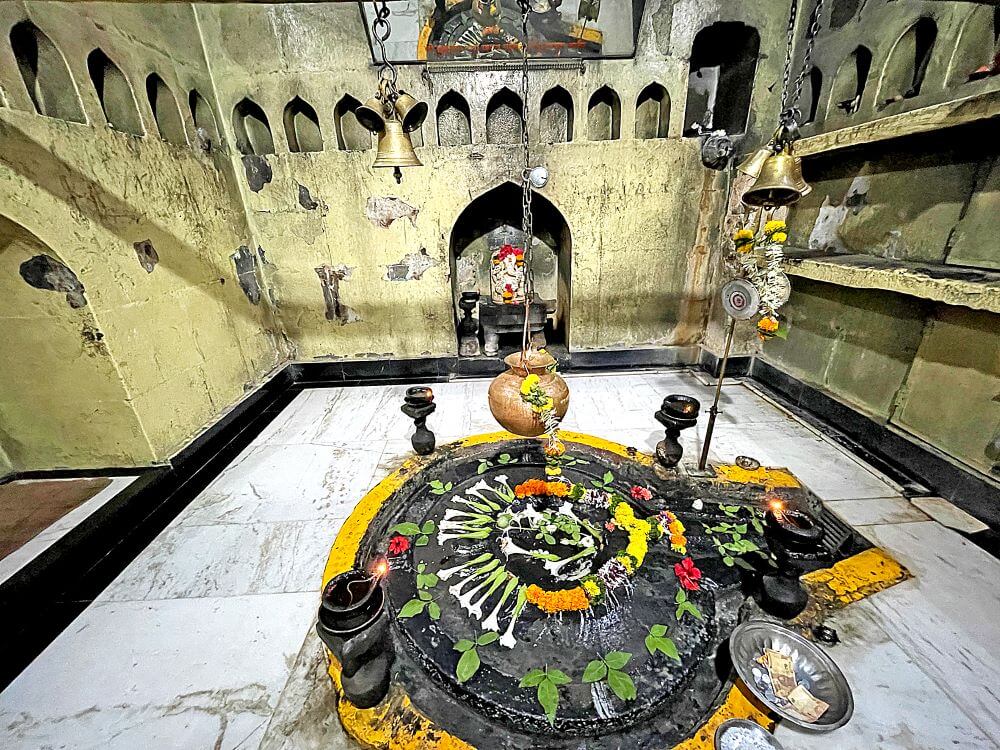
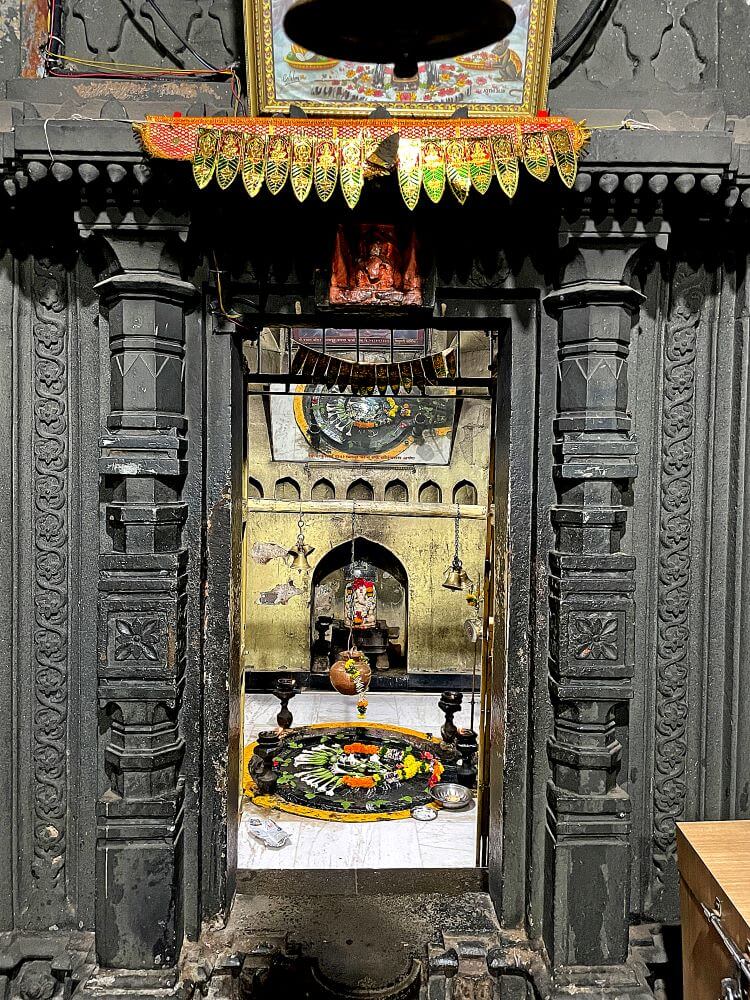
The entrance to the Garbhagriha displays extremely intricate carvings. The doorframe features vines of leaves and flowers, a small sculpture of Ganesha on the Lalatabimba (central part of the lintel), and a Kirtimukha on the threshold. In the centre of the Garbhagriha floor is a large black stone Shivling. It is believed that Saint Changdev himself consecrated it. In the niche on the wall facing the Shivling is an idol of Ganapati. Although this temple is built of stone, its shikhara is constructed using bricks and lime. The shikhara has idols of deities in niches at various levels, and each of these niches is topped with an Amalaka and Kalasha. The main shikhara tapers upwards, culminating in a large Amalaka and Kalasha at its apex. Along with this main shikhara above the Garbhagriha, there are also smaller shikharas above the Sabha Mandapa and Nandi Mandapa. The intricate carvings of floral motifs and elephant garlands on the outer walls of the temple are still in excellent condition today.
Mahashivaratri is considered the grandest festival here. On this auspicious day, programmes of Rudrabhishek and bhajan-kirtan commence from the early hours of dawn. At that time, thousands of devotees arrive for darshan, transforming the entire area into a vibrant fairground. Special religious rituals are performed here every Monday during the holy month of Shravan. Due to the spacious garden within the temple precincts and the natural ambience, many films have been shot here. Some scenes from the renowned Marathi film ‘Valu’ were also filmed in this very area.
This sacred temple stands as a testament to deep spiritual devotion, ancient architectural grandeur, and rich local cultural traditions.
The sanctum sanctorum houses the divine idol consecrated according to ancient Vedic traditions, surrounded by serene courtyards and traditional temple architecture.
Navratri, Maha Shivratri, Annual Temple Jatra & Deepotsav
Compare and book flights, secure top-rated local hotels near the temple, hire reliable guides, and rent cars instantly.
Extend your pilgrimage by visiting other highly sacred temples located nearby.


Add ₹999 more to unlock FREE SHIPPING!
Your sacred cart is currently empty.
Shop Photo FramesFill in your delivery details below to place your order.
Add comment