
Add ₹999 more to unlock FREE SHIPPING!
Your sacred cart is currently empty.
Shop Photo FramesThe Someshwar Temple, situated on the banks of the Ram River in Pashan, Pune, boasts an ancient history spanning approximately nine hundred years. Records indicate that this temple, which has foundations dating back to the Yadava era, was renovated in the 17th century by Rajmata Jijau. In his childhood, Chhatrapati Shivaji Maharaj would visit this temple for darshan along with his mother. The temple also experienced days of great glory during the Peshwa era. Due to the special care taken by Nanasaheb Peshwa, this temple has become a symbol of historical richness alongside its religious significance.
According to historical records, Chhatrapati Shivaji Maharaj used to visit this Someshwar Temple for darshan while residing at Lal Mahal in Pune during his childhood. Rajmata Jijau Maasaheb had immense faith in this sacred site. She undertook a major renovation of the temple between the years 1640 and 1660. Due to this work, the entire surrounding area came to be known as ‘Jijapur Peth’. Hanumante, a minister in the cabinet of Shivaji Maharaj, played a vital role in the construction of this temple. His samadhi can still be seen in the temple premises today. Because of Jijau’s association with the site, this temple is considered an important witness to the history of Swarajya. Many memories from the rise of the Maratha Empire are linked to this temple.
The glory of this temple expanded further during the Peshwa period. Shivrambhat Chitrav Swami, the spiritual guru of the Peshwas, discovered a treasure of gold coins within the temple premises. Instead of keeping this treasure for himself, he handed it over to Nanasaheb Peshwa. Nanasaheb used these funds for the maintenance and repair of the temple. The Mughal Sardar Shaistekhan had also provided funds for the assembly hall (sabhamandap) of this temple. During this time, the fame of the temple spread far and wide. The samadhis of Nanasaheb Peshwa and Chitrav Swami can still be seen here today. During the Peshwa era, this temple was also a major center for social justice. People would come to this holy place to resolve their mutual disputes. The temple received significant royal patronage during the Peshwa rule.
There is a record of Narayanrao Natu renovating the temple in the year 1830. Subsequently, in 1884, the citizens of Pune collected public donations and repaired the temple. During this period, marble pillars and new structures were added to the temple. The Pune Municipal Corporation has granted this temple the status of a Grade II cultural heritage site. Due to the ‘Gram Sanskruti Udyan’ (Village Culture Park) established a few years ago in the temple premises and the exhibition center featuring replicas of the 12 Jyotirlingas, the site attracts tourists alongside devotees.
Surrounded by strong stone fortifications, this architectural structure resembles a sturdy fort. Within these fortifications, there is a main entrance gate that is approximately twelve feet high and features strong wooden shutters. There are entrances in the fortification on three sides: east, south, and north. Additionally, separate chambers for guards have been built on both sides inside the entrance. In the courtyard, adjacent to the fortification, there are rooms for the accommodation of temple servants and an exhibition center for ancient documents. The layout of the entire premises, including the sacrificial hall (yagnamandap) on the north side, appears to be designed in a very disciplined manner.
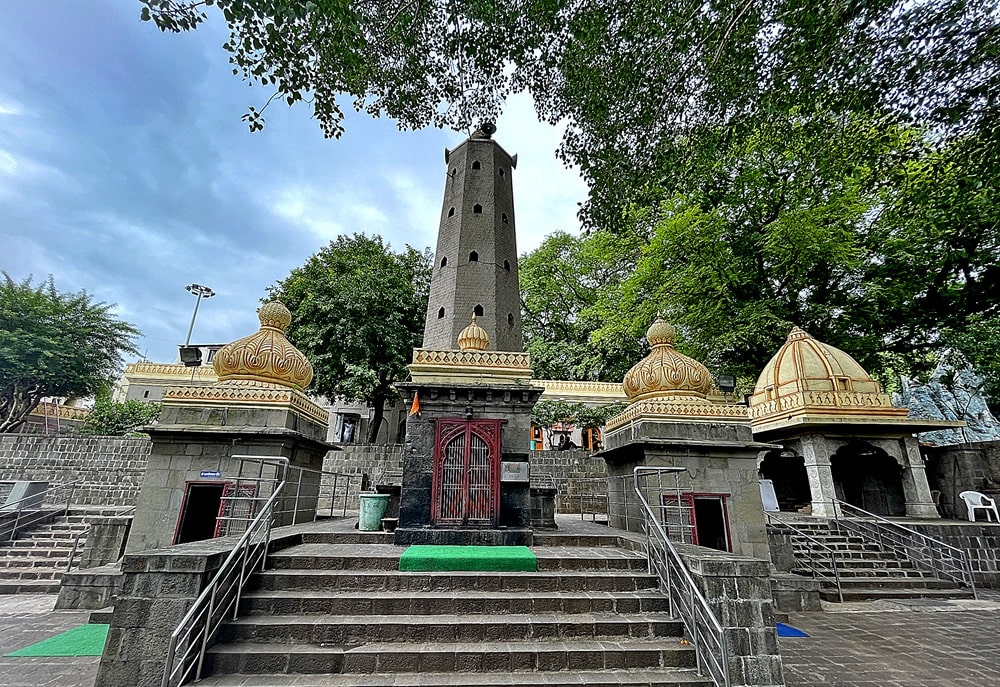
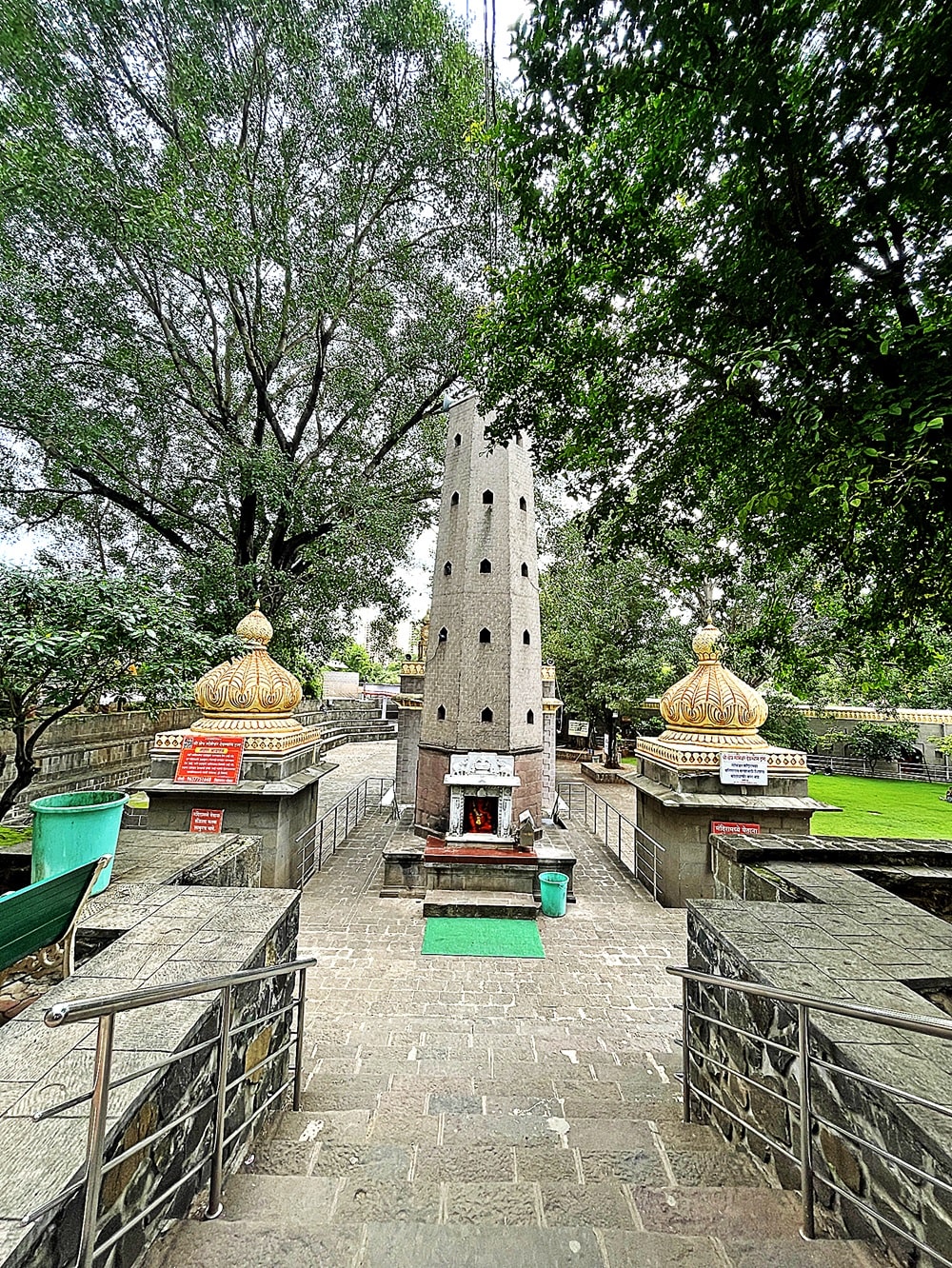
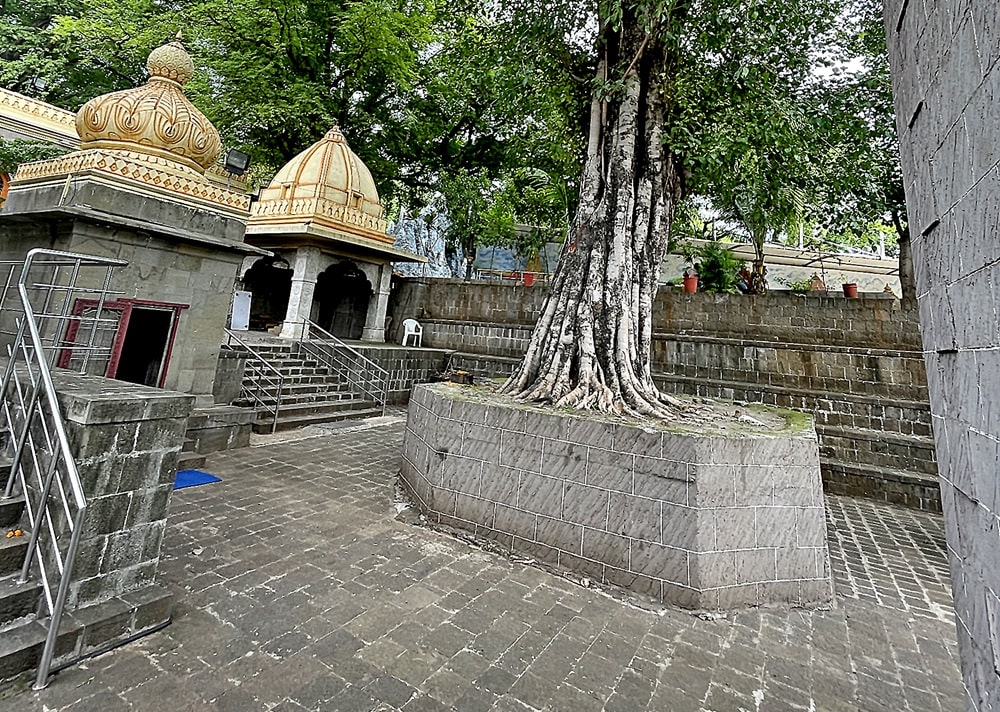
Upon entering through the main gate, one enters the courtyard. In front of the temple stands a magnificent 40-foot-high lamp tower (deepmal) carved from black stone. At the base of this lamp tower, in a niche, is a vermilion-smeared idol of Lord Ganesha. There is also a staircase inside this lamp tower to go to the top. To the right of the lamp tower is a separate marble temple of Kalbhairav-Bhairavi, and to the left is one for Lord Ganesha. The dome-shaped spires (shikharas) on these small temples are adorned with finials (kalash). In the nearby Maruti temple, there is a large idol of the heroic Lord Maruti. In front of this Maruti temple stands an ancient hero stone (virgal) pillar.
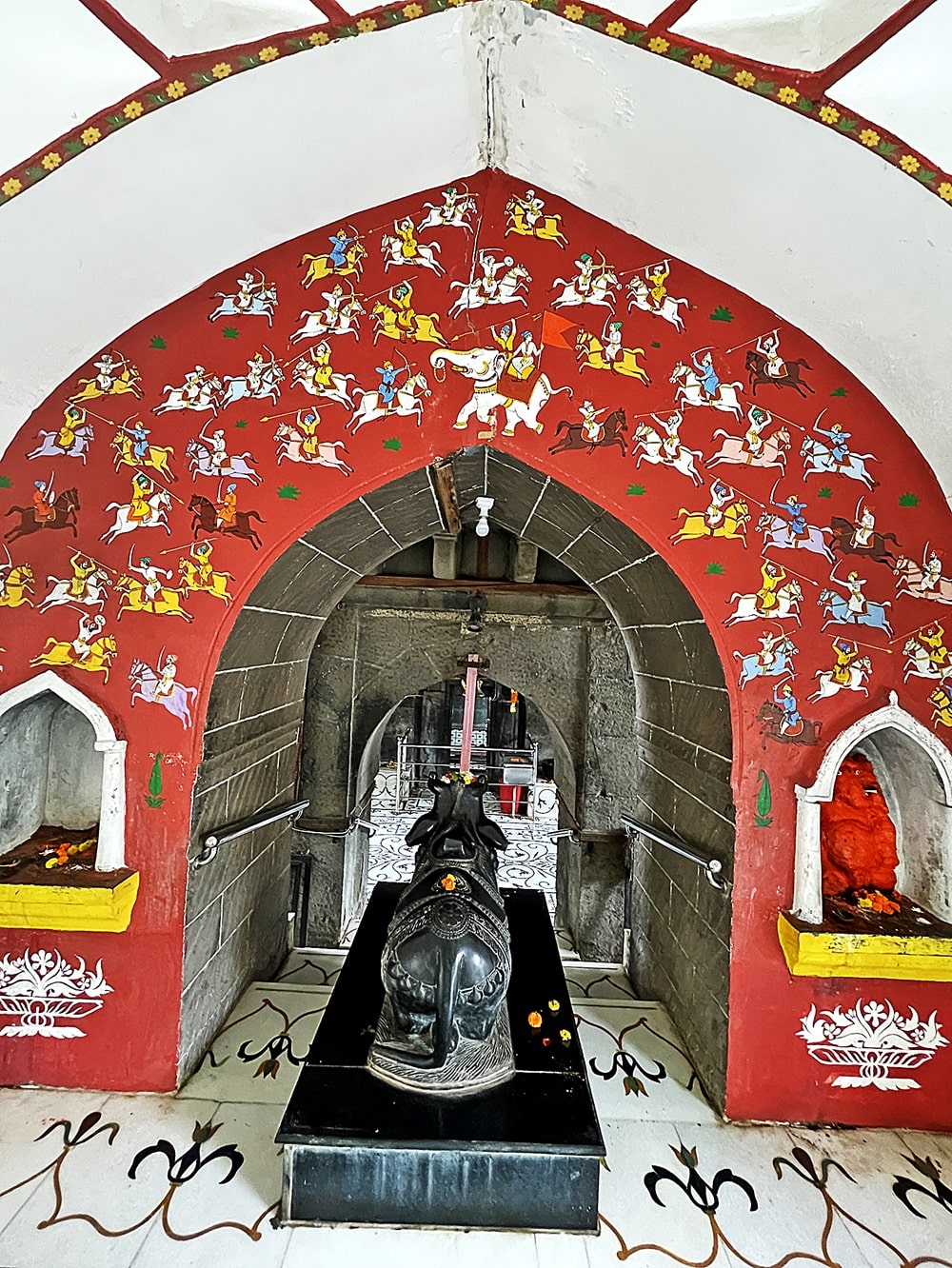
Built on a platform approximately two feet high, this temple consists of an assembly hall (sabhamandap), an intermediate chamber (antaral), and the sanctum sanctorum (garbhagriha). The assembly hall here has open entrances on three sides. Its dome-shaped ceiling is supported by strong walls, and on the inner side of the ceiling, colorful paintings of the eight directional guardians (ashtadikpalas) are depicted. The ceiling features intricate carvings and paintings of pairs of peacocks. In the center of the assembly hall, on a platform, is a Nandi idol carved from a single stone. In the niche next to the entrance of the intermediate chamber, there is an idol of Lord Ganesha.
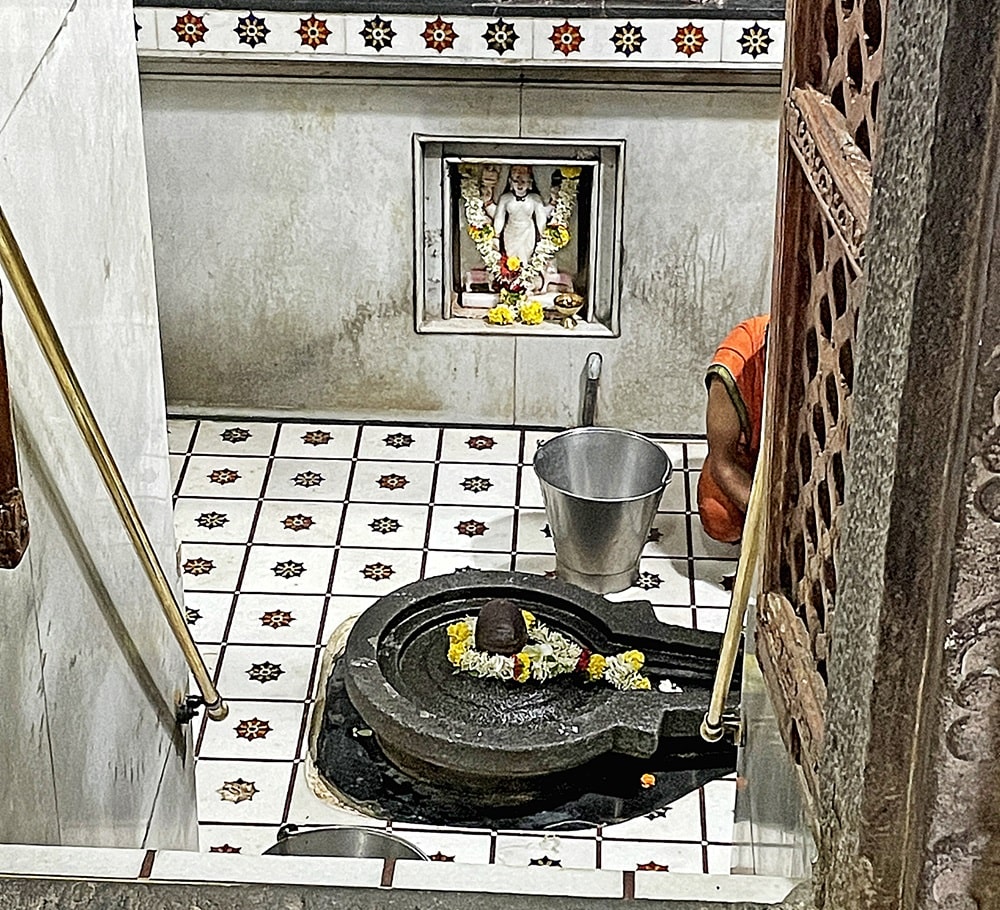
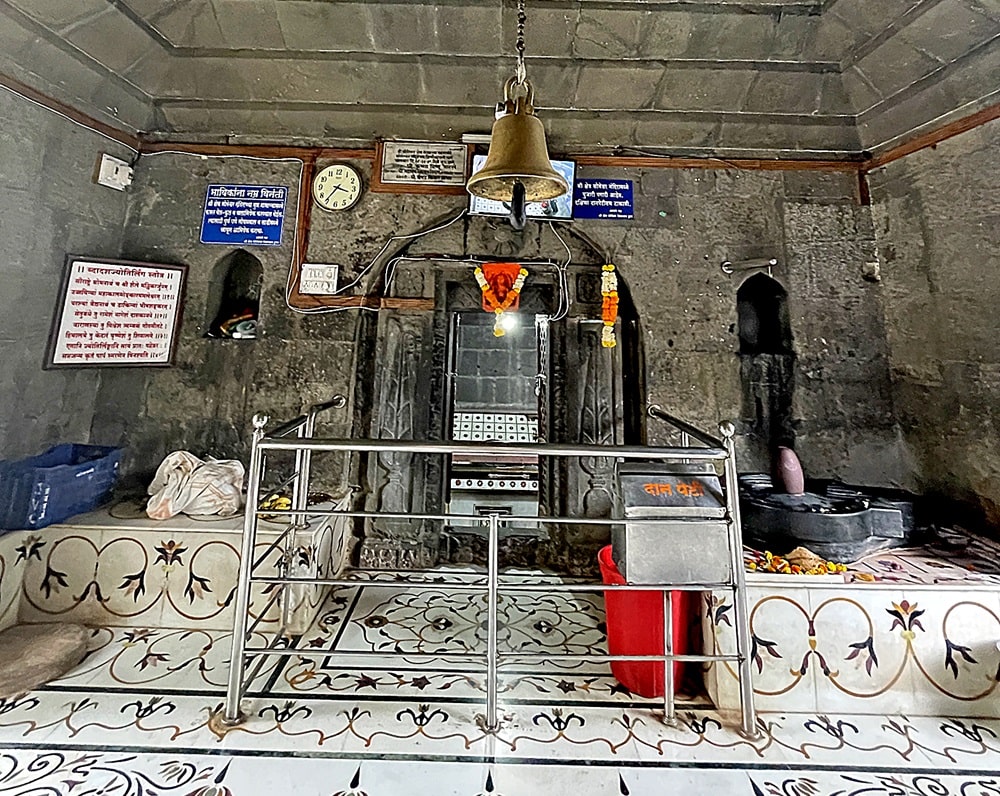
In the intermediate chamber, there is a tortoise idol on the floor, and a separate Shiva Linga is installed in the right corner. A continuous stream of water is poured onto this Linga through an abhishek vessel hanging from the ceiling. From here, one enters the slightly deeper sanctum sanctorum. The door frames of the sanctum are carved with delicate patterns of leaves, flowers, and banana trees, and there is a sculpture of Lord Ganesha on the lintel. In the center of the sanctum is the Swayambhu Someshwar Mahadeva Shiva Linga. A brass abhishek vessel hangs above it. On the back wall, there is a vermilion-smeared idol of Lord Ganesha.
On the four small pillar-like spires on the roof of the temple’s assembly hall, amalakas and kalashas are installed. Over the main sanctum sanctorum, there is a large dome-shaped spire with ancient-style carvings. At its apex are an amalaka and a kalasha. A ghat has been built from the back of the temple to descend into the Ram River. On this ghat, there is a spring called ‘Chakratirth’. Outside the temple fortifications, there is a stepped well (kund) built of stone.
Many festivals are celebrated in this temple throughout the year. Devotees can have darshan of Someshwar Mahadeva daily from 8 in the morning to 7 in the evening. The Ganga Dashara festival is celebrated here on Jyeshtha Shukla Dashami. There is a massive crowd of devotees on Mahashivratri. On this day, a procession of Someshwar Mahadeva is taken out through the entire area, with the deity’s silver mask placed in a palanquin. During the month of Shravan, special pujas and abhishek are organized every Monday. Also, on Tripurari Purnima, the large lamp tower near the temple is illuminated. Special religious rituals are also performed in the temple on Hanuman Jayanti and Kalbhairav Jayanti.
This sacred temple stands as a testament to deep spiritual devotion, ancient architectural grandeur, and rich local cultural traditions.
The sanctum sanctorum houses the divine idol consecrated according to ancient Vedic traditions, surrounded by serene courtyards and traditional temple architecture.
Navratri, Maha Shivratri, Annual Temple Jatra & Deepotsav
Compare and book flights, secure top-rated local hotels near the temple, hire reliable guides, and rent cars instantly.
Extend your pilgrimage by visiting other highly sacred temples located nearby.


Add ₹999 more to unlock FREE SHIPPING!
Your sacred cart is currently empty.
Shop Photo FramesFill in your delivery details below to place your order.
Add comment