
Add ₹999 more to unlock FREE SHIPPING!
Your sacred cart is currently empty.
Shop Photo FramesThe Avanti Hanuman Temple is situated in Dangariya village within the Devgadh Baria taluka of Dahod district. This shrine, with its remarkable historical antiquity of around five hundred years, serves as the cornerstone of faith for the Baria tribal community in the region. Devotees hold an unshakeable faith that Hanuman swiftly answers vows at this site. The temple underwent extensive structural restoration in recent times. To expand this sanctuary, Rajmata and Maharaj of the princely state of Devgadh Baria generously donated land plots.
Devgadh Baria was established as a princely state in the sixteenth century, ruled by twelve successive generations of Baria kings. Within this taluka, the Rajmahal palace and the Ratanmahal Wildlife Sanctuary are recognised as crucial habitats for leopards. The Naldhara waterfall and the Choganiya valley are also popular tourist spots located in this immediate vicinity.
The history of the Baria state is intimately linked with the illustrious Khichi Chauhan clan of Rajputs, who trace their lineage back to the legendary Emperor Prithviraj Chauhan of Delhi. The immediate ancestors of the ruling family of Baria were the last Chauhan kings of Champaner, Rawal Patai (also known as Jaysinh Deva). In 1484 AD, Mahmud Begada, the Sultan of Gujarat, besieged and captured Champaner. Following the fall of Champaner, this royal family sought refuge in the dense forests and rugged hills of eastern Gujarat. Rawal Patai’s son, Rawal Raisinghji, succeeded in maintaining the independence of his clan in these wild highlands. Rawal Raisinghji had two sons : the elder son assumed leadership of the Chhota Udepur state, while the younger son, Raja Dungarsinghji, moved north-eastward and laid the foundation of the Baria (Devgadh Baria) state around 1524.
Under his leadership, the territory was consolidated and the local Bhil chieftains were pacified and integrated into the state’s administration. Originally belonging to the Chauhan clan, these rulers eventually chose to call themselves Baria. The contemporary figures of this royal lineage, Maharaja Tusharsinh Kanaksinh and Rajmata Urvashidevi, have both served as former Members of the Legislative Assembly (MLAs) of Gujarat. Driven by their profound devotion to Avanti Hanuman in Dangariya, they generously donated land plots for the expansion of this temple.
A grand welcome archway marks the approach path leading from the primary thoroughfare toward the temple. The two composite structural columns of this archway feature sculpted figures of gatekeepers. Surmounting the archway are three ornate domed pavilions (meghdambaris). The central pavilion houses a finely carved representation of Lord Hanuman. The left and right pavilions enshrine sculpted figures of monkeys. Positioned upon a stone pedestal directly fronting the left side of this archway is a sculpture of the mythical golden deer. The stone pedestal on the right side showcases the figures of Sita and Shri Ram. This sculpture depicts Mother Sita pointing out the golden deer to Lord Shri Ram, who firmly holds a bow and arrow. The pathway connecting this archway to the main shrine is officially designated as the ‘Suvidha Path’. The walkway is flanked on both sides by trees and fitted with comfortable benches.
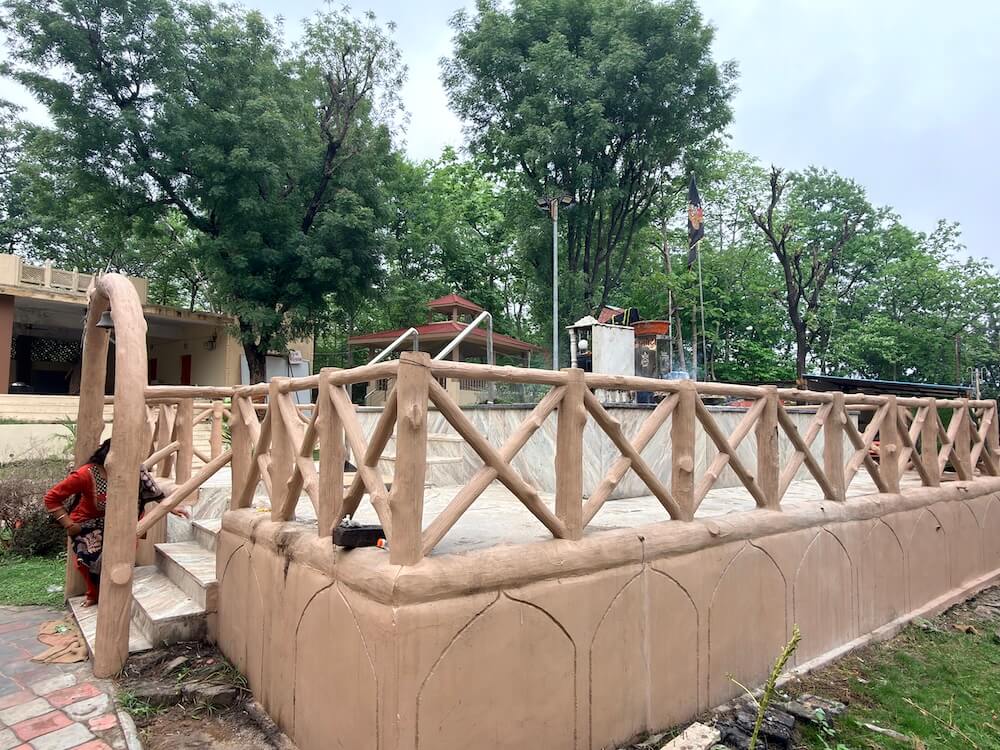
A robust defensive perimeter wall encompasses the entire sanctuary. The primary gateway structure is built directly into this wall. The inner courtyard integrates practical facilities, including ritual worship stalls, parking spaces, resting benches placed beneath the shade of trees and water kiosks. A dedicated sacrificial hall (Yajnamandap), stands constructed fronting the primary facade of the temple. This hall integrates a yajnakunda and a Tulsi Vrindavan. Located within the same courtyard is a roofless shrine dedicated to Shani. This open structure features a protective balustrade on all four sides and an elevated central platform. Consecrated upon this platform is a stone idol of Shani, flanked by a statue of Yama. Perched in a quiet corner of the courtyard is the memorial shrine (Samadhi) of the late spiritual preceptor, Mahant Bappa Sitaram. Positioned beneath a sheltered canopy adjacent to this memorial is a colossal eight-foot-tall sculpture depicting Hanuman ritualistically adoring a shivlinga.
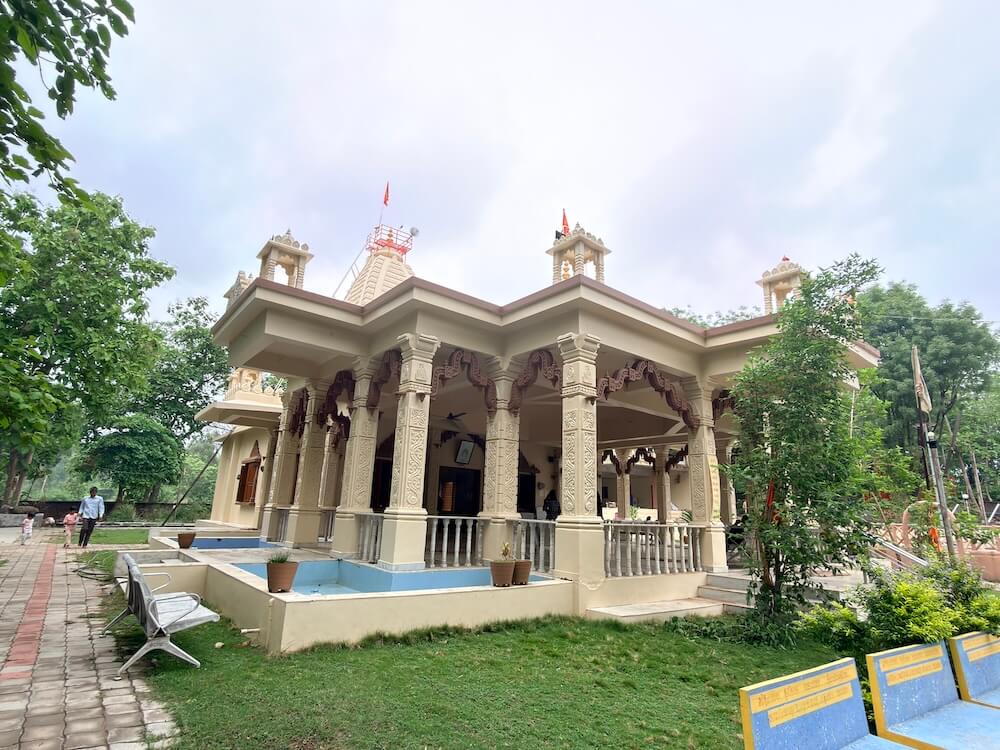
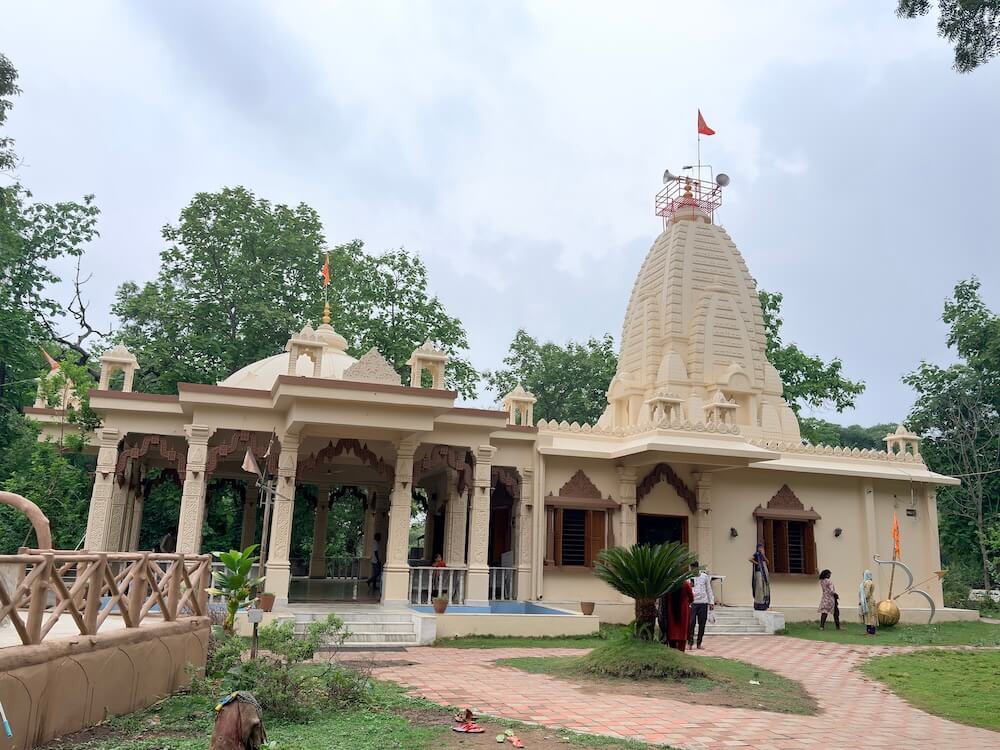
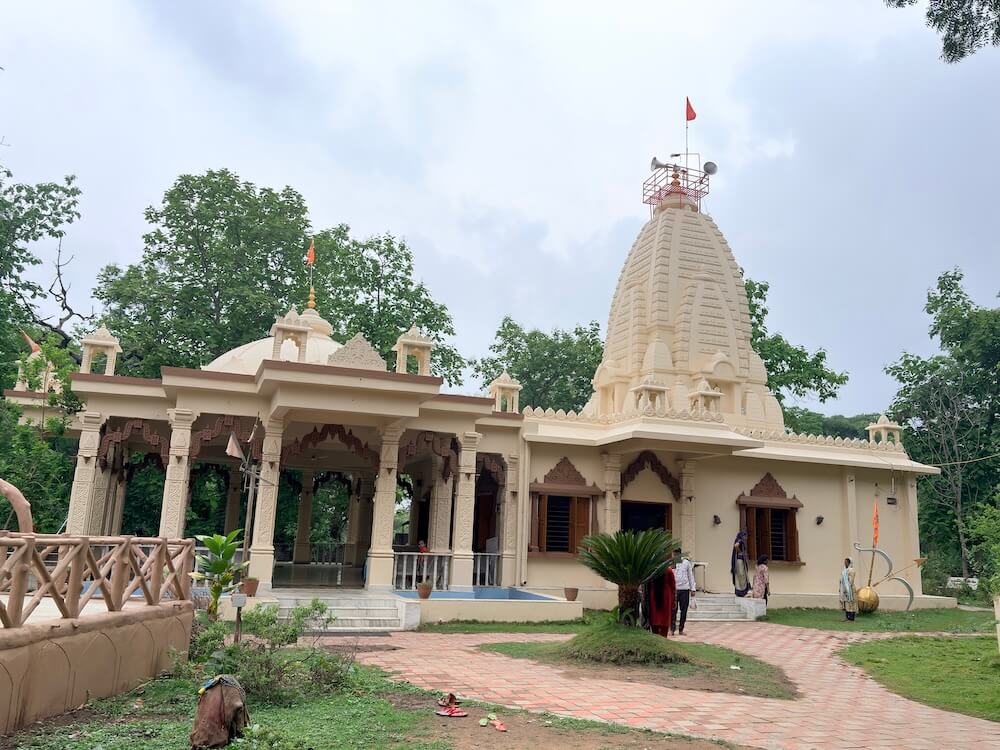
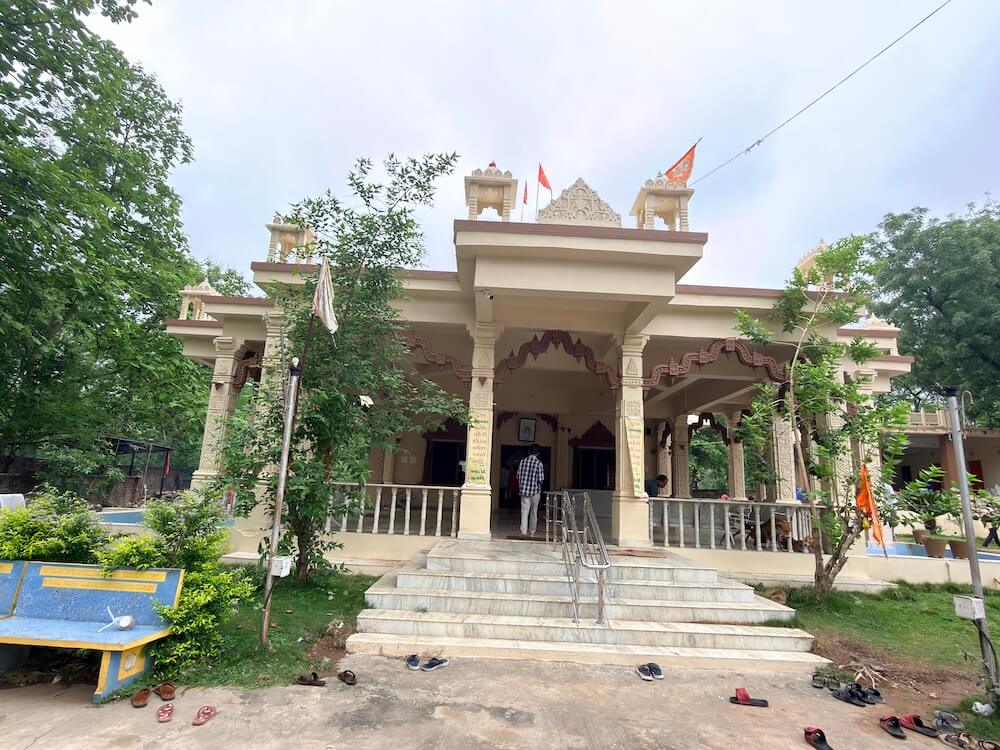
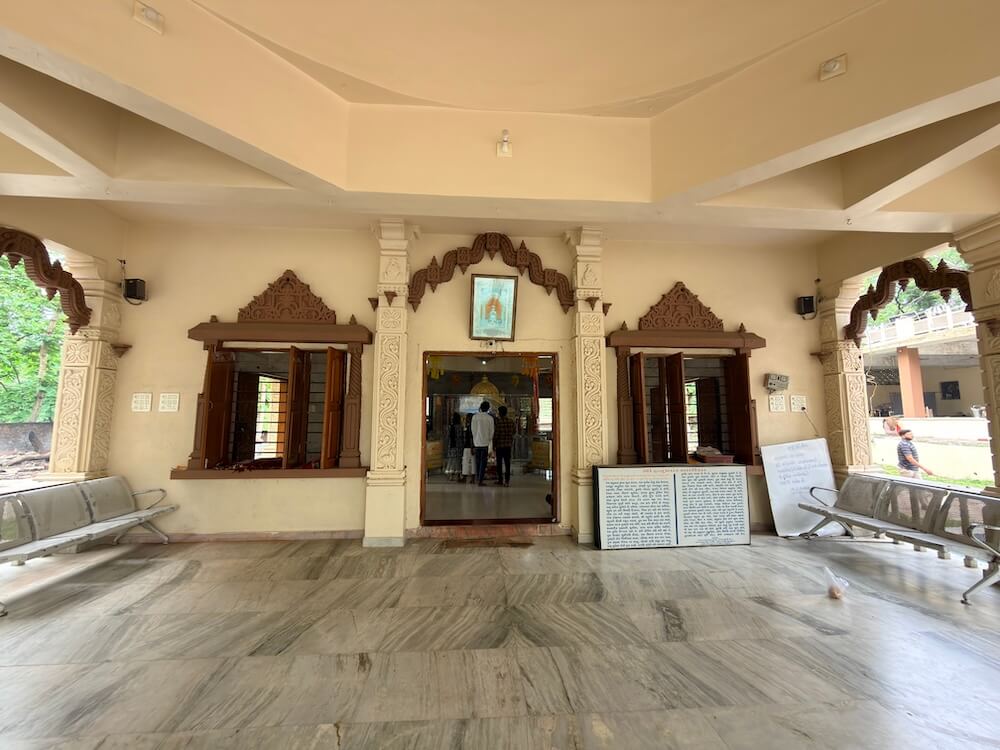
The principal temple structure rests upon an elevated stone plinth rising approximately three feet high. The edifice is configured with three separate front porticos facing three different directions. Structurally, the sanctuary also comprises a main assembly hall and the primary sanctum sanctorum. Both the front porticos and the main assembly hall are designed in a semi-open architectural style. Their external perimeter features a columnar balustrade. This framework supports carved pillars seamlessly linked via decorative cusped arches. These pillar shafts culminate in capital brackets that bear heavy load-bearing beams. Comfortable seating is systematically arranged across the assembly hall for the relaxation of visiting pilgrims.
Beyond the assembly hall lies the enclosed chamber of the sanctum sanctorum. The door jambs of the sanctum entrance display detailed relief carvings, surmounted by an elegant decorative archway. The primary entrance is fitted with beautifully carved wooden doors. The right and left walls of the sanctum incorporate two additional side doors. The interior walls are decorated with framed portraits of various Hindu saints. Consecrated at the exact geometric centre of the sanctum is a splendid canopy supported by eight carved columns. The upper sections of these pillars support a vaulted dome-shaped ceiling via crescent-shaped beams. This secondary superstructure is embellished with rows of matching miniature spires in urushringa style. Enshrined upon a stone pedestal (vajrapitha) within this canopy is the principal idol of Hanuman. Adorned in fine vestments and precious ornaments, a polished crown rests upon His head. The stone backing behind the main deity features fine relief carvings of numerous ascetics. Positioned directly before this stone icon are a brass festival idol and a traditional mace.
The roofline covering the external corners of the temple features smaller domed pavilions. The roofs of the front porticos are capped with decorative pediments displaying relief carvings of various deities. The central assembly hall is surmounted by a dome-shaped roof structure. The superstructure covering the primary sanctum rises into a towering, square-based principal spire. This main spire is embellished on all four faces with matching miniature auxiliary spires (angashikharas).
A rich calendar of traditional religious festivals is meticulously celebrated at the temple premises throughout the year. The festival of Hanuman Jayanti stands as the pre-eminent annual celebration. On the occasion of this festival, which falls on Chaitra Purnima, special prayers and rituals commence at the temple from the early hours of dawn. On this day, Hanuman’s principal idol undergoes elaborate traditional ablutions, followed by a grand ‘Maha Aarti’. Thousands of devotees from Dangariya and its rural hinterlands converge upon the shrine to witness this ceremony. The temple trust organises grand community feasts (bhandaras) to distribute sanctified food to all visiting pilgrims.
Besides Hanuman Jayanti, the festival of ‘Kali Chaudas’ is celebrated here with immense public enthusiasm. Falling during the festival period of Diwali, Kali Chaudas is considered highly crucial for Shaivite and Hanuman worship. The deity is adored with special rites on this night, including traditional offerings of vermilion and mustard oil. The festival of Ram Navami also witnesses grand religious programs. Alongside these major annual events, the temple hosts special daily worship services throughout the holy month of Shravan. Meticulous ritualistic offerings are maintained across this entire month. Furthermore, because Tuesdays and Saturdays are universally considered sacred to Lord Hanuman, the temple witnesses a massive weekly influx of pilgrims on these two days. The temple doors remain open to welcome devotees for the ‘darshan’ of Hanuman daily from 6:00 am until 8:00 pm.
This sacred temple stands as a testament to deep spiritual devotion, ancient architectural grandeur, and rich local cultural traditions.
The sanctum sanctorum houses the divine idol consecrated according to ancient Vedic traditions, surrounded by serene courtyards and traditional temple architecture.
Navratri, Maha Shivratri, Annual Temple Jatra & Deepotsav
Compare and book flights, secure top-rated local hotels near the temple, hire reliable guides, and rent cars instantly.
Extend your pilgrimage by visiting other highly sacred temples located nearby.


Add ₹999 more to unlock FREE SHIPPING!
Your sacred cart is currently empty.
Shop Photo FramesFill in your delivery details below to place your order.
Add comment