
Add ₹999 more to unlock FREE SHIPPING!
Your sacred cart is currently empty.
Shop Photo FramesThe Navgrah Aradhanadham Jain Derasar stands as a prominent religious centre in Godhra, the administrative headquarters of the Panchmahal district. Within Jainism, exceptional significance is attached to the adoration of the nine planets (‘navgrahas’) and their subtle cosmic influence on human life. Founded upon this specific ideological paradigm, the ‘derasar’ has been constructed blending traditional Jain temple architecture with absolute mathematical precision. The pristine white marble temple is strictly executed according to the classical principles of ancient Indian iconography and the structural codes of Maru-Gurjara architecture.
The planetary categorisation in Jainism systematically links cosmic bodies like the Sun, Moon and Mars to specific Tirthankaras such as Padmaprabha, Chandraprabha or Vasupujya. The foundational core of Jain philosophy rests firmly upon the immutable law of karma. Nevertheless, Jain religious scriptures, known as the Agamas, explicitly recognise the operational influence of celestial bodies over human life and the natural order. Ancient scriptural treatises like the ‘Suryaprajnapti’ and ‘Chandraprajnapti’ preserve detailed calculations regarding astronomy and planetary motion. These texts describe the nine planets as crucial components of the cosmic astral wheel.
Rather than fearing these planets, Jain philosophy prescribes the adoration of the Vitaraga—the fully liberated Tirthankaras who are entirely free from worldly attachments—as the ultimate path to master these energies. Consequently, a systematic practice emerged to pacify each planet by worshipping a designated Tirthankara, chosen to match the distinct attributes and colour associated with that celestial body.
In accordance with this scriptural framework, the exact correlation between each planet and its corresponding Tirthankara is meticulously established. Considering the brilliant radiance and crimson hue of the Sun, it is directly aligned with the sixth Tirthankara, Padmaprabha, who possesses a complexion resembling a red lotus. Reflecting the soothing coolness and white aura of the Moon, it is systematically paired with the eighth Tirthankara, Chandraprabha. Mars is characterised by a fiery red colouration and therefore, the adoration of the twelfth Tirthankara, Vasupujya Swami, is specifically prescribed to pacify its turbulent effects. The planet Mercury is countered through the spiritual contemplation of the nineteenth Tirthankara, Mallinath. Recognising the yellow radiance and spiritual gravity of Jupiter, scriptures mandate the worship of the first Tirthankara, Rishabhadev or the sixteenth Tirthankara, Shantinath. Venus is placated through the dedicated devotion offered to the ninth Tirthankara, Suvidhinath. Saturn is universally associated with a dark black colour, linking it directly to the twentieth Tirthankara, Munisuvrat Swami. Following this exact sequence, the spiritual contemplation of the twenty-third Tirthankara, Parshvanath, is prescribed for the shadow planet Rahu, while the worship of the twenty-second Tirthankara, Neminath, is ordained for the planet Ketu.
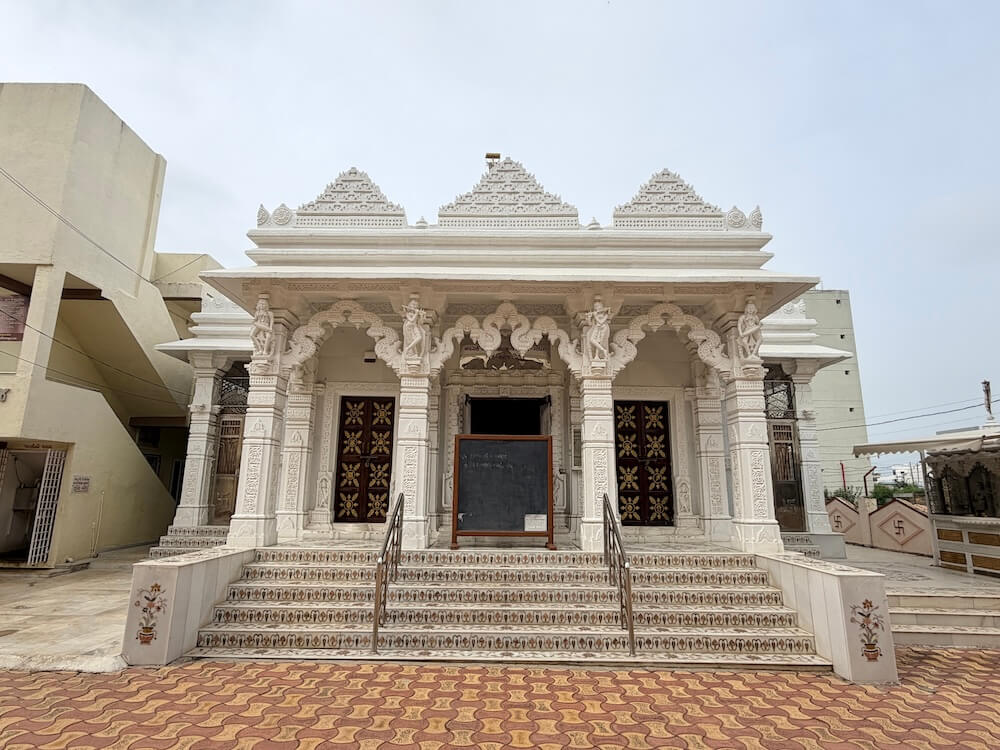
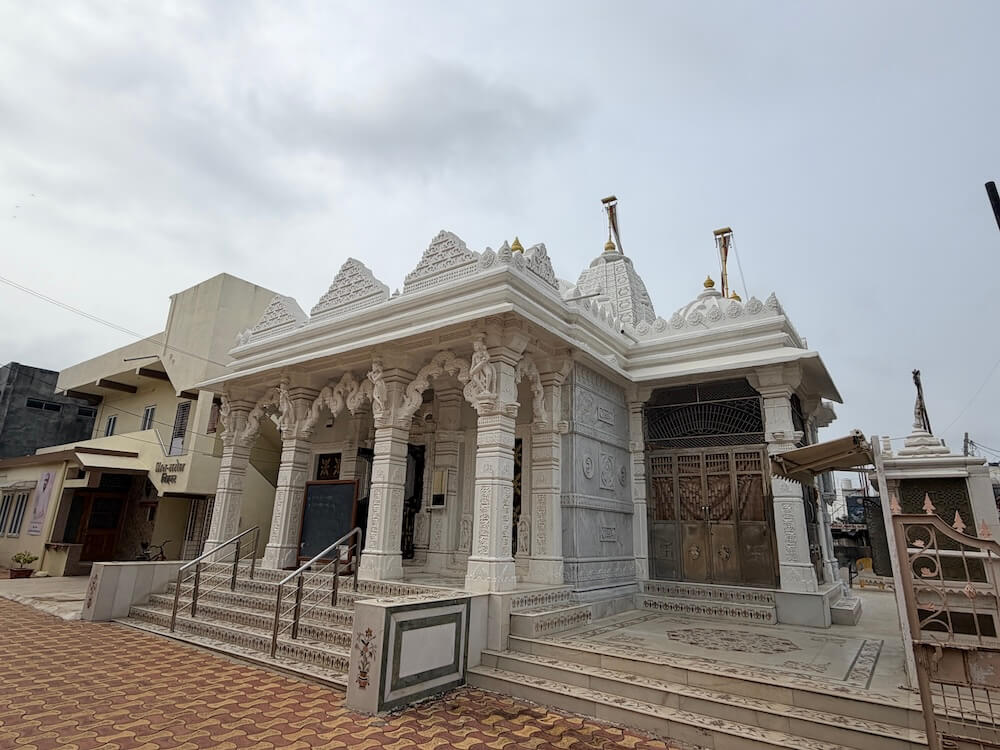
Situated adjacent to the primary metropolitan thoroughfare of Godhra, the temple complex is secured by a robust defensive perimeter wall. Access to the paved inner courtyard is gained through a grand gateway structure set into this wall. The administrative office of the trust is situated to the left in the courtyard, while the white marble derasar stands elegantly to the right. The structural framework exhibits a architectural influence derived from the traditional Maru-Gurjara or Solanki style of Western India. The building comprises a front portico, a main assembly hall, an antechamber and the principal sanctum sanctorum, flanked by two dedicated subsidiary shrines. An ascent of six ceremonial steps leads from the courtyard into the elevated front portico (‘mukhamandap’). The four columns gracing the primary facade are seamlessly linked at the apex via highly detailed, decorative cusped arches. Positioned near the primary entrance of the assembly hall is a sacred threshold slab known as the ‘Shilapatt’. Local traditions affirm that this structural slab serves as an energetic barrier, regulating the flow of spiritual energy generated within the inner sanctum to prevent it from escaping the temple precinct.
The door jambs leading into the assembly hall display refined relief carvings, surmounted by an elegant decorative archway. The interior pillars and walls of the assembly hall (‘sabhamandap’) feature delicate stone craftsmanship. The central ceiling vault displays detailed depictions of the Tirthankaras seated in the meditative lotus posture (‘padmasana’), framed by the sacred ‘Ashtamangala’ symbols. The outer concentric circles of the ceiling showcase paintings of the nine pre-eminent Jain pilgrimage centers across India. These include Ashtapad, Abu, Shatrunjay, Pavapuri, Shankheshwar, Champapuri, Rajgrihi, Girnar and Sammed Shikhar. In accordance with the Jain doctrine of pilgrimage (‘bhav-yatra’), this pictorial narrative is deliberately integrated to enable devotees to experience the visual audience and spiritual remembrance of all holy sites simultaneously in one place.
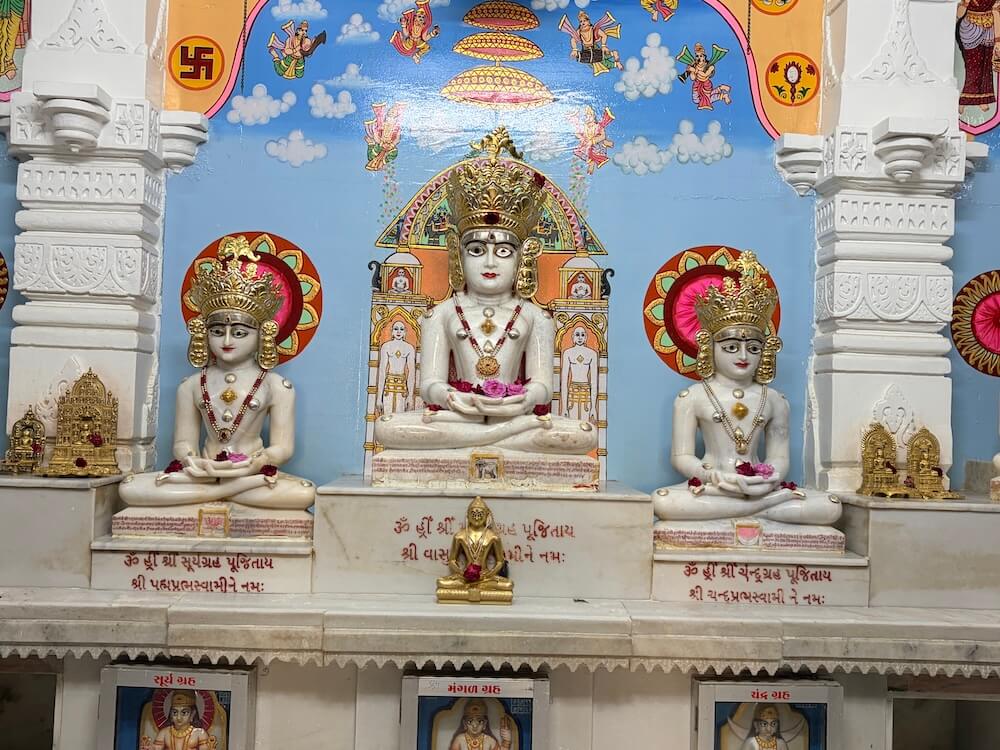
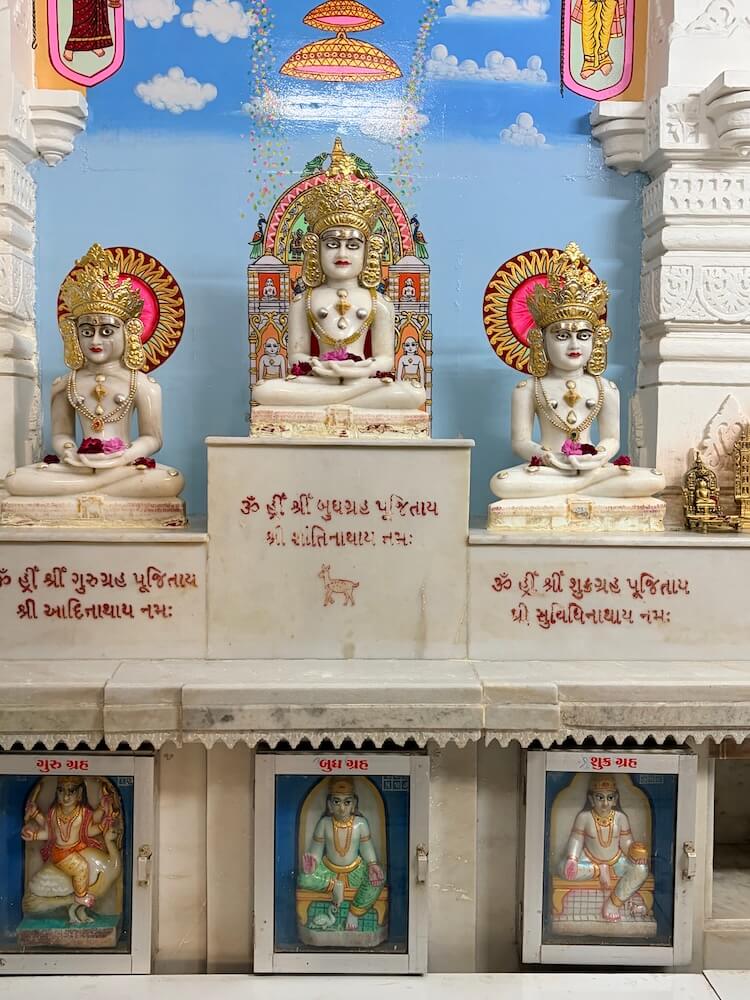
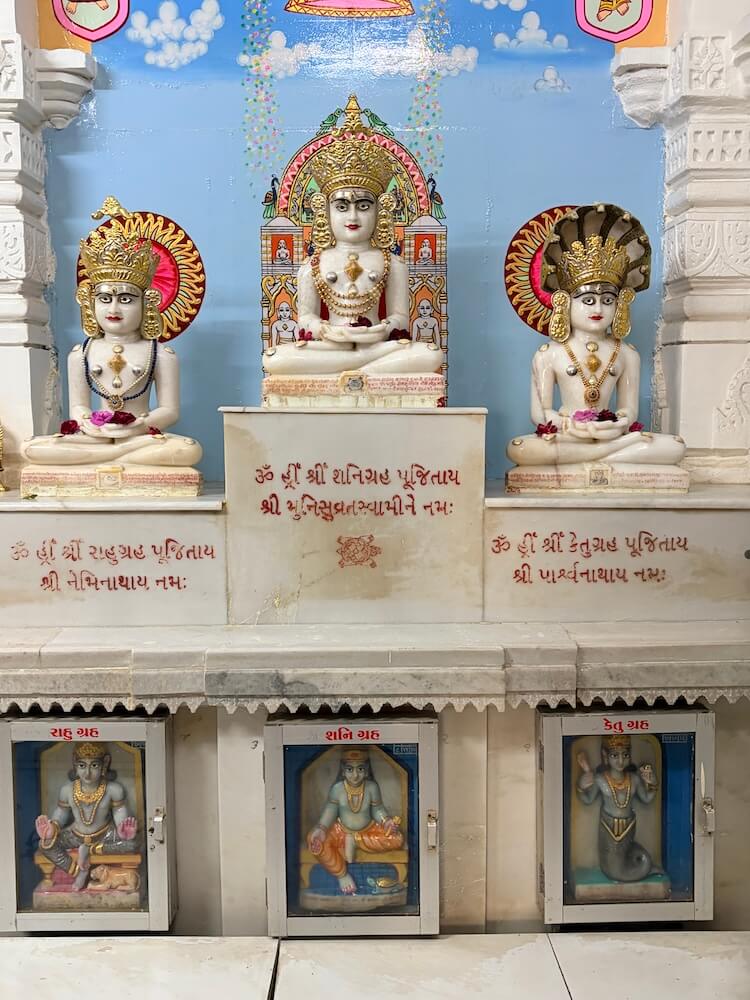
The antechamber extending beyond the assembly hall matches the spatial layout of the front portico. Its four composite columns are interconnected via intricate, cusped arches. The inner sanctum sanctorum houses the consecrated icons of the specific Tirthankaras linked to the respective planets. The principal central deity is the twentieth Tirthankara, Munisuvrat Swami, who governs the planet Saturn. Flanking this central icon are the statues of the twenty-third Tirthankara, Parshvanath, representing Rahu on the right and the twenty-second Tirthankara, Neminath, representing Ketu on the left. Furthermore, the main stone pedestal (‘vajrapitha’)
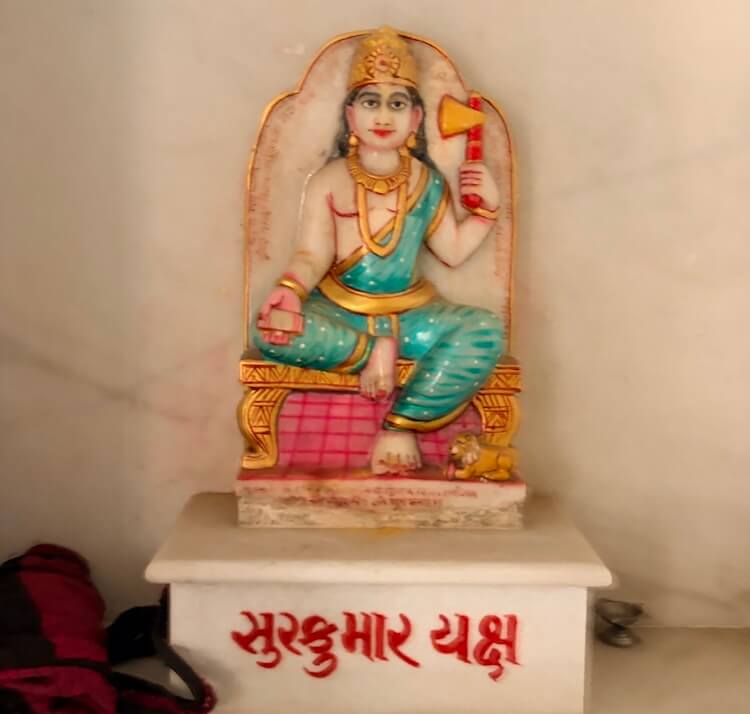
houses the idols of the sixth Tirthankara Padmaprabha (Sun), the eighth Tirthankara Chandraprabha (Moon), the twelfth Tirthankara Vasupujya Swami (Mars), the nineteenth Tirthankara Mallinath (Mercury), the first Tirthankara Rishabhadev (Jupiter) and the ninth Tirthankara Suvidhinath (Venus). Positioned within independent glass niches directly below the main altar base are symbolic representations of the respective planetary deities. The subsidiary shrines located to the right and left sides of the primary structure house the idols of Padmavati, Gajalakshmi, Saraswati, Nakoda Bhairav, Manibhadra Veer and Ghantakarna Mahavir. Structurally, dome-shaped spires crown the roofs of the assembly hall and the side shrines. The superstructure covering the primary sanctum rises into a towering, square-based principal spire that tapers gradually towards the sky, with all spires displaying detailed carvings.
The Navgrah Aradhanadham Jain Temple hosts a structured calendar of liturgical services and celebrations throughout the year. The daily routine features the traditional eight-fold worship ritual (‘Ashtaprakari Puja’) performed with absolute devotion before the deities. Major annual festivals of the Jain faith are observed here with immense public enthusiasm. These include the sacred ‘Navpad Oli’ fasts observed during Chaitra and Ashwin months. Additionally, Bhagwan Mahavir’s Janma Kalyanak, which is celebrated as Mahavir Jayanti, is observed during the month of Chaitra. The holy festival of ‘Paryushan Parva’, falling in the months of Shravan and Bhadrapad, is celebrated with great spiritual intensity.
Furthermore, the annual calendar includes the celebrations of Kartik Purnima and Lord Mahavir’s Nirvana Kalyanak. Because this sanctuary is explicitly configured as a Navgrah Aradhanadham, specialised planetary pacification rituals and intensive spiritual sessions are organised during these festive periods. The temple doors remain open to welcome devotees for the ‘darshan’ daily from 6:00 am until 12:00 noon and from 5:00 pm until 8:30 pm.
Navratri, Maha Shivratri, Annual Temple Jatra & Deepotsav
Compare and book flights, secure top-rated local hotels near the temple, hire reliable guides, and rent cars instantly.
Extend your pilgrimage by visiting other highly sacred temples located nearby.


Add ₹999 more to unlock FREE SHIPPING!
Your sacred cart is currently empty.
Shop Photo FramesFill in your delivery details below to place your order.
Add comment