
Add ₹999 more to unlock FREE SHIPPING!
Your sacred cart is currently empty.
Shop Photo FramesThe Siddheshwar Nagnath Temple is situated at Navkund Jhari in the Chakur taluka of Latur district. In Hindu religious tradition, the water reservoirs (kunds) within temple premises are considered sacred pilgrimage sites (teerth). Devotees believe that bathing in these reservoirs cleanses one of physical and mental ailments. While such water reservoirs are found at various religious sites across India, having nine such reservoirs within a single temple complex is considered rare. This unique feature of the nine reservoirs makes this Shiva temple at Navkund Jhari a significant religious site. The Hemadpanti architecture of the temple and the copper plates associated with it have bestowed a distinct importance upon this region.
There are clear references in ancient scriptures like the ‘Shiva Purana’ and ‘Skanda Purana’ regarding why Lord Mahadeva is addressed as ‘Siddheshwar Nagnath’. The story of the origin of Nagnath Mahadeva in the Darukavana forest is detailed in the twenty-ninth and thirtieth chapters of the Kotirudra Samhita of the Shiva Purana. According to the references in these texts, in ancient times, an asura named Daruka and his wife Daruka lived in this region. They began to torment sages and gods with their powers. Among the captives of these demons was a devotee of Shiva named Supriya. Even while in prison, he, along with other captives, began worshipping Lord Shiva and chanting the Shiva mantra. Witnessing this devotion, Lord Shiva manifested from the earth. Lord Shiva defeated the demons and protected his devotees. He revealed his form adorned with serpents on his body. He was established in this forest in the form of a Linga. This earned him the name ‘Nagnath’ or ‘Nageshwar’, meaning the Lord of Serpents.
The ‘Siddheshwar’ part of this name is linked to the penance of ancient sages and Siddha purushas (accomplished beings). The Kumarika Khanda of the Skanda Purana and the Shiva Purana mention that the Darukavana region is rich in spiritual energy. In this forest, many Siddha yogis, sages, and Siddhas of the Nath tradition performed penance to Lord Shiva to attain liberation and various supernatural powers (siddhis). The form of Mahadeva that granted these Siddhas the fruits of their yoga practice—their siddhis—came to be known as ‘Siddheshwar’, meaning the Lord of the Siddhas. Both these forms and concepts are embodied in the same deity. It is believed that Siddheshwar Nagnath is the one Supreme Lord who bears the serpents and grants powers to the Siddhas.
The earliest history of this temple dates back to the era of the Rashtrakuta kings. The ‘Jharika Copper Plate’ from the year 803 CE, during the reign of Rashtrakuta King Govinda (III), has been discovered. The name of the village is mentioned in this copper plate. According to the administrative structure of that time, this village was an important ‘Agrahar’ in the Pauna division, meaning a village donated to Brahmins for religious purposes. The copper plate mentions that the land here was donated to the scholar Rishyappabhatta, a resident of Dharashiv. This evidence clarifies that in the ninth century, this village in the Latur region functioned as a cultural and educational center.
This Siddheshwar Nagnath Temple is known as ‘Dakshin Kashi’ (Southern Kashi). There are twelve Jyotirlingas and many Shiva temples in India. In Maharashtra, there are independent Siddheshwar temples in Solapur, Latur, and Alandi, as well as an independent Nagnath temple at Aundha Nagnath. However, it is said that this rare temple, where Shri Siddheshwar and Shri Nagnath are present in the same place facing each other, exists only in North Kashi (Varanasi) and here at Navkund Jhari in the south.
The legend of the temple states that when Lord Shri Ram, Lakshman, and Mother Sita were passing through the Dandakaranya forest towards the south during their exile, they stayed at this place. Lord Shri Ram performed daily Shiva worship. For this purpose, he established a Shiva Linga here. He invoked the Navagrahas (nine planets) to perform Abhisheka on the Shiva Linga. Shri Ram struck the earth with an arrow to create nine reservoirs. The Navagrahas performed the Abhisheka of Mahadeva with the water from these nine reservoirs. A sculpture panel of the Navagrahas, which bears witness to this event, is carved in the temple. Because water flows into these nine reservoirs from underground springs, the village came to be known as Navkund Jhari.
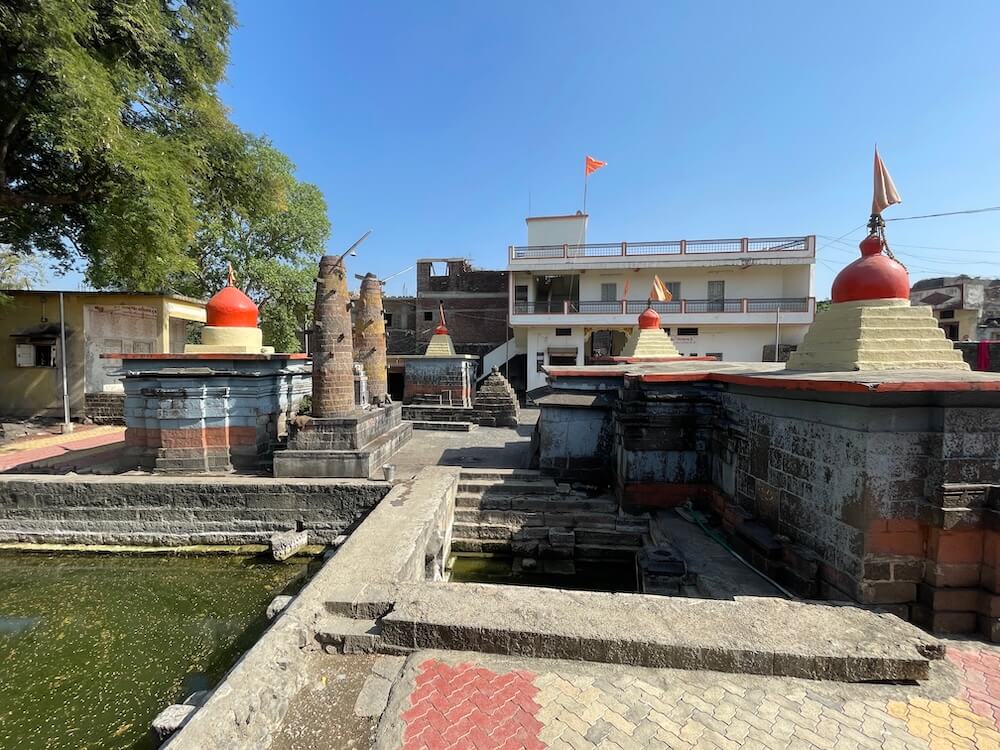
The temple entrance is located within the surrounding fortification wall. Through this, one enters the temple courtyard. In the courtyard, there is a stone platform. In the center of it is a Tulsi Vrindavan, and on both sides are two lamp towers (Deepmalas). Ancient sculptures and hero stones (Veergals) are placed at the base of the lamp towers. In the courtyard, there is a water reservoir built of carved stone with steps on all four sides to descend. There are a total of nine reservoirs in this area. A natural spring flows from the bottom of some of these reservoirs, while water flows into others from the adjacent ones. All these reservoirs remain filled with water at a uniform level throughout the year. On the edge of the reservoir in the courtyard, there is a small temple of the water deity. All the temples here are of the Hemadpanti architectural style.
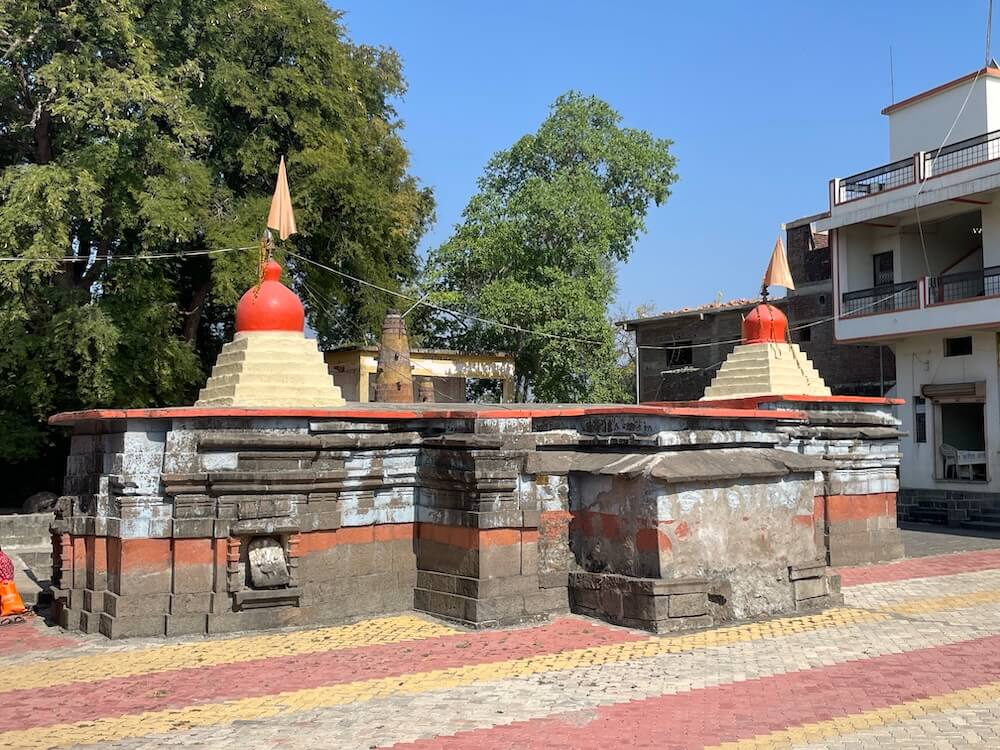
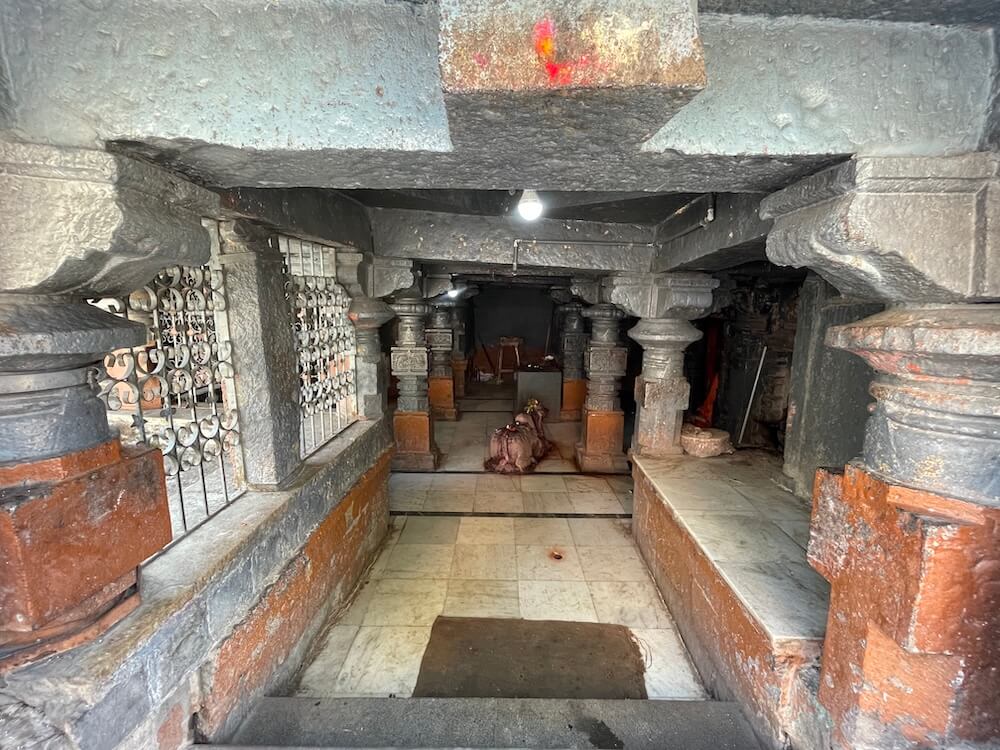
In the center of the courtyard stands the joint temple of Shri Siddheshwar and Shri Nagnath. The structure of this temple consists of an Ardhamandapa (half-hall), Sabhamandapa (assembly hall), Antarala (vestibule), and more than one Garbhagriha (sanctum sanctorum). Hero stones are placed against the pillars at the entrance of the Ardhamandapa. This Ardhamandapa is semi-open and has stone seats for devotees. Beyond the Ardhamandapa is the enclosed Sabhamandapa. This assembly hall has four stone pillars. Various geometric shapes such as squares, hexagons, octagons, and circles are carved on the bases and sections of the pillars. Sculptures of various deities and mythological scenes are carved on the square panels of the pillars. In the center of the ceiling of the Sabhamandapa, a stone lotus flower and a stone chandelier are carved.
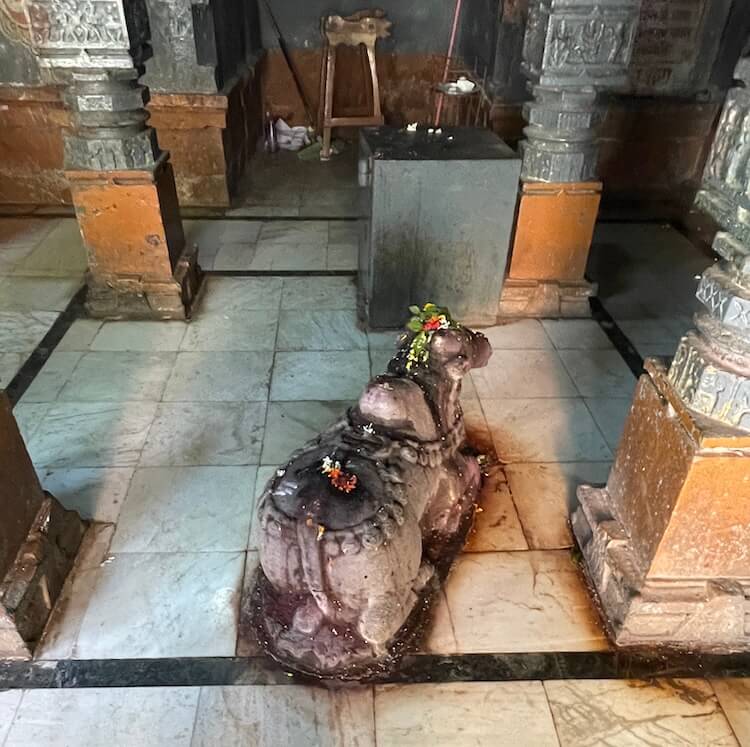
In the main hall (Sabhamandapa), there is a stone idol of Nandi. The neck of this Nandi is tilted to one side. To the left of the main hall is the Antarala (vestibule) and Garbhagriha (sanctum sanctorum) of Lord Nageshwar. At the entrance of the Antarala, there are sculptures of gatekeepers (Dwarapalas) and intricately carved door frames. On the lintel of the entrance, there is a floral vine design, while the central panel features a sculpture of Gajalakshmi, topped by a peacock arch (Mayur Torana). A Shiva Linga is consecrated on the floor of the Antarala. A brass serpent is placed over this Shiva Linga, and a brass mask of Lord Mahadeva is kept to the side. Further ahead is the entrance to the Pashupatinath Garbhagriha. On both sides of this entrance, there are sculptures of gatekeepers and carved door frames. The lintel features floral patterns, and the central panel bears a sculpture of Lord Ganesha. This Garbhagriha is about four feet below the level of the Antarala and remains completely filled with water. There are steps to descend into the Garbhagriha. In the center of the floor, beneath the water, lies the Shiva Linga.
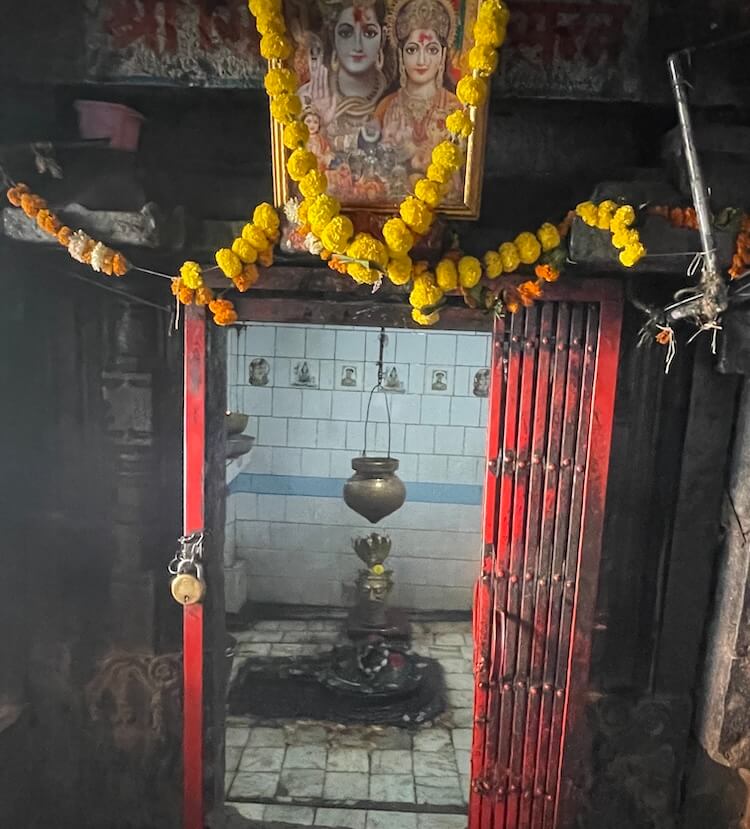
To the right of the main hall is the Garbhagriha of Siddheshwar, with an Antarala in front of it. A Navagraha sculpture panel is installed in this Antarala. Legend has it that these Navagrahas descended here at the invocation of Lord Shriram. Beyond the Antarala is the entrance to the Garbhagriha. Sculptures of male and female gatekeepers and the goddesses Ganga and Yamuna are carved on the entrance of the Garbhagriha. The entrance is adorned with carved door frames, and the central panel features a sculpture of Lord Ganesha. A moonstone (Chandrashila) is carved at the base of the entrance steps. A Shiva Linga is consecrated on the floor of the Garbhagriha. A brass serpent canopy covers this Shiva Linga, and an Abhisheka vessel (a pot for ritual bathing) is suspended from the ceiling to drip water. Opposite the main hall, there is another Garbhagriha. It is said that this Garbhagriha contains the entrance to an underground passage.
On the outer walls of the structure, there are three niches (Devakoshthakas) on three sides. Sculptures of various deities are carved within these niches. Pyramid-shaped towers with stepped designs are built over the roofs of all three Garbhagrihas. Each of these towers is topped with an Amalaka and a Kalasha. Directly in front of the Siddheshwar Nagnath temple is the Nrusimha temple. This temple consists of a main hall and a Garbhagriha. Inside the Garbhagriha, on an intricately carved stone pedestal, stands the idol of Lord Nrusimha tearing open the chest of Hiranyakashipu. The roof of this Garbhagriha features a pyramid-shaped tower with a stepped design. Opposite this temple is the Mallikarjuna temple, which also comprises a main hall and a Garbhagriha. Two niches are built into the main hall; one contains a vermilion-smeared stone idol of Lord Ganesha, while the other features a relief sculpture of Lord Vishnu. At the feet of the Vishnu idol, there is a sculpture of Garuda on the right and Goddess Lakshmi on the left. Sculptures of gatekeepers are carved on both sides of the Garbhagriha entrance. This Garbhagriha is about four feet below the entrance level, with steps leading down. Natural water accumulates in the Garbhagriha, and a Shiva Linga is situated on the floor beneath the water. This Garbhagriha is considered one of the sacred water tanks (Kundas) of the temple. The roof of the Garbhagriha is topped with a square, pyramid-shaped tower adorned with an Amalaka and a Kalasha.
Mahashivratri is the annual festival celebrated at this temple. Additionally, the festival of Nag Panchami is observed with great enthusiasm. Every Monday during the holy month of Shravan, the temple is crowded with devotees. During festivals, the day begins at dawn with Rudrabhisheka. The deity is adorned in traditional attire, and various rituals are performed. Religious programs such as Bhajans, Kirtans, scripture readings, and Mahaprasad are organized in the temple premises. The temple sees a special influx of devotees on Mondays, Pradosh, Purnima, and Amavasya. Mahaprasad is served to devotees every Monday afternoon. Devotees can visit the temple daily from 6:00 AM to 8:00 PM.
This sacred temple stands as a testament to deep spiritual devotion, ancient architectural grandeur, and rich local cultural traditions.
The sanctum sanctorum houses the divine idol consecrated according to ancient Vedic traditions, surrounded by serene courtyards and traditional temple architecture.
Navratri, Maha Shivratri, Annual Temple Jatra & Deepotsav
Compare and book flights, secure top-rated local hotels near the temple, hire reliable guides, and rent cars instantly.
Extend your pilgrimage by visiting other highly sacred temples located nearby.


Add ₹999 more to unlock FREE SHIPPING!
Your sacred cart is currently empty.
Shop Photo FramesFill in your delivery details below to place your order.
Add comment