
Add ₹999 more to unlock FREE SHIPPING!
Your sacred cart is currently empty.
Shop Photo FramesThe village of Parchanda is situated in the Ahmadpur taluka of Latur district and is home to the famous Rokdoba Hanuman Temple. Known for its cleanliness, solid waste and sewage management, revenue generation by the Gram Panchayat, and transparent use of technology, the village of Parchanda secured the first position at the district level under the government’s ‘R. R. Patil Beautiful Village’ scheme for the year २०२१-२२, receiving a cash award of ३० lakh rupees. This village is also famous for the Rokdoba Hanuman Temple, a place believed to alleviate financial hardships. The unique feature of this temple is its roofless sanctum sanctorum (Garbhagriha); this distinct architectural design and the site itself serve as a focal point of faith for devotees in the region.
According to references in the Uttarakanda (Chapters ३५ and ३६) of the epic ‘Ramayana’ authored by Maharishi Valmiki, the Vanaparva of the ‘Mahabharata’, as well as the ancient ‘Shiva Purana’ and ‘Skanda Purana’, Maruti was fascinated by the sun immediately after his birth. Mistaking the rising sun for a ripe red fruit, Maruti leaped into the sky and attempted to catch it. Fearing that if Maruti swallowed the sun, the entire world would be destroyed and darkness would prevail everywhere, all the gods requested Indra to find a solution. Seeing the gravity of the situation, Indra struck Maruti with his Vajra (thunderbolt). Due to this strike, Maruti’s left jaw was broken, and he fell unconscious onto a mountain. In Sanskrit, the jaw is called ‘Hanu’, and because it was broken, he came to be known as ‘Hanuman’.
Seeing his son severely injured, his father Pawan, or Vayudeva, became enraged. In his fury, he stopped his movement and began to withdraw all the air from the earth. As the flow of air stopped completely, all living beings began to suffocate, and life on earth was endangered. Believing the destruction of the world to be inevitable, all the gods surrendered to Vayudeva and promised to compensate for Hanuman’s injuries. To appease Vayudeva and revive the child Hanuman, all the gods bestowed divine powers and various boons upon him. Accordingly, the Sun God gave one-hundredth of his radiance to Hanuman, granting him brilliance like the sun. Varunadeva granted him the boon that he would never be harmed by water and gave him a portion of his power, ensuring that water could never affect him.
Similarly, Yamadeva granted Hanuman the boon of being Chiranjeevi (immortal). Kubera offered his Gada (mace) to Hanuman and blessed him that he would never face a shortage of wealth. Vishwakarma, the architect of the gods, granted the boon that no weapon in the world would harm Hanuman, rendering all types of weapons ineffective against him. Seeing all the gods offering different powers to his son, Vayudeva gave Hanuman the power of his speed, enabling him to travel at the speed of wind.
The temple is directly linked to these boons and cosmic powers given to the child Hanuman by the gods. The sanctum sanctorum was built without a roof with the concept that the flow of powers granted by Vayudeva and the Sun God should continuously circulate within the idol of Maruti. The intention behind this is that the open air of nature and the direct light of the sun should fall upon the idol. In the past, the temple was renovated several times, but the roof built over the sanctum sanctorum collapsed every time for one reason or another. Finally, considering this a divine sign, the villagers decided to keep the roof of the sanctum sanctorum open, allowing sunlight, fresh air, and cosmic energies to remain in constant contact with the idol.
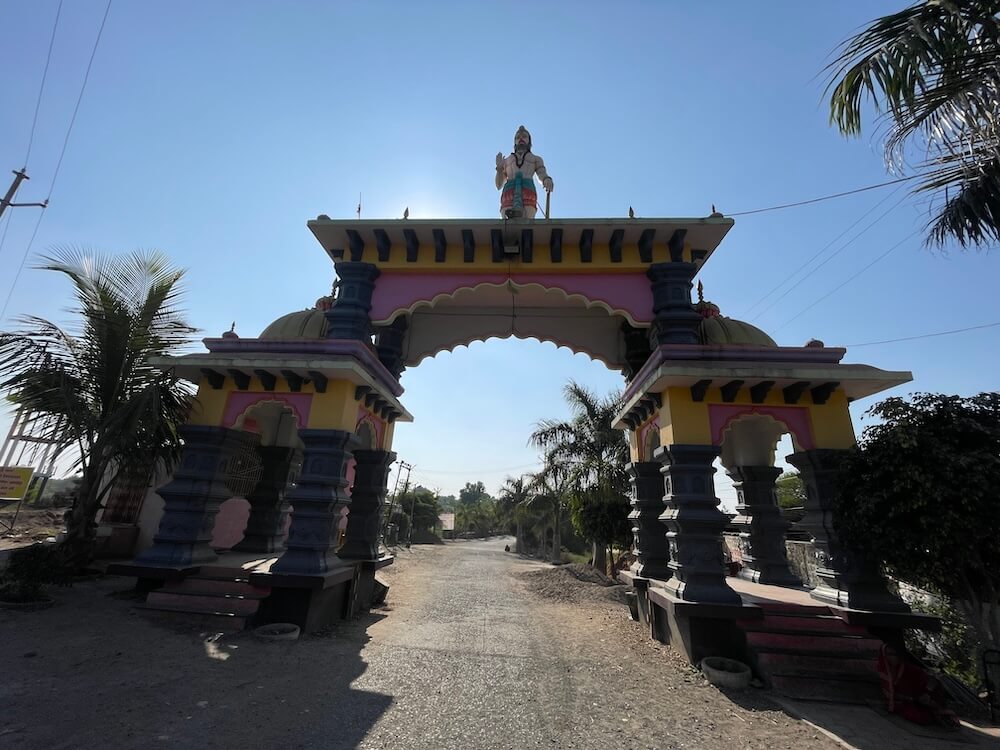
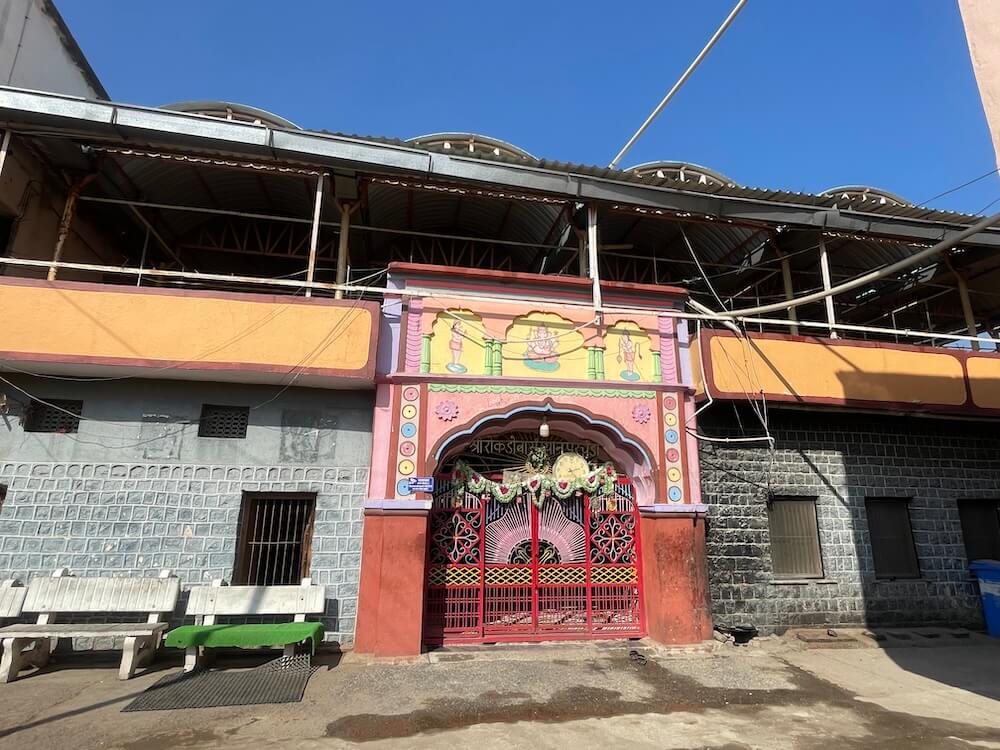
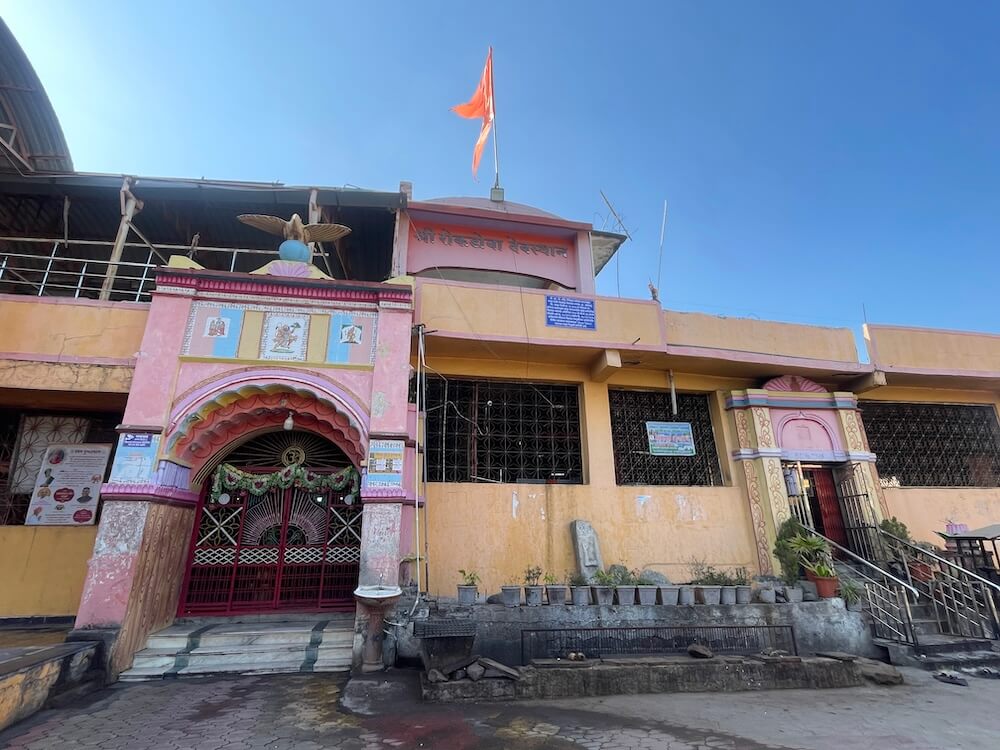
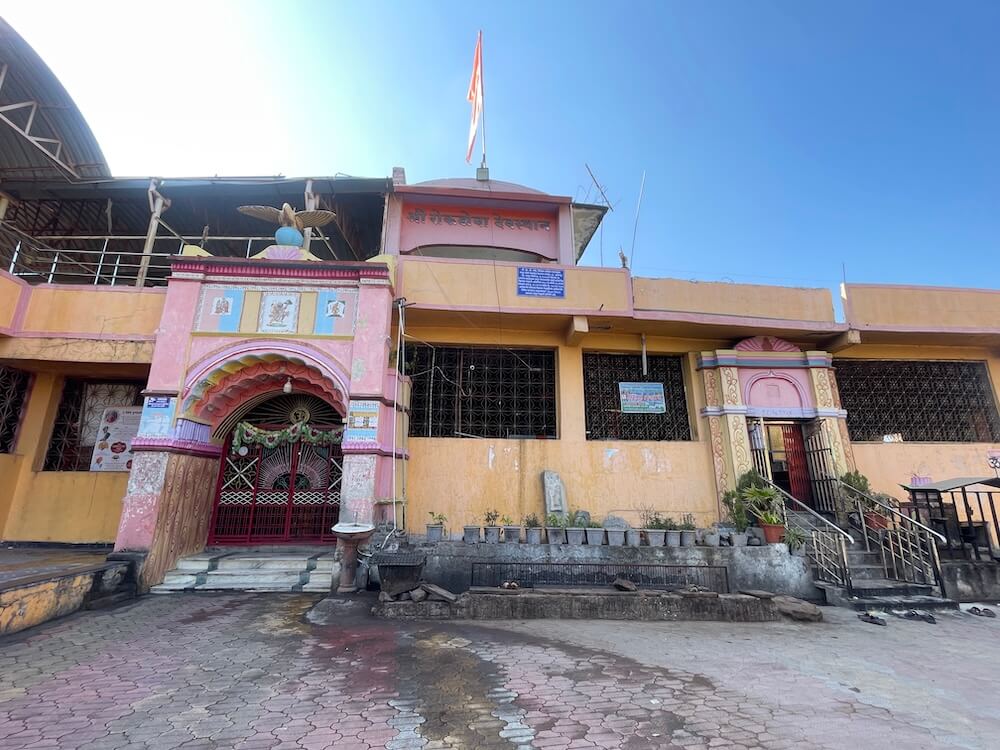
The first welcome arch of the temple is located on the path leading from the main road. On both sides of the arch are rectangular platforms upon which a four-pillared Nagarkhana (drum house) is built. This Nagarkhana features sculptures of guards and elephant-headed motifs carved by hand. There are sculptures of Dasa Hanuman at all four corners of this arch. In the niches of the outer walls, sculptures of Parvatdhari Hanuman, Sai Baba, and Gajanan Maharaj are carved. The roof of the Nagarkhana features a Shikhara, Amalaka, and Kalasha. The fortification wall surrounding the temple has a main entrance and two sub-entrances, with dome-shaped Shikharas, Amalakas, and Kalashas on their pillars. A twenty-foot-tall standing statue of Hanuman in the center of the entrance roof draws attention.
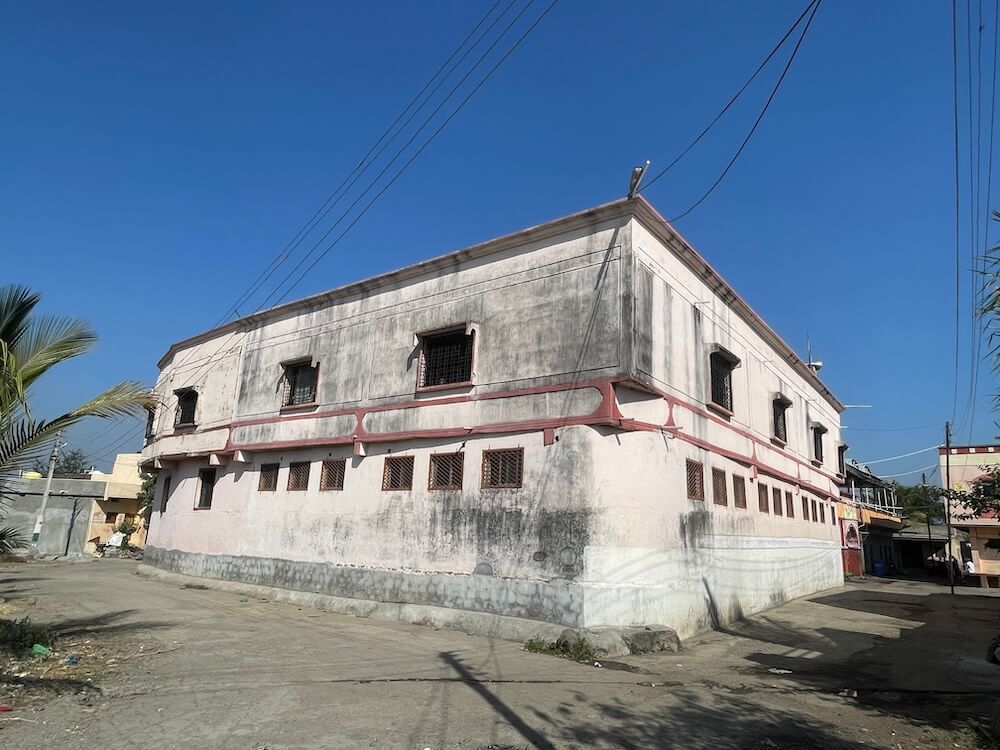
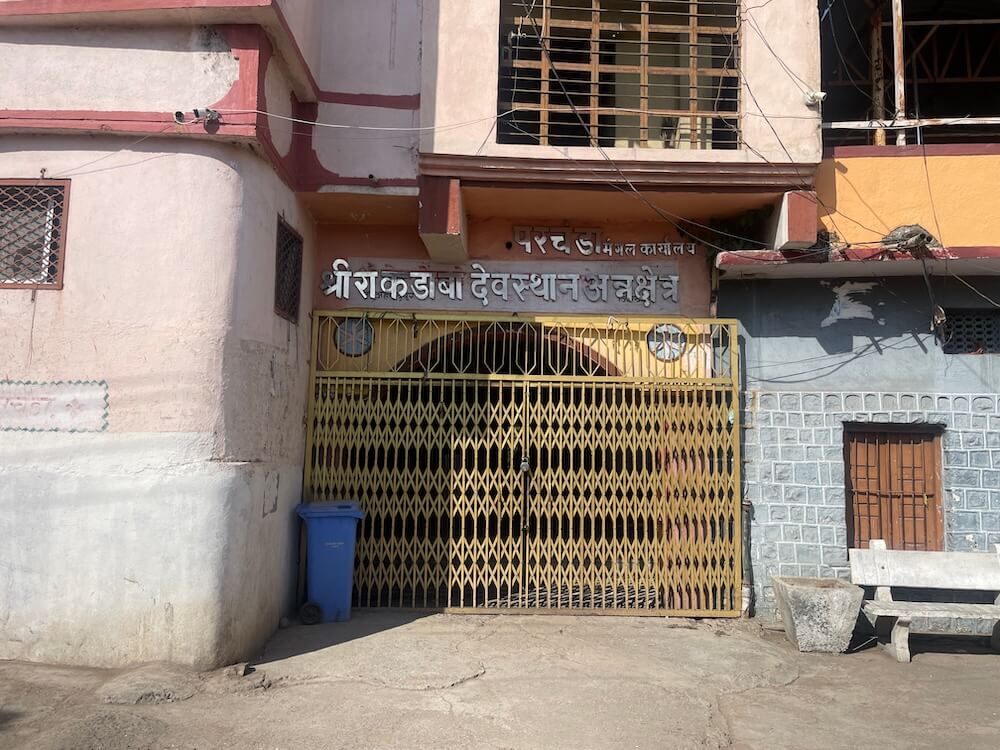
Rows of palm trees line both sides of the road leading from the entrance to the courtyard in front of the temple. From there, private vehicles reach the large parking lot in the courtyard. In this courtyard, which features various trees, facilities such as seating for devotees, residential quarters for servants, a kitchen, Annachhatra (free food distribution center), storage rooms, and a wedding hall are available. The overall architecture of the temple is divided into the Mukhamandapa (front porch), Sabhamandapa (assembly hall), main Sabhamandapa, and the Garbhagriha.
The Mukhamandapa, which is higher than the courtyard, has arched gateways on both sides. The subsequent enclosed Sabhamandapa has circular ornate pillars, a glass chandelier on the ceiling, and glass enamel decorations on the canopy. Due to the windows, this area remains airy and well-lit. There are three shrines on the left side of this Sabhamandapa, housing idols of Vitthal-Rukhumai, Shriram-Sita, and a Shiva Linga with Nandi on Vajrapithas, respectively.
A main Sabhamandapa is built on a higher level in front of the assembly hall, and in front of its entrance are two circular stone-carved lamp towers (Deepmalas). Hundreds of brass bells offered by devotees are hung from the ceiling of this hall. In the shrine on the left here, there are idols of Shriram, Lakshman, Janaki, and Dasa Maruti, while a Dravidian-style cloth donation box (Hundi) is hung in the center. In front of the entrance to the sanctum sanctorum, there is a black stone idol of Nandi on a Vajrapitha. The front and inner walls of the sanctum sanctorum are covered with ornate gold plating. The entrance has ornate silver doors. Inside the sanctum sanctorum, on a Vajrapitha, is the vermilion-smeared stone idol of Rokdoba Hanuman. On the ornate golden back wall, there are relief sculptures of Shriram and Sitamai. Since the sanctum sanctorum has no roof, no Shikhara or Kalasha is built over it, allowing sunlight or the moonlight of a full moon to enter the sanctum directly. However, the roof of the Mukhamandapa features a dome-shaped Shikhara, Amalaka, and Kalasha in the center.
Hanuman Jayanti is the main annual fair celebrated here, on which occasion the Palkhi procession of Lord Hanuman is held, and the Utsavamurti is taken around the village in a procession. During this fair, a temporary market is set up for puja materials, sweets, household items, and agricultural products.
Apart from this, festivals like Ram Navami, Maha Shivaratri, Ashadhi and Kartiki Ekadashi, Dussehra, and Diwali are celebrated with Maha Abhishek, Bhajans, Kirtans, scripture readings, and Maha Prasad. Every Saturday, four to five thousand devotees come here for Darshan, and arrangements for Maha Prasad are made for them. Devotees can have Darshan of Rokdoba Hanuman in this temple daily from 6 in the morning until 9 at night.
This sacred temple stands as a testament to deep spiritual devotion, ancient architectural grandeur, and rich local cultural traditions.
The sanctum sanctorum houses the divine idol consecrated according to ancient Vedic traditions, surrounded by serene courtyards and traditional temple architecture.
Navratri, Maha Shivratri, Annual Temple Jatra & Deepotsav
Compare and book flights, secure top-rated local hotels near the temple, hire reliable guides, and rent cars instantly.
Extend your pilgrimage by visiting other highly sacred temples located nearby.


Add ₹999 more to unlock FREE SHIPPING!
Your sacred cart is currently empty.
Shop Photo FramesFill in your delivery details below to place your order.
Add comment