
Add ₹999 more to unlock FREE SHIPPING!
Your sacred cart is currently empty.
Shop Photo FramesThe city of Jalna, blessed with a rich historical and cultural heritage, holds significant religious importance. A vast array of ancient and historical temples can be found within the city and its surrounding areas. These include the four-hundred-year-old Panchmukhi Hanuman Temple in Jalna, which houses a self-manifested (Swayambhu) idol in its basement; the Hemadpanti architectural style Dhavaleshwar Mahadev Temple in the Mondha area; the Amriteshwar Mahadev Temple in Old Jalna; and the thousand-year-old Kodeshwar Mahadev Temple in Bhokardan Taluka. Among this series of temples, the Thadeshwar Mahadev Temple in the Shrikrishnanagar area of Jalna city is particularly famous as an ancient and historical shrine.
The legend regarding the origin of the Thadeshwar Mahadev Temple states that, in the past, a Nath-sect ascetic named Thadeshwarnath lived in this quiet and scenic area on the banks of the Kundalika River. He resided here and constantly worshipped Lord Mahadev, spending his entire day in chanting, penance, and meditation. He continued this spiritual practice for a period of about twelve years. After some time, Thadeshwarnath sensed his approaching death. At that moment, a feeling arose in his mind that if he were to die without having a direct vision of Lord Mahadev, his human life would be in vain. With the singular obsession of attaining a vision of the Lord, he completely renounced food and water and began rigorous penance. Seeing his pure devotion and severe austerity, Lord Shiva was pleased. Once, while Thadeshwarnath was sitting in deep meditation, Lord Mahadev appeared to him in a vision and said, “I am beneath the water in the riverbed in the form of a Shiva Linga. You must retrieve me from the water and install me on the banks of this river.”
Upon receiving this divine vision, Thadeshwarnath rose from his meditation and plunged directly into the Kundalika River. After searching for some time in the deep riverbed, he found a Shiva Linga. The Nath brought the Linga out of the river, performed its formal installation on the bank, and built a small temple there. Since this Linga was installed by Thadeshwarnath himself, this Mahadev came to be known as Thadeshwar Mahadev. A few days later, Thadeshwarnath took Samadhi within the temple premises.
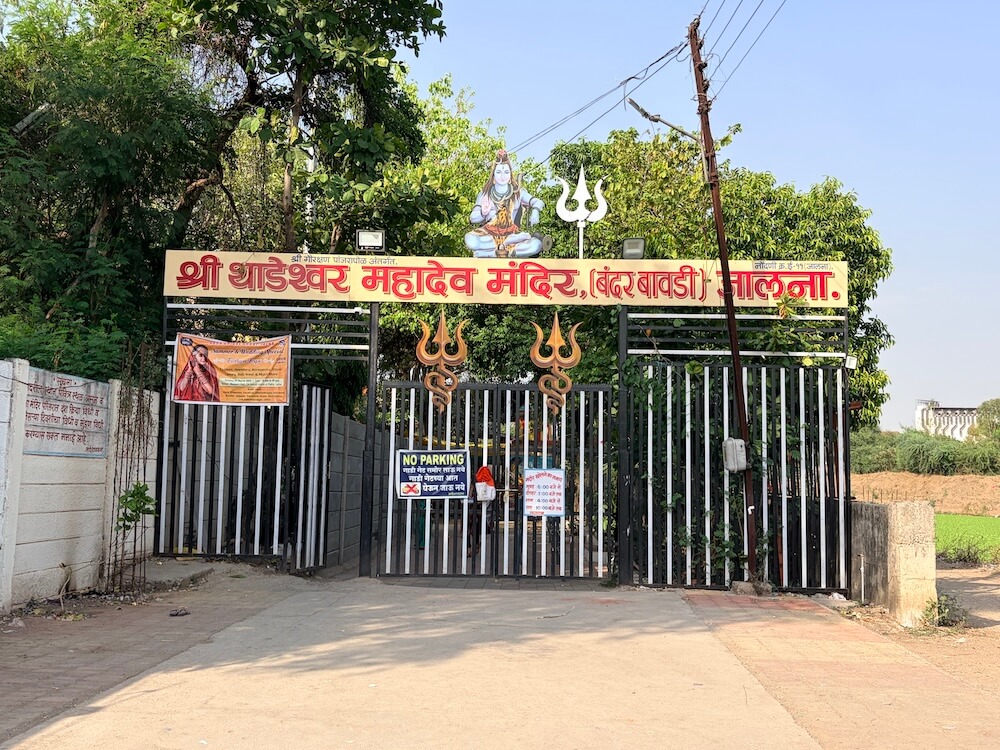
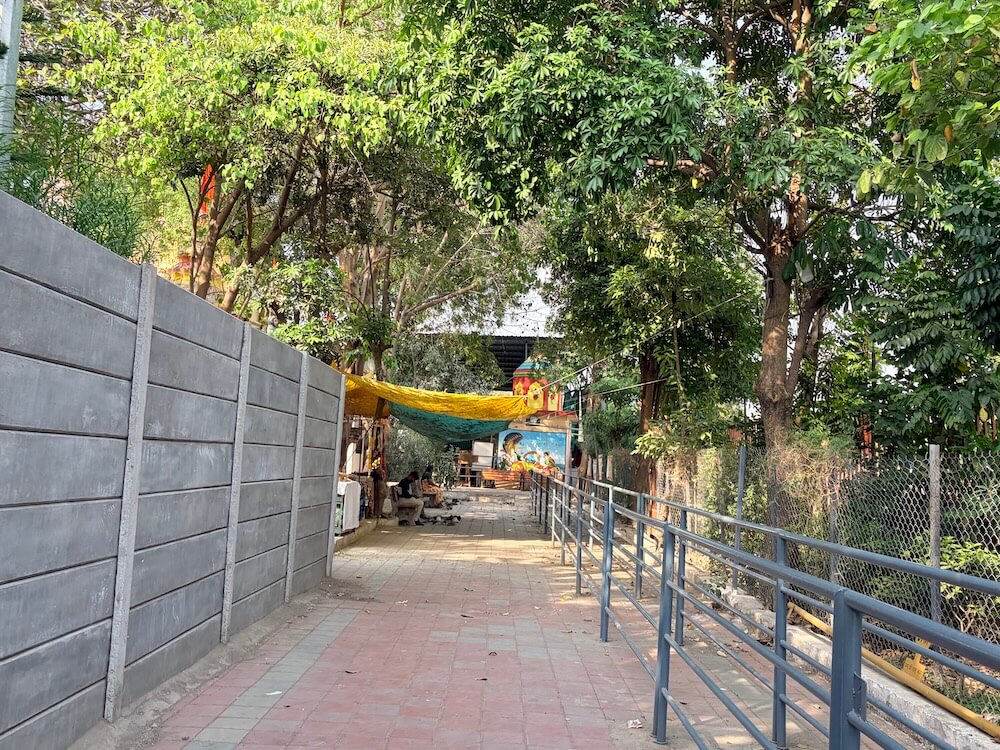
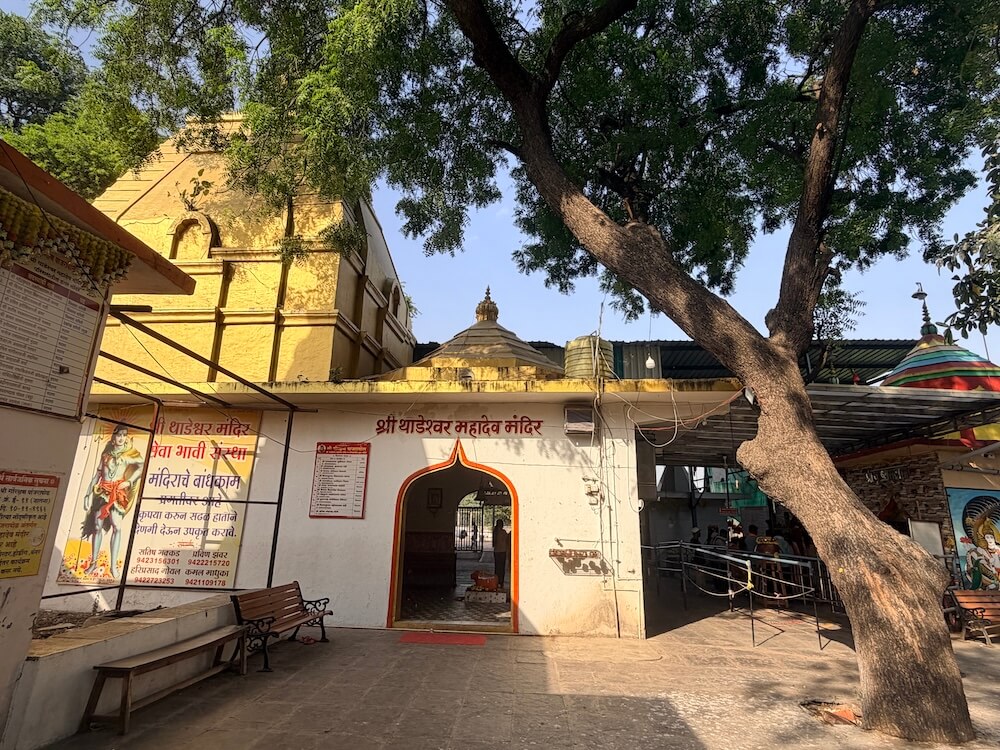
There is a paved road leading to this temple situated on the banks of the Kundalika River. In front of the temple, there is a spacious parking area for the vehicles of devotees. A stone fortification has been erected on all four sides for the security and protection of the entire temple. One enters the spacious, paved courtyard of the temple through the entrance gate in this fortification. The temple structure consists of a Sabha Mandap (assembly hall) and a Garbhagriha (sanctum sanctorum). The Sabha Mandap has doors on the left and right sides in addition to the front entrance. Inside this enclosed hall, there are stone seats built along the walls. In the Sabha Mandap, facing the entrance of the sanctum, there is a stone idol of Nandi on a pedestal. The door frames of the sanctum are carved with vertical patterns. Inside the sanctum, there is a Shiva Linga on the floor, which is adorned with a brass cover or armor. Beside the Shiva Linga, a large trident and a drum (Damaru), symbols of Lord Mahadev, are placed. On a high pedestal against the back wall of the sanctum are the idols of Ganpati and Mother Parvati.
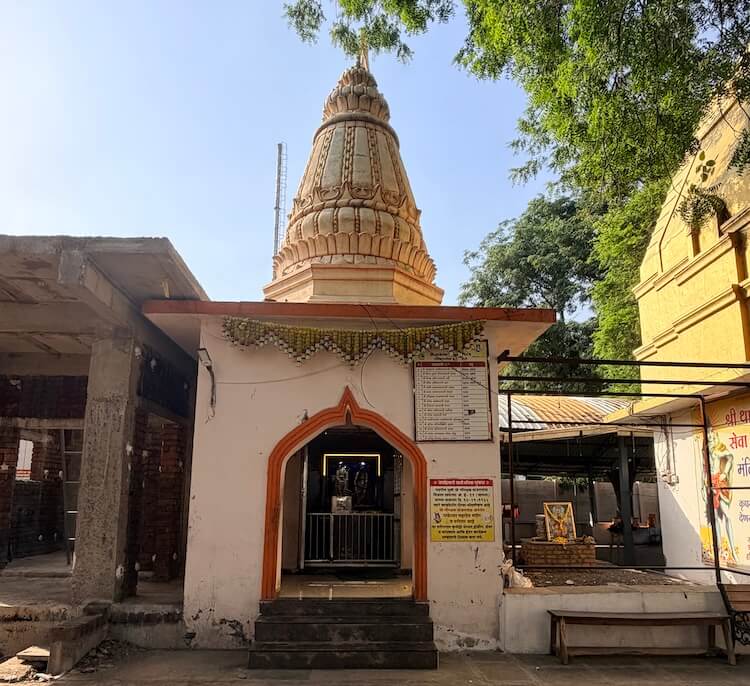
The design of the temple spire (Shikhara) is distinctive. On the roof of the Sabha Mandap, there is a square spire shaped like a pyramid with a stepped design. At the top of the spire, there is a stone Amalaka and a finial (Kalash). There is a large square spire over the roof of the sanctum, with smaller subsidiary spires (Angashikhara) arranged on all four sides. This spire, which bears a resemblance to the Nagara architectural style, attracts the attention of devotees even from a distance.
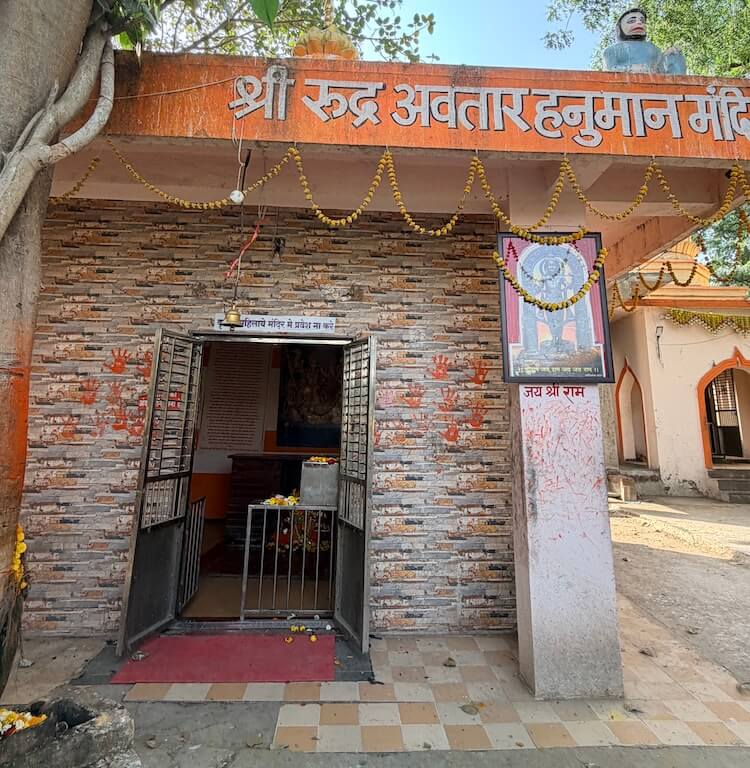
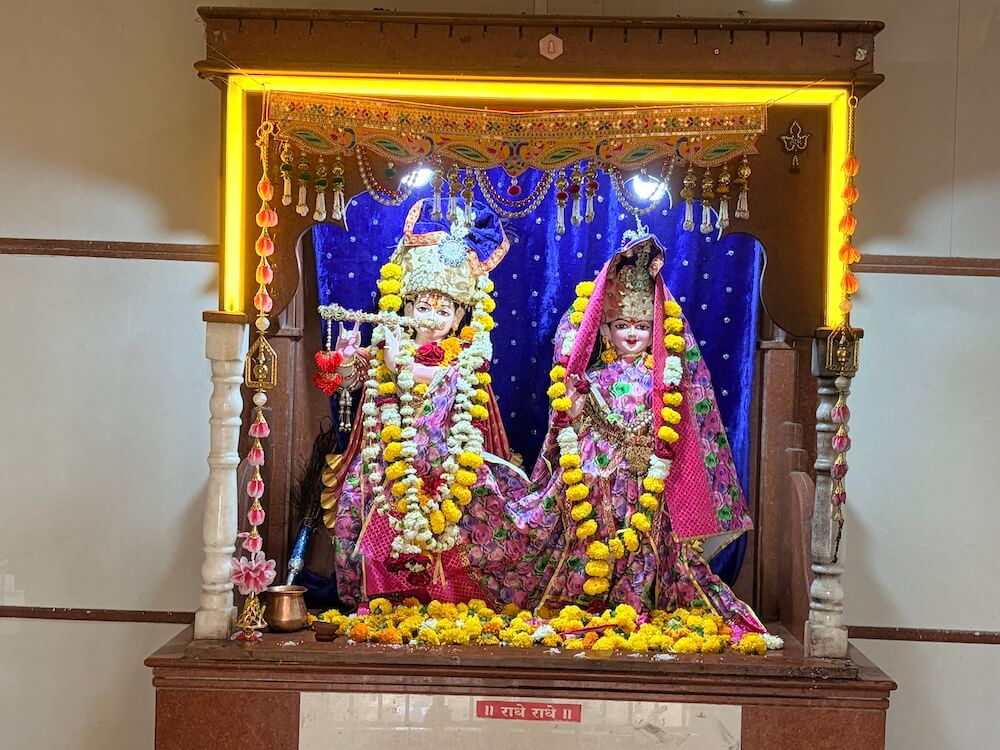
To the left of the Thadeshwar Mahadev Temple is the Rudra Hanuman Temple. In this small temple, a stone idol of Hanuman is installed on a central stone pedestal. Right next to the Hanuman Temple is the Samadhi of Thadeshwarnath Baba, the original founder of this temple. On the high pedestal of this Samadhi, an ornate canopy (Makhar) has been built using Dholpur stone, the famous red stone of Dholpur. Inside this canopy, there is a small Shiva Linga. Behind the Samadhi site is the Radhakrishna Temple, which follows the traditional structure of a Sabha Mandap and a Garbhagriha. On the pedestal inside the sanctum of this temple are white marble idols of Lord Shrikrishna and Mother Radha. Right next to the Radhakrishna Temple is a small Shrikrishna-Subhadra Temple. On the pedestal in this temple, one can see a rare and unique idol of Lord Shrikrishna in a form where he is affectionately embracing his dear friend Sudama, along with Mother Subhadra. Adjacent to the Subhadra-Shrikrishna Temple, in the same premises, are the famous temples of Khatushyam and Jalaram Bapa. The Samadhis of some late Mahants are also built in a line in this area. To provide accommodation and meals for devotees, the temple courtyard features a large Annachhatra (free kitchen), residences for priests and temple staff, and a modern Bhakta Niwas (pilgrim guest house). On one side of the courtyard, there is an iron mesh. Near this mesh, devotees tie a coconut wrapped in red cloth as a vow, praying for the fulfillment of a wish. Later, after their wish or desire is fulfilled, the devotees return to untie the coconut and complete their vow.
Mahashivratri, Hanuman Jayanti, Shrikrishna Janmotsav, and Shravani Mondays are considered the major festivals here. Apart from the main festivals, occasions like Dussehra, Diwali, Nagpanchami, Narali Purnima, Gurupurnima, and Ramnavami are celebrated in the traditional manner. During festival periods, the temple organizes various religious and cultural programs such as Laghurudra, Mahabhishek, Akhand Bhajan, Kirtan, and the distribution of Mahaprasad. Every year, on the day of Phalguna Purnima, a fair (Jatra) of Khatushyam Baba is held here. Additionally, on every Ekadashi and Pradosh, the Shiva Linga is adorned with special decorations (Shringar). Devotees make it a point to visit every Ekadashi to witness this Shringar. Devotees can visit the temple daily from 6 in the morning to 1 in the afternoon and from 4 in the evening to 10 at night.
This sacred temple stands as a testament to deep spiritual devotion, ancient architectural grandeur, and rich local cultural traditions.
The sanctum sanctorum houses the divine idol consecrated according to ancient Vedic traditions, surrounded by serene courtyards and traditional temple architecture.
Navratri, Maha Shivratri, Annual Temple Jatra & Deepotsav
Compare and book flights, secure top-rated local hotels near the temple, hire reliable guides, and rent cars instantly.
Extend your pilgrimage by visiting other highly sacred temples located nearby.

Add ₹999 more to unlock FREE SHIPPING!
Your sacred cart is currently empty.
Shop Photo FramesFill in your delivery details below to place your order.
Add comment