
Add ₹999 more to unlock FREE SHIPPING!
Your sacred cart is currently empty.
Shop Photo Frames‘Kanada Vitthalu’ is the presiding deity of Maharashtra. Similarly, Sant Eknath Maharaj has referred to the deity Malhari Martand Khandoba as ‘Mairal Dev Kanade’ and ‘Kanada Khanderaya’. Malhari Martand Khandoba is the family deity (Kuldaivat) of Maharashtra. Khandoba resides on the Kadepathar of the Jejuri fort. Likewise, the Khandoba temple is situated on this high hill in the Jagdusha Nagar area of Ghatkopar. This temple is a major center of faith for the working class and middle-class Marathi people of this region. Thousands of devotees visit this place for Darshan on the days of Somvati Amavasya and Champashasthi.
In ancient times, this area was part of the Salsette islands, and since the 12th century, there were two villages named ‘Ghate’ and ‘Kopar’. The text ‘Mahikavatichi Bakhar’, which narrates the history of Pratap Bimb, the first king of Mumbai who established his capital at Mahim in 1142 AD, and Bimbdev Yadav, the son of the Yadava King Ramdevraya who came to power in 1295 AD, mentions both these villages. The combined name ‘Ghatkopar’ was formed from these two villages. This area was hilly and consisted of salt pans. The geographical features of Ghatkopar are still evident today from the hills that exist here. Today, most of the hills in this area are covered by large buildings, chawls, and huts. The hill known by the name of Khandoba is one of them.
This hill is situated in Jagdusha Nagar. The name of this locality also has a special history. It is named after Jagdu Shah, a wealthy and philanthropic Jain merchant from the Kutch region of Gujarat who lived in the 13th century. Known by various names such as Jagdu, Jagdusha, and Jagdev, Jagdu Shah owned many ships. During that time, he traded with countries in Persia, Arabia, and Africa. The story of Damajipant of Mangalwedha in Maharashtra opening two grain stores of Sultan Alauddin Shah Bahmani for the common people during the Durgadevi famine (1460 AD) is well-known. Two hundred years before this famine, a similar terrible famine had occurred in the south. At that time, between 1256 and 1258 AD, Jagdu Shah had opened his seven hundred grain warehouses for the poor and needy. This Khandoba temple in Jagdusha Nagar, named after such a philanthropist, was built by a Warkari saint from this area. His name is Haribhaktaparayan Shantaram-baba Sudamrao Shinde Deshmukh (Ursekar).
Saints have composed metaphors about the deity Khandoba, and heroes have drawn inspiration for courage from him. H.B.P. Shantaram-baba had immense devotion to this Lord Khandoba. He used to regularly perform the Wari (pilgrimage) of both the Vaishnava deity Vithoba and the Shaiva deity Khandoba. In one of his compositions, Sant Eknath said, “Waghya-Murali dance in various ways; with such devotion, I shall see Jejuri.” Shantaram-baba also used to regularly visit Jejuri. With the intention of being able to worship his beloved deity daily in solitude, he chose this spot on the hill on the border of Jagdusha Nagar and Bhatwadi in 1967. Formerly known as ‘Lalbatti Dongar’ (Red Light Hill), this part of the hill was then mostly covered in dense greenery and was extremely peaceful. On Chaitra Shuddha Pournima, Shake 1889, April 24, 1967, he built a small temple and consecrated the idols of Khandoba and Mhalsa. Programs like Bhajans, Kirtans, and Jagaran-Gondhal began to be held there. The Jagdusha Nagar, Bhatwadi, and Asalpha areas were home to a large population of workers, laborers, and employees who had come from various districts of Maharashtra, primarily from Western Maharashtra. Khandoba, also addressed by names such as Khanderaya, Malhari Martand, Martand Bhairav, Malhari, Mhalsakant, and even Mallukhan and Ajmatkhan, is their family deity. The main seat of this deity is on the Jejuri fort in Pune district. The Khandoba shrine at Pali in Satara district also holds great importance. These people would diligently go on pilgrimages to these places. However, for those Khandoba devotees who could not go there due to work or other reasons, this temple on the hill emerged as an important religious alternative. This is why this seat of Khandoba became famous as ‘Sahyadri Kadepathar’.
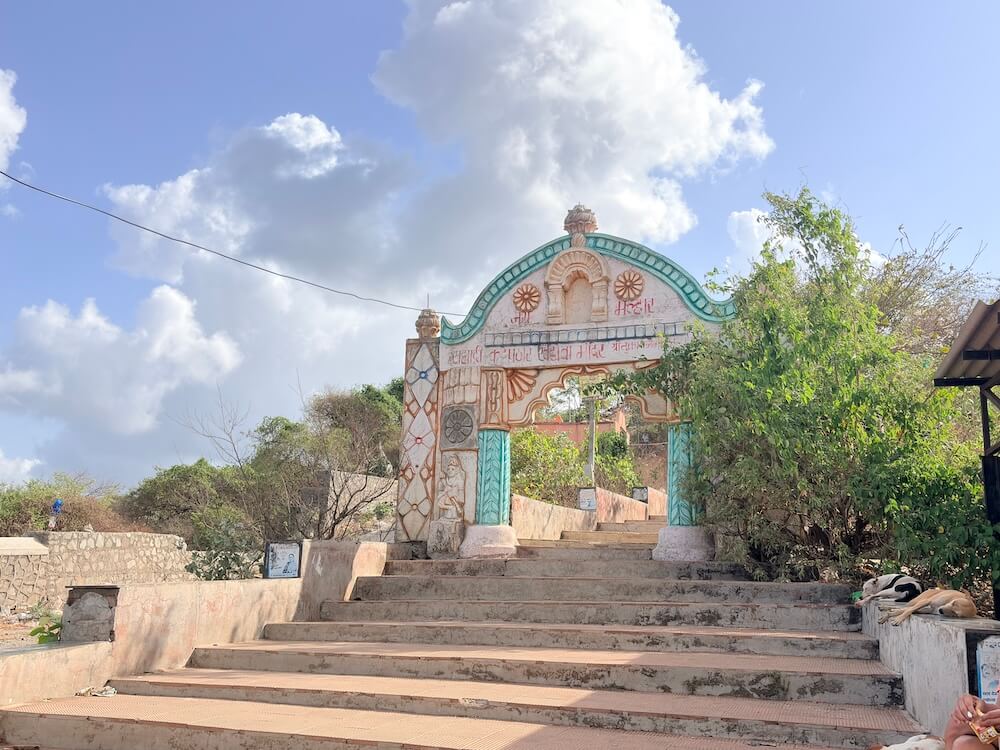
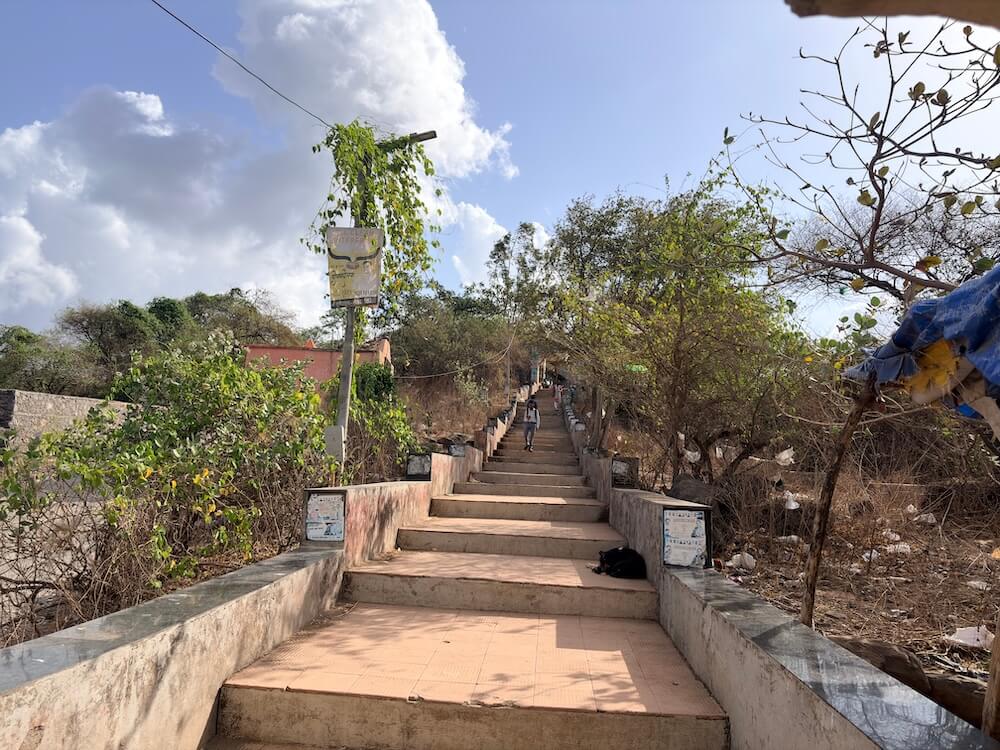
One has to make their way to this hill through narrow paths in densely packed chawls. The hill was beautified in 2018-19. Stairs were built to reach this hill, which is about 200 meters above sea level. Similarly, a path has been made where two-wheelers can go directly. After walking some distance on this path, there is a welcome arch for the temple premises. A short distance from here is a small shrine of Suryamukhi Hanuman. Hanuman is seated in that shrine in the form of a stone idol. After climbing a few stairs from here, one sees the main entrance of the temple complex, built within a large fortification. In the front, there is a large Deepmal (lamp pillar) in the paved courtyard. Generally, in traditional Deepmals, the lamp holders are from bottom to top. Here, these lamp holders are fitted in the upper half of the Deepmal.
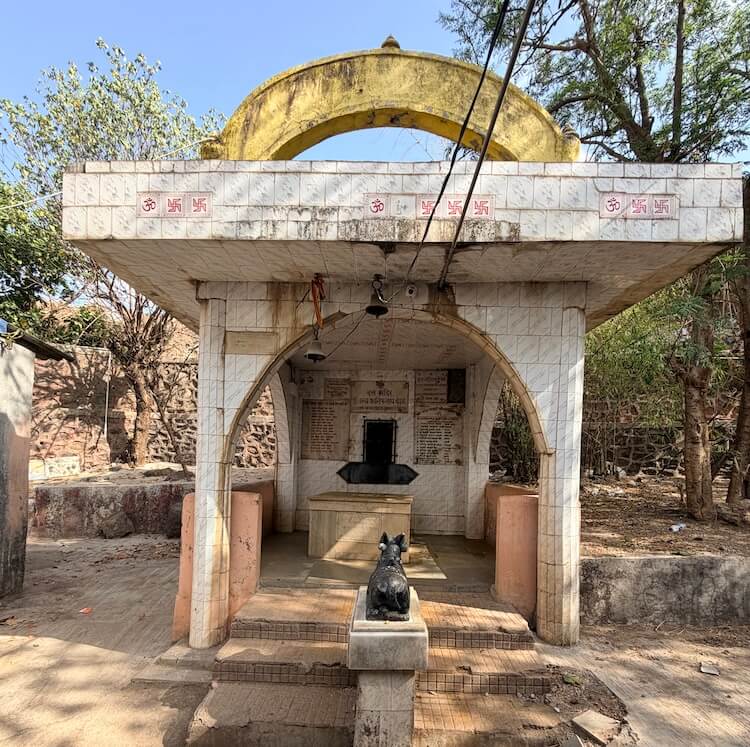
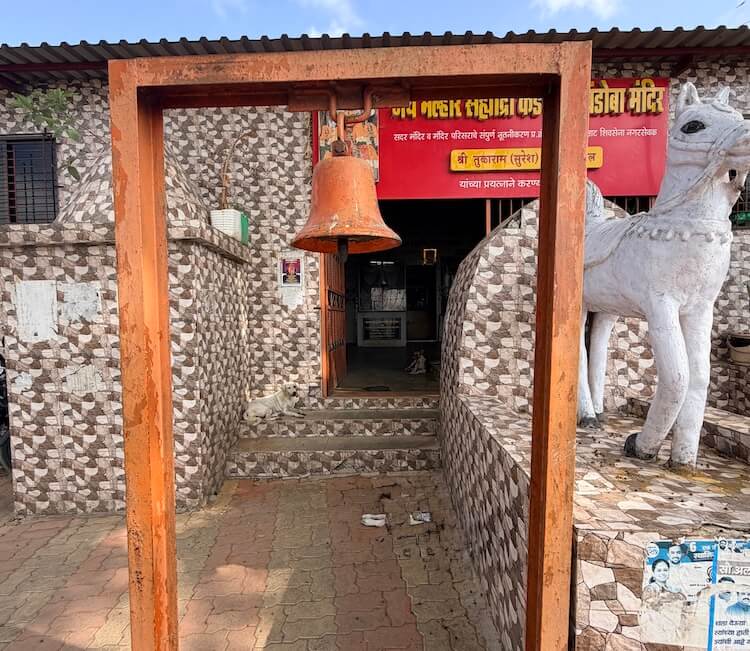
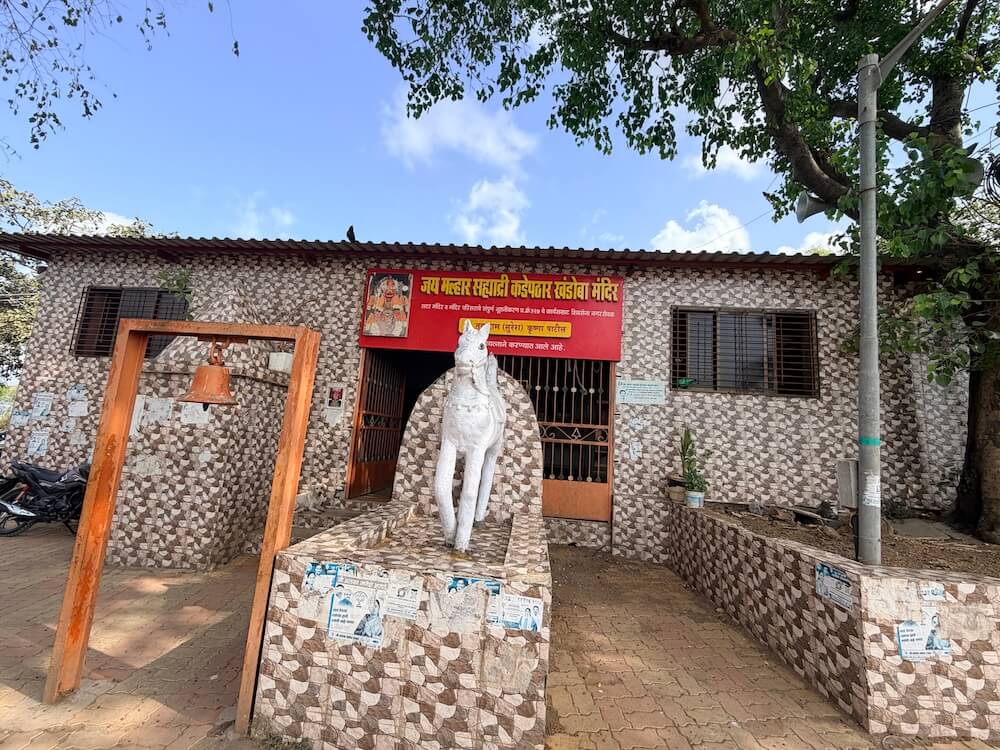
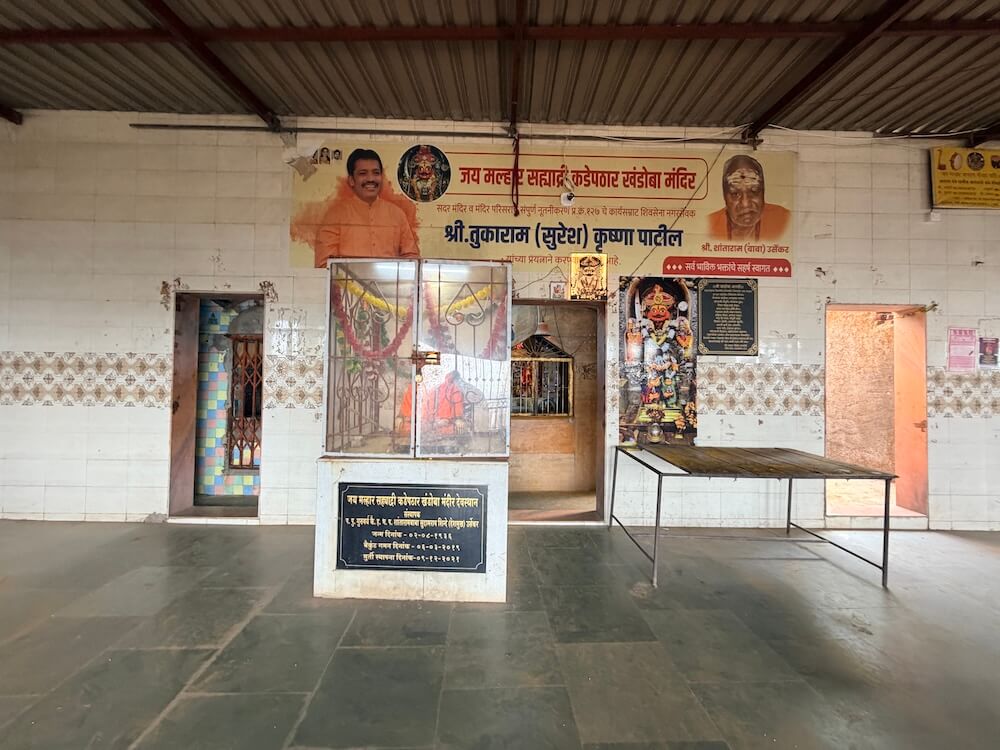
The temple of Khanderaya here is simple and of modern construction, with a tin roof. The temple’s appearance is a result of periodic renovations, the idols installed over time, and the shrines built for them. Marble tiles, giving the impression of a mosaic design, have been fitted on its outer walls. In front of the temple, on a pedestal, there is a large cement statue of a horse. A large bell is hung on an iron frame here. From here, one climbs three steps to enter the temple’s assembly hall (Sabhamandap). To the right of this entrance is a shrine facing the sanctum sanctorum. A stone idol of Ganesha is seated there. To the left of the entrance, on a pedestal, is a standing idol of Hegde Pradhan in traditional attire. Hegde is considered the brother of Banai and the minister (Pradhan) of Khandoba. The Kannada word ‘Hegde’ means ‘minister’. In front of the Ganesha shrine, on a marble pedestal, is an old stone idol of Nandi. Khandoba, or Martand Bhairav, is considered an incarnation of Lord Shiva. That is why the idol of Nandi, the attendant of Lord Shiva, is installed here. Nearby, there is a Havan Kund (sacrificial fire pit). In front is the main sanctum sanctorum of the temple. Near its entrance, on a large marble platform, sits the seated idol of H.B.P. Shantaram Baba, adorned in saffron robes. Shantaram Baba passed away on March 6, 2019. Two years later, on December 9, 2021, his idol was installed here. On the wall to the right of this entrance, a large image of Khanderaya is displayed. In the center of the sanctum, on a high pedestal, the idols of Khandoba and Mhalasa are installed within a large marble arch (Makhar). Here, Khandoba is depicted in a seated posture, with a pleasant countenance and in the Abhaya Mudra (gesture of fearlessness). The idol wears a large Shinde-style turban on its head, and garlands of Rudraksha and flowers around its neck. The idol of Mhalasa stands in the Samapada posture. She is adorned with garments and ornaments, as well as floral garlands. Behind these idols is a relief sculpture of Khanderaya and Mhalasa riding a horse, depicting the slaying of the demons Mani and Malla. This arch also houses two brass masks of Khandoba. On the pedestal of the arch, there is a small image of Ganesha, while nearby, a stone-carved idol of Hanuman in the Abhaya Mudra is enshrined. Adjacent to the main sanctum, there is another inner chamber. In it, the idol of Mother Kali is enshrined on a high altar. The consecration (Pranapratishtha) of this idol took place here in the year 1982. There is also a temple of Vitthal-Rukmini here. Inside its marble arch, marble idols of Vitthal-Rukmini are enshrined. Beside this arch, on a high pedestal, is the idol of Saint Dnyaneshwar. A few steps away from the Khandoba temple, there is also a temple of Vitthal-Rukmini and Dattatreya-Kanifnath. This small temple of Dattatreya-Kanifnath has an open-style assembly hall (Sabhamandap). In front of it, an idol of Nandi is installed. In the assembly hall lies the Samadhi site of Guruvarya Laxmanbaba Sudamrao Shinde. In the small sanctum, there are idols of Kanifnath and Dattatreya. On the walls within the Khandoba temple premises, there are relief sculptures of Sai Baba and Shiva Shankar.
Devotees frequent this temple from 6:00 AM to 8:00 PM. In the worship of Khandoba, Sunday holds special significance. It is considered the day of Bhairava. Since this is also a holiday for the majority of workers and employees, many people come here for the darshan of Khandoba on this day. A large crowd of devotees gathers here on occasions like Somvati Amavasya, Chaitra Purnima, Shravan Purnima, Maghi Purnima, and Margashirsha Shuddha Shashthi (Champa Shashthi). On Chaitri Purnima, Martand Bhairava took his avatar. On Maghi Purnima, Mhalasa Devi was born at the house of Timmashhet in Nevasa, and on Paush Purnima, the marriage of Mhalasa and Khandoba took place at Pali. On Champa Shashthi, Khanderaya slew the demons Mani and Malla. Due to this, these days hold special importance in the worship of Khandoba. On the days of Champa Shashthi and Somvati Amavasya, the temple premises are specially decorated. At that time, there is a fair-like atmosphere here. During the monsoon, many young men and women come to this Khandoba hill for trekking. Waterfalls can also be seen here during the rainy season. From this hill, one can get a panoramic view of the metropolis of Mumbai. Because of this, along with being a religious site, this hill has also become a tourist destination.
This sacred temple stands as a testament to deep spiritual devotion, ancient architectural grandeur, and rich local cultural traditions.
The sanctum sanctorum houses the divine idol consecrated according to ancient Vedic traditions, surrounded by serene courtyards and traditional temple architecture.
Navratri, Maha Shivratri, Annual Temple Jatra & Deepotsav
Compare and book flights, secure top-rated local hotels near the temple, hire reliable guides, and rent cars instantly.
Extend your pilgrimage by visiting other highly sacred temples located nearby.


Add ₹999 more to unlock FREE SHIPPING!
Your sacred cart is currently empty.
Shop Photo FramesFill in your delivery details below to place your order.
Add comment