
Add ₹999 more to unlock FREE SHIPPING!
Your sacred cart is currently empty.
Shop Photo FramesIn the area of ‘Asanpe’, known today as Asalpha, located in Ghatkopar—a region originally formed around 900 years ago by the twin villages of ‘Ghate’ and ‘Kopar’—stands this sacred shrine dedicated to Lord Dattatreya and Goddess Durgambika. The holy abode of the Goddess here is said to date back nearly 300 years. Six decades ago, citizens who migrated to Mumbai from the Dakshina Kannada region came together to establish this temple. Along with Lord Dattatreya and Goddess Durgambika, the temple enshrines five divine sanctums (Devapeethas), including Anjaneya, Nagashesha, and Chamundi Mata. Devotees gather here in large numbers every Saturday.
The history of Ghatkopar, the suburb where this temple is situated, reveals that in ancient times, Ghatkopar was part of the Sashti (Salsette) islands and consisted of hilly terrain and salt pans. In January 1805, during the tenure of British Governor Jonathan Duncan, the Sion bridge was constructed. On 16 April 1853, the first railway ran between Mumbai and Thane. This made travel between Kurle (Kurla), Kirol (Vidyavihar), Ghatkopar, and the islands of Mumbai much easier. In the year 1877, a railway station was opened at Ghatkopar. Around this time, due to its healthy climate, the Ghatkopar area attracted affluent merchants and entrepreneurs from Mumbai. Many wealthy Gujarati, Parsi, Bhatia, and Marwari families built their residences here. With the textile mills of Mumbai and the factories emerging in the Kurla area, many workers and middle-class families also settled in this region, of which Asalpha became a part.
The origin of the name ‘Ghatkopar’ is explained in various ways. The hills of Powai are clearly visible from Ghatkopar. There are various popular accounts suggesting that because it was situated at the corner (kopra) of these hills (ghats), it came to be called Ghatkopar, or that because this region lay ‘Ghat ke Upar’ (above the ghats), the name became Ghatkopar. In reality, since the 12th century, two villages named Ghate and Kopar existed in this region of the Salsette islands. The ‘Mahikavatichi Bakhar’—a historical chronicle detailing King Pratap Bimba, the early ruler of Mumbai who established his capital at Mahim in 1142 CE, as well as Bimbadeva Yadava, son of the Yadava King Ramdevaraya who came to power in 1295 CE—mentions both Ghate and Kopar villages. The compound name Ghatkopar was formed from these two villages. In this chronicle, the village is mentioned as Asanpe, while in the text ‘Bimbakhyan’, it is referred to as Asanap. According to scholars, the name Asanpe evolved over time into Asalpe – Asalfe – Asalpha.
The legend of the Dattatreya Durgambika Devasthan states that this entire area of Ghatkopar was once covered with hills and dense foliage. About 300 years ago, during the British period, a devout devotee of the Goddess named Devidas Maharshi lived on the Asalpha hill here. He used to worship Goddess Durgambika at this spot. Since then, it has been a sacred abode of the Goddess, and local devotees also offered prayers to Her. Later, in the year 1964, some people from the Mangalore region came to reside in Subhash Nagar of Asalpha. In the evenings, they performed worship and sang devotional hymns (bhajans) in praise of Lord Dattatreya. They built a small shrine for Lord Dattatreya here and appointed a priest for daily worship. One day, a devotee from their ‘Dattatreya Mitra Bhajani Mandal’ brought an image of Mother Durga. From that time on, everyone began worshipping Goddess Durga as well.
One Tuesday, while the temple priest was performing the auspicious Aarati of Lord Dattatreya and Goddess Durgambika, Goddess Durga suddenly manifested through him. The same occurred on the following Saturday as well. Speaking through the priest, the Goddess declared, ‘I am pleased with your devotion and worship, which is why I have come here. Since time immemorial, I have been residing in the form of a sacred stone (Shila) on the hill in front of your chawl, enduring heat and rain. As I am now becoming defiled on that hill, take Me to a place where I can bless and protect the people.’ The members of this Bhajani Mandal belonged to the poor working class and lacked the funds and land required to build a temple. When they expressed this difficulty, the Goddess speaking through the priest instructed them to meet the owner of the land opposite the chawl. She suggested that they could place Her Shaktishila beneath the mango tree there, The members of the mandal went to meet the owner of that land, Mr. M. S. Khanna, but he did not respond to their request initially. When this was conveyed to the Goddess, She advised them to visit him once more. On that occasion, Mr. Khanna expressed his inability to grant the specific spot near the mango tree, but agreed to provide an alternative piece of land instead. After the Goddess bestowed Her consent upon that land, the temple was constructed there. The construction of the shrine was completed on 19 February 1965. The members of the ‘Dattatreya Mitra Bhajani Mandal’ brought Mother Durga’s Shaktishila from the hill in a grand procession and consecrated it in the temple. This is the present-day Dattatreya Durgambika Temple.
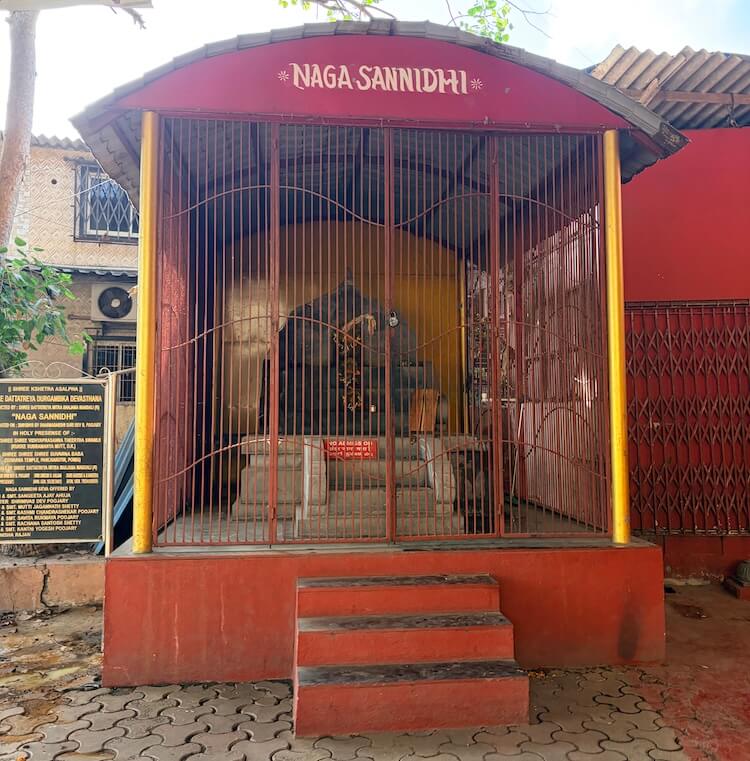
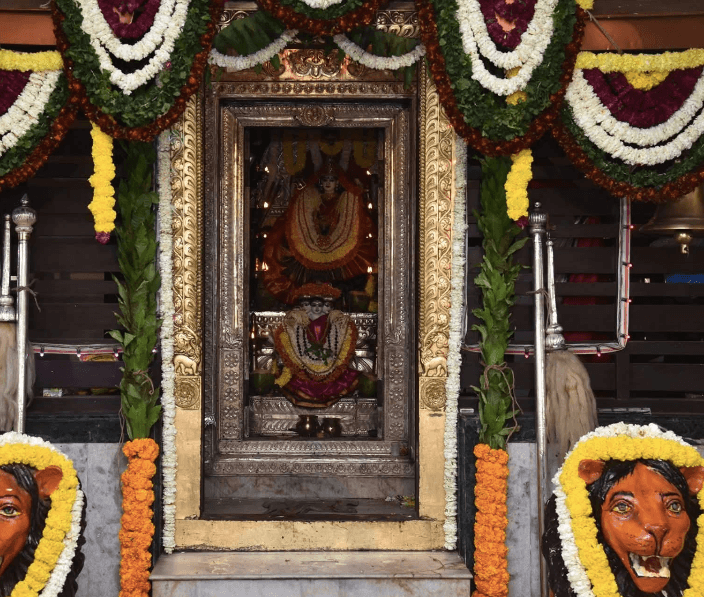
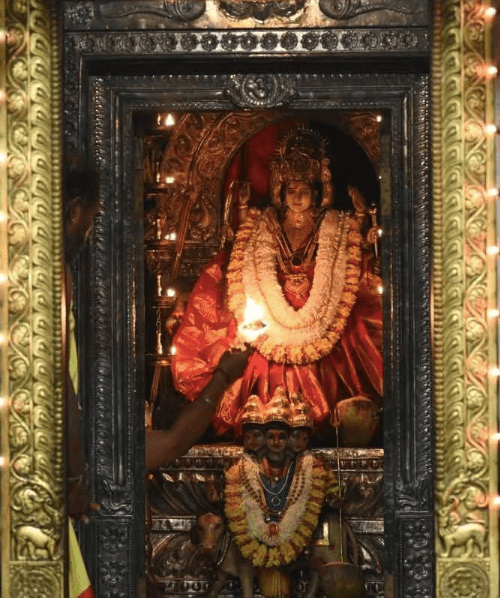
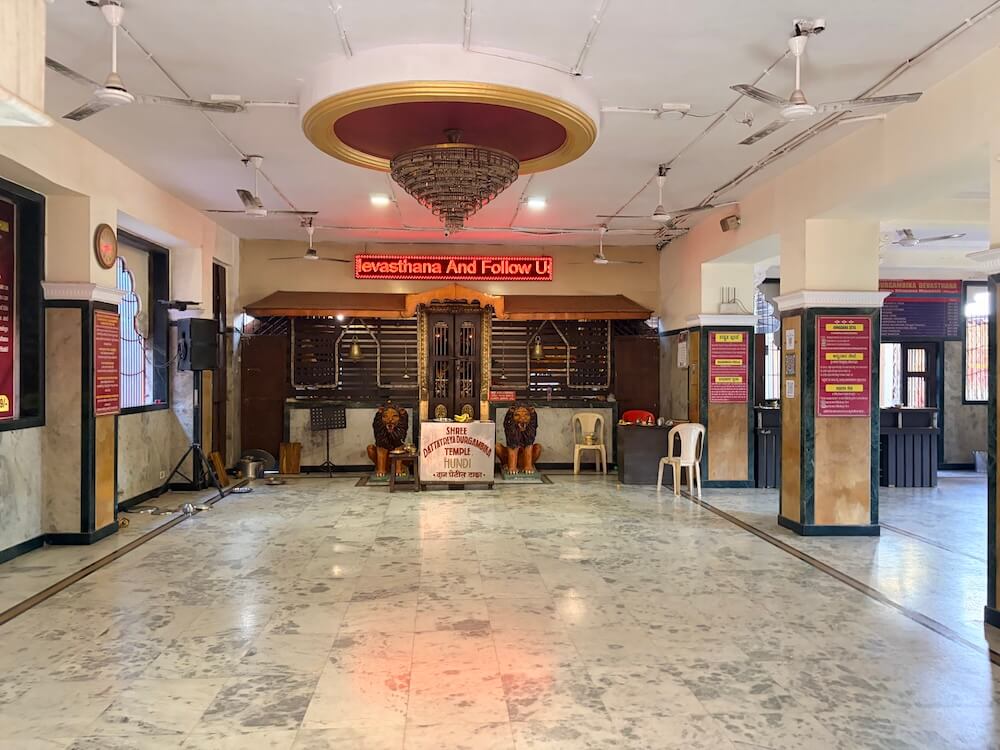
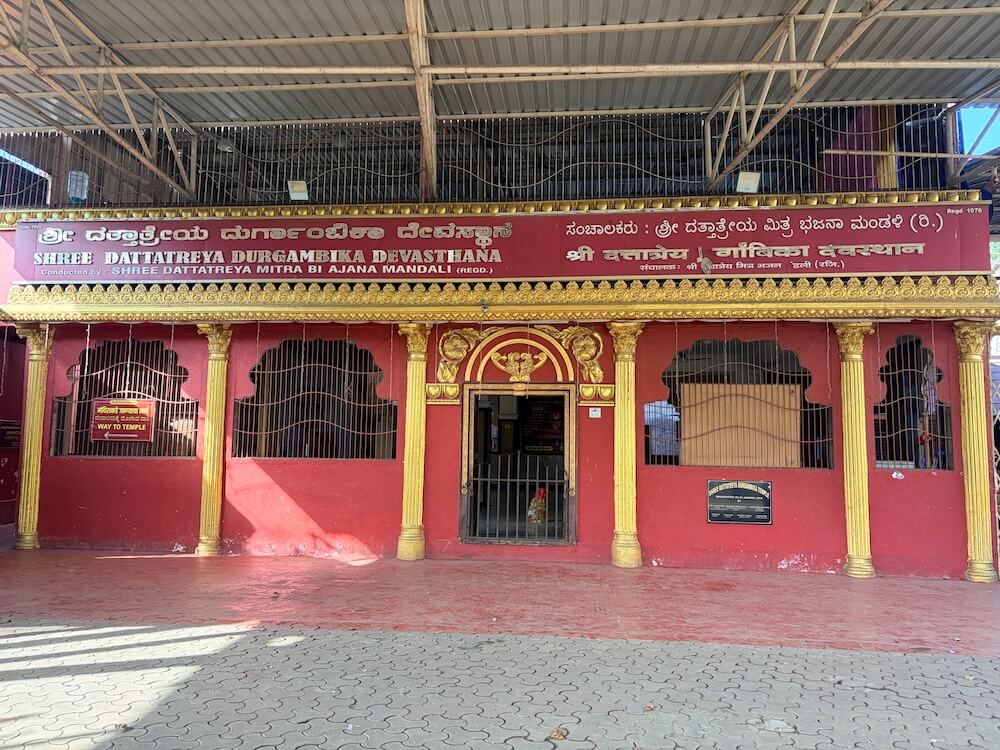
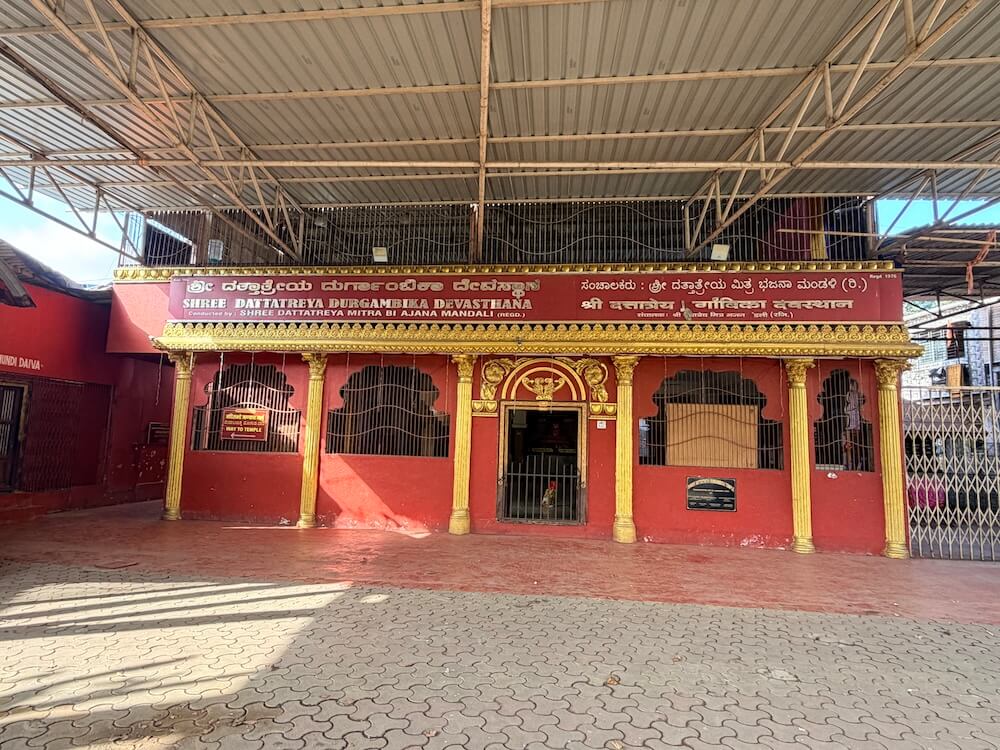
In front of the main entrance, the temple features an open ground enclosed by an iron gate. Facing the ground stands the two-storeyed, wide structure of the temple. A tin roof has been erected in front of the temple for the convenience of devotees. On the left side here is the shrine of Goddess Chamundi, where an idol of Goddess Chamundi adorned with a silver mask is consecrated upon a raised altar. Behind the idol is an intricately carved silver halo (Prabhavali). Nearby is the Nag Sannidhi, a shrine dedicated to the Serpent Deity. Located on a raised platform under a tin roof, this shrine houses three idols of Nagashesha placed one above the other on a step-like pedestal. During festivals and special occasions, these serpent idols are adorned with silver masks. The outer facade of the main temple features golden-painted pilasters and arched windows. A small entrance here leads into the temple courtyard. The temple structure comprises an assembly hall (Sabhamandap) and a sanctum sanctorum (Garbhagriha). In front of the entrance to the Sabhamandap, following the South Indian temple tradition, stands a tall flagstaff (Dhwajastambha), faced by a stone altar (Balipitha). The temple’s Sabhamandap is spacious and paved with marble flooring. Adorned with square pillars, the ceiling of this Sabhamandap features a crystal chandelier. Within the marble niches of the Sabhamandap, sacred idols of Lord Ganesha, Shri Ram-Lakshman-Sita, and Anjaneya (Lord Hanuman) are enshrined. Gracing the entrance of the main sanctum sanctorum are two lion statues crafted in the Karnataka architectural style. The doorframes of the sanctum sanctorum are clad in intricately carved silver plating. Inside, seated upon a high silver-plated pedestal, presides the divine idol of Goddess Durgambika. Carved in marble, the idol is beautifully adorned with garments, ornaments, and floral garlands. Below the main deity, on the same pedestal, a marble idol of Lord Dattatreya is consecrated. Here, Lord Dattatreya is depicted in His divine form with three faces, six hands, and Mother Cow (Gomata) standing behind Him.
A revered center of faith for Kannada-speaking devotees, the Dattatreya Durgambika Temple opens for Darshan daily from 6:00 AM to 12:00 PM and from 5:30 PM to 9:00 PM. Daily Aarti is performed here at 7:00 AM, 10:30 AM, and 8:00 PM. The temple witnesses a large gathering of devotees every Saturday. A special Bhajan program is organized here every Saturday from 7:00 PM to 8:30 PM.
This is followed by the Maha Aarti of the Goddess from 8:30 PM to 9:00 PM. A special Goddess Darshan ceremony takes place between 9:00 PM and 10:00 PM. During this time, sacred food offerings (Annadaan) and holy Prasad (Tirtha-Prasad) are distributed. Following this, the auspicious Mangal Aarti is conducted at 10:00 PM. On the last Saturday of every month, devotees gather in large numbers for the Darshan of Goddess Chamundi between 9:00 PM and 10:00 PM. In addition, major festivals such as Datta Jayanti, Navratri, Hanuman Jayanti, Krishna Janmashtami, and Ram Navami are celebrated here in a traditional manner.
On the day of Holi, a 24-hour non-stop singing of praises (Akhand Bhajan) dedicated to Lord Vitthal and Goddess Rukmini takes place from 7:00 AM until 7:00 AM the following day, traditionally known as ‘Ekka Bhajan’. Devotees can offer specific donations at the temple to perform Annadaan Seva, Shashwat Puja, Goddess Chamundi’s Paniyar Seva, as well as vehicle worship (Vahana Puja).
This sacred temple stands as a testament to deep spiritual devotion, ancient architectural grandeur, and rich local cultural traditions.
The sanctum sanctorum houses the divine idol consecrated according to ancient Vedic traditions, surrounded by serene courtyards and traditional temple architecture.
Navratri, Maha Shivratri, Annual Temple Jatra & Deepotsav
Compare and book flights, secure top-rated local hotels near the temple, hire reliable guides, and rent cars instantly.
Extend your pilgrimage by visiting other highly sacred temples located nearby.


Add ₹999 more to unlock FREE SHIPPING!
Your sacred cart is currently empty.
Shop Photo FramesFill in your delivery details below to place your order.
Add comment