
Add ₹999 more to unlock FREE SHIPPING!
Your sacred cart is currently empty.
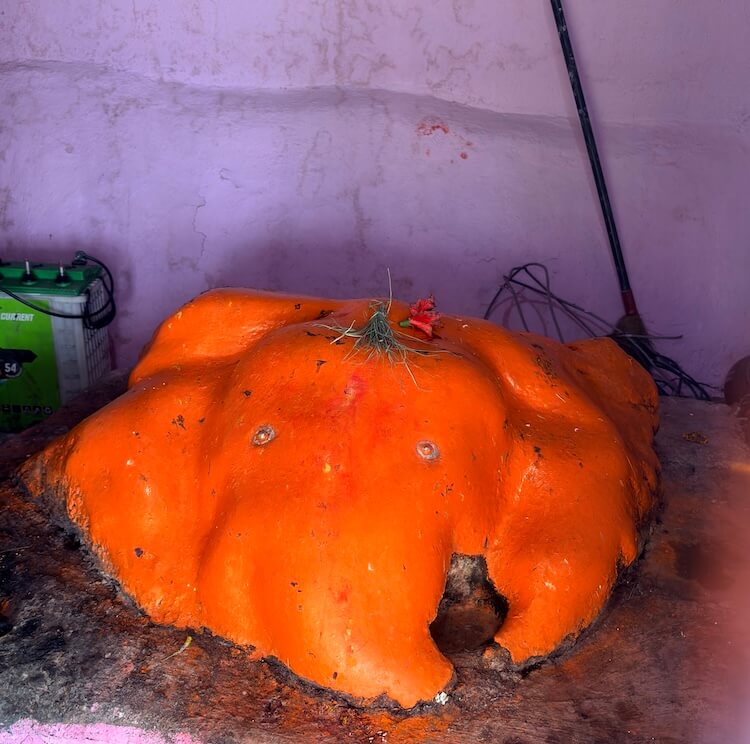
Shop Photo FramesIn the Hindu tradition, Swayambhu (self-manifested) deities hold unique significance. Swayambhu refers to an idol that was not created by human hands but appeared naturally. Such self-manifested idols are found in many ancient temples, with Shiva Lingas being the most common. The Jyotiba shrine in the Deccan of Maharashtra, many of the twelve Jyotirlingas across the country, Lord Balaji at Tirupati, the Vishnu idol at Pushkar, and the Kalratri Devi idol at Parli Vaijnath are all considered Swayambhu. In this same tradition, a famous and ancient Swayambhu Shiva Linga is located in the temple at Narayangad in the Ambad taluka of Jalna district. Because the Mahadev here is renowned as a ‘Jagrut’ (awakened) deity who fulfills the vows of devotees, the local people hold deep faith in this site.
According to local records, this Shiva temple is approximately 700 to 800 years old. Over time, the original temple had become completely dilapidated. Villagers state that in the eighteenth century, the pious Queen Ahilyadevi Holkar of the Holkar dynasty of the Malwa region reconstructed this temple. An ancient legend is famous regarding the establishment of this temple. Hundreds of years ago, this entire hilly region was surrounded by a dense forest. A devotee of Shiva, a shepherd who brought his cattle to graze here every day, had a vision of Mahadev in a dream. He learned that Mahadev resided on the summit of this hill. Following the signs received in his vision, he searched the hill and saw the form of Mahadev in a specific stone. Intending to take that sacred stone to the village and install it, the shepherd tried to separate it from the ground. During that attempt, his pickaxe struck the stone, and streams of blood began to flow from it. Seeing this, he became convinced of the living presence of Mahadev within the stone. He immediately asked for forgiveness from the deity and, with the help of the villagers, established the temple on that very spot. Later, after the original temple was destroyed, Queen Ahilyadevi Holkar built a well on the path to the temple and renovated the main structure.
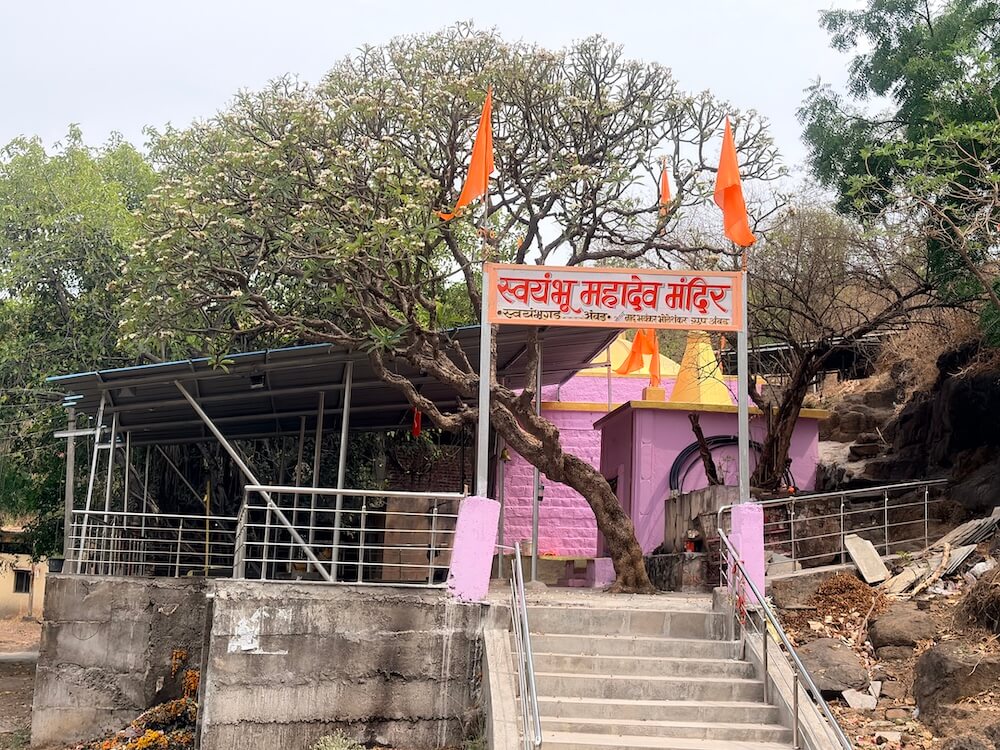
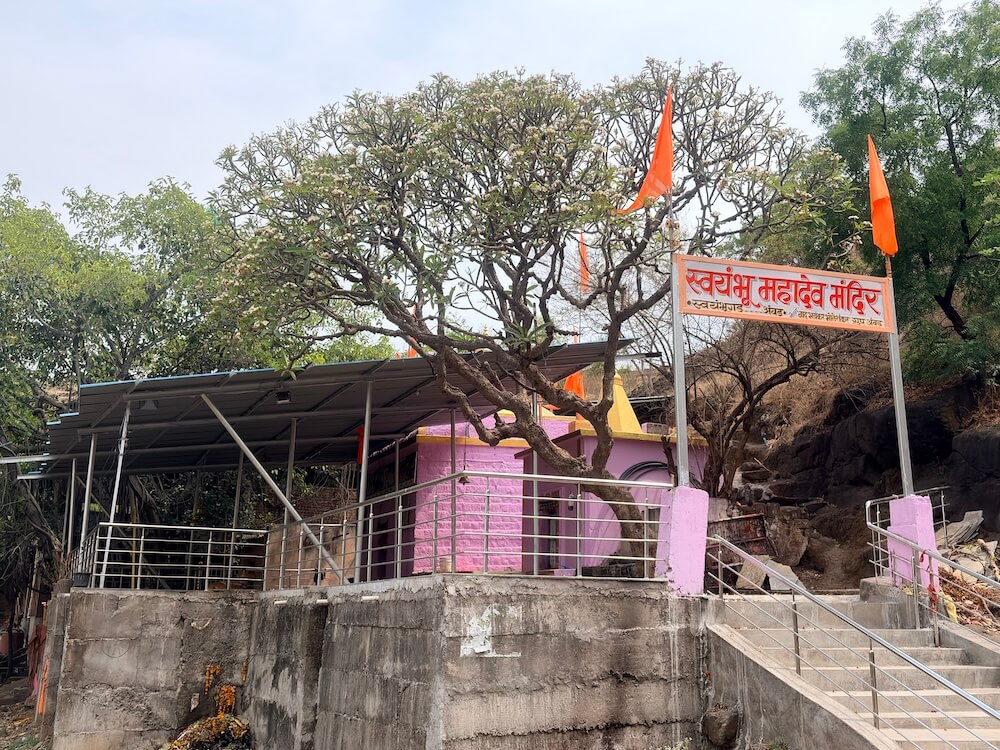
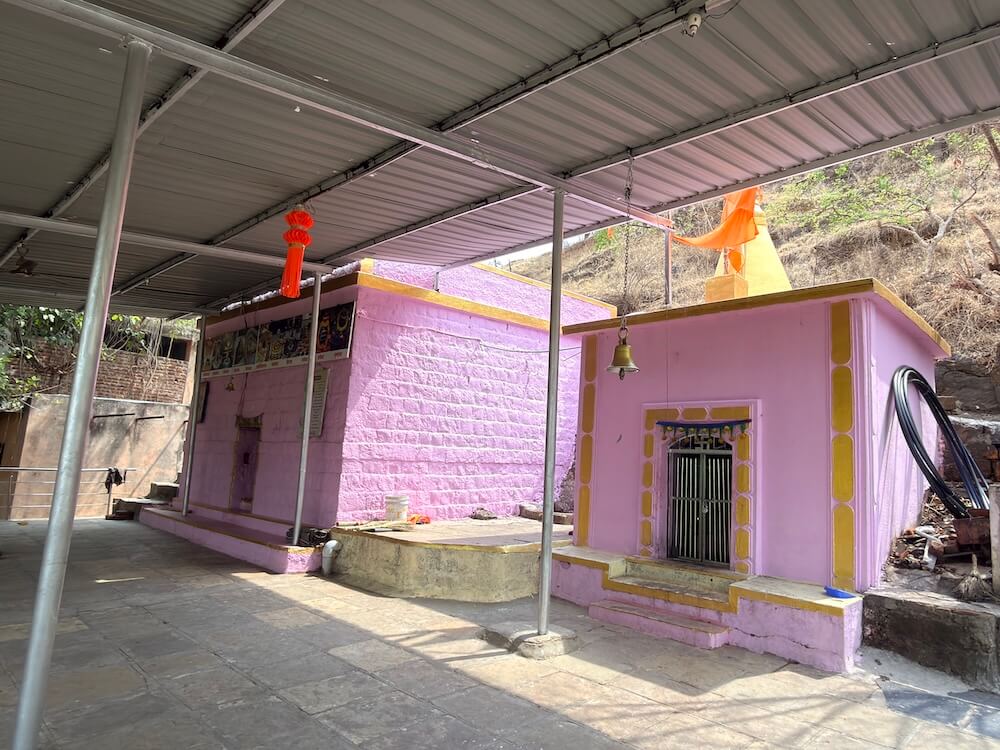
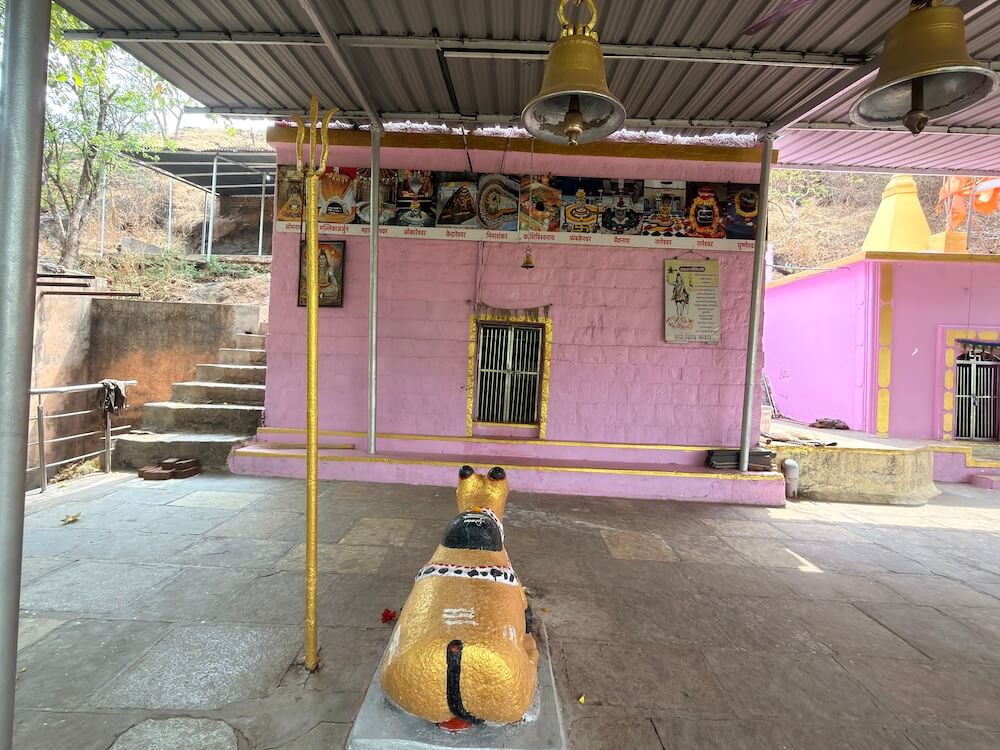
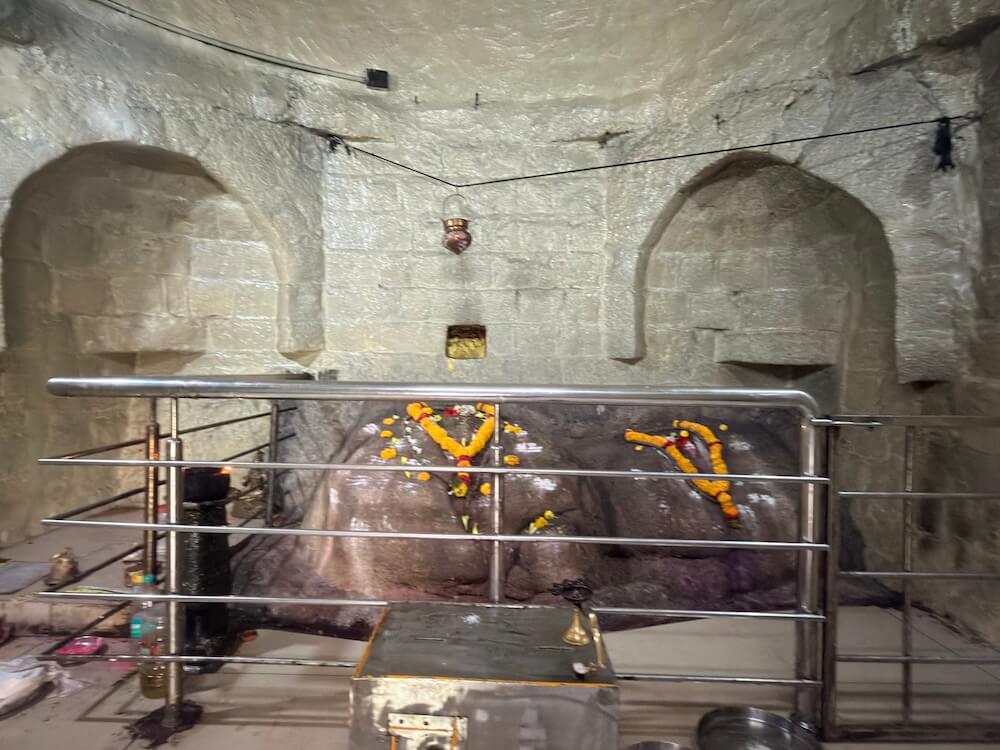
A paved road is available to reach this temple, which is situated on the hilltop of Narayangad. A parking facility has been provided for vehicles right in front of the temple. In the area in front of the temple, an eight-foot-high stone platform has been built. There are eight steps to climb onto this platform. On the platform, directly in front of the temple, there is a tin roof supported by iron pillars. This area is known as the Rangamandapa. Many brass bells are hung from the roof of this pavilion. In front of the main entrance of the temple, an idol of Nandi made of black stone is installed on a stone pedestal. The structure of this temple, built entirely of stone, is unique. It primarily consists only of a sanctum sanctorum (Garbhagriha). Inside the sanctum, natural Swayambhu stone idols of Mahadev and Parvati are seated on a spacious pedestal. A stainless steel railing has been installed around these main idols for protection. An Abhishekapatra (consecration vessel) is hung from the ceiling to continuously pour water over the Mahadev idol. The ceiling of the sanctum is shaped like a circular dome. From the outside, a round, dome-shaped Shikhara (spire) is visible on the temple roof. On the top of this Shikhara is a stupika, followed by an amalaka and a kalasha.
Behind the main temple, there is a natural cave in the hill. Inside this cave temple is an idol of Saint Tukaram Maharaj. To reach this cave, there is a path of about fourteen steps adjacent to the outer right wall of the Shiva temple. In front of this cave temple, a semi-open Rangamandapa with a tin roof on iron pillars has also been built. Right next to the Mahadev temple is a separate temple dedicated to Shri Ganesha. The main entrance of this temple, which consists only of a sanctum, is slightly higher than the platform. There is a sculpture of Ganesha on the lintel of the entrance, and floral patterns are carved on the door frames on both sides. Inside, a vermilion-smeared stone idol of Ganesha is seated on a pedestal. On the roof of this temple, there is a circular, tall Shikhara that tapers towards the top. There is an amalaka and a kalasha at the top of the Shikhara.
An extremely ancient well can be seen in the area at the foot of the hill. It is said that this historical well was built by Queen Ahilyadevi Holkar. Throughout her reign, Ahilyadevi built water troughs, wells, and stepwells in various places; this water source is a part of that legacy. In the olden days, there was a staircase available to descend to the bottom of this well. Villagers report that this staircase was completely closed for safety reasons during the renovation of the temple and its surroundings. Even today, if one peers into the inner wall of the well, the old entrance to that staircase is clearly visible. The main feature of this well is that its water supply is inexhaustible and never runs dry.
In this ancient shrine, Mahashivratri and Shravani Mondays are the main annual festivals celebrated. On these special occasions, thousands of devotees from the surrounding areas come to Narayangad for the darshan of the deity and to fulfill their vows. During the festival period, Laghurudra, Mahabhishek, Bhajans, Kirtans, and Mahaprasad are organized in the temple. Apart from the main festivals, Hindu festivals like Dussehra, Diwali, Kartik Purnima, and Kojagiri Purnima are celebrated in the temple according to tradition. Considering the weekly and fortnightly cycles, there is a large influx of pilgrims and devotees for darshan on the hill on every Monday, Pradosh, Purnima, and Amavasya.
This sacred temple stands as a testament to deep spiritual devotion, ancient architectural grandeur, and rich local cultural traditions.
The sanctum sanctorum houses the divine idol consecrated according to ancient Vedic traditions, surrounded by serene courtyards and traditional temple architecture.
Navratri, Maha Shivratri, Annual Temple Jatra & Deepotsav
Compare and book flights, secure top-rated local hotels near the temple, hire reliable guides, and rent cars instantly.
Extend your pilgrimage by visiting other highly sacred temples located nearby.


Add ₹999 more to unlock FREE SHIPPING!
Your sacred cart is currently empty.
Shop Photo FramesFill in your delivery details below to place your order.
Add comment