
Add ₹999 more to unlock FREE SHIPPING!
Your sacred cart is currently empty.
Shop Photo FramesIn Hindu scriptures, three *bhuvanas* (worlds) are described: Svarga (heaven), Prithvi (earth), and Patala (the netherworld). The Lord of these three worlds is Bhuvaneshwar. An ancient and renowned temple dedicated to Mahadev, known by this name, is located in Chinchavali-Narangi in Alibaug Taluka. Thousands of devotees from the surrounding region hold immense faith in Lord Shivshankar at this temple, which is built in the Hemadpanti architectural style. Every Monday, and especially during the auspicious occasion of Mahashivratri, many devotees come to offer *belpatra* and perform *abhishek* on the *Shivlinga* in this temple, chanting “Har Har Mahadev!”
Alibaug Taluka in Raigad District, famous as ‘Mini Goa’, is renowned not only for tourism but also for its many historical sites and ancient temples. Among these, the Bhuvaneshwar Mandir in Chinchavali-Narangi, in the Kharepatan region, is known for its *Swayambhu Shivlinga*. A *Swayambhulinga* or *Swayambhuvalinga* is considered the most sacred, as it manifests naturally and has existed since time immemorial. The *Swayambhu Shivlinga* here is of *rujiv pashan*, meaning a stone that has naturally rooted and merged with the earth. This very ancient temple was renovated in the eighteenth century during the reign of Ahilyabai Holkar. There is also a record that in the year one thousand eight hundred and thirty-seven, the then British government granted an annual *sanad* of fifteen rupees to this temple for lighting.
The Kharepatan region of Alibaug Taluka is famous for the historic farmers’ strike at Chari, which lasted for a full six years. This strike, called between the years one thousand nine hundred and thirty-three and one thousand nine hundred and thirty-nine against the oppressive rule of the *khots* and moneylenders, is recorded in history as the largest farmers’ strike in the world. To oppose the *khoti* system in Konkan, farmers from the Kharepatan region united with great courage under the guidance of farmer and labour leader Narayan Nagu Patil. Many meetings of the farmers were held in this Bhuvaneshwar Mandir at that time, and the blueprint for the agitation was decided. Dr. Babasaheb Ambedkar also publicly supported this strike. It is said that Dr. Ambedkar, along with many farmer leaders, came here to guide the farmers in these meetings. Despite facing severe hardship for themselves and their families, the farmers did not cultivate crops for a full six years. The British government was forced to bow before the farmers’ resolve. After this strike, the Tenancy Act was implemented in the country, and land became the property of landless farmers and labourers.
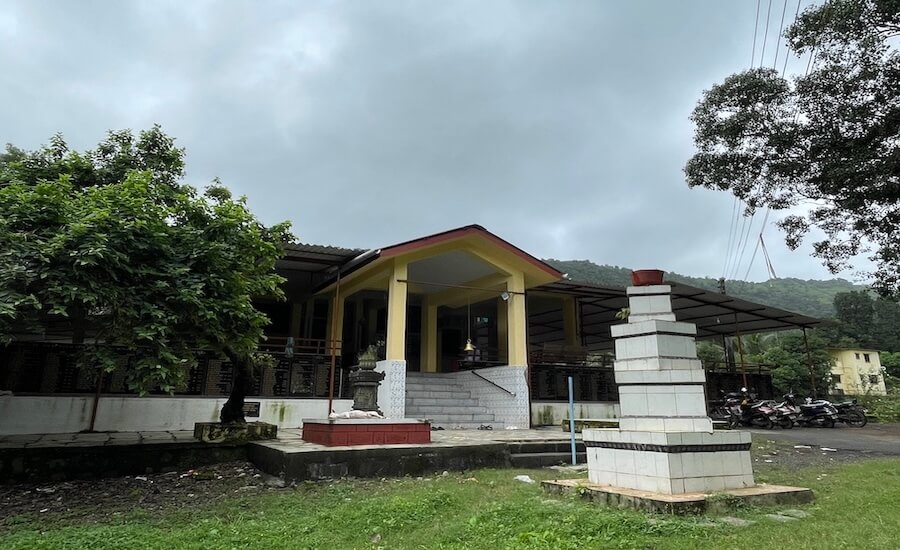
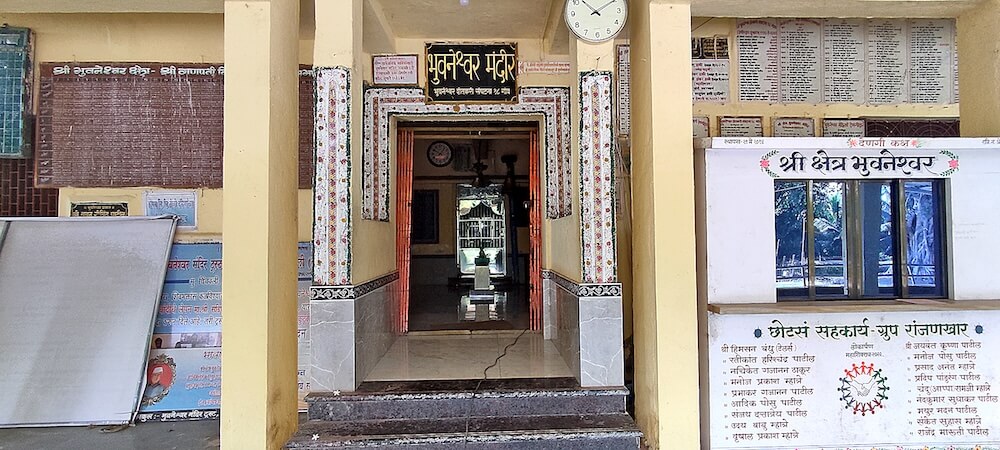
On the Karlekhind to Revdanda road, two kilometres from Narangi village, at the foothills of a mountain in Chinchavali, amidst a nature-rich environment, stands the Bhuvaneshwar Mahadev Mandir. This east-facing temple has a spacious परिसर (precinct). After renovations a few years ago, the temple has acquired its current form. Situated on a high plinth, the temple’s structure comprises a *mukhamandapa* (entrance porch), *mandapa* (hall), *sabhamandapa* (assembly hall), *antarala* (vestibule), and *garbhagriha* (sanctum sanctorum). In front of the *mukhamandapa* are a *deepastambha* (lamp pillar) and *Tulsi vrindavanas* (sacred basil altars) on both sides. Lamps are lit on this *deepastambha* during Mahashivratri and Kartik Purnima. Ascending eight steps in the *mukhamandapa* leads to the semi-open *mandapa* of the temple. This *mandapa* has seating arrangements and a tin shed for the convenience of devotees. From the *mandapa*, one enters the main *sabhamandapa*. In one corner of this *sabhamandapa* is a *havankunda* (fire pit), and in the centre, on a platform, is a small idol of Nandi.
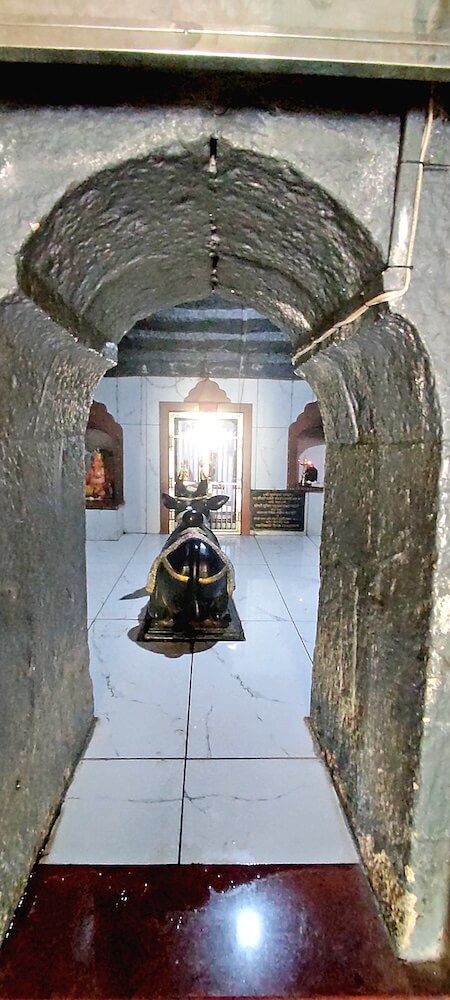
From the *sabhamandapa*, one enters the *antarala*. The carved stone wall of the *antarala*’s entrance is about four to four and a half feet wide. In the *antarala*, in front of the *garbhagriha*’s entrance, on the ground, is a uniquely large idol of Nandi carved from a single stone. Both of Nandi’s front legs are folded. His left hind leg is tucked under his belly, and his right leg is bent at the knee. His body is adorned with various ornaments and strings of bells. There is also carved ornamentation on Nandi’s forehead. Of the two *devakoshthakas* (niches for deities) on the frontal walls of the *garbhagriha*, the one on the right contains an ancient idol of Ganapati. In front of this idol is a brass idol of a *mushaka* (mouse). The *devakoshthaka* on the left contains an idol of Kalabhairava.
At the *lalatabimba sthana* (lintel) above the *garbhagriha*’s entrance is a vermilion-smeared idol of Ganapati. In the centre of the *garbhagriha* is the *Swayambhu Shivpindi*, carved from a single stone. This *pindi* is covered with silver plating. The artistry on this plating makes the *pindi* appear beautiful and attractive. A metal serpent coiled around the *pindi* is also present. *Abhishek* is performed on the *Shivlinga* from an *abhishek patra* (vessel for ritual bathing) suspended from the ceiling. On the *vajrapeetha* (pedestal) on the wall in front of the *Shivlinga* are a brass mask of Shivshankar and an idol of Mother Parvati. During festive occasions, this mask is placed on the *Shivlinga*. The design of the main *shikhara* (spire) above the *garbhagriha* of this temple is also distinctive. Below the circular *shikhara* is a lotus flower design. Within it are the *shikhara*, surmounted by an *amalaka* (fluted stone disc) and a *kalasha* (finial). Small *shikharas* adorn all four sides of this main *shikhara*.
Behind the main temple is an ancient temple of Shri Datta. On the *vajrapeetha* in this temple is a three-faced idol of Shri Datta. A grand festival is held here on Datta Jayanti. A large *jatra* (fair) takes place at Bhuvaneshwar Mandir on Mahashivratri. It is famous in the taluka as the ‘Watermelon Fair’. On this day, *tula* (weighing oneself against offerings) is performed here to fulfil vows. Hundreds of devotees visit this temple daily for the *darshan* of Bhuvaneshwar Mahadev, a revered place of faith for many.
This sacred temple stands as a testament to deep spiritual devotion, ancient architectural grandeur, and rich local cultural traditions.
The sanctum sanctorum houses the divine idol consecrated according to ancient Vedic traditions, surrounded by serene courtyards and traditional temple architecture.
Navratri, Maha Shivratri, Annual Temple Jatra & Deepotsav
Compare and book flights, secure top-rated local hotels near the temple, hire reliable guides, and rent cars instantly.
Extend your pilgrimage by visiting other highly sacred temples located nearby.


Add ₹999 more to unlock FREE SHIPPING!
Your sacred cart is currently empty.
Shop Photo FramesFill in your delivery details below to place your order.
Add comment